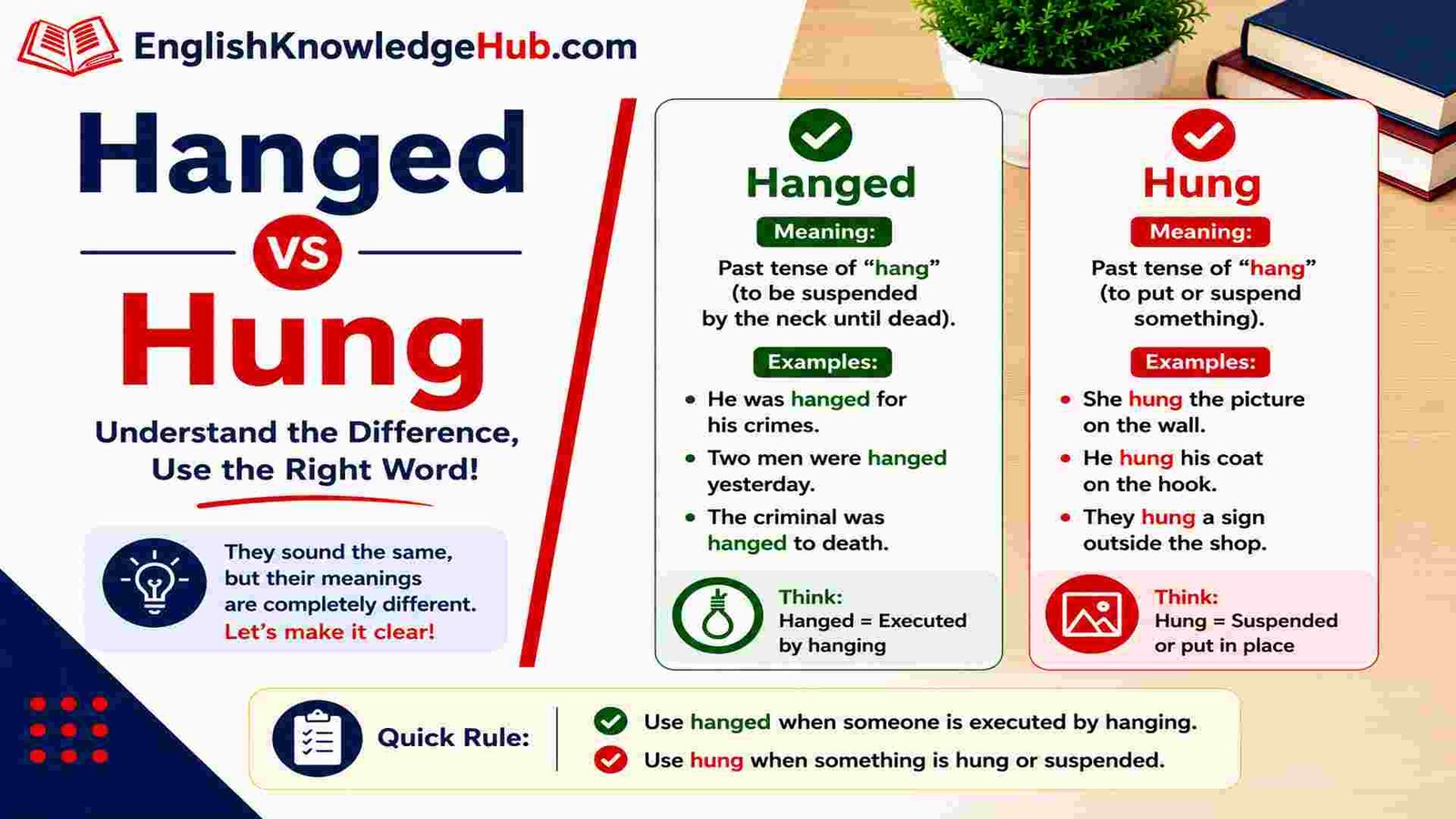
Use hung for almost every ordinary past-tense use of hang, especially objects, pictures, clothes, curtains, and things suspended from above. Use hanged most appropriately when referring to a person put to death by hanging, especially in official or historical contexts. The familiar rule is useful, but real English has some overlap.
In this article, you’ll learn how Hanged vs Hung works with objects, executions, people who die by hanging, idioms, phrasal verbs, and expressions such as hung up, hung out, and hung in effigy. Merriam-Webster’s usage guide for hang says hung is the past form in almost all situations, while hanged tends to be preferred for executions, though hung also occurs in that sense.
The Everyday Rule Is Simple: Objects Are Hung
When something is suspended, displayed, attached, or allowed to hang down, the past tense is normally hung.
“She hung the picture above the desk.” “The coats hung near the door.” “We hung the curtains yesterday.” “A lamp hung from the ceiling.”
This is by far the most common use of the verb. If your sentence is about an object, decoration, clothing, sign, cable, painting, or similar thing, hung is almost certainly the form you need.
Why “Hanged” Is Associated With Execution
Hanged developed as the conventional past form for a person executed by suspension around the neck. That is why formal historical and legal writing commonly says “The prisoner was hanged” or “He was sentenced to be hanged.”
The special form helps separate an execution from the ordinary act of suspending an object. “The portrait was hung” and “The prisoner was hanged” immediately signal different meanings.
Is “Hung” Ever Used for a Person’s Death?
Yes, and this is where strict school rules can become misleading. Merriam-Webster notes that both hanged and hung have been used for death by hanging. It describes hanged as the most appropriate form for official executions, while hung also appears, especially in less formal contexts.
So if you are writing an essay, history article, news-style account, or formal description of an execution, hanged is the safest choice. But do not assume every historical example of hung is automatically ungrammatical.
What About Suicide or Accidental Death?
Usage can vary outside the specific context of an official execution. Many style guides and writers still prefer hanged when a person dies by hanging, while others use hung in non-execution contexts.
If you are writing sensitively about a real death, clarity and respectful wording matter more than forcing a simplistic grammar slogan. In general-purpose edited English, hanged is a defensible choice when the method of death is central, while hung remains the ordinary past form for suspension in other senses.
“Hung in Effigy” Shows the Rule Is Not About Human Shape
An effigy is a representation of a person, not the actual person. Both hung in effigy and hanged in effigy can be found, but Merriam-Webster notes hung is appropriate for less formal hangings such as effigies.
This helps reveal the deeper rule: hanged is not simply “for anything shaped like a person.” It is especially tied to the execution meaning.
Hung Up, Hung Out, and Other Phrasal Verbs
Phrasal verbs use hung, not hanged.
“She hung up the phone.” “We hung out after work.” “He hung on to the railing.” “The decision hung over the team for weeks.”
These meanings have nothing to do with execution. Even when a phrasal verb is figurative, the normal past form stays hung.
“Well-Hung” Is a Different Expression
You may encounter well-hung as an adjective. Depending on context, it can describe something hung or arranged well, and it also has an informal sexual meaning when referring to a man. The form is hung, not hanged.
This is another reminder that hanged is a very narrow past-tense choice associated mainly with execution or death by hanging.
Hang, Hung, and Hanged as Verb Forms
The present form is hang. For ordinary meanings, the past and past participle are hung: “I hung the frame,” “I have hung the frame.”
For the execution sense, the conventional forms are hanged and have been hanged.
| Meaning | Past form | Example |
|---|---|---|
| display a picture | hung | She hung the painting. |
| suspend clothes | hung | He hung the coat outside. |
| remain suspended | hung | The lamp hung over the table. |
| spend time socially | hung | We hung out after class. |
| official execution | hanged preferred | The prisoner was hanged. |
Why English Has Two Past Forms
English often preserves older or specialized forms when a word develops a distinct meaning. Hang is unusual because the past form split by sense: hung became dominant for ordinary uses, while hanged remained strongly associated with execution.
You do not need to memorize the history to use the words correctly. Just remember that the special form exists for a special meaning.
Common Mistakes and Better Choices
Incorrect: We hanged the family photo in the hallway.
Correct: We hung the family photo in the hallway.
The photo was displayed, not executed.
Preferred in formal historical writing: The condemned prisoner was hanged at dawn.
Not normally: The condemned prisoner was hung at dawn.
The second form has historical precedent, but hanged is the clearer conventional choice in this context.
Incorrect: We hanged out after the concert.
Correct: We hung out after the concert.
The phrasal verb hang out uses hung.
How the Rule Appears in Real Writing
At home: “I hung the new mirror in the hallway.” At work: “The safety notice was hung beside the entrance.” In a museum description: “Several portraits hung along the west wall.” In a historical account: “The prisoner was hanged after the trial.”
The context usually makes the correct form obvious once you stop treating hanged and hung as fully interchangeable past tenses.
A Memory Trick That Does Not Overstate the Rule
Use this as a practical default: things are hung; people executed are hanged.
Then remember one footnote: real English has some overlap in the death-by-hanging sense, so hung is not historically impossible. For careful modern writing, however, hanged remains the safest formal choice for execution.
If irregular verb forms are a recurring challenge, our Flew vs Flown guide explains another verb whose forms depend on grammar rather than simple -ed endings.
Frequently Asked Questions
Is it “hung a picture” or “hanged a picture”?
Use hung a picture.
Is a person hanged or hung?
For an official execution, hanged is the preferred formal form. Hung has also occurred historically and in less formal usage.
What is the past tense of hang?
Usually hung. Hanged is the specialized conventional form for execution.
Is it “hung out” or “hanged out”?
Hung out is correct.
Is it “hung up” or “hanged up”?
Hung up is correct.
Can “hung” be used for an effigy?
Yes. Hung in effigy is standard, though hanged in effigy also occurs.
Final Takeaway
For Hanged vs Hung, use hung for almost all ordinary meanings of hang: pictures, clothes, signs, objects, phrasal verbs, and figurative uses. Use hanged as the preferred formal form for an execution. The school rule is useful as a default, but dictionaries show that real usage around death by hanging has never been completely absolute.
For more accurate, practical grammar guides, explore EnglishKnowledgeHub.com.
