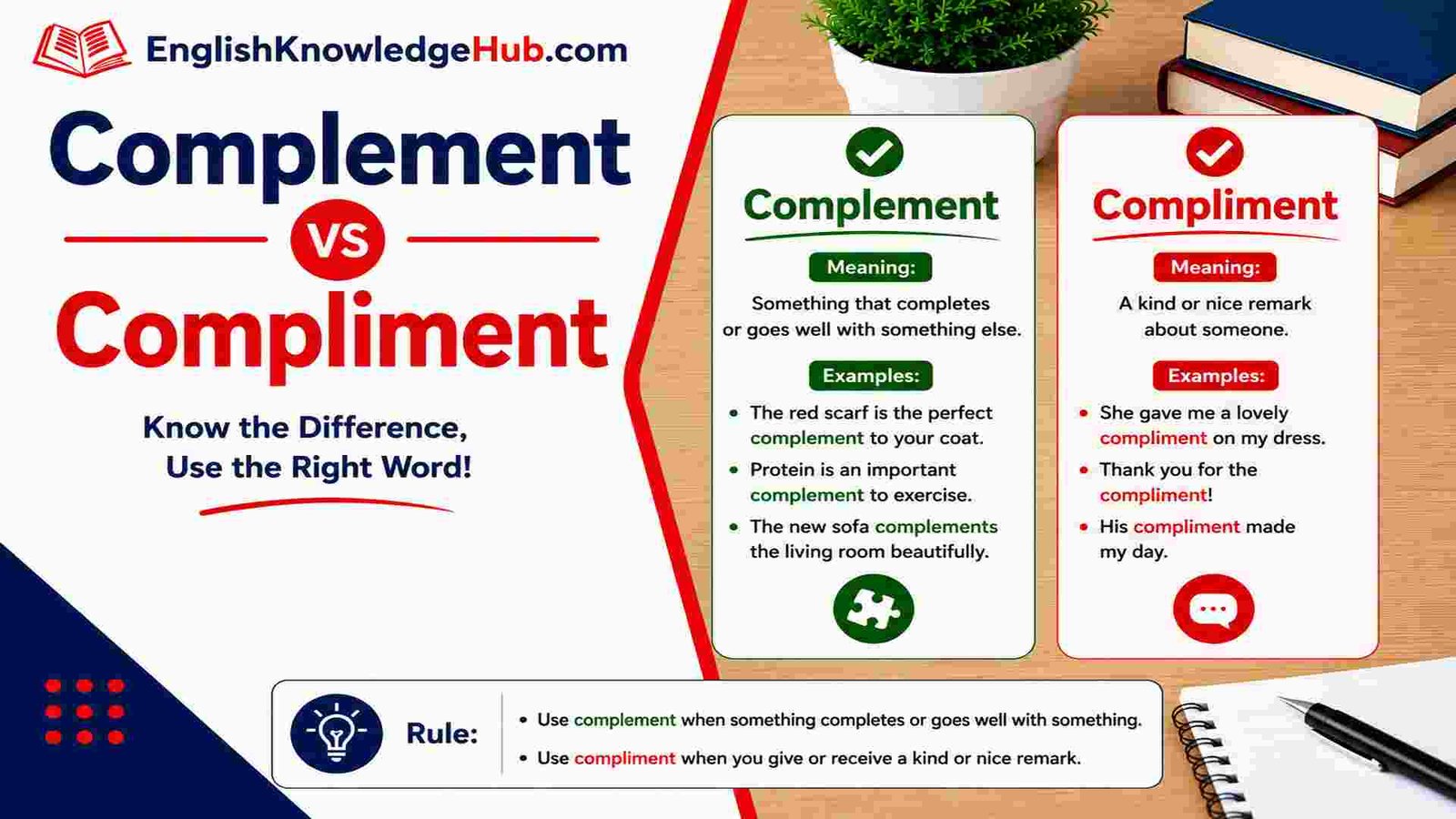
Complement vs Compliment: Complement means that two things go well together or make each other better. Compliment means something nice you say about a person or thing. For example, red shoes may complement a black dress. Saying, “Your dress looks beautiful,” is a compliment.
These two words sound almost the same, so many people mix them up.
The easiest rule is:
- Complement = goes well with
- Compliment = praise or kind words
Once you remember this small difference, choosing the right word becomes much easier.
What Does Complement Mean?
Complement means that one thing works well with another thing.
It can also mean that something adds to another thing and makes it better or more complete.
For example:
- The yellow flowers complement the blue vase.
- This sweet sauce complements the cake.
- Her calm voice complements his strong speaking style.
- The new pictures complement the story.
In these sentences, one thing goes nicely with another.
Complement as a Verb
When complement is a verb, it tells us that one thing makes another thing look, feel, or work better.
For example:
- The white curtains complement the green walls.
- His skills complement the skills of the other workers.
- The soft music complements the peaceful room.
A simple question can help you:
Do these two things work well together?
If yes, complement is probably the right word.
Complement as a Noun
Complement can also be a noun.
In this form, it means something that goes well with another thing.
Examples:
- The salad is a good complement to the chicken.
- Her drawing is a nice complement to the story.
- The small lamp is a perfect complement to the desk.
The idea is still the same.
One thing adds something useful or nice to another.
What Does Compliment Mean?
A compliment is a kind or nice thing you say about someone or something.
For example:
- “Your work was really well done” is a compliment.
- “Your new shoes look nice” is a compliment.
- “You are a very helpful person” is also a compliment.
A compliment makes someone feel happy because it shows praise.
Compliment as a Noun
When compliment is a noun, it means a nice comment.
Examples:
- My teacher gave me a compliment about my drawing.
- Zara smiled after hearing the compliment.
- He gave his sister a kind compliment.
If someone says something nice about you, you have received a compliment.
Compliment as a Verb
Compliment can also be used as a verb.
It means to say something nice about someone.
Examples:
- I complimented Sam on his new haircut.
- The teacher complimented Mia on her neat work.
- Dad complimented me on the meal.
- The boss complimented the team on their good work.
A common pattern is:
compliment someone on something
For example:
She complimented me on my painting.
Complement vs Compliment: Quick Difference
| Word | Simple Meaning | Example |
|---|---|---|
| Complement | Goes well with something | The hat complements your coat. |
| Compliment | A nice or kind comment | She gave me a compliment. |
Here is another easy example:
The green scarf complements your jacket.
This means the scarf looks good with the jacket.
I complimented you on your jacket.
This means I said something nice about your jacket.
Easy Memory Trick
Look at the middle letter.
Complement has an e.
Think:
E = extra help
A complement gives something extra and makes it better.
Compliment has an i.
Think:
I like it!
When you like something and say something nice, you give a compliment.
So remember:
Complement = goes together
Compliment = kind words
Complement vs Compliment: Everyday Examples
These examples show the difference in simple situations.
Clothes
- The red bag complements her white dress.
- I gave her a compliment about the dress.
Food
- The rice complements the chicken.
- The cook received a compliment about the meal.
School
- The pictures complement the lesson.
- The teacher complimented Noor on her project.
Home
- The brown table complements the light walls.
- Our guest complimented us on the room.
Workplace Examples
You may also see these words at work.
Complement
- Her computer skills complement his design skills.
- The new tool complements the old system.
- The chart complements the written report.
- Their different skills complement each other.
Compliment
- The manager complimented the worker on his good job.
- A customer gave the team a compliment.
- She complimented her coworker on the presentation.
- The boss gave him a nice compliment.
School and Academic Examples
These words are also useful in school writing.
Complement
- The map complements the history lesson.
- The pictures complement the science project.
- The second book complements the first book.
Compliment
- The teacher complimented the student on her clear writing.
- The student received a compliment for his good work.
- The teacher gave Mia a compliment after her speech.
Complement vs Compliment: Common Mistakes
Because these words sound alike, spelling mistakes are common.
Mistake 1
Incorrect:
The blue shoes compliment the dress.
Correct:
The blue shoes complement the dress.
Explanation:
The shoes are not saying nice things. They look good with the dress, so use complement.
Mistake 2
Incorrect:
My teacher gave me a complement.
Correct:
My teacher gave me a compliment.
Explanation:
The teacher gave praise, so compliment is correct.
Mistake 3
Incorrect:
She complemented me on my haircut.
Correct:
She complimented me on my haircut.
Explanation:
She said something nice about the haircut, so use complimented.
Mistake 4
Incorrect:
The new rug compliments the sofa.
Correct:
The new rug complements the sofa.
Explanation:
The rug looks good with the sofa. It does not praise it.
Complementary vs Complimentary
You may also see these two words:
complementary
and
complimentary
They also have different meanings.
Complementary
Complementary means two things work well together.
Examples:
- Their skills are complementary.
- The two colors are complementary.
- Their ideas are different but complementary.
Complimentary
Complimentary can mean kind or praising.
Example:
- The teacher was very complimentary about my work.
It can also mean free.
Examples:
- The hotel gives complimentary breakfast.
- We received complimentary tickets.
- Guests get complimentary water.
So:
complementary = works well together
complimentary = kind or free
Does Complement Mean Complete?
The words are related, but they are not exactly the same.
Complete means finished or having everything needed.
Complement means something adds to another thing and makes it better.
For example:
- The final page completes the book.
- The pictures complement the book.
The page finishes the book.
The pictures make the book better.
Complement in Grammar
Complement also has a special grammar meaning.
A complement can be a word or group of words that gives more information in a sentence.
For example:
Sara is a teacher.
The words a teacher tell us more about Sara.
Another example:
The game made him tired.
The word tired tells us more about him.
This grammar use always uses complement, not compliment.
Quick Practice
Choose the correct word.
- The white shoes ________ her blue dress.
- My friend gave me a nice ________.
- The pictures ________ the story.
- I ________ Ali on his new bike.
- This sauce is a good ________ to the meal.
- The teacher ________ the class on their good work.
Answers
- complement
- compliment
- complement
- complimented
- complement
- complimented
Frequently Asked Questions
Is complement or compliment correct?
Both words are correct. Use complement when two things work well together. Use compliment when someone says something nice.
What is a simple example of complement?
The red hat complements her black coat.
This means the hat looks good with the coat.
What is a simple example of compliment?
“You look great today” is a compliment.
Is it compliment someone or complement someone?
Use compliment someone when you praise them.
Example:
I complimented her on her drawing.
Use complement when two people or things work well together.
Example:
Their skills complement each other.
Is free food complementary or complimentary?
Use complimentary.
A complimentary meal is free.
Is it compliment the dress or complement the dress?
Both can be correct, but the meanings are different.
Complement the dress means something looks good with the dress.
Compliment the dress means to say something nice about the dress.
What is the easiest way to remember the difference?
Remember:
Complement = goes well together
Compliment = kind words
Final Thoughts
The difference between Complement vs Compliment is easy when you remember what each word does.
Use complement when one thing goes well with another or makes it better.
Use compliment when you praise someone or say something kind.
A simple trick is to think of I like it for compliment. If you are talking about things matching or working well together, choose complement.
For more simple word differences, grammar help, and easy English lessons, visit EnglishKnowledgeHub.com.
