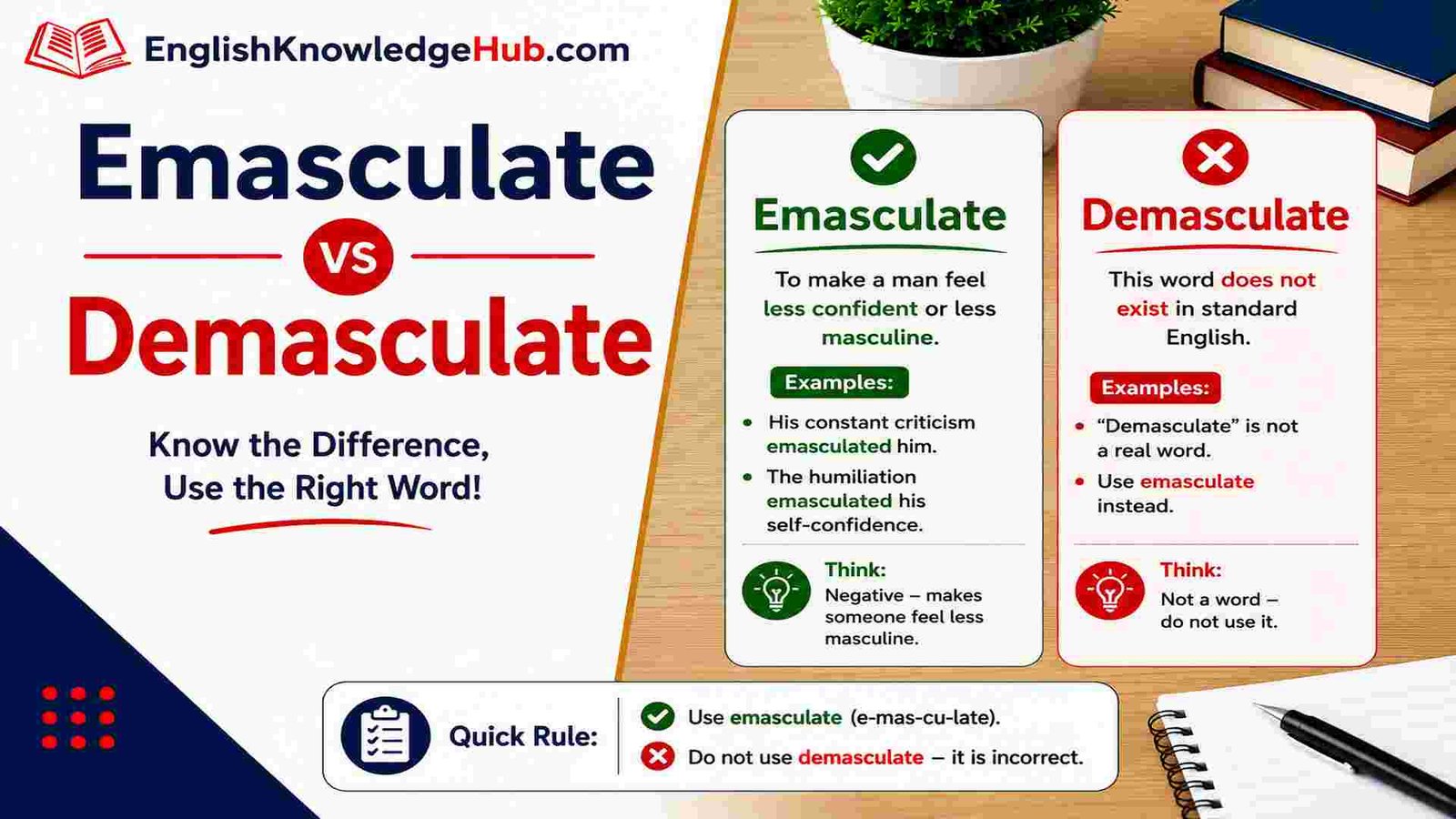
Emasculate is the standard word in English. It means to make a person feel less powerful or to make something weaker. Demasculate may appear in some places, but it is rare and not the normal word to use. In this guide, you will learn the meaning of emasculate, how to use it, and why demasculate is usually avoided.
The easiest rule is simple:
Use “emasculate.”
For school work, office writing, articles, emails, and formal English, emasculate is the better choice.
What Does Emasculate Mean?
Emasculate is a verb.
In easy words, it means:
to make someone or something weaker or less powerful.
When we use it for a man, it can also mean making him feel less strong, less confident, or less masculine.
Example:
His friends kept making fun of him, and he felt emasculated.
This means he felt that his confidence or sense of strength had been hurt.
The word can also be used for things.
Example:
The new rule could emasculate the committee.
This means the rule could make the committee much weaker.
What About Demasculate?
You may sometimes see the word demasculate online.
It may look correct because many English words start with de-.
For example:
- deactivate
- devalue
- defrost
- disconnect
Because of this, some people may think:
de + masculine = demasculate
But that is not the usual standard word.
The correct word to use is:
emasculate
So, if you are not sure which one to choose, always go with emasculate.
Emasculate vs Demasculate
| Word | Normal English? | Meaning | Should You Use It? |
|---|---|---|---|
| Emasculate | Yes | Make weaker or less powerful | Yes |
| Demasculate | Rare | Sometimes used with a similar meaning | Usually no |
A quick way to remember it is:
E = Established
So:
Emasculate = Established English word
How to Use Emasculate in a Sentence
You can use emasculate when a person, group, rule, or system loses power.
Example:
The new limits may emasculate the manager’s role.
This means the manager may have much less power.
Another example:
Taking away all control could emasculate the board.
The board would still exist, but it would not be able to do much.
Forms of Emasculate
The main forms are:
- emasculate
- emasculates
- emasculated
- emasculating
- emasculation
Emasculate
The new plan may emasculate the team.
Emasculates
This rule emasculates the manager’s role.
Emasculated
The group felt emasculated after losing its power.
Emasculating
He found the public jokes emasculating.
Emasculation
The changes caused the emasculation of the committee’s power.
You do not need to learn all of these at once.
Just remember that they all come from emasculate.
Emasculate When Talking About a Man
When emasculate is used for a man, it can be a strong word.
It may mean that he feels:
- less confident
- less powerful
- less respected
- less independent
- less masculine
Example:
He felt emasculated when everyone laughed at his work.
The sentence does not only mean that he felt sad.
It means his confidence or sense of strength was hurt.
Because of this, the word should be used carefully.
Emasculate Can Also Be Used for Things
This is very important.
Emasculate does not only talk about men.
It can also mean:
to make something much weaker or less useful.
Example:
The budget cut could emasculate the school program.
Here, the word means the program may become too weak to work well.
You can use emasculate with:
- a law
- a rule
- a policy
- a team
- a company
- a group
- a committee
- a system
- a department
- an organization
Example:
The new law could emasculate the local office.
This means the office may lose much of its power.
Easy Daily Conversation Examples
Here are some simple examples:
He felt emasculated when his friends kept laughing at his choices.
She did not want to emasculate him in front of the group.
He said the joke made him feel emasculated.
Being corrected once does not mean someone has been emasculated.
The last sentence shows an important point.
Emasculate is a strong word.
Do not use it for every small problem.
Workplace Examples
You can also use emasculate at work.
The new rule may emasculate team leaders.
Taking away the manager’s power could emasculate the role.
The office was emasculated after it lost control of the budget.
The changes may emasculate the department.
In these examples, the word means:
make less powerful
School and Academic Examples
In school or academic writing, the word can also be used.
The new rule may emasculate the power of the school board.
The changes could emasculate the system.
Removing this part may emasculate the plan.
The policy may emasculate local control.
These sentences use emasculate in a formal way.
Formal Writing Examples
Here are some formal examples:
The new law may emasculate the agency’s power.
The changes could emasculate the agreement.
The plan may emasculate the role of the committee.
Removing all control would emasculate the office.
In formal writing, emasculate often means that something loses a large part of its power.
Common Mistake 1: Using Demasculate
Incorrect:
The new rule may demasculate the team.
Correct:
The new rule may emasculate the team.
Explanation:
Emasculate is the normal standard word. Demasculate is rare and should usually be avoided.
Common Mistake 2: Using Emasculate for a Small Problem
Incorrect or unnatural:
Losing my pencil emasculated me.
Correct:
Losing my pencil annoyed me.
Explanation:
Emasculate is too strong here.
Losing a pencil may annoy you, but it usually does not take away your power or confidence.
Common Mistake 3: Thinking It Only Means “Less Masculine”
Incorrect idea:
Emasculate can only be used for men.
Correct idea:
Emasculate can also mean making a group, law, role, or system weaker.
Explanation:
The word has a wider meaning.
It can talk about a person, but it can also talk about power and control.
Common Mistake 4: Using It Instead of Every Word for “Weak”
Sometimes weaken is better.
For example:
The small delay emasculated the project.
This sounds too strong.
A better sentence is:
The small delay slowed the project.
Use emasculate when the loss of power is big or serious.
Emasculate vs Weaken
These words are close, but they are not always the same.
Weaken is a simple and common word.
Example:
The heavy rain weakened the wall.
Emasculate is stronger.
Example:
The new rules emasculated the board’s power.
A simple way to see the difference is:
weaken = make less strong
emasculate = take away a lot of power or strength
Emasculate vs Humiliate
These words are also different.
Humiliate means to make someone feel very ashamed or embarrassed.
Example:
The rude comment humiliated him.
Emasculate can mean that a man feels less powerful, confident, or masculine.
Example:
He felt emasculated when his authority was taken away in public.
A person can feel humiliated without feeling emasculated.
Emasculate vs Undermine
Undermine means to slowly make someone or something weaker.
Example:
Constant criticism undermined her confidence.
Emasculate often sounds stronger.
Example:
The new policy emasculated the manager’s role.
So:
undermine = weaken slowly
emasculate = take away a lot of power
Is Demasculate a Real Word?
You may find demasculate in some rare or informal writing.
That does not make it the best word to use.
For normal English, choose:
emasculate
This is especially important in:
- school work
- exams
- business writing
- formal emails
- articles
- reports
If you want your writing to sound correct and natural, use emasculate.
Is Emasculate Formal or Informal?
Emasculate is usually a strong and somewhat formal word.
You may see it in:
- news articles
- essays
- reports
- office writing
- legal writing
- political writing
- serious discussions
In daily speech, people may use easier words such as:
- weaken
- hurt
- reduce
- limit
- embarrass
- undermine
For example:
Formal:
The new rule emasculated the manager’s authority.
Simple:
The new rule weakened the manager’s authority.
Both can work, but the second sentence is easier.
British English and American English
There is no big spelling difference here.
In both British and American English, the normal spelling is:
emasculate
You do not need to use demasculate in one country and emasculate in another.
The standard word stays the same.
An Easy Memory Trick
Here is a very simple trick:
E = English standard
Think:
E + masculate = emasculate
Or remember this short line:
“Emasculate starts with E.”
If you write demasculate, check your spelling again.
When Should You Use Emasculate?
Use emasculate when someone or something loses a lot of:
- power
- confidence
- control
- strength
- authority
- effectiveness
For example:
The new policy may emasculate the department.
His public comments made him feel emasculated.
The budget cuts could emasculate the program.
These are good uses because something important is being weakened.
When Should You Choose an Easier Word?
Sometimes emasculate is correct, but another word sounds clearer.
Instead of:
The new schedule emasculated the team’s freedom.
You can say:
The new schedule greatly reduced the team’s freedom.
Instead of:
The change emasculated the manager.
You can say:
The change took away much of the manager’s power.
Simple words are often better when they explain the meaning clearly.
Emasculate or Demasculate: The Easy Rule
Here is the main rule again:
Use emasculate.
It is the standard word.
Use it when you mean:
- make someone feel less powerful
- hurt a man’s sense of strength or masculinity
- make a group weaker
- reduce the power of a law
- take away control from a team or office
- make a system less effective
Avoid demasculate in normal writing because it is rare and nonstandard.
FAQs About Emasculate or Demasculate
Is it emasculate or demasculate?
The standard word is emasculate.
What does emasculate mean?
It means to make someone or something weaker, less powerful, or less effective.
Is demasculate wrong?
It is rare and nonstandard. For normal English, use emasculate.
What is the past tense of emasculate?
The past tense is emasculated.
Example:
The new rule emasculated the team.
What is the noun form of emasculate?
The noun is emasculation.
Example:
The change led to the emasculation of the board’s power.
Can emasculate be used for a group?
Yes.
Example:
The budget cut could emasculate the group.
Here, it means to make the group weaker.
Does emasculate only talk about men?
No. It can also be used for laws, groups, systems, roles, and organizations.
Is emasculate a formal word?
Yes, it often sounds strong and formal. In simple English, weaken may sometimes be easier.
Final Thoughts
When choosing between emasculate or demasculate, use emasculate.
It is the standard English word. It can mean making a person feel less powerful or making a group, law, role, or system much weaker.
You do not need to remember a hard rule.
Just remember:
E = Established, so use emasculate.
For more easy grammar lessons, word meanings, and simple English comparisons, visit EnglishKnowledgeHub.com.
