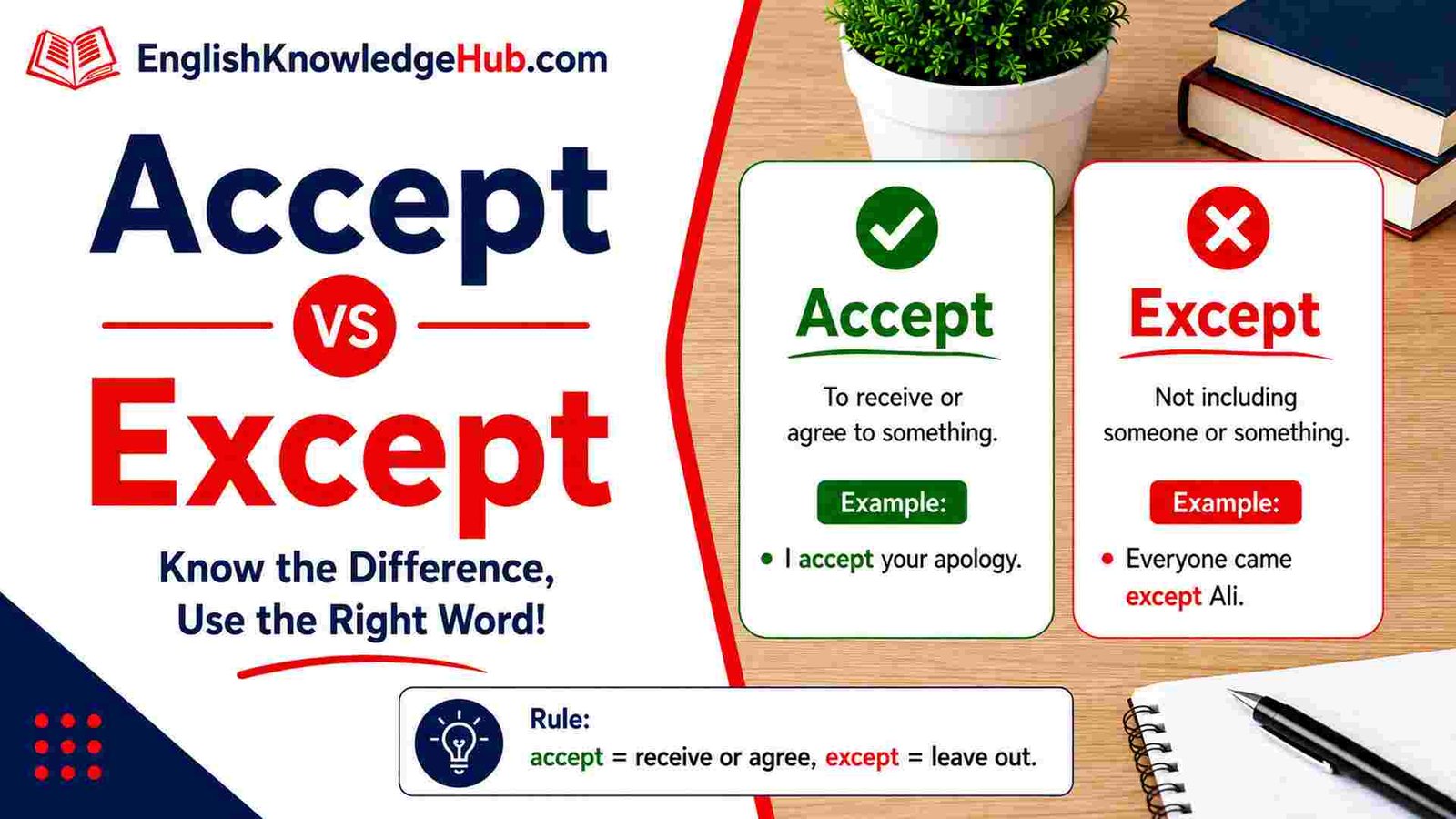
Accept vs Except is easy to understand when you look at the meaning. Accept means to receive something, say yes to something, or agree that something is true. Except means not including someone or something. This guide will show you how each word works and how to choose the correct one.
The two words look similar and can sound similar when people speak quickly. That is why writers sometimes mix them up. Their meanings, however, are very different.
Here is the shortest rule to remember:
Accept = receive or agree
Except = leave out
If you remember those two ideas, you can solve most sentences in seconds.
Accept vs Except at a Glance
| Word | Main Meaning | Usual Grammar Job | Example |
|---|---|---|---|
| Accept | Receive, agree, approve | Verb | I accepted the gift. |
| Except | Not including, leave out | Usually a preposition or conjunction | Everyone came except Mia. |
Think of it this way.
When you accept something, you allow it to come to you.
When you use except, you remove one person or thing from a group.
This simple image can make the difference easier to remember.
What Does Accept Mean?
Accept is a verb. A verb shows an action.
We use accept when someone receives something willingly, agrees to something, or believes that something is true.
Accept Can Mean “Receive”
You can accept a gift, letter, payment, invitation, or delivery.
Examples:
- Emma accepted the flowers with a smile.
- I cannot accept this money from you.
- The shop accepts card payments.
- Tariq accepted the parcel for his neighbor.
- She was happy to accept the prize.
In each sentence, something is being received.
Accept Can Mean “Say Yes”
You can also accept an offer, invitation, request, or job.
Examples:
- Daniel accepted the new job.
- We accepted their dinner invitation.
- The manager accepted my request to take a day off.
- Her parents accepted the plan.
- I decided to accept the offer.
Here, accept means that someone agrees to what is being offered or suggested.
Accept Can Mean “Believe or Admit Something”
Sometimes we use accept when talking about facts, results, or difficult situations.
Examples:
- You need to accept that the bus has already left.
- Nina finally accepted her mistake.
- The team accepted the final result.
- He could not accept that the old shop had closed.
- We should accept the facts before making a decision.
Nothing physical is being received in these sentences. The person is recognizing that something is true.
What Does Except Mean?
Except usually means not including someone or something.
Imagine a group of six children. Five children receive an apple, but one does not.
You could say:
Everyone received an apple except Adam.
Adam is the person who is left out.
More examples:
- The museum is open every day except Monday.
- Everyone finished lunch except Leo.
- I like all these colors except orange.
- We cleaned every room except the attic.
- All the lights worked except the one near the door.
A useful replacement is “not including.”
For example:
Everyone except Sara came early.
This means:
Everyone, not including Sara, came early.
If “not including” gives the same meaning, except is usually the correct choice.
Accept vs Except: Easy Memory Trick
Try this idea:
Accept lets something in.
Except keeps something out.
Imagine a school gate.
A teacher accepts a new student into the class.
One rule applies to everyone except one student.
One word brings something into the situation. The other word removes something from it.
You can also connect except with exit.
Both words begin with ex.
An exit is a way out.
Except also gives you the idea of something being left out.
It is not a grammar rule, but it is a useful memory trick.
How to Know Which Word You Need
When you are writing, ask yourself one simple question.
Am I Receiving or Agreeing?
Use accept.
Examples:
- Will you accept my apology?
- The hotel will accept online bookings.
- She accepted the invitation.
Am I Leaving Someone or Something Out?
Use except.
Examples:
- Everyone except Jake went outside.
- I eat every vegetable except peas.
- The store is open daily except Sunday.
This meaning test is much safer than choosing the word only by its sound.
Accept vs Except: Daily Conversation Examples
Here are some natural examples you may hear in normal conversation.
Using Accept
- “Please accept my gift.”
- “I think she will accept your apology.”
- “Would you accept fifty dollars for the bike?”
- “He did not accept my reason.”
- “I have decided to accept their invitation.”
Using Except
- “I can come any day except Friday.”
- “Everyone is ready except Ben.”
- “I packed everything except my toothbrush.”
- “She likes every subject except history.”
- “The street was quiet except for one barking dog.”
Workplace Examples
These words also appear often at work.
Accept
- The company will accept applications until June.
- Our client accepted the new price.
- Please accept the calendar invitation.
- The bank does not accept damaged notes.
- She accepted responsibility for the error.
Except
- Everyone except the director attended the meeting.
- The office is open every weekday except Friday.
- All reports are finished except the sales report.
- Every employee except Omar has completed the training.
- The new rule applies to all teams except support.
School and Academic Examples
Students may also see these words in lessons, essays, and instructions.
Accept
- The teacher will not accept work without a name.
- Researchers accept the result after checking the data.
- The school accepted twenty new students.
- We should not accept a claim without evidence.
Except
- All students except Maria passed the test.
- Each answer was correct except number seven.
- The rule applies to every class except Grade Five.
- Every book was returned except the science book.
Formal Writing Examples
Both words can appear in formal English.
Examples with accept:
- We are pleased to accept your proposal.
- The committee accepted the revised plan.
- Please accept our thanks for your support.
Examples with except:
- The policy applies to all staff except temporary workers.
- No visitors may enter except with written permission.
- All sections were approved except the final paragraph.
The main meanings remain the same in both formal and informal writing.
Common Mistakes: Accept vs Except
Because the words look so similar, spelling mistakes are very common.
Mistake 1: Using Except When You Mean to Receive Something
Incorrect:
I excepted the birthday present.
Correct:
I accepted the birthday present.
Explanation:
The person received the present. Use accepted, not excepted.
Mistake 2: Using Accept When You Mean “Not Including”
Incorrect:
Everyone accept David went swimming.
Correct:
Everyone except David went swimming.
Explanation:
David is not included in the group. That means except is correct.
Mistake 3: Saying “Accept to Do Something”
Incorrect:
Ryan accepted to help me.
Correct:
Ryan agreed to help me.
Another correct option is:
Ryan accepted my request for help.
Explanation:
In standard English, we normally use agree to + verb when someone says yes to doing an action.
We use accept naturally before nouns such as:
- accept an offer
- accept a request
- accept a job
- accept an invitation
- accept responsibility
Accept and Agree Are Not Always the Same
Learners sometimes use accept where agree is needed.
Look at these two sentences:
I accept your offer.
This is correct.
But:
I accept to meet you tomorrow.
This is not the normal standard form.
Say:
I agree to meet you tomorrow.
A useful pattern is:
accept + thing
- accept the offer
- accept the invitation
- accept the payment
agree + to + action
- agree to come
- agree to help
- agree to wait
This small rule can make your writing sound much more natural.
What Does “Except For” Mean?
You may also see except for.
It means that one person, thing, or detail is different from the rest of the statement.
Examples:
- The park was empty except for two children.
- The meal was perfect except for the cold soup.
- The house was silent except for the sound of rain.
- My test went well except for one question.
You can often think of except for as meaning:
“apart from this one thing.”
For example:
The room was clean except for the dusty window.
Most of the room was clean. The window was the one problem.
Can Except Be a Verb?
Yes, but this use is uncommon in normal daily speech.
As a verb, except can mean exclude or leave out.
For example:
The rule excepts emergency vehicles from the limit.
This means emergency vehicles are excluded from the rule.
You are more likely to see this use in legal, official, or formal writing.
For everyday English, the “not including” meaning is much more important to learn first.
Do British and American English Use These Words Differently?
There is no major difference in the basic use of these words.
In both British and American English:
- Accept can mean receive, agree, approve, or admit.
- Except usually means not including.
Pronunciation may change slightly depending on a person’s accent, but the spelling and meaning rules stay the same.
Quick Practice
Choose accept or except.
- We cannot ___ your payment after Friday.
- Everyone ___ Liam finished the race.
- She decided to ___ the new position.
- I like every juice ___ grapefruit.
- You must ___ that mistakes sometimes happen.
- The café opens every morning ___ Sunday.
- Would you ___ my apology?
- Every window was closed ___ the kitchen window.
Answers
- accept
- except
- accept
- except
- accept
- except
- accept
- except
If you are still unsure, replace the word.
Does receive or agree fit?
Choose accept.
Does not including fit?
Choose except.
Frequently Asked Questions
What Is a Simple Way to Remember the Difference Between Accept and Except?
Remember this simple idea:
Accept = take in
Except = leave out
Use accept when someone receives or agrees to something. Use except when one thing is not included.
Is accept a verb?
Yes. Accept is a verb.
Example:
She accepted the invitation.
Is except a verb?
Although it can also work as a verb, this meaning is rarely used. It usually means exclude in formal writing. In everyday English, except is more commonly used to mean not including.
Is it “everyone accept me” or “everyone except me”?
If you mean that all other people are included but you are not, write:
Everyone except me.
“Everyone accepts me” has a completely different meaning. It means everyone welcomes or approves of you.
Do I accept or except an invitation?
You accept an invitation when you say yes to it.
Example:
I accepted the invitation to her party.
Is “except for” correct English?
Yes. Except for is correct.
Example:
The beach was empty except for one family.
It shows that one person, thing, or detail is different from the general statement.
Can I say “I accept to go”?
Normally, no.
Say:
I agree to go.
You can say:
I accept the invitation.
The first sentence uses agree + to + verb. The second uses accept + noun.
Final Thoughts
The main rule in Accept vs Except is simple. Use accept when you mean receive, approve, believe, or say yes to something. Use except when you mean that someone or something is not included.
When you get stuck, remember two short ideas:
Accept brings something in.
Except leaves something out.
A few seconds spent checking the meaning can prevent a very common spelling mistake.
For more easy grammar lessons, word comparisons, meanings, and practical English examples, keep learning with EnglishKnowledgeHub.com.
