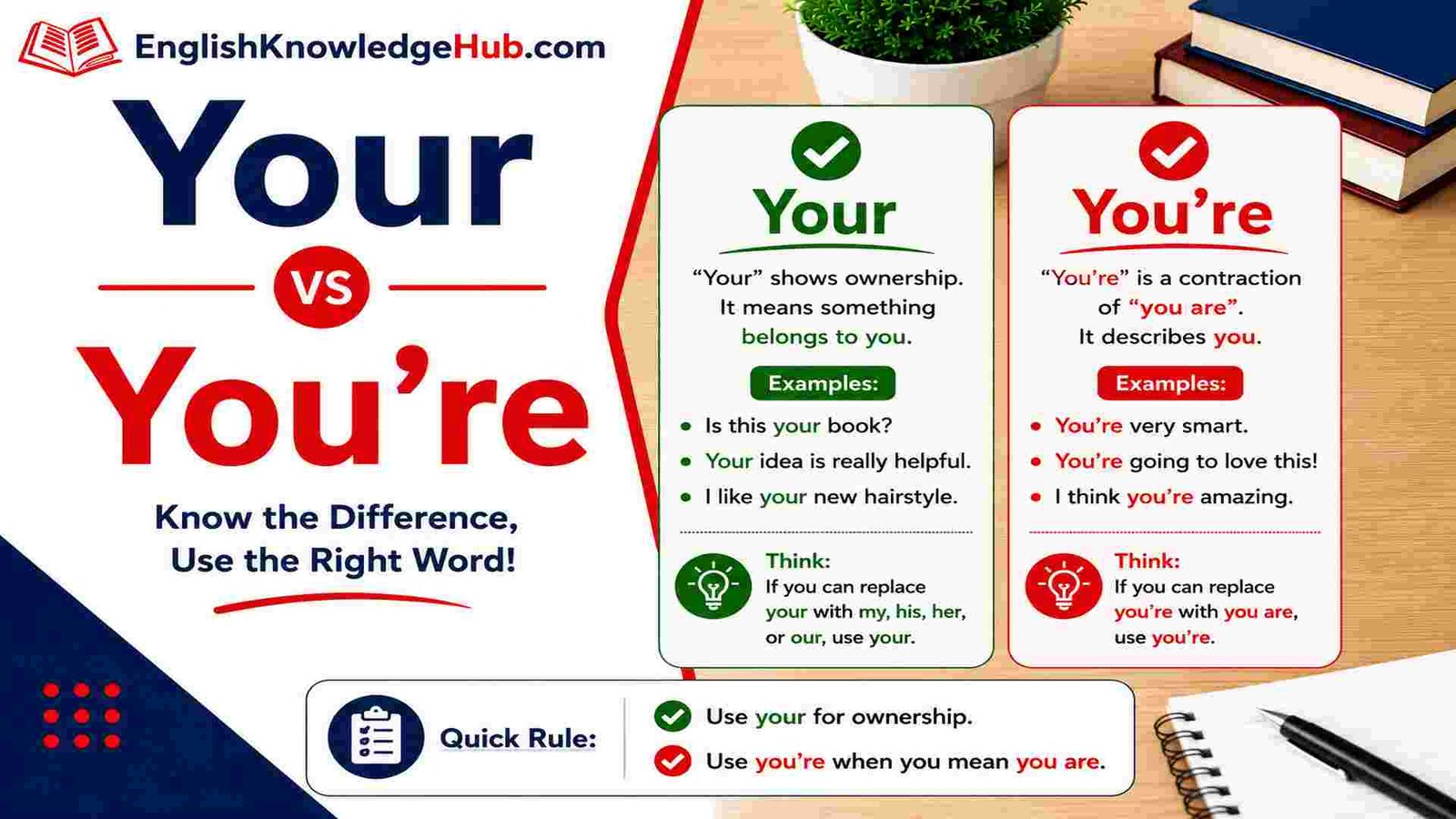
Your vs You’re has one simple difference. Your shows that something belongs to you or is connected with you. You’re is a short form of you are. If you can replace the word with you are and the sentence still sounds right, you should use you’re.
The two forms sound very similar when people speak, so they are easy to mix up in writing.
The good news is that you do not need a difficult grammar rule. A small test can help you choose the correct form almost every time.
The Rule You Need to Remember
Think about what the sentence means.
Use your when you are talking about something connected with a person.
Use you’re when you mean you are.
Look at these two sentences:
- Your lunch is on the table.
- You’re eating lunch early today.
In the first sentence, the lunch belongs to or is connected with the person.
In the second sentence, you’re means you are.
You can check it:
You are eating lunch early today.
The sentence still makes sense.
That tells us that you’re is correct.
What Does “Your” Mean?
Your is used before a noun. It tells us that the noun belongs to, relates to, or is connected with the person we are speaking to.
Examples:
- Your bag is under the chair.
- I like your drawing.
- Your mother called this morning.
- Please bring your notebook.
- Your seat is near the window.
Notice what comes after your:
- your bag
- your drawing
- your mother
- your notebook
- your seat
These are all nouns.
A simple pattern is:
your + noun
This is a very useful clue.
“Your” Can Show More Than Ownership
Sometimes your does not mean that you physically own something.
For example:
- Your class starts at ten.
- Your doctor will see you soon.
- Your idea made the task easier.
- Your turn is next.
You do not own a class, doctor, idea, or turn in the same way that you own a phone.
Here, your simply shows a connection with you.
What Does “You’re” Mean?
You’re is the short form of you are.
It is called a contraction.
Two words join together:
you are → you’re
The apostrophe shows that some letters have been removed.
Examples:
- You’re very quiet today.
- I think you’re correct.
- You’re standing in the wrong line.
- You’re going to love this game.
- Tell me when you’re ready.
Now change you’re to you are:
- You are very quiet today.
- I think you are correct.
- You are standing in the wrong line.
- You are going to love this game.
- Tell me when you are ready.
Every sentence still works.
That is the easiest way to understand you’re.
Your vs You’re in a Simple Table
| Form | Meaning | What often comes next? | Example |
|---|---|---|---|
| your | Shows possession or connection | A noun | Your shoes are outside. |
| you’re | Means “you are” | An adjective, verb, or other description | You’re wearing new shoes. |
Do not choose the word because of how it sounds.
Choose it because of what the sentence means.
Use the “You Are” Test
This is the best trick for checking Your vs You’re.
Whenever you see you’re, replace it with you are.
If the sentence still sounds correct, you’re works.
Example 1
You’re late for class.
Test it:
You are late for class.
It makes sense.
So you’re is correct.
Example 2
Your bike needs air in the tires.
Try:
You are bike needs air in the tires.
That sounds wrong.
So we need your.
Example 3
I hope you’re feeling better.
Try:
I hope you are feeling better.
It works.
Use you’re.
Example 4
Your answer made me smile.
Try:
You are answer made me smile.
It does not work.
Use your.
Why Are These Forms So Easy to Mix Up?
The main problem is pronunciation.
In normal speech, your and you’re may sound almost the same.
When you hear:
“Your ready.”
you cannot always tell from the sound which spelling the speaker means.
You must think about the grammar.
If the meaning is you are ready, the correct spelling is:
You’re ready.
Another reason for the mistake is the apostrophe.
Some learners think an apostrophe always shows that something belongs to someone.
That is not true.
In you’re, the apostrophe shows that you are has been shortened.
It does not show possession.
Your vs You’re: Common Mistakes and How to Fix Them
Mistake 1: Using “your” when the sentence means “you are”
Incorrect:
Your looking tired today.
Correct:
You’re looking tired today.
Explanation:
The sentence means you are looking tired today. Because you are works, you’re is correct.
Mistake 2: Using “you’re” before a noun
Incorrect:
I found you’re pencil.
Correct:
I found your pencil.
Explanation:
The pencil belongs to or is connected with the person. We need your before the noun pencil.
Mistake 3: Using the wrong form in a common phrase
Incorrect:
Your welcome.
Correct:
You’re welcome.
Explanation:
The full form is you are welcome. That is why we write you’re welcome.
Mistake 4: Writing “you’re” for possession
Incorrect:
Is this you’re jacket?
Correct:
Is this your jacket?
Explanation:
The jacket belongs to the person being asked about. Use your.
Examples From Everyday Conversation
These examples show how both forms work in normal speech.
- Your sandwich is still in the fridge.
- You’re sitting in my usual seat.
- Your cat is watching the birds.
- You’re much taller than your brother now.
- I think your phone is ringing.
- You’re welcome to come with us.
- Your shoes are covered in mud.
- You’re walking too fast for me.
A useful clue appears again and again.
Your often comes before a thing or person.
You’re often tells us what someone is, feels, or is doing.
Examples at Work
You may also see both forms in emails, meetings, and office conversations.
- Your meeting begins at two.
- You’re presenting the first slide.
- I received your email this morning.
- You’re doing a good job with the new system.
- Your desk has been moved upstairs.
- Please tell me when you’re available.
- Your report needs one small change.
- You’re responsible for checking the final numbers.
These sentences follow exactly the same rule as everyday English.
Examples for School and Academic Writing
Students often make this mistake when writing quickly.
Look at these examples:
- Your homework is due tomorrow.
- You’re allowed to work with a partner.
- Your paragraph needs another example.
- You’re improving with every lesson.
- Please check your spelling before you finish.
- You’re expected to explain your answer.
- Your research question is clear.
- You’re ready to begin the next task.
The grammar does not change in school or college writing.
Your vs You’re: Formal and Informal Use
Both your and you’re are correct English.
However, you’re is a contraction, so it can sound more relaxed.
It is very common in:
- conversation
- text messages
- friendly emails
- blogs
- everyday writing
Example:
You’re invited to join us on Saturday.
In very formal writing, a writer may choose you are instead.
Example:
You are required to show identification at the entrance.
The meaning is the same.
The full form simply sounds more formal.
Is There a British and American English Difference?
There is no important difference in the grammar rule.
American English and British English both use:
your for possession or connection
and
you’re for you are
The pronunciation may sound a little different depending on the speaker or region, but the spelling rule stays the same.
Your, You’re, and Yours Are Not the Same
Learners sometimes also mix up your and yours.
Use your before a noun:
- your phone
- your coat
- your room
Use yours when the noun does not need to be repeated.
Compare:
This is your coat.
This coat is yours.
Do not say:
This coat is your.
That sentence is incomplete.
So:
your + noun
but:
The noun + is yours
A Small Memory Trick
Here is an easy way to remember the difference.
Look at the apostrophe in you’re.
Imagine that it is holding the words you and are together.
So whenever you see:
you’re
think:
you are
Then test the sentence.
For example:
You’re my best player.
Becomes:
You are my best player.
It works.
Now try:
Your best player is absent.
You cannot say:
You are best player is absent.
So your is correct.
Quick Practice
Choose your or you’re.
- ___ dinner is getting cold.
- I think ___ very funny.
- Where did you put ___ keys?
- ___ going to miss the bus.
- Is that ___ new teacher?
- Tell me when ___ finished.
Answers
- Your dinner is getting cold.
- I think you’re very funny.
- Where did you put your keys?
- You’re going to miss the bus.
- Is that your new teacher?
- Tell me when you’re finished.
For questions 2, 4, and 6, you can replace you’re with you are.
That is why those answers are correct.
One Final Check Before You Write
When you are unsure, ask yourself two questions.
First:
Does this mean “you are”?
If yes, use you’re.
Second:
Am I talking about something connected with the person?
If yes, use your.
This simple check can prevent most mistakes.
FAQs
Which is correct, “your welcome” or “you’re welcome”?
You’re welcome is correct. It means you are welcome.
Which is correct, “your right” or “you’re right”?
If you mean that someone is correct, write you’re right because it means you are right.
However, your right can also be correct when right is a noun.
Example:
You should understand your right to ask questions.
Is “your” short for “you are”?
No. Your shows possession or connection. You’re is the short form of you are.
Can I write “you’re name”?
No. Write your name because the name belongs to or identifies the person.
Is “you’re” informal?
You’re is common in conversation and normal everyday writing. In very formal writing, you are may sometimes sound more suitable.
What is the easiest way to remember Your vs You’re?
Replace you’re with you are. If the sentence still makes sense, use you’re. If it does not, you may need your.
Can “your” come at the end of a sentence?
Usually, no. Your normally comes before a noun. When no noun follows, English often uses yours instead.
Example:
This seat is yours.
Final Thoughts
The difference in Your vs You’re is easier than it first appears. Your shows possession or connection, while you’re means you are.
Whenever you feel unsure, use the you are test. If you are fits naturally in the sentence, write you’re. If you are talking about a noun connected with someone, write your.
Keep practicing with short sentences, and this small grammar mistake will become much easier to spot.
For more simple grammar lessons, clear word differences, and easy English examples, visit EnglishKnowledgeHub.com.
