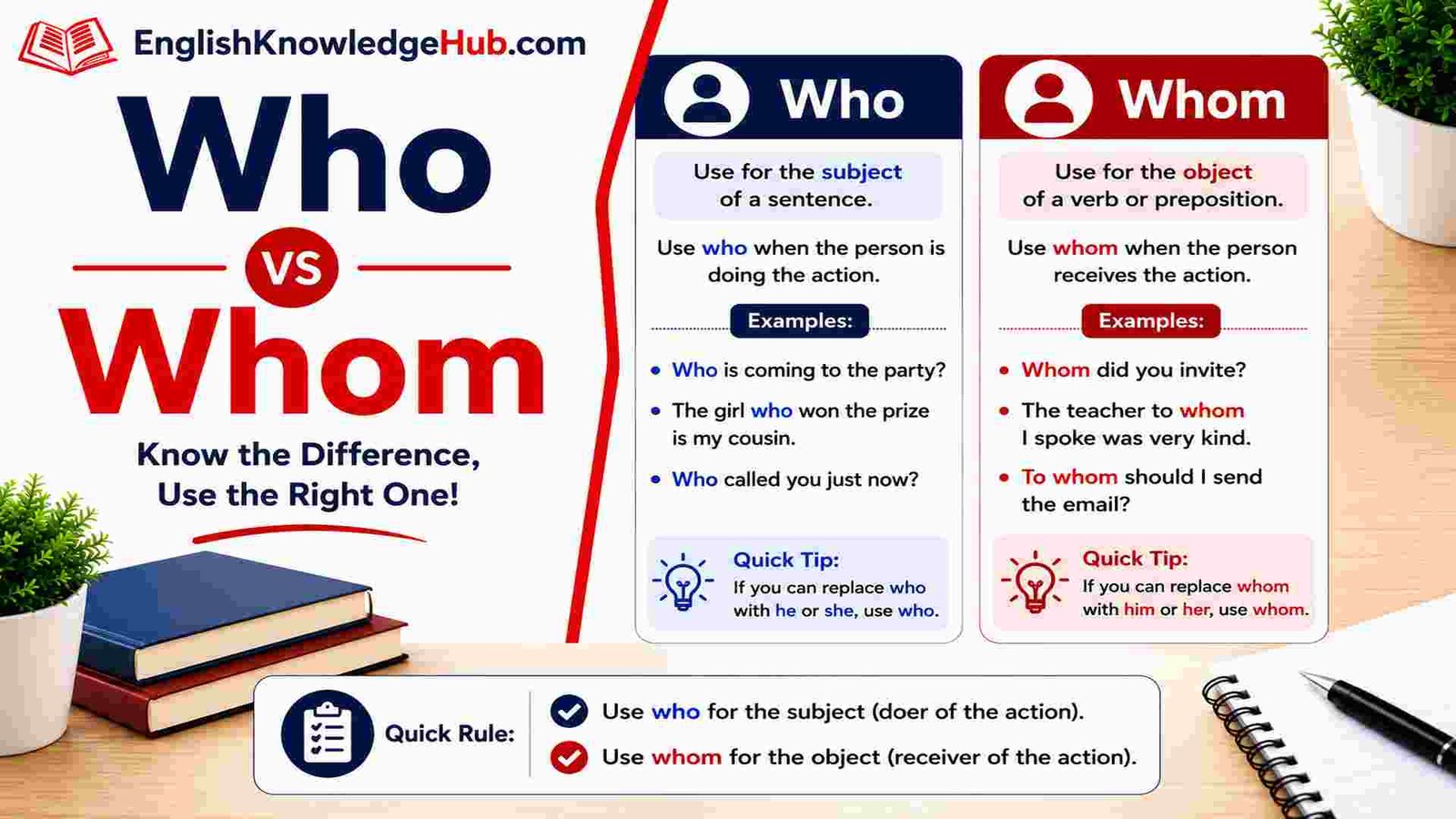
Who vs Whom is easy to understand when you look at the job each word does. Use who for the person doing an action. Use whom for the person receiving an action. In everyday English, people often use who instead of whom, but whom is still useful in formal writing.
The two words both refer to people, so they can look confusing at first.
Which word fits the sentence correctly?
Is the person doing the action or receiving the action?
Once you answer that, choosing the correct word becomes much easier.
The Main Rule in Simple Words
The basic difference in Who vs Whom is about the subject and object of a sentence.
A subject does the action.
An object receives the action.
Use:
- Who when the person does the action.
- Whom when the action happens to the person.
Look at this example:
Who opened the gate?
The person opened the gate.
That person did the action, so who is correct.
Now look at this:
Whom did Maria invite?
Maria did the inviting.
Another person received the invitation, so whom is correct in formal grammar.
Here is a simple comparison:
| Word | Use it when | Easy example |
|---|---|---|
| Who | The person does the action | Who called you? |
| Whom | The person receives the action | Whom did you call? |
That is the main rule.
An Easy He and Him Trick
There is a very useful trick for choosing between the two words.
Think about he and him.
If he fits, use who.
If him fits, use whom.
For example:
Who brought the cake?
Try answering:
He brought the cake.
“He” sounds correct, so use who.
Now try:
Whom did Emma choose?
Answer:
Emma chose him.
“Him” sounds correct, so whom is the formal choice.
You can also use:
- she = who
- her = whom
- they = who
- them = whom
A small memory trick can help:
Whom and him both end with m.
When Should You Use Who?
Use who when you are asking about the person doing something.
For example:
Who baked these cookies?
Someone baked the cookies.
That person did the action.
So who is correct.
More examples:
- Who cleaned the classroom?
- Who wants some juice?
- Who sent this package?
- Who changed the password?
- Who lives in that house?
In every sentence, the person connected to who performs the action.
You can also use who in the middle of a sentence.
The girl who found my notebook returned it today.
The girl found the notebook.
She did the action, so we use who.
Another example:
I spoke to the teacher who runs the art club.
The teacher runs the club.
The teacher performs the action.
When Should You Use Whom?
Use whom when the person receives the action.
For example:
Whom did the coach select?
The coach selected someone.
The unknown person did not perform the action. The coach performed it.
That makes whom correct in formal English.
More examples:
- Whom did the company hire?
- Whom should we invite?
- Whom did you meet yesterday?
- Whom did the teacher praise?
You may notice that some of these sentences sound a little formal.
That is normal.
In everyday conversation, many people would say:
Who did the company hire?
instead of:
Whom did the company hire?
Both forms can be understood, but whom follows the traditional object rule.
Why Do People Often Use Who Instead of Whom?
This is an important part of Who vs Whom because grammar books and real conversations do not always sound the same.
In normal speech, whom is less common than it used to be.
People often say:
Who are you calling?
instead of:
Whom are you calling?
They may also say:
Who did you travel with?
instead of:
With whom did you travel?
The versions with who sound natural in everyday conversation.
The versions with whom sound more formal.
This does not mean that whom is wrong or dead. It simply means that its use is more limited today.
You are more likely to see it in:
- formal letters
- academic writing
- business writing
- legal writing
- official documents
- carefully written reports
Whom After a Preposition
Whom is especially common after words such as:
- to
- with
- for
- from
- about
- by
For example:
To whom should I give this letter?
With whom did you discuss the plan?
For whom was this gift bought?
From whom did the message come?
These sentences sound formal.
In normal conversation, people often move the preposition to the end.
Formal:
With whom are you going?
Everyday:
Who are you going with?
Formal:
To whom did you send the file?
Everyday:
Who did you send the file to?
Both styles can be useful. Your choice depends on the situation.
Who or Whom in Everyday Conversation
In normal speech, who is often the safest and most natural choice.
Imagine that you are talking to a friend.
You would probably say:
Who did you meet at the park?
You would probably not say:
Whom did you meet at the park?
The second sentence is grammatically correct in formal English, but it may sound too serious for a casual chat.
Another example:
Who are you sitting next to?
This sounds natural.
Next to whom are you sitting?
This is much more formal.
So when learning Who vs Whom, remember that correct grammar and natural speech can sometimes use different styles.
Who vs Whom: Examples From Daily Life
Here are some easy examples you could hear in normal situations.
Who left the door open?
The person did the action.
Who wants the last slice of pizza?
The person wants something.
Who are you waiting for?
In strict formal grammar, whom could be used because the person is the object of “waiting for.” However, who sounds much more natural in everyday speech.
Who helped you with your homework?
The person did the helping.
Whom did you choose for the team?
The person received the action of being chosen. This version sounds more formal.
Examples From the Workplace
You may also see both words at work.
Who will lead tomorrow’s meeting?
The person will perform the action.
Who prepared this report?
The person prepared it.
Whom should we contact about the invoice?
The person will receive the contact.
In normal office speech, people may simply say:
Who should we contact about the invoice?
Another formal example:
To whom should I send the signed form?
A less formal version is:
Who should I send the signed form to?
The meaning stays the same. The tone changes.
Examples in School and Academic Writing
Formal writing may use whom more often.
Who wrote the first draft?
The person wrote it.
The student who answered first received an extra point.
The student performed the action.
The students whom the professor selected joined the research team.
The professor selected the students.
The students received the action, so whom works.
You could also write:
The students who the professor selected joined the research team.
This is common in modern English and sounds less formal.
Common Mistakes With Who and Whom
Understanding common errors can make the Who vs Whom rule easier to remember.
Mistake 1: Using Whom for the Person Doing the Action
Incorrect:
Whom broke the window?
Correct:
Who broke the window?
Explanation:
The person broke the window. The person did the action, so who is correct.
Mistake 2: Using Whom Just Because It Sounds Formal
Incorrect:
Whom do you think will win the race?
Correct:
Who do you think will win the race?
Explanation:
Look at the smaller idea:
He will win the race.
We say he, not him.
That means who is correct.
Mistake 3: Using Who in a Very Formal Preposition Phrase
Less suitable in formal writing:
To who should the letter be sent?
Better:
To whom should the letter be sent?
Explanation:
After the preposition to, formal English uses whom when the person is the object.
In everyday conversation, you could simply say:
Who should the letter be sent to?
Mistake 4: Thinking Whom Must Always Be Used for Objects
Too formal for many conversations:
Whom did you see at the shop?
Natural everyday English:
Who did you see at the shop?
Explanation:
Traditional grammar uses whom because the person receives the action of “see.” However, modern speakers commonly use who in sentences like this.
A Tricky Sentence Made Easy
Some sentences contain extra words that can hide the real rule.
Look at this:
Who do you think called me?
You may think “do you think” changes the grammar.
Remove those words for a moment:
Who called me?
Now it is easy.
The person did the calling.
So use who.
Now look at:
Whom do you think the manager chose?
Remove “do you think”:
The manager chose whom?
The manager did the choosing.
The other person received the action.
So whom is the formal form.
When a sentence feels difficult, look for the smaller sentence inside it.
Is Whom Old-Fashioned?
Not completely.
Whom is less common in casual speech, but people still use it.
You may see it in expressions such as:
To whom it may concern
You may also see it in formal questions:
To whom should this payment be made?
It appears in business letters, formal emails, reports, academic work, and official writing.
So it is better to call whom formal rather than outdated.
Is There a British and American Difference?
There is no major rule difference.
British and American English both use who as the subject form and whom as the traditional object form.
In both varieties of English, everyday speakers often choose who instead of whom.
Formal writing is more likely to keep whom, especially after a preposition.
So you do not need separate rules for British and American English.
A Fast Way to Check Your Sentence
When you are unsure, follow these three steps.
Step 1: Find the person.
Ask what that person is doing.
Step 2: Try he or him.
If he fits, choose who.
If him fits, whom is the formal choice.
Step 3: Think about the situation.
Are you writing a formal letter or academic paper?
You may want whom.
Are you talking to a friend?
Who will often sound more natural.
For example:
Who did Sam invite?
The test gives:
Sam invited him.
Traditional grammar points to whom.
So:
Whom did Sam invite?
is formally correct.
But:
Who did Sam invite?
is completely normal in everyday English.
Frequently Asked Questions
Is it “Who did you call?” or “Whom did you call?”
Both are used. Whom did you call? follows the traditional object rule. Who did you call? is much more common in everyday English.
Is “Who are you talking to?” correct?
Yes. It is natural and common. The more formal form is “To whom are you talking?”
When should I use whom?
Use whom when a person is the object of a verb or preposition, especially in formal writing.
Can I always use who instead of whom?
In casual speech, who works in many places where formal grammar uses whom. In formal writing, it is still useful to know the difference.
Is “To whom it may concern” correct?
Yes. It is a standard formal phrase often used when you do not know the name of the person who will read a letter.
Is whom still used today?
Yes. It is less common in conversation, but it still appears in formal and professional English.
Which is correct, “Who should I ask?” or “Whom should I ask?”
Whom should I ask? follows the formal object rule. Who should I ask? is very common and natural in everyday English.
What is the easiest way to remember who and whom?
Use the he/him test. If he works, use who. If him works, whom is usually the formal answer.
Final Thoughts
The difference in Who vs Whom becomes much easier when you stop thinking about how formal the words sound and focus on their job in the sentence.
Use who when the person does the action.
Use whom when the person receives the action, especially in formal English.
Remember the simple test:
Who = he
Whom = him
Also remember that normal modern conversation often uses who where older or more formal grammar uses whom. Knowing both forms helps you write correctly without making your English sound stiff.
For more easy grammar lessons, simple word comparisons, and clear English examples, visit EnglishKnowledgeHub.com.
