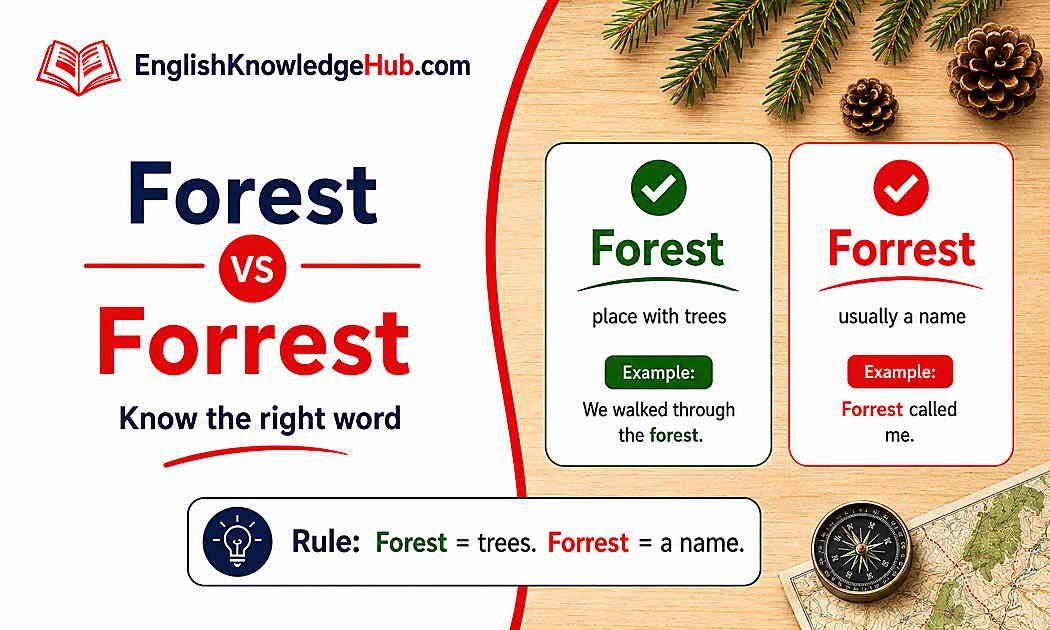
Use forest with one r when you mean a wooded area filled with trees. Forrest, with two r’s, is most commonly a person’s first name or surname. So “We walked through the forest” is correct for nature, while “Forrest called me” is correct if Forrest is someone’s name. The two forms may sound the same, but their usual roles are different.
In this article, you’ll learn how Forest vs Forrest differ in meaning, capitalization, grammar, names, related forms such as forested and forestry, and common spelling mistakes. Merriam-Webster defines forest as a dense growth of trees and underbrush covering a large tract and also records forest as a verb meaning to cover land with trees.
For Trees and Woodland, the Word Is “Forest”
When you are talking about nature, ecology, woodland, wildlife, or land covered mainly with trees, the standard common noun is forest.
“The forest was quiet after the rain.” “Researchers studied the forest ecosystem.” “A fire damaged part of the forest.” In each sentence, only one r appears in the middle.
The same spelling stays in common compounds and phrases: forest fire, forest floor, forest path, forest ranger, forest habitat, forest management, and forest conservation.
What “Forrest” Usually Means
Forrest is most familiar as a proper name. It can be a first name, surname, place name, business name, or another official proper name.
If a person is officially named Forrest, changing it to Forest would be a spelling error because names keep their own established spelling. The same rule applies to organizations and places.
That gives us an easy contrast: “The forest is beautiful” refers to woodland. “Forrest said it is beautiful” refers to a person.
Can “Forest” Also Be a Person’s Name?
Yes. Forest can also be used as a given name or surname. That is an important nuance because some guides make the rule too absolute.
When you are writing someone’s name, do not choose the spelling based on the nature word. Use the spelling that belongs to that person: Forest or Forrest.
So the practical rule is not “Forrest is only a name and Forest is never a name.” It is: forest is the standard common noun for wooded land, while Forrest is commonly encountered as a proper name.
Why Writers Add the Extra R
The confusion comes partly from pronunciation. In most accents, forest and the name Forrest sound the same. When you hear the word aloud, your ear cannot tell you how many r’s to write.
The name Forrest is also familiar enough that the double-r spelling looks believable. Spell-check software may not flag it because Forrest is a valid proper name.
That means proofreading has to use context. If the sentence is about trees or woodland, write forest.
Forest as a Noun and as a Verb
Most learners know forest as a noun, but it can also be a verb meaning to cover land with trees.
You are more likely to see related forms such as forested: “The northern slopes are heavily forested.” Environmental writing also uses terms such as reforestation, deforestation, and forestry.
This matters because the nature word has a larger word family than simply the noun forest.
Forest, Woods, and Woodland
These words overlap, but they are not always interchangeable. Forest often suggests a large area dominated by trees. Woods can sound smaller or more informal. Woodland is a general term for land covered with trees and may appear often in environmental or land-use writing.
The exact boundaries depend on context and local usage, so avoid inventing a strict size rule such as “a forest must be larger than X acres” unless you are working with a specific legal or scientific definition.
Rainforest or Rain Forest?
Readers searching forest vs forrest sometimes also wonder about rainforest. Rainforest is widely written as one word in modern English. You may also encounter rain forest in some sources and styles.
The important point for this article is that the root remains forest with one r, not forrest.
Capitalization Can Give You a Clue
The common noun forest is usually lowercase unless it begins a sentence or appears in an official proper name: “We entered the forest,” but “Black Forest” or another official name may use capitals.
Forrest is often capitalized because it commonly refers to a person or another proper name.
Capitalization is a clue, not the full rule. A person named Forest is also capitalized, and an official place may contain the word Forest.
Common Mistakes and Corrections
Incorrect for woodland: We spent the afternoon in the forrest.
Correct: We spent the afternoon in the forest.
The sentence refers to trees and land, so use the common noun forest.
Incorrect if that is the person’s name: Forest Gump is the character’s name.
Correct: Forrest Gump is the character’s name.
Proper names must keep their established spelling.
Potentially wrong: I changed Mr. Forest’s surname to Forrest because it looked more familiar.
Never “correct” a person’s name unless you know the official spelling. Both Forest and Forrest can occur as names.
Real-Life Examples
In everyday writing: “We followed a narrow path through the forest.” In environmental writing: “The region contains several protected forest habitats.” In a workplace email: “Forrest will send the report this afternoon.” In a directory: “Please confirm whether the client’s surname is Forest or Forrest.”
Those examples show why context matters more than pronunciation.
A Simple Memory Trick
For the nature word, remember one r for the trees: forest. If you see Forrest, pause and ask whether it is a name or another official proper noun.
This is similar to other spelling problems where a familiar-looking form can pass spell-check even when it is wrong for the sentence. Our Involved or Envolved guide shows another case where sound can mislead spelling.
Quick Comparison
| Form | Usual role | Example |
|---|---|---|
| forest | common noun for wooded land | The forest is protected. |
| forest | verb, less common | The land was forested with pine. |
| Forrest | proper name | Forrest joined the meeting. |
| Forest | can also be a proper name | Forest signed the form. |
Frequently Asked Questions
Is it forest or forrest for trees?
Forest is the standard spelling for an area of trees.
Is Forrest a real word?
It is widely used as a proper name, including first names, surnames, and official names.
Can Forest be a person’s name?
Yes. Both Forest and Forrest can occur as names. Use the person’s actual spelling.
Does forest have one r or two?
The common noun for woodland has one r in the middle: forest.
Is it Forrest Gump or Forest Gump?
Forrest Gump is the correct spelling of the character’s name.
Can forest be a verb?
Yes. It can mean to cover land with trees, though forms such as forested are more common in many contexts.
Final Takeaway
For Forest vs Forrest, use forest when you mean wooded land, trees, or a forest-related concept. Use Forrest when that is the official spelling of a person, place, organization, or other proper name. And remember that Forest can also be a name, so names should always be checked rather than “corrected” by rule.
For more practical spelling and word-choice guides, explore EnglishKnowledgeHub.com.
