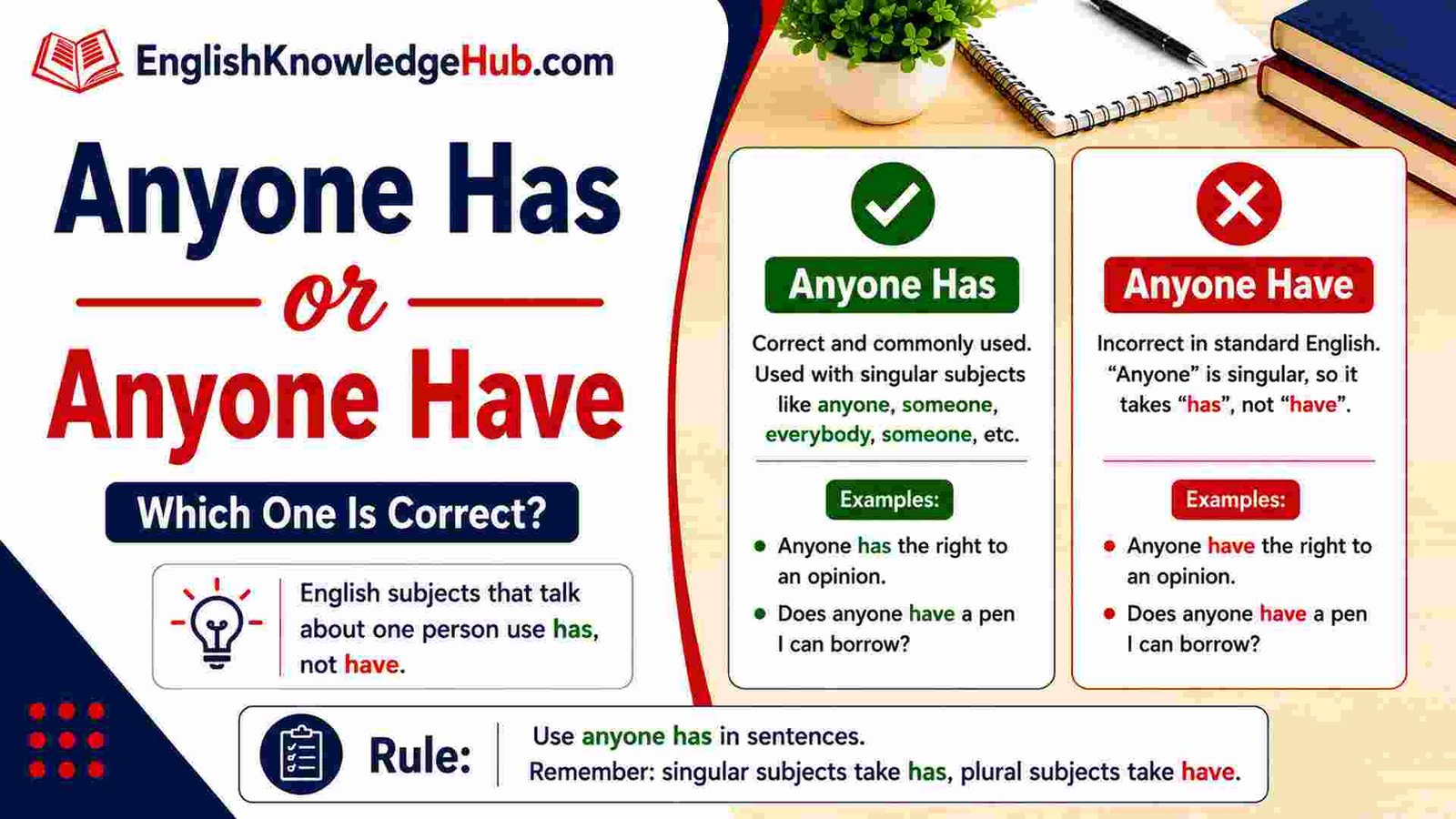
“Anyone has” and “anyone have” can both appear in correct English, but not in the same sentence pattern. Treat anyone as singular in an ordinary statement, so write “Anyone has a chance.” In questions and negatives with does, use the base verb have: “Does anyone have a question?” and “Anyone doesn’t have” is usually replaced by “Doesn’t anyone have…?”
In this article, you’ll learn exactly when to use Anyone Has or Anyone Have, why does changes the verb form, and how the rule works with questions, negatives, contractions, and everyday speech. Cambridge Grammar notes that anyone takes a singular verb, even though singular they can refer back to it.
Why Does “Anyone” Use a Singular Verb?
The word anyone means any person.
It may refer to one person from a large group, but English grammar treats anyone as singular.
That is why we use singular verbs with it.
For example:
- Anyone is welcome to join.
- Anyone knows that practice takes time.
- Anyone has the right to ask for help.
- Anyone needs rest after a long day.
The same idea works with words such as:
- someone
- everyone
- anybody
- everybody
- nobody
- no one
These words usually take singular verbs.
For example:
- Someone has my pen.
- Everybody needs a break.
- Nobody knows the full story.
So when anyone is the subject of a normal statement, has is the correct form.
When to Use “Anyone Has”
Use anyone has when you are making a simple statement and have is the main verb.
The pattern is:
Anyone + has + something
Examples:
- Anyone has the chance to improve with practice.
- Anyone has a reason to feel nervous before an interview.
- Anyone has the right to ask for more information.
- Anyone has something useful to offer.
Because anyone is singular, we use has, just as we use it with he or she.
Compare:
- He has a question.
- She has a question.
- Anyone has a chance to ask a question.
The verb follows the same singular pattern.
When to Use “Does Anyone Have?”
In questions, the sentence changes.
We say:
Does anyone have…?
For example:
- Does anyone have a pencil?
- Does anyone have the door key?
- Does anyone have a copy of the report?
- Does anyone have an idea?
Why do we use have instead of has?
Because does already shows that the subject is singular.
After does, the main verb stays in its basic form.
So we say:
- Does he have?
- Does she have?
- Does anyone have?
We do not say:
- Does he has?
- Does she has?
- Does anyone has?
A simple rule to remember is:
After “does,” always use the base form of the main verb.
Anyone Has or Anyone Have: Quick Comparison
| Sentence type | Correct form | Example |
|---|---|---|
| Normal statement | anyone has | Anyone has a chance to speak. |
| Question | does anyone have | Does anyone have a spare chair? |
| After a modal verb | anyone have | Could anyone have the answer? |
| Casual question | anyone have | Anyone have a charger? |
| Wrong form | does anyone has | Does anyone has a charger? |
This table shows why both has and have may appear with anyone.
The sentence structure decides which one you need.
Is “Anyone Have?” Correct?
Yes, but it depends on the sentence.
You may hear:
Anyone have a pen?
This is common in everyday speech.
The full form is:
Does anyone have a pen?
People often leave out does when speaking casually.
For example:
- Anyone have a phone charger?
- Anyone have the Wi-Fi password?
- Anyone have a minute?
- Anyone have an extra seat?
These sentences sound natural in casual conversation.
However, in formal writing, school work, exams, and professional emails, it is better to use the full form:
Does anyone have…?
“Anyone Have” After Modal Verbs
There is another case where anyone have is fully correct.
After modal verbs, we use the base form of the next verb.
Common modal verbs include:
- can
- could
- may
- might
- should
- would
- will
Examples:
- Can anyone have access to this room?
- Could anyone have made this mistake?
- Would anyone have time to help?
- Might anyone have another idea?
- Should anyone have a problem, please call us.
The word have is correct because it comes after a modal verb.
Compare:
Anyone has a question.
But:
Could anyone have a question?
The modal verb changes the form of the next verb.
Why “Does Anyone Has” Is Wrong
A very common mistake is:
Incorrect:
Does anyone has the answer?
Correct:
Does anyone have the answer?
Explanation:
The word does already carries the singular form. The next verb must stay in its base form, so we use have.
This rule works with many other verbs too.
Incorrect:
Does anyone knows her name?
Correct:
Does anyone know her name?
Explanation:
After does, use know, not knows.
Incorrect:
Does anyone needs help?
Correct:
Does anyone need help?
Explanation:
The base form after does is need
Incorrect:
Does anyone wants some tea?
Correct:
Does anyone want some tea?
Explanation:
The verb after does should not end in -s.
Daily Conversation Examples
Here are some easy examples from everyday life:
- Does anyone have an umbrella?
- Does anyone have some change?
- Anyone have an extra bottle of water?
- Could anyone have left the window open?
- Anyone who has a ticket can enter.
These examples show that the correct verb depends on the words around it.
Workplace Examples
You may also use these forms at work.
- Does anyone have the latest file?
- Does anyone have the meeting notes?
- Anyone who has access can update the document.
- Could anyone have entered the wrong number?
- Anyone have a quick update?
The last example is casual.
In a professional email, it is better to write:
Does anyone have a quick update?
Academic Examples
In school or university writing, complete sentence forms are usually better.
Examples:
- Does anyone have another explanation?
- Does anyone have evidence for this idea?
- Anyone who has finished the test may leave.
- Could anyone have reached a different result?
- Does anyone have a question about the lesson?
These forms are clear and suitable for careful writing.
Formal Writing Examples
Formal English usually uses complete grammar structures.
Examples:
- Does anyone have information about the missing file?
- If anyone has a concern, they should contact the office.
- Anyone who has permission may enter the room.
- Should anyone have questions, please speak with the manager.
Notice these two forms:
If anyone has a question…
Should anyone have a question…
Both are correct.
In the first sentence, has is the main verb.
In the second sentence, have follows the modal verb should.
“If Anyone Has” or “If Anyone Have”?
The correct form is usually:
If anyone has
Examples:
- If anyone has a question, please ask.
- If anyone has my notebook, please return it.
- If anyone has more information, let me know.
This is because anyone is singular.
So this is normally wrong:
Incorrect:
If anyone have a question, please ask.
Correct:
If anyone has a question, please ask.
However, have can appear after a modal:
If anyone should have a problem, call this number.
Here, have follows should, so it is correct.
“Anyone Who Has” or “Anyone Who Have”?
Use:
Anyone who has
Examples:
- Anyone who has a ticket may enter.
- Anyone who has finished can go home.
- Anyone who has experience may apply.
- Anyone who has the answer can speak first.
Do not normally say:
Anyone who have finished can leave.
Use:
Anyone who has finished can leave.
The verb has agrees with anyone.
“Has Anyone” vs “Does Anyone Have”
These two forms are both correct, but they are not always used in the same way.
Has anyone…?
Use has anyone in present perfect sentences.
Examples:
- Has anyone called me?
- Has anyone finished the task?
- Has anyone seen my bag?
- Has anyone visited this place before?
Does anyone have…?
Use does anyone have when have means to own, hold, or possess something.
Examples:
- Does anyone have my bag?
- Does anyone have a car?
- Does anyone have the password?
- Does anyone have enough time?
Compare:
Has anyone found the key?
This asks if someone found it.
Does anyone have the key?
This asks if someone has it now.
Anyone Has or Anyone Have: A Simple Memory Trick
If you are unsure about Anyone Has or Anyone Have, replace anyone with he.
For a statement:
He has a ticket.
So:
Anyone has a chance to get a ticket.
For a question:
Does he have a ticket?
So:
Does anyone have a ticket?
You would not say:
Does he has a ticket?
So you should not say:
Does anyone has a ticket?
This small trick can help you remember the rule quickly.
Is There a British and American English Difference?
There is no important difference in this basic grammar rule.
Both British and American English use:
Does anyone have…?
However, British English also commonly uses have got for possession.
For example:
Has anyone got a spare pen?
This has a similar meaning to:
Does anyone have a spare pen?
Both are correct.
Anyone Has or Anyone Have: Common Mistakes
Mistake 1: Using “Have” in a Simple Statement
Incorrect:
Anyone have the right to speak.
Correct:
Anyone has the right to speak.
Explanation:
Anyone is singular, so use has in a normal present tense statement.
Mistake 2: Using “Has” After “Does”
Incorrect:
Does anyone has a spare key?
Correct:
Does anyone have a spare key?
Explanation:
After does, use the base verb have.
Mistake 3: Treating “Anyone” as Plural
Incorrect:
Anyone are welcome to join.
Correct:
Anyone is welcome to join.
Explanation:
Anyone is grammatically singular.
Mistake 4: Using Casual Grammar in Formal Writing
Informal:
Anyone have the report?
Better for formal writing:
Does anyone have the report?
Explanation:
The shorter form is common in speech, but the complete form is better in careful writing.
FAQs
Is “anyone has” grammatically correct?
Yes. Use anyone has in a normal statement when has is the main present tense verb.
Is “anyone have” grammatically correct?
Yes, especially after does or a modal verb. It also appears in casual shortened questions.
Is “Does anyone has” correct?
No. Use Does anyone have because the verb after does must stay in its base form.
Which is correct: “Does anyone have” or “Does anyone has”?
Does anyone have is correct.
Is “Anyone have any questions?” correct?
It is common in informal speech. The full standard form is Does anyone have any questions?
Do we say “If anyone has” or “If anyone have”?
Use if anyone has in normal present tense sentences.
Is anyone singular or plural?
Anyone is grammatically singular, even though it may refer to any person in a group.
Which is correct: “Anyone who has” or “Anyone who have”?
Use anyone who has because anyone takes a singular verb.
Final Thoughts
The difference in Anyone Has or Anyone Have depends on sentence structure. Use anyone has in a normal statement. Use does anyone have in a question because the main verb stays in its base form after does. You can also use have after modal verbs such as can, could, and should.
If you remember just one pattern, make it this:
Anyone has…
Does anyone have…?
For more simple grammar lessons, word comparisons, and easy English explanations, visit EnglishKnowledgeHub.com.
