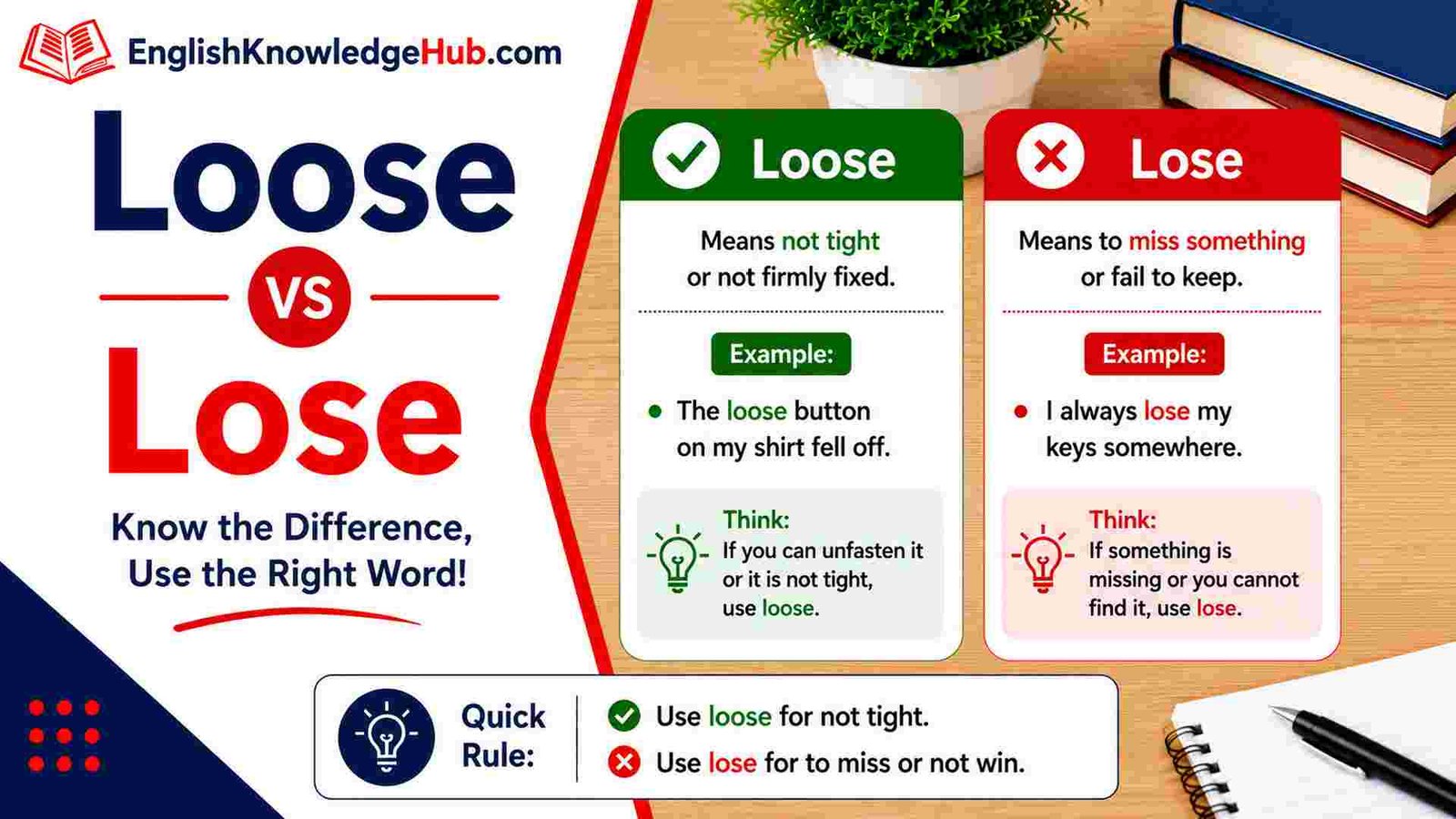
Loose and lose are different words and are not interchangeable. Loose usually describes something that is not tight, firmly attached, or restrained. Lose is a verb meaning to misplace something, stop having it, or fail to win. A quick test is simple: “not tight” = loose; “no longer have” = lose.
In this article, you’ll learn how Loose vs Lose differ in meaning, grammar, and pronunciation, how forms such as losing and loosing work, and how to fix the mistakes that appear most often in everyday writing. Merriam-Webster’s confused-words guide also distinguishes loose as usually describing something not tight from lose as a verb about failing to find, keep, hold, or win something.
Start With the Meaning, Not the Extra Letter
Writers often focus on the spelling difference, but meaning is the faster way to choose correctly. If a shirt does not fit closely, it is loose. If that shirt goes missing, you lose it.
That contrast works in many real situations. A screw can be loose, but you can lose the screw. A dog can get loose, but you can lose the dog. A team can have a loose defensive shape, but it can lose the match.
Once you ask what is happening in the sentence, the spelling usually becomes obvious.
What “Loose” Means in Everyday English
Loose is most often an adjective. Its central idea is that something is not tight, not securely fixed, or free to move.
“My shoes are loose” means they do not fit tightly. “The door handle is loose” means it is not firmly attached. “The horse got loose” means it escaped restraint and can move freely.
The word can also be more abstract. A loose plan is flexible rather than exact. A loose interpretation is not strict. A loose group may be connected without a very formal structure.
So although “not tight” is the best memory clue, loose can extend to anything that is not fixed, strict, controlled, or exact.
What “Lose” Means
Lose is a verb, and its meanings all involve something no longer being available, possessed, maintained, or won.
You can lose your keys because you cannot find them. You can lose money because you no longer have it. You can lose patience because your patience runs out. You can lose a game because you fail to win.
The same verb works with physical and abstract things: lose a phone, lose a job, lose trust, lose interest, lose hope, lose time, lose an opportunity, lose your place, or lose control.
The Pronunciation Difference Helps More Than Many Learners Realize
The spellings are close, but the final sounds differ. Loose ends with an s sound, similar to the end of goose. Lose ends with a z sound, closer to choose.
Say these aloud: “loose shoes” and “lose shoes.” In the first, the shoes are not tight. In the second, the shoes go missing.
This sound difference can be a useful backup check when the meaning test does not immediately come to mind.
Loose Can Also Be a Verb
This is one nuance many short guides skip. Loose can function as a verb meaning to release, set free, or let something go, though this use is much less common than the adjective.
You may see sentences such as “The archer loosed an arrow” or “They loosed the animals from the enclosure.” In everyday modern English, release, let loose, or loosen may sound more natural depending on the situation.
This verb meaning explains why loosing is a real word, even though writers often use it by mistake when they actually mean losing.
Losing vs Loosing
Losing comes from lose: “We are losing time,” “She keeps losing her keys,” “The team is losing,” and “He is losing interest.”
Loosing comes from the verb loose, meaning releasing or setting free. It is comparatively uncommon. “The crew was loosing the ropes” can be grammatical in a context where ropes are being released, but most everyday sentences about something disappearing, decreasing, or not being won need losing.
So if you mean “no longer having,” “misplacing,” “falling behind,” or “failing to win,” choose losing.
Past Forms: Lost, Not Losed
Lose is irregular. Its past tense and past participle are both lost.
Present: “I sometimes lose my glasses.”
Past: “I lost my glasses yesterday.”
Present perfect: “I have lost my glasses again.”
Do not write losed. Learning the irregular form matters because many learner mistakes continue even after the loose/lose spelling itself is understood.
Common Expressions With “Lose”
Some phrases are searched so often that they are worth learning as complete units.
Lose weight is correct, not loose weight. The meaning is to have less body weight than before. Lose interest means to stop feeling interested. Lose your mind is an idiom for becoming extremely upset, confused, or irrational. Lose touch means to stop communicating or become less familiar with something.
These phrases all use the verb because they describe a change or loss, not a state of being “not tight.”
Common Expressions With “Loose”
Break loose means escape restraint. Let loose means release something or allow energy or emotion to come out freely. Cut loose can mean separate yourself from something or relax without restraint.
You may also hear on the loose, especially for a person or animal that is free when people expect it to be confined: “The escaped dog was still on the loose.”
These phrases make sense when you remember the underlying idea of freedom or lack of restraint.
Why the “Two O’s = Extra Room” Trick Works
A common memory trick is that loose has an extra o, and something loose has extra room. Loose shoes have extra room. A loose shirt has extra room. A loose knot has extra space.
For lose, think of one o disappearing, just as something can disappear when you lose it.
This is only a memory device, not a grammar rule, but it is useful because it connects the spelling with a real visual idea.
Mistakes That Look Small but Change the Sentence
Incorrect: Please do not loose my passport.
Correct: Please do not lose my passport.
The passport might go missing, so the verb is lose.
Incorrect: This bolt is lose.
Correct: This bolt is loose.
The sentence describes the bolt as not securely fixed, so the adjective is loose.
Incorrect: We might loose the match.
Correct: We might lose the match.
Failing to win uses lose.
Incorrect: I am loosing patience.
Correct: I am losing patience.
The patience is decreasing or running out, so use losing.
How the Difference Appears in Real Contexts
At home: “The cupboard handle is loose, and I do not want to lose the screw.” At work: “A loose cable could cause a problem, and the team could lose valuable time fixing it.” In sports: “Their formation looked loose, and they eventually lost the game.”
Academic writing uses the same meanings. A researcher might describe a “loose conceptual framework” if the categories are flexible, while a sample may “lose moisture” during an experiment.
The words are simple, but using them accurately matters in every level of writing.
Loose vs Lose in British and American English
The core distinction is the same in British and American English. Both varieties use loose for the adjective and lose for the verb.
You do not need a regional spelling change here. That makes this pair easier than differences such as color/colour.
A Fast Proofreading Test
Ask one question: Am I describing a state, or am I describing an action/change?
If something is not tight, secure, strict, or restrained, use loose. If something is going missing, no longer being kept, decreasing, or not being won, use lose.
| Meaning | Correct word | Example |
|---|---|---|
| not tight | loose | The belt is loose. |
| not firmly attached | loose | A tile is loose. |
| free from restraint | loose | The dog got loose. |
| misplace | lose | Do not lose the ticket. |
| stop having | lose | We may lose funding. |
| fail to win | lose | They could lose the final. |
If meaning-first tests help you with confusing pairs, the same approach works well in our Than vs Then guide.
Frequently Asked Questions
Is it lose weight or loose weight?
Lose weight is correct.
Is it lose your mind or loose your mind?
Lose your mind is the standard expression.
What is the past tense of lose?
Lost. For example, “I lost my wallet yesterday.”
Is loosing a real word?
Yes, but it comes from the less-common verb loose, meaning to release. Most sentences about something disappearing or decreasing need losing.
Can loose be a verb?
Yes. It can mean release or set free, though the adjective use is much more common.
How do you pronounce loose and lose?
Loose ends with an s sound; lose ends with a z sound.
Final Takeaway
The easiest way to solve Loose vs Lose is to focus on meaning. Use loose when something is not tight, secure, strict, or restrained. Use lose when something goes missing, stops being kept, decreases, or is not won. Remember the pronunciation difference and the form lost, and this pair becomes much easier to use confidently.
For more practical word-choice lessons with real examples, explore EnglishKnowledgeHub.com.
