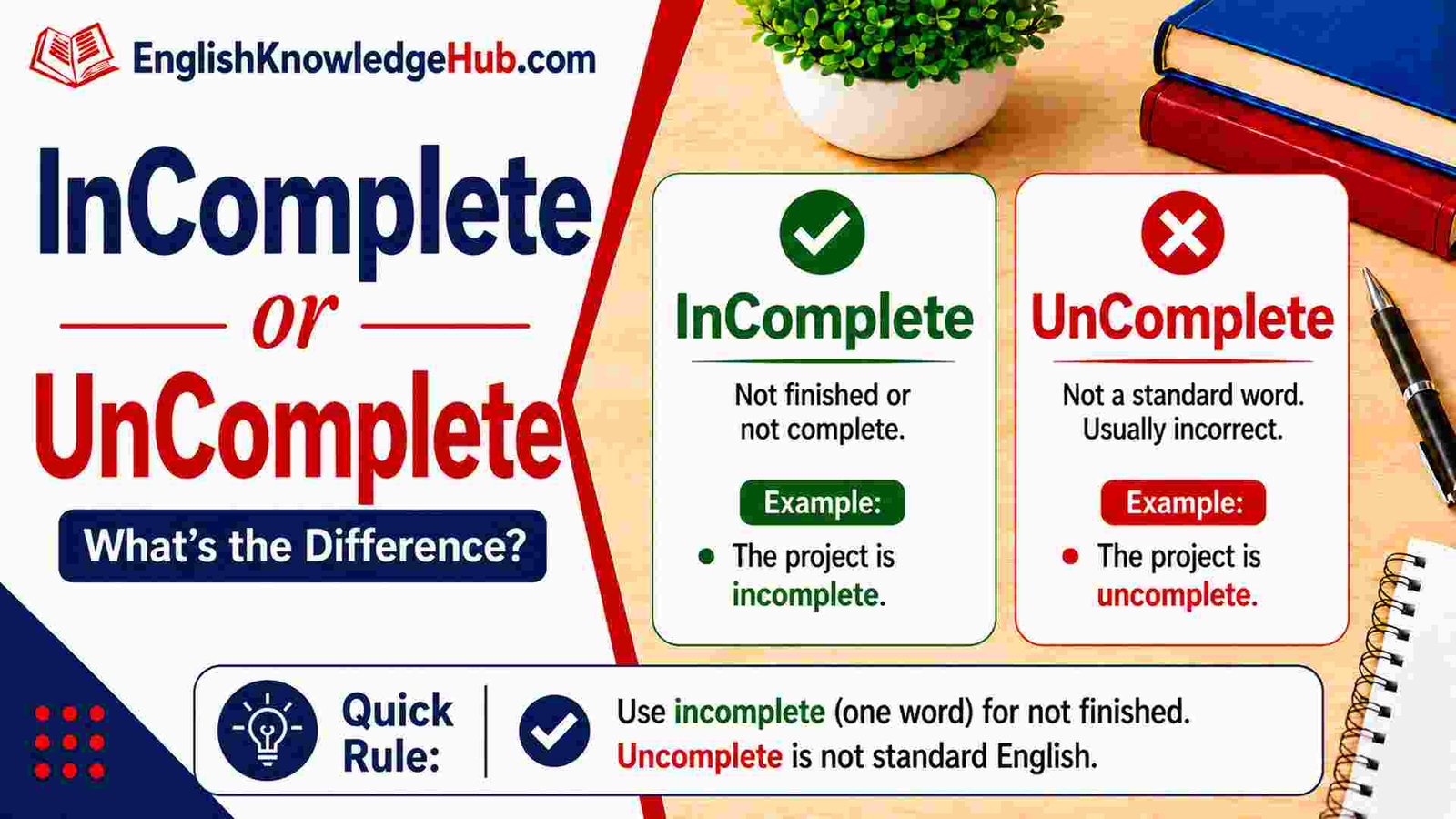
Incomplete or Uncomplete? “Incomplete” is the standard word in modern English. It means that something is missing a part, lacks needed information, or has not been fully finished. “Uncomplete” has existed in English, but it is uncommon today. In normal speaking and writing, use “incomplete.”
The choice may seem strange at first. We say unfinished, unpaid, and unknown, so it is easy to think that uncomplete should work in the same way.
English does not always build negative words with the same prefix, though. Some words use un-, while others use in-.
With complete, the normal negative form is incomplete.
This article will show you what the word means, why it uses in-, where uncomplete fits, and how uncompleted is different.
Incomplete or Uncomplete: The Short Rule You Can Remember
When choosing between Incomplete or Uncomplete, use incomplete in normal modern English.
Incomplete = not complete
You can use it when something:
- is missing a part
- does not contain all the needed information
- still needs more work
- has not reached its full form
- does not give the whole picture
Examples:
- Your address is incomplete because the house number is missing.
- The report is incomplete and needs one more section.
- We received incomplete information from the customer.
- Her answer was incomplete because she did not explain her reason.
- The puzzle looked incomplete without the final piece.
These examples sound natural in everyday English.
What Does “Incomplete” Mean?
Incomplete is an adjective.
It describes something that is not whole, finished, or fully provided.
Think about a school form with ten boxes. You fill in only eight of them.
The form is not useless. It simply does not contain everything it needs.
We can say:
The form is incomplete.
The same idea works in many situations.
A story can be incomplete.
A list can be incomplete.
A project can be incomplete.
Information can be incomplete.
Even someone’s understanding of a topic can be incomplete.
For example:
- My notes are incomplete, so I need to borrow Sarah’s notebook.
- The police had an incomplete description of the missing bicycle.
- His understanding of the rule was incomplete.
- The file contains an incomplete record of last year’s payments.
The word focuses on the fact that something is not fully complete.
Why Do We Say “Incomplete” Instead of “Uncomplete”?
The answer is mainly about established English usage.
The prefix in- can mean “not.”
You can notice this same word pattern in examples like:
- incorrect
- inactive
- inaccurate
- invisible
So:
in + complete = incomplete
The word has become the normal form used by English speakers.
The important lesson is that English prefixes do not always follow one simple rule.
You cannot always look at a word and decide that un- should be added to make the opposite.
For example:
We normally say incorrect, not uncorrect.
We say inaccurate, not unaccurate.
In the same way, we normally say incomplete, not uncomplete.
It is better to learn the whole word as one vocabulary item.
Is “Uncomplete” a Real Word?
This part needs a careful answer.
Uncomplete has been used in English, so it is not fair to say that it has never been a word.
However, it is uncommon in present-day English.
Most speakers would naturally choose incomplete instead.
For that reason, English learners should normally avoid uncomplete in:
- school assignments
- emails
- job applications
- reports
- business documents
- formal writing
- everyday conversation
Compare:
Less natural:
The document is uncomplete.
Natural:
The document is incomplete.
Less natural:
We received an uncomplete application.
Natural:
We received an incomplete application.
The first versions may be understood, but they can sound unusual.
So if you are wondering Incomplete or Uncomplete, incomplete is the safer and more natural choice.
Incomplete and Uncompleted Are Not Exactly the Same
There is another useful word to know: uncompleted.
Unlike uncomplete, uncompleted is a normal English word.
It means that something has not been completed or finished.
The difference can be small, but the focus is slightly different.
| Word | Simple meaning | Example |
|---|---|---|
| Incomplete | Missing something or not fully complete | The form is incomplete. |
| Uncomplete | Rare form, usually avoid | The form is uncomplete. |
| Uncompleted | Not finished | Two tasks remain uncompleted. |
| Unfinished | Still not finished | She left an unfinished drawing. |
Use “incomplete” for missing parts or details
- The application is incomplete.
- Our information is incomplete.
- The list is incomplete.
- His explanation is incomplete.
Use “uncompleted” when work was not finished
- Three uncompleted jobs remain on the schedule.
- The builder returned to the uncompleted room.
- She found an uncompleted painting in her grandfather’s attic.
There can be some overlap.
You might say:
The project is incomplete.
This tells us the project is not fully complete.
You might also say:
The project remains uncompleted.
This places more attention on the fact that nobody has finished it yet.
A Simple Way to Feel the Difference
Imagine you order a meal with a drink, fries, and a sandwich.
The fries are missing.
Your order is incomplete because one part is not there.
Now imagine a worker starts painting a wall but goes home before finishing.
The painting job is uncompleted or unfinished.
That small difference can help you choose the best word.
Incomplete often points to something missing.
Uncompleted often points to work that has not reached the end.
How “Incomplete” Works in Daily Conversation
Here are some fresh examples:
- This phone number is incomplete. Can you send the last two digits?
- My set of recipe cards is incomplete because I lost one.
- Your story feels incomplete. What happened after you reached the station?
- The grocery list is incomplete. We forgot to add milk.
- His message was incomplete, so I was not sure where to meet him.
The word is common and natural in normal speech.
Using “Incomplete” at Work
You will often see this word in workplaces because forms, files, reports, and records may be missing information.
Examples:
- The manager returned the incomplete expense form.
- We cannot send the order because the customer details are incomplete.
- Mia submitted an incomplete sales report.
- The team made a decision using incomplete data.
- Please update the incomplete contact list before the meeting.
In professional English, incomplete is clear and suitable.
Using “Incomplete” in School and Academic Writing
Students may see this word when talking about answers, assignments, research, or evidence.
Examples:
- The teacher marked my answer as incomplete.
- The student’s research was incomplete because one source was missing.
- Our knowledge of the event is still incomplete.
- The essay gives an incomplete explanation of the main idea.
- The chart shows only an incomplete picture of the results.
Notice that incomplete does not always mean someone simply stopped working.
Sometimes it means that important information is missing.
Common Mistakes to Avoid
Mistake 1: Using “uncomplete” in normal writing
Incorrect:
The registration form is uncomplete.
Correct:
The registration form is incomplete.
Explanation:
Uncomplete is uncommon. Incomplete is the normal modern form.
Mistake 2: Writing “in complete” when you mean “not complete”
Incorrect:
My homework is in complete.
Correct:
My homework is incomplete.
Explanation:
When the meaning is “not complete,” write incomplete as one word.
However, in complete can be correct when the two words have separate jobs.
For example:
The children sat in complete silence.
Here, in is a preposition, and complete describes silence.
Mistake 3: Writing “InComplete”
Incorrect:
The file is InComplete.
Correct:
The file is incomplete.
Explanation:
There is no capital letter in the middle of the standard word.
Write:
incomplete
Not:
inComplete
Not:
InComplete
A capital letter may appear only at the beginning of a sentence or where normal title capitalization requires it.
Mistake 4: Treating “uncompleted” as the same error
Incorrect idea:
Uncompleted must be wrong because uncomplete is uncommon.
Correct idea:
Uncompleted is a standard English word.
Explanation:
Uncompleted describes something that has not been finished.
For example:
Several uncompleted tasks were moved to Friday.
Is There a Difference in British and American English?
There is no major British and American difference for the main rule.
Both British and American English normally use incomplete.
You can comfortably write:
- an incomplete form
- incomplete information
- an incomplete answer
- an incomplete project
- incomplete records
These expressions work naturally in both varieties of English.
American academic English also sometimes uses incomplete as a noun for a temporary course grade when required work has not yet been finished.
For example:
The student received an incomplete and finished the missing work later.
This special use does not change the main spelling rule.
A Quick Memory Trick
When you see complete, think of:
complete → incomplete
You can remember another pair at the same time:
correct → incorrect
Both use in-.
So instead of trying to build the word yourself with un-, remember the pair as a set:
complete / incomplete
That is much easier.
FAQs About Incomplete or Uncomplete
Is it incomplete or uncomplete?
Incomplete is the normal and standard choice in modern English. Uncomplete exists but is uncommon.
Is “uncomplete” incorrect?
It is better described as rare or uncommon rather than completely nonexistent. In normal writing, use incomplete.
Is “incomplete” one word or two?
It is one word: incomplete.
What is the meaning of incomplete?
It means that something is missing a part, lacks needed information, or is not fully finished.
What is the difference between incomplete and uncompleted?
Incomplete often means that something lacks parts or details. Uncompleted usually means that work or a task has not been finished.
Can I say “an incomplete work”?
Sometimes, but it may sound unnatural depending on the meaning. You will often get a more natural sentence with unfinished work, incomplete work, or an incomplete piece of work.
Is “in complete” ever correct?
Yes. It is correct when in and complete are separate words, such as “in complete agreement.” It does not mean “not complete” in that sentence.
Should I use “uncomplete” in formal writing?
Usually no. Choose incomplete in professional, academic, and formal writing because it is the standard modern form.
Final Thoughts
If you are choosing between Incomplete or Uncomplete, remember one simple answer: incomplete is the word you will normally need.
Use incomplete when something is missing information, parts, details, or full completion. Treat uncomplete as an uncommon form rather than your everyday choice. If you specifically want to show that work was started but not finished, uncompleted or unfinished may fit better.
Keep the pair complete / incomplete in your memory, and the spelling becomes much easier to remember.
For more simple explanations of tricky English words, spelling choices, and grammar rules, keep learning with Home – englishknowledgehub.com.
