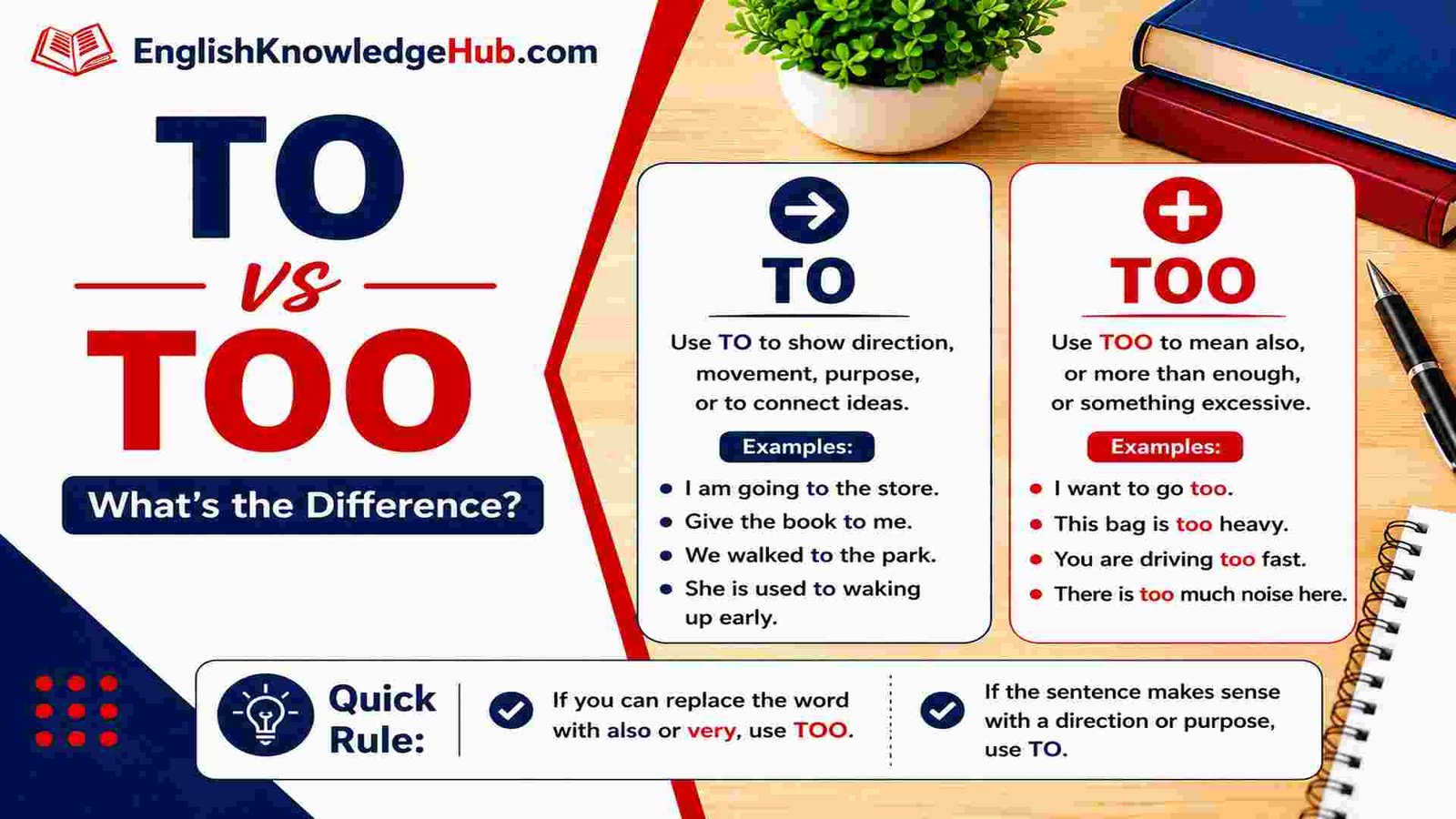
To and too sound the same, but they do different jobs. Use to for direction, a receiver, or before the base form of a verb, as in “go to school,” “send it to Maya,” and “want to learn.” Use too when you mean “also” or “more than is needed,” as in “I want one too” and “This bag is too heavy.”
In this article, you’ll learn the main To vs Too patterns, the sentence tests that work best, common mistakes such as “to much” and “me to,” and the cases where both words appear together. Merriam-Webster lists too as an adverb meaning “also” or “to an excessive degree.”
The Difference Is About Meaning, Not Sound
The reason to and too cause so many mistakes is simple: in normal speech they sound alike. Your ear usually cannot tell you which spelling you need. The sentence meaning has to do that work instead.
Think of to as a grammatical connector. It often points toward a place or person, or it introduces a verb. Think of too as an amount or addition word. It either adds another person or thing, or says that something goes beyond a useful level.
Compare “I am going to the store” with “I am going too.” In the first sentence, to points toward a destination. In the second, too means “also.”
When to Use “To”
One common use of to is direction. “We drove to the airport,” “She walked to the window,” and “Please send the form to Daniel” all show movement or a relationship toward a place or receiver.
The other major use is before a verb: “I want to leave,” “They plan to study,” “She needs to call,” and “We hope to arrive early.” In these sentences, to helps form the infinitive.
That gives you a useful proofreading question: if the next word is a basic verb such as go, eat, learn, call, or finish, to is often the correct choice.
When “Too” Means “Also”
When too means “also,” it often appears near the end of a sentence. “I want to come too,” “Leah likes that movie too,” and “Can we join too?” all add another person, action, or idea.
The easiest test is substitution. If you can replace the word with also without changing the main meaning, write too.
For example, “I want some coffee too” becomes “I also want some coffee.” The sentence still makes sense, so too is correct.
This is also why the familiar reply is “Me too,” not “me to.” You are saying “the same is true for me also.”
When “Too” Means More Than Needed
The second important meaning of too is excess. “The soup is too salty” does not simply mean the soup is very salty. It means the saltiness has passed a useful or comfortable point.
This difference matters. “The room is very warm” describes a high temperature. “The room is too warm” suggests the temperature is a problem.
You will often see too before adjectives and adverbs: too expensive, too slow, too loud, too quickly, too far. The same idea appears in too much and too many.
Use too much with uncountable nouns such as water, time, noise, or sugar. Use too many with countable plural nouns such as books, cars, messages, or people. If that distinction is the part you keep mixing up, see our Too Many vs To Many guide.
Why “Too … To” Can Look Strange but Be Completely Correct
One of the most useful patterns to learn is too + adjective/adverb + to + verb.
“The box is too heavy to carry.” “It is too late to call.” “She was too tired to drive.” Both spellings appear because the two words are doing different jobs. The first too means “more than is suitable.” The second to introduces the verb.
This same pattern explains phrases such as too fast to stop. If “to fast” versus “too fast” is a recurring problem, our To Fast or Too Fast explanation goes deeper into that phrase.
“I’d Like To” Is Not “I’d Like Too”
There is a small trap here. In “I’d like to, but I can’t,” the word to may look as if it is standing alone. It is still the infinitive marker. The missing verb is understood from context.
“Do you want to come?” “I’d like to, but I have work.” The full idea is “I’d like to come.” We do not change it to too simply because it appears at the end of the clause.
Common Mistakes in Real Sentences
Incorrect: I want too go home.
Correct: I want to go home.
Go is a verb, so the infinitive needs to.
Incorrect: This coffee is to hot.
Correct: This coffee is too hot.
The meaning is “hotter than is comfortable or suitable,” so too is correct.
Incorrect: I want dessert to.
Correct: I want dessert too.
Here too means “also.”
Incorrect: Please send the file too Maria.
Correct: Please send the file to Maria.
To shows the receiver.
To, Too, and Two
Some searches include two because all three words are homophones in most everyday pronunciation. Two is simply the number 2: “two chairs,” “two days,” “two questions.”
A useful three-way test is: number 2 = two; also or excessive = too; direction, receiver, or infinitive = to.
You can even get correct sentences that look almost comically repetitive: “I bought two tickets, and my brother wants to come too.” Each spelling has a different job.
Does “Too” Need a Comma?
When too means “also,” commas are often optional and depend on rhythm and emphasis. “I want to go too” is perfectly normal. “I, too, want to go” gives too more emphasis and sounds slightly more formal.
The spelling rule does not change. The punctuation question is separate from choosing to or too.
How These Words Work in Everyday and Formal English
In a text message, you might write, “I’m going to the café too.” At work, “Please send the revised file to Amir. I need to review it too” uses both forms naturally. In academic writing, you may see “The sample was too small to support a firm conclusion.”
The words themselves are not informal. What changes is the sentence around them. Too meaning “also” can sometimes be replaced by also in more formal prose, but there is nothing grammatically wrong with too.
A Quick Test That Catches Most Errors
Before you hit send, ask what the word means. If it means also, use too. If it means more than is suitable, use too. If it points toward something, identifies a receiver, or comes before a base verb, use to. If it means the number 2, use two.
| Meaning or job | Correct word | Example |
|---|---|---|
| Direction | to | We walked to the station. |
| Receiver | to | Give it to Sam. |
| Before a verb | to | I want to learn. |
| Also | too | I want to come too. |
| Excessive amount | too | The bag is too heavy. |
| Number 2 | two | We need two chairs. |
Frequently Asked Questions
Is it “me to” or “me too”?
Use me too when you mean “the same is true for me” or “me also.”
Is it “to much” or “too much”?
Use too much. It means an amount greater than is wanted or suitable.
Is it “to late” or “too late”?
Use too late when something happens later than the useful or acceptable time.
Can “to” and “too” appear in the same sentence?
Yes. “The box is too heavy to lift” is a standard example.
Is “I’d like too” ever correct?
Not when the understood meaning is “I’d like to do that.” In that pattern, use to.
What is the easiest memory trick?
The extra o in too can remind you of something extra: an additional person or an excessive amount.
Final Takeaway
The simplest way to solve To vs Too is to forget the sound and test the meaning. Use to for direction, a receiver, or before a base verb. Use too for “also” or “more than needed.” Once you learn those two meanings of too, most spelling mistakes disappear quickly.
For more practical grammar explanations built around real learner questions, explore EnglishKnowledgeHub.com.
