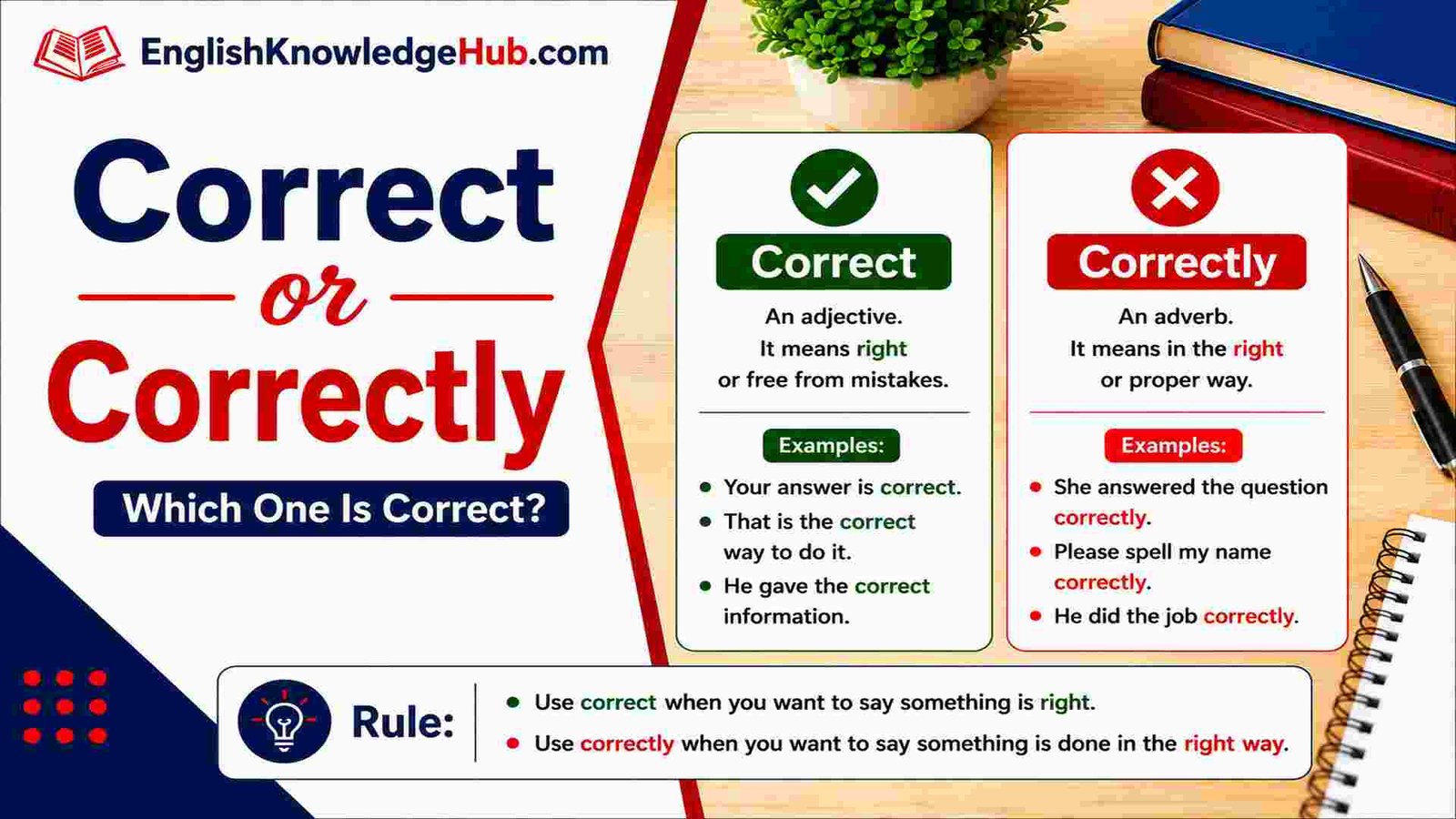
Correct or Correctly depends on what you are describing. Use correct when you describe a thing, answer, idea, number, or choice as right. Use correctly when you explain how someone does something. In this guide, you will learn the simple rule, see easy examples, and understand common mistakes.
Here are two quick examples:
- Your answer is correct.
- You answered correctly.
Both sentences talk about being right, but the two words have different jobs.
The Simple Rule
The easiest way to remember the difference is this:
Correct describes a person, thing, answer, idea, or result.
Correctly describes how an action is done.
Look at this table:
| Word | Main Job | Simple Meaning | Example |
|---|---|---|---|
| correct | Adjective | right, not wrong | That answer is correct. |
| correctly | Adverb | in the right way | She answered correctly. |
So, if you describe what something is like, use correct.
If you describe how someone does something, use correctly.
When to Use Correct
Use correct when something is right, true, accurate, or suitable.
For example:
- This is the correct door.
- Your phone number is correct.
- Sam chose the correct answer.
- That spelling is correct.
- We used the correct password.
In these sentences, the word describes a noun.
It describes:
- door
- phone number
- answer
- spelling
- password
That is why correct works.
Correct After Is, Are, Was, and Were
You will often see correct after forms of the verb be.
For example:
- The answer is correct.
- These numbers are correct.
- His guess was correct.
- The details were correct.
We use correct because it describes the subject.
For example:
The address is correct.
The word correct describes the address.
Do not say:
Incorrect:
The address is correctly.
Correct:
The address is correct.
Explanation:
We are describing the address, not an action.
Correct Can Also Be a Verb
The word correct can also mean “fix a mistake.”
In this use, it is a verb.
For example:
- Please correct this sentence.
- I need to correct the date.
- The teacher corrected my spelling.
- Can you correct this mistake?
Compare these two sentences:
The sentence is correct.
Here, correct means the sentence is right.
Please correct the sentence.
Here, correct means fix the sentence.
The same word can have two different grammar jobs.
When to Use Correctly
Use correctly when you describe the way an action happens.
For example:
- Mia spelled my name correctly.
- He answered the question correctly.
- Please hold the tool correctly.
- The worker connected the wires correctly.
- She completed the form correctly.
In every example, correctly tells us how the action was done.
Ask this question:
How was it done?
If the answer is “in the right way,” you usually need correctly.
Example:
Leo solved the puzzle correctly.
How did Leo solve it?
Correctly.
That is why the adverb fits.
Correct or Correctly With Easy Sentence Pairs
Seeing both words in similar sentences can make the difference much easier.
Example 1
Your answer is correct.
The word describes the answer.
You answered correctly.
The word describes the action answered.
Example 2
The total is correct.
The word describes the total.
You added the numbers correctly.
The word describes how you added them.
Example 3
Her pronunciation is correct.
The word describes her pronunciation.
She pronounced the word correctly.
The word describes how she pronounced it.
Example 4
This is the correct key.
The word describes the key.
You used the key correctly.
The word describes how you used it.
A Very Easy Memory Trick
Use this quick trick:
What is right? = correct
How was it done? = correctly
For example:
What is right?
The answer is correct.
How was it done?
She answered correctly.
You can also remember:
correct + thing
action + correctly
Examples:
- correct answer
- correct address
- correct number
- correct choice
But:
- answer correctly
- write correctly
- speak correctly
- use correctly
Common Mistakes With Correct and Correctly
Learners often mix these two words because they have almost the same meaning.
The difference comes from grammar.
Mistake 1
Incorrect:
She answered the question correct.
Correct:
She answered the question correctly.
Explanation:
The word tells us how she answered. It describes an action, so we need correctly.
Mistake 2
Incorrect:
Your answer is correctly.
Correct:
Your answer is correct.
Explanation:
The word describes the answer. It does not describe an action.
Mistake 3
Incorrect:
He wrote my address correct.
Correct:
He wrote my address correctly.
Explanation:
The word tells us how he wrote the address.
Mistake 4
Incorrect:
The final number looks correctly.
Correct:
The final number looks correct.
Explanation:
Here, looks means “seems.” The word describes the number, so use correct.
Correct After Look, Seem, and Sound
Words such as look, seem, and sound can confuse learners.
When these verbs connect the subject to a description, use correct.
For example:
- The answer looks correct.
- Your idea seems correct.
- That sentence sounds correct.
- The information appears correct.
We are describing the answer, idea, sentence, or information.
Compare:
The sentence sounds correct.
But:
You said the sentence correctly.
In the second sentence, the word describes the action said.
Correct or Correctly in Daily Conversation
Here are some natural examples:
- Is this the correct bus?
- Did I write your name correctly?
- Yes, your spelling is correct.
- Please place the box correctly.
- Is this address correct?
- I think you entered it correctly.
These sentences show how both words are used in normal English.
Correct or Correctly at Work
You may also use these words in emails, reports, forms, and instructions.
Examples:
- Please check that the amount is correct.
- Make sure you enter the code correctly.
- The manager chose the correct document.
- Sara filled out the form correctly.
- The final figures appear correct.
- Please save the file correctly before closing the program.
The rule stays the same.
A thing can be correct.
An action can be done correctly.
Correct or Correctly in School and Academic Writing
Students also use these words often.
For example:
- The student gave the correct answer.
- The student answered correctly.
- This is the correct formula.
- Ravi used the formula correctly.
- Her final result was correct.
- She explained the process correctly.
This difference is useful in tests, assignments, essays, and classroom writing.
Is “Do It Correct” Correct English?
You may hear people say:
Do it correct.
This can appear in informal speech in some places.
However, in standard English, it is better to say:
Do it correctly.
Why?
Because correctly describes how the action should be done.
For school, work, exams, and formal writing, use:
Please do it correctly.
Correctly or Right?
In everyday English, people also use right in sentences like:
- Did I do it right?
- Did I spell your name right?
These sentences are common and natural in conversation.
You can also say:
- Did I do it correctly?
- Did I spell your name correctly?
Correctly can sound a little more formal or exact.
For example:
Casual:
Did I enter the code right?
More formal:
Did I enter the code correctly?
Both can work depending on the situation.
Quick Practice
Choose correct or correctly.
- Is this the ___ answer?
- She spelled the word ___.
- The address looks ___.
- Please use the machine ___.
- His final total was ___.
- You completed the task ___.
- Can you ___ this mistake?
Answers
- correct
- correctly
- correct
- correctly
- correct
- correctly
- correct
The last answer is different because correct works as a verb there.
FAQs
Is it “you are correct” or “you are correctly”?
Use you are correct. The adjective correct describes the person’s answer, idea, or statement.
Is it “answer correct” or “answer correctly”?
Say answer correctly when answer is a verb.
Example:
You answered correctly.
But say:
Your answer is correct.
Is “correctly” an adjective?
No. Correctly is an adverb. It usually describes an action.
Can correct be a verb?
Yes. It can mean to fix a mistake.
Example:
Please correct the wrong date.
Should I say “I did it correct” or “I did it correctly”?
In standard English, say I did it correctly because the word describes how you did the action.
Is “that looks correct” right?
Yes. That looks correct is natural because correct describes the subject.
Is there a British and American English difference?
There is no important difference in the main rule. Both British and American standard English use correct mainly as an adjective and correctly as an adverb.
Final Thoughts
The choice between Correct or Correctly becomes simple when you check what the word describes. Use correct for something that is right, such as a correct answer or correct number. Use correctly when an action is done in the right way, such as answering correctly or writing correctly.
A simple reminder is enough:
Something is correct.
Someone does something correctly.
For more easy grammar lessons, word comparisons, and simple English explanations, visit EnglishKnowledgeHub.com.
