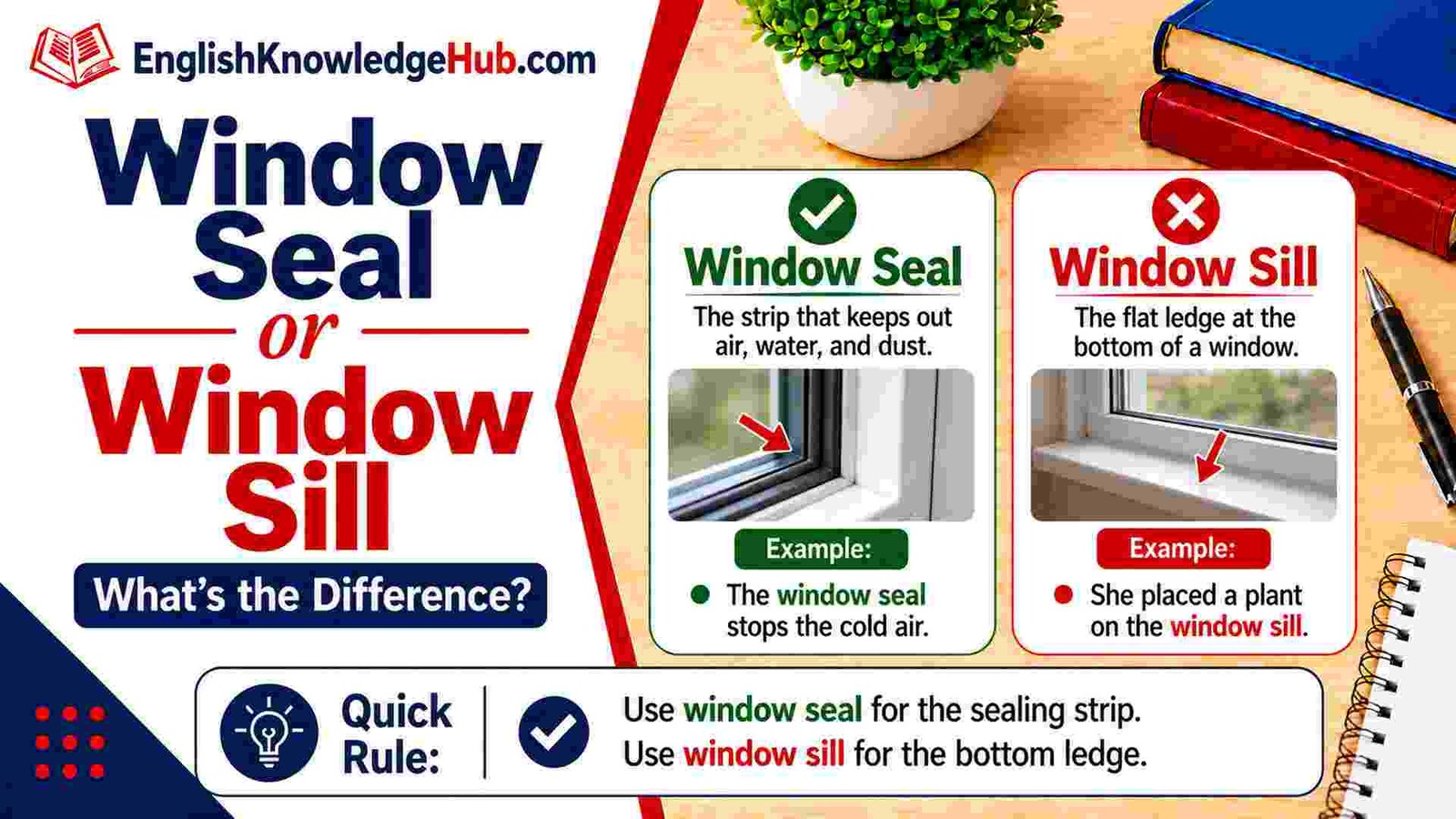
Window Seal or Window Sill are both correct, but they mean different things. A window sill is the flat part at the bottom of a window. A window seal helps close small gaps around a window so air or water does not pass through. This guide will show you how to use both terms correctly.
Many people mix up these words because seal and sill sound a little alike. The best way to choose the right word is to think about what part of the window you mean.
If you can put a plant on it, you mean the sill.
If it helps stop air or water, you mean the seal.
Window Seal or Window Sill: Quick Answer
Here is the easiest way to remember the difference:
| Word | Simple Meaning | Example |
|---|---|---|
| Window sill | The flat bottom part of a window | The cat sat on the window sill. |
| Window seal | The part that helps close gaps | The window seal is letting cold air in. |
So, sill means a surface, while seal means something that helps close a gap.
What Is a Window Sill?
A window sill is the flat part at the bottom of a window.
It often looks like a small shelf. Some window sills are wide enough to hold flowers, books, or small items.
For example:
- Mia placed a small plant on the window sill.
- The bird landed near the outside window sill.
- Dad painted the window sill white.
- I found dust on the bedroom window sill.
- The cat likes to sleep on the warm sill.
In all these examples, the word sill means the flat part under the window.
What Is a Window Seal?
A window seal helps close spaces around a window.
Its job is to help stop things such as:
- Cold air
- Warm air
- Rainwater
- Moisture
- Dust
A seal may be made from rubber, foam, or another sealing material.
Examples:
- The window seal is old and cracked.
- Cold air came through the broken seal.
- We checked the seal before winter.
- Water entered near the damaged window seal.
- The worker replaced the loose seal.
The word seal is about closing or blocking a gap.
A Very Easy Way to Remember the Difference
Try this simple memory trick:
Sill = sit
You can sit something on a sill.
A flower pot can sit on it.
A cup can sit on it.
A cat may even sit on it.
Now think:
Seal = stop
A seal helps stop air or water from coming through.
So remember:
Sill = place to sit something
Seal = helps stop a gap
This is an easy way to remember Window Seal or Window Sill.
Window Sill in Everyday English
People often talk about window sills when they clean, paint, decorate, or place something near a window.
Here are some natural examples:
“Please move the books from the window sill.”
“There is dust on the kitchen sill.”
“I put my flower pot on the window sill.”
“The paint on the sill is starting to peel.”
“She left her phone on the window sill.”
These sentences are about the flat part of the window.
Window Seal in Everyday English
People usually talk about a window seal when there is a problem with air, water, or the window closing well.
Examples:
“The window seal feels loose.”
“I can feel cold air near the seal.”
“The seal around the window needs repair.”
“Rainwater came through the old seal.”
“The new window seal keeps the room warmer.”
In these examples, the speaker is not talking about a shelf or ledge.
They are talking about the part that helps close the window area.
Common Mistakes
Mistake 1: Using “seal” for the ledge
Incorrect:
I put the flower pot on the window seal.
Correct:
I put the flower pot on the window sill.
Explanation:
A flower pot sits on a flat surface. That surface is the window sill.
Mistake 2: Using “sill” for a gap problem
Incorrect:
Cold air is coming through the broken window sill.
Correct:
Cold air is coming through the broken window seal.
Explanation:
If air is coming through a gap, seal is usually the better word.
However, a window sill can also be broken. The sentence must match the real problem.
For example:
Correct:
The wooden window sill has a large crack.
Here, the sill itself has damage.
Mistake 3: Thinking One Word Is Wrong
Incorrect idea:
Window sill is correct, so window seal must be wrong.
Correct idea:
Both terms are correct. They just mean different things.
This is why context matters when choosing Window Seal or Window Sill.
Can You Say “Windowsill”?
Yes.
Windowsill is also a correct word.
It means the same thing as window sill when you are talking about the flat part at the bottom of a window.
For example:
- The kitten sat on the windowsill.
- I placed a candle on the windowsill.
- She cleaned the dusty windowsill.
You may see both forms:
window sill
and
windowsill
Both are easy to understand.
Is a Window Ledge the Same as a Window Sill?
In normal conversation, people sometimes use window ledge when they mean the flat area near the bottom of a window.
For example:
“The plant is on the window ledge.”
“The plant is on the window sill.”
Both sentences may describe the same place.
However, window seal does not mean window ledge.
A seal has a different job.
Daily Conversation Examples
Here are a few simple examples you might hear at home:
- “Your keys are on the window sill.”
- “The window seal looks damaged.”
- “Can you clean the sill for me?”
- “I think air is coming through the seal.”
- “The cat jumped onto the window sill.”
The meaning becomes clear when you look at what the speaker is talking about.
Workplace Examples
These words are also useful at work, especially in offices, repair work, and building care.
- The cleaner wiped every window sill.
- The repair team checked the window seals.
- Please remove the files from the sill.
- The worker found a loose seal near the frame.
- The office window sill needs fresh paint.
Using the right word helps people understand exactly what needs attention.
Academic Examples
Students may also see these words in reports or class writing.
- The plant was placed on the window sill to get more light.
- The report found damage near the window seal.
- Dust was collected from the sill for the test.
- The seal helped reduce air coming through the window.
In school writing, clear word choice makes the sentence easier to understand.
Formal Writing Examples
In formal writing, use the word that gives the exact meaning.
For example:
“The inspection found damage to the interior window sill.”
“The report noted a weak seal around the window frame.”
“The wooden sill showed signs of water damage.”
“The window seal should be checked before the rainy season.”
These sentences sound clear because each word describes the correct part or job.
What Does “Seal the Window” Mean?
The word seal can also be a verb.
To seal a window means to close small gaps around it.
For example:
“We need to seal the window before winter.”
“The worker sealed the gap around the frame.”
You would not normally say:
“We need to sill the window.”
That does not have the same meaning.
This gives you another clue.
Seal can describe the action of closing a gap.
Sill names the bottom part of the window.
What If Water Is Near the Window?
Seeing water near a window does not always tell you which word to use.
You need to describe the exact problem.
If the flat bottom part is wet, you can say:
“Water is sitting on the window sill.”
If water is coming through a gap, you can say:
“Water is coming through the window seal.”
Both sentences can be correct, but they describe different things.
A Five-Second Test
Not sure which word to use?
Ask yourself this:
Is it a flat part, or does it help close a gap?
If it is flat:
Use sill.
If it closes a gap:
Use seal.
Try these:
“The plant is sitting on the window ___.”
Answer: sill
“The old window ___ is letting air inside.”
Answer: seal
“The cleaner wiped the ___.”
Answer: sill
“The repair worker replaced the damaged ___.”
Answer: seal
Simple, right?
Window Seal or Window Sill: Which One Is Correct?
Both are correct.
Use window sill when you mean the flat bottom part of a window.
Use window seal when you mean the part that helps close gaps and stop air or water.
The easiest rule is:
Sill = flat surface
Seal = closes a gap
Once you remember this rule, choosing between the two words becomes much easier.
FAQs
Is it window seal or window sill?
Both are correct. A window sill is the flat bottom part of a window. A window seal helps close gaps around it.
What is the part under a window called?
The flat part under a window is called a window sill or windowsill.
What does window seal mean?
A window seal helps close gaps around a window and can help keep out air, moisture, or water.
Is windowsill one word?
Yes. Windowsill is a correct spelling. You may also see window sill written as two words.
Can I put plants on a window seal?
If you mean the flat ledge, the correct word is window sill, not window seal.
Why do people confuse seal and sill?
They sound similar when spoken quickly, but their meanings are different.
Is a window sill the same as a window ledge?
In everyday speech, people may use window ledge and window sill for the same flat area below a window.
Final Thoughts
The difference between Window Seal or Window Sill is easy once you connect each word with its job. A window sill is the flat part at the bottom of a window. A window seal helps close gaps and can help stop air or water from getting through.
Remember this small trick: sill is a surface, seal stops a gap.
For more simple grammar, vocabulary, and commonly confused word guides, visit EnglishKnowledgeHub.com.
