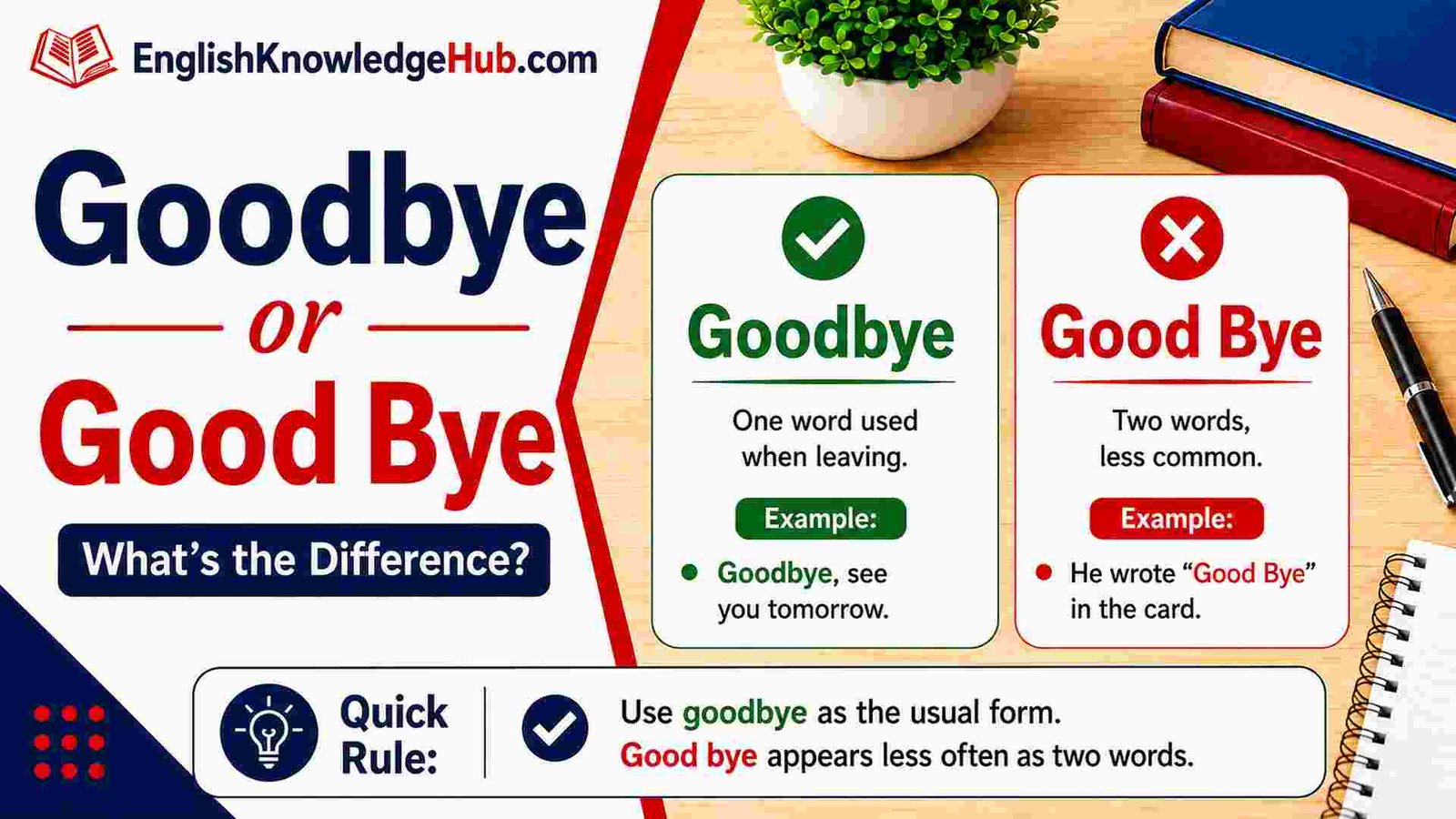
Goodbye is the standard spelling in modern English. If you are choosing between Goodbye or Good Bye, write goodbye as one word. The two-word form, good bye, is not the normal spelling for the farewell. The hyphenated form good-bye also exists, but goodbye is the clearest choice for everyday and formal writing.
That is the main rule. Now we can look at why the word is written this way, how it works in sentences, and which mistakes learners should avoid.
Goodbye or Good Bye: The Easiest Rule
When you mean a farewell, write:
goodbye
Not:
good bye
For example:
- Goodbye, Mia. I hope you have a safe journey.
- We said goodbye outside the library.
- He left a goodbye note on his desk.
You do not need to separate good and bye. In modern English, goodbye works as one complete word.
A useful way to remember it is:
One farewell, one word.
Why Do People Write “Good Bye”?
The mistake is easy to understand.
Both good and bye are real English words. Because of that, some learners think they should be written separately.
For example:
- good morning
- good night
- good luck
These expressions use two words, so good bye may look correct too.
But goodbye developed differently. English speakers now treat it as one established word rather than as the adjective good followed by the noun bye.
That is why modern dictionaries such as Cambridge, Merriam-Webster, and Oxford Learner’s Dictionaries list goodbye as a standard form.
Goodbye or Good Bye: A Quick Comparison
| Form | Is it standard? | Best use |
|---|---|---|
| goodbye | Yes | Best choice in modern English |
| good-bye | Accepted variant | Possible, but less common as a default |
| good bye | Usually not standard | Avoid in normal writing |
The most useful lesson is simple: if you are unsure, choose goodbye.
It works in messages, school writing, emails, stories, workplace communication, and formal writing.
What Does “Goodbye” Mean?
Goodbye is something we say or write when we leave someone or when another person leaves.
It can express a simple farewell:
- Goodbye! See you tomorrow.
It can also name the act of leaving:
- Their goodbye was short because the train was about to leave.
The feeling behind the word depends on the situation. A goodbye can be cheerful, polite, sad, warm, or formal.
Compare these examples:
- Goodbye, everyone. Enjoy your weekend.
- She gave her old friend a quiet goodbye at the airport.
- The director ended his speech with a formal goodbye to the staff.
The spelling remains the same even when the feeling changes.
“Goodbye” Can Do More Than One Job
Many learners think goodbye is only something we say directly to another person. It can actually work in different sentence positions.
As a Farewell Expression
Use it when speaking directly to someone who is leaving.
- Goodbye, Uncle Ray. Call us when you arrive.
- Goodbye! Thank you for visiting.
- Goodbye, class. I will see you on Monday.
Here, the word stands by itself or starts a farewell sentence.
As a Noun
It can also name the farewell itself.
- Her goodbye sounded cheerful.
- We shared a quick goodbye near the elevator.
- The team planned a small goodbye for their coach.
This use is common after words such as a, the, his, her, and their.
After “Say”
One of the most common patterns is:
say goodbye to someone
Examples:
- I went upstairs to say goodbye to my grandparents.
- Owen forgot to say goodbye to his classmates.
- The visitors said goodbye to the host before leaving.
This is a natural and useful phrase to remember.
Daily Conversation Examples
Here are some simple examples you may hear or use in normal life:
- Goodbye, Emma. Have a nice evening.
- I waved goodbye from the car window.
- Dad said goodbye before leaving for work.
- We hugged goodbye at the bus stop.
- She did not want to say goodbye to her cousin.
Notice that every example uses the one-word spelling.
Workplace Examples
In work settings, goodbye can sound friendly or professional.
- Our manager said goodbye before leaving the meeting room.
- I wrote a goodbye email to my team on my last day.
- The receptionist waved goodbye to the final visitor.
- We held a small goodbye lunch for Daniel.
- The director said goodbye to the retiring employees.
In professional writing, the one-word form is also the safest choice.
Academic and School Examples
Students may use the word in stories, essays, classroom writing, or speeches.
- The teacher said goodbye after the final lesson.
- The students wrote goodbye cards for their exchange partners.
- Maya ended her story with a painful goodbye between two friends.
- The guest speaker said goodbye before leaving the hall.
- The class prepared a goodbye poster for their teacher.
The word does not change because the setting is academic.
Formal Writing Examples
Formal writing may use goodbye less often than everyday conversation, but it is still correct when a farewell is needed.
- We offer a warm goodbye as you begin the next stage of your career.
- The chairman ended the event with a respectful goodbye to the guests.
- She included a short goodbye message in her final letter to the team.
- The organization arranged a formal goodbye for its retiring director.
In very formal writing, words such as farewell may sometimes sound more suitable, but goodbye is still correct.
Common Mistakes Learners Make
Here are some mistakes that are worth fixing.
Mistake 1
Incorrect:
I said good bye to my neighbor.
Correct:
I said goodbye to my neighbor.
Explanation:
The standard modern spelling is one word.
Mistake 2
Incorrect:
She wrote a good bye message for the class.
Correct:
She wrote a goodbye message for the class.
Explanation:
Here, goodbye describes the type of message. It still stays as one word.
Mistake 3
Incorrect:
We waved good bye from the front door.
Correct:
We waved goodbye from the front door.
Explanation:
The phrase wave goodbye uses the standard one-word form.
Mistake 4
Incorrect:
They said goodbye’s to everyone.
Correct:
They said goodbyes to everyone.
Explanation:
Do not use an apostrophe to make the word plural. The plural is goodbyes.
Is “Good-bye” Wrong?
No.
The spelling good-bye with a hyphen is an accepted variant. You may see it in older books, older publications, or some dictionaries.
For example:
- She waved good-bye from the platform.
This spelling can be correct, but most learners do not need to use it as their main form.
For clear modern writing, goodbye is easier and more widely useful.
So the difference in Goodbye or Good Bye is not really a choice between two equal spellings. Goodbye is the standard form, while the spaced spelling should usually be avoided.
Is “Bye” Different From “Goodbye”?
Yes, but the meaning is very close.
Bye is a shorter and more informal way to say goodbye.
Compare:
- Goodbye, Mrs. Lane. Thank you for your help.
- Bye, Jake. See you later.
Both are correct. The second sounds more casual.
You are likely to hear bye among:
- friends
- family members
- classmates
- close coworkers
Goodbye can work in both casual and more serious situations.
What About “Bye-bye”?
Bye-bye is also a farewell expression, but it sounds more informal.
For example:
- Bye-bye, Grandma!
- The little boy waved and said, “Bye-bye!”
Adults also use it sometimes in playful or warm conversation.
However, it may sound too childish or casual in formal business writing.
For a professional email or formal message, goodbye or farewell is usually better.
British and American English
There is no important British versus American rule that learners need to memorize here.
Major British and American dictionaries recognize the one-word spelling goodbye.
You can safely use it in:
- British English
- American English
- school assignments
- business writing
- online messages
- everyday conversation
You do not need a different spelling for each country.
A Simple Test You Can Use
When you are writing, ask:
Am I talking about leaving or saying farewell?
If yes, use:
goodbye
Examples:
- I need to say goodbye now.
- Her goodbye made everyone emotional.
- Goodbye, and thank you for coming.
This quick check can stop the most common spelling mistake.
Why “Goodbye” Is Better for Learners
A good grammar rule should make writing easier, not harder.
If you try to remember several spellings at once, you may hesitate every time you write the word.
Instead, use one dependable form:
goodbye
It is clear, familiar, and accepted in modern English.
This is especially useful for ESL learners because you can use the same spelling in casual and formal situations.
Goodbye or Good Bye: Frequently Asked Questions
1. Goodbye or Good Bye, Which Is Correct?
Goodbye is the standard spelling in modern English. Write it as one word when you mean a farewell.
2. Is “Good Bye” Grammatically Correct?
The spaced form good bye is not the usual standard spelling for the farewell word. Use goodbye instead.
3. Is “Good-bye” Still Correct?
Yes. Good-bye is an accepted variant, but goodbye is the better default for modern writing.
4. Is Goodbye One Word or Two Words?
It is normally written as one word.
Example:
We said goodbye after dinner.
5. What Is the Plural of Goodbye?
The plural is goodbyes.
Example:
The family exchanged their goodbyes at the station.
Do not write goodbye’s when you only want a plural.
6. Can I Use “Bye” Instead of “Goodbye”?
Yes, especially in informal speech and messages.
Example:
Bye, Tom. See you tomorrow.
7. Is “Goodbye” Formal or Informal?
It can work in both formal and informal situations. Bye is more casual, while farewell can sound more formal or serious.
Final Thoughts
The rule for Goodbye or Good Bye is easy to remember: use goodbye as one word in normal modern English. The hyphenated form good-bye can also be correct, but the two-word spelling should usually be avoided.
Whenever you mean “farewell,” remember this small teaching trick: one farewell, one word.
For more simple grammar lessons, spelling comparisons, and clear English explanations, visit EnglishKnowledgeHub.com.
