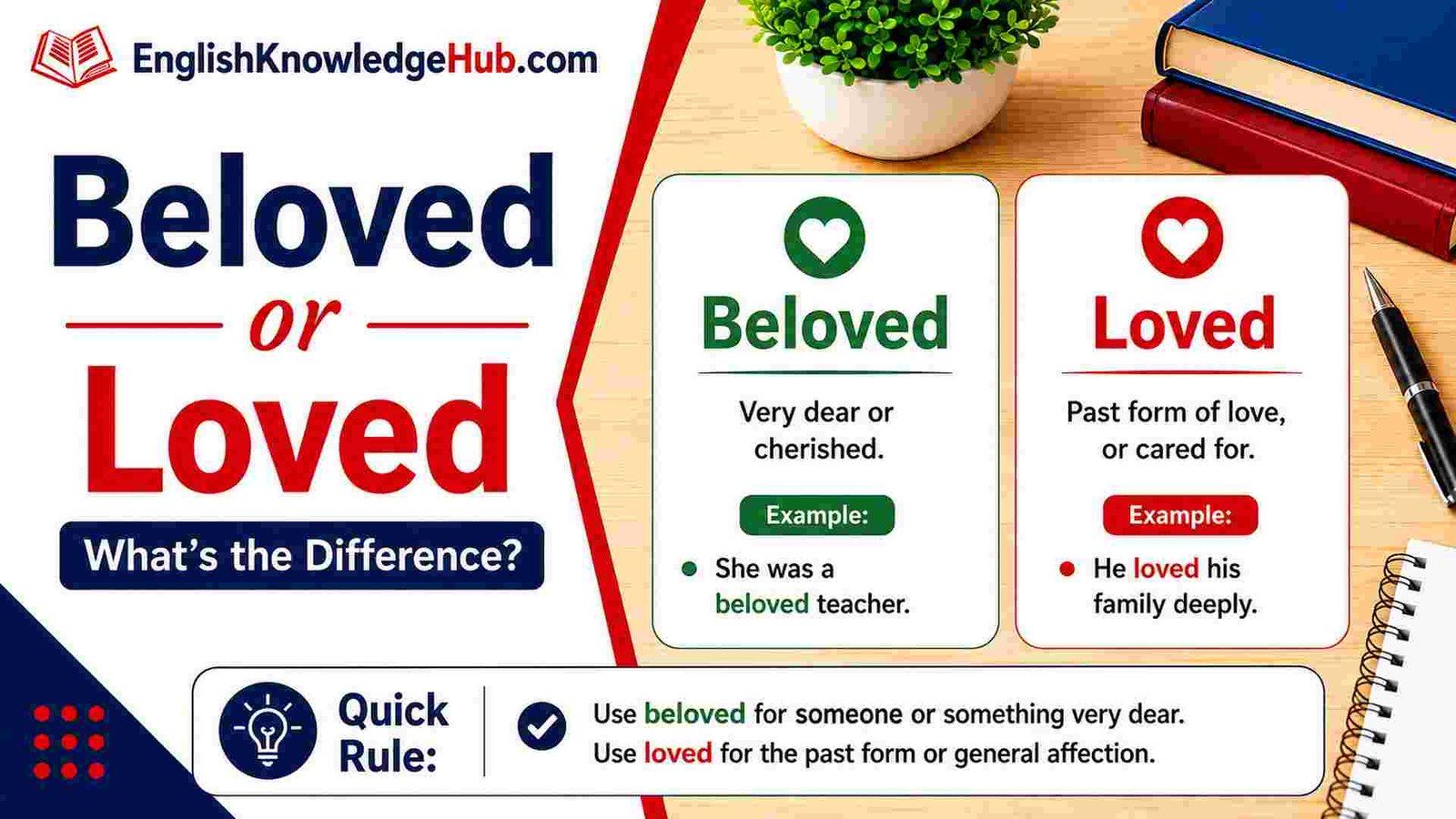
Beloved or Loved are both correct, but they are used in different ways. Loved is the past form of the verb love and is common in everyday English. Beloved usually describes a person, place, or thing that is deeply loved. It often sounds warmer, stronger, and more formal. This article explains when to use each word.
Beloved or Loved: The Main Difference in Simple Words
The easiest way to understand these two words is to look at what job they do in a sentence.
Loved often tells us that someone felt love in the past.
- I loved that little shop near my school.
- She loved the birthday gift.
- We loved spending time at the lake.
In these sentences, loved works as a verb.
Beloved usually describes someone or something that is very dear to a person or group.
- Her beloved uncle taught her how to cook.
- The town saved its beloved old library.
- He still keeps his beloved childhood guitar.
Here, beloved works like a describing word.
A simple memory trick is:
Loved tells what someone felt. Beloved tells how special someone or something is.
What Does “Loved” Mean?
Loved is the past tense and past participle of the verb love.
The verb changes like this:
- Present: love
- Past: loved
- Past participle: loved
For example:
- I love this song.
- I loved this song when I was ten.
- I have loved this song for many years.
You can also use loved when someone receives love.
- The little boy was loved by his grandparents.
- Our old teacher was loved by every class.
- The dog was loved by everyone in the household.
This use is very common and natural.
What Does “Beloved” Mean?
Beloved usually means deeply loved, very dear, or greatly valued.
It often comes before a noun.
- a beloved teacher
- a beloved mother
- a beloved pet
- a beloved book
- a beloved tradition
It can also come after forms of be.
- The singer was beloved by her fans.
- The old park is beloved by local families.
- The professor was beloved by generations of students.
The word often carries more emotion than loved.
Compare:
- The coach was loved by the players.
- The coach was beloved by the players.
Both are correct.
The first sentence simply tells us that the players loved him.
The second suggests that the coach was very special to them.
Beloved or Loved: Quick Comparison Table
| Point | Beloved | Loved |
|---|---|---|
| Main use | Describes deep affection | Past form of love |
| Common word type | Adjective | Verb or past participle |
| Tone | Warm, emotional, sometimes formal | Normal and everyday |
| Example | My beloved aunt lives nearby. | I loved visiting my aunt. |
| Common in speech | Less common | Very common |
| Can show past time | No, not by itself | Yes |
When Should You Use “Loved”?
Use loved when you talk about a feeling or action in the past.
Daily Conversation
- I loved the soup you made yesterday.
- My brother loved that video game as a child.
- We loved our weekend at the farm.
- Emma loved the shoes you bought for her.
Workplace Examples
- The team loved the new office layout.
- Our clients loved the final design.
- The manager loved Sarah’s idea.
- Everyone loved the shorter meeting schedule.
Academic Examples
- The students loved the science project.
- I loved studying history at college.
- The class loved the professor’s simple explanations.
- Daniel loved researching old maps for his paper.
In all these examples, the word describes an action or feeling.
When Should You Use “Beloved”?
Use beloved when you want to show that someone or something is deeply valued.
Family and Daily Life
- My beloved grandmother taught me this recipe.
- Their beloved cat sleeps near the kitchen door.
- He keeps a photo of his beloved father on his desk.
- She visited her beloved hometown again after a long absence.
Workplace Examples
- The company honored its beloved founder.
- Our beloved receptionist retired after thirty years.
- The staff kept a beloved office tradition.
- Employees gathered to thank their beloved team leader.
Academic and Formal Examples
- The writer often described his beloved village.
- The museum displayed the artist’s beloved sketchbook.
- The school named the hall after a beloved former principal.
- The community gathered to remember a beloved doctor.
Notice how the word often adds respect or emotional warmth.
Is “Beloved” More Formal Than “Loved”?
Usually, yes.
Loved is very normal in daily speech.
You might say:
- I loved your dress.
- We loved the restaurant.
- She loved the movie.
Using beloved in these sentences would sound strange because you are talking about a simple reaction.
However, beloved works well when the feeling is deep or lasting.
For example:
- her beloved grandfather
- our beloved family home
- a beloved local teacher
This is why you often see beloved in formal speeches, tributes, biographies, memorial writing, and emotional stories.
Can “Loved” Be an Adjective?
Yes, but it usually appears in certain patterns.
For example:
- a much-loved teacher
- a well-loved story
- a loved family member
Much-loved is especially natural.
Compare:
- She was a much-loved teacher.
- She was a beloved teacher.
Both are correct.
The first sounds warm and natural.
The second may sound slightly more formal or emotional.
Common Mistakes and How to Fix Them
Mistake 1: Using “Beloved” as the Past Tense of Love
Incorrect:
I beloved the movie last night.
Correct:
I loved the movie last night.
Explanation:
The past tense of love is loved. Beloved does not replace the normal past-tense verb.
Mistake 2: Using “Loved” Where “Beloved” Sounds More Natural
Less natural:
She returned to her loved hometown.
Better:
She returned to her beloved hometown.
Explanation:
A hometown can be loved, but beloved hometown sounds more natural when you want to show a strong emotional connection.
Mistake 3: Thinking “Loved” Means the Love Has Ended
Incorrect idea:
“I loved my school” always means “I do not love it now.”
Correct idea:
The sentence talks about a past time, but it does not always tell us how the speaker feels now.
For example:
- I loved my school as a child, and I still feel close to it today.
Context gives us the full meaning.
Mistake 4: Using “Beloved” for Small Likes
Awkward:
I beloved the sandwich at lunch.
Correct:
I loved the sandwich at lunch.
Explanation:
Beloved does not work as a simple past verb. It also sounds too strong for a quick reaction like this.
“Beloved By” or “Loved By”?
Both expressions are correct.
- She was loved by her students.
- She was beloved by her students.
The meaning is close, but the feeling is slightly different.
Loved by is simple and neutral.
Beloved by sounds warmer and may suggest deep, lasting affection.
For example:
- The nurse was loved by her patients.
- The nurse was beloved by the whole community.
The second sentence feels more like a tribute.
Can You Use “Beloved” for Things?
Yes.
You can use it for people, animals, places, books, traditions, and objects.
For example:
- a beloved pet
- a beloved song
- a beloved restaurant
- a beloved family tradition
- a beloved children’s book
- a beloved holiday
- a beloved old house
The key idea is not whether something is alive.
The key idea is that it holds strong emotional value.
“Beloved” and “Loved One” Are Not the Same
A loved one means a person who is close to you and important to you.
For example:
- She spent the holiday with her loved ones.
- It helps to speak to a loved one when you feel worried.
A beloved can also mean a deeply loved person, but this use sounds more literary or romantic.
For example:
- He wrote a poem for his beloved.
In normal conversation, loved one is much more common.
Is “My Beloved” Romantic?
It can be.
If someone says:
- my beloved
the phrase may sound romantic, poetic, or old-fashioned.
But beloved is not only for romantic love.
You can also say:
- my beloved mother
- my beloved teacher
- my beloved pet
- my beloved hometown
The surrounding noun tells us what kind of relationship or feeling is meant.
A Simple Test for Learners
When you are unsure, ask yourself two questions.
Question 1: Am I talking about an action or feeling in the past?
If yes, use loved.
- I loved that book.
Question 2: Am I describing someone or something as deeply special?
If yes, beloved may be the better word.
- It was her beloved book.
That one difference solves most learner mistakes.
British and American English
There is no major difference here.
British and American English both use loved as the normal past form of love.
Both also use beloved to describe someone or something that is deeply cherished.
The bigger difference is tone, not country.
Loved sounds normal and everyday.
Beloved often sounds warmer, more emotional, or more formal.
Beloved or Loved: Frequently Asked Questions
Is “Beloved” the Same as “Loved”?
Not exactly. Beloved usually means deeply loved and works mainly as an adjective. Loved is also the past form of the verb love.
Which Is Stronger, “Beloved” or “Loved”?
Beloved often sounds stronger because it suggests deep or lasting affection. However, loved can still express very strong feelings.
Can I Say “Beloved Friend”?
Yes. Beloved friend is correct, but it sounds warm and somewhat formal. In casual speech, dear friend is more common.
Is “Loved” the Past Tense of “Love”?
Yes. The correct past form is loved.
Example:
- I loved that song when I was younger.
Is “Beloved” Old-Fashioned?
Not completely. It is still used today, especially in formal, emotional, literary, and respectful writing. However, using beloved as a noun can sound more old-fashioned or poetic.
Can I Say “A Loved Person”?
Yes, but a loved person is less common than a loved one or a beloved person. The best choice depends on the sentence.
What Does “Much-Loved” Mean?
Much-loved means loved by many people or loved very strongly.
Example:
- She was a much-loved teacher in the village.
Final Thoughts
When choosing Beloved or Loved, look at the job of the word. Use loved for the past form of love and for simple statements about affection. Use beloved when you want to describe someone or something as deeply special, dear, or cherished.
For more clear grammar lessons, easy examples, and practical English tips, visit EnglishKnowledgeHub.com.
