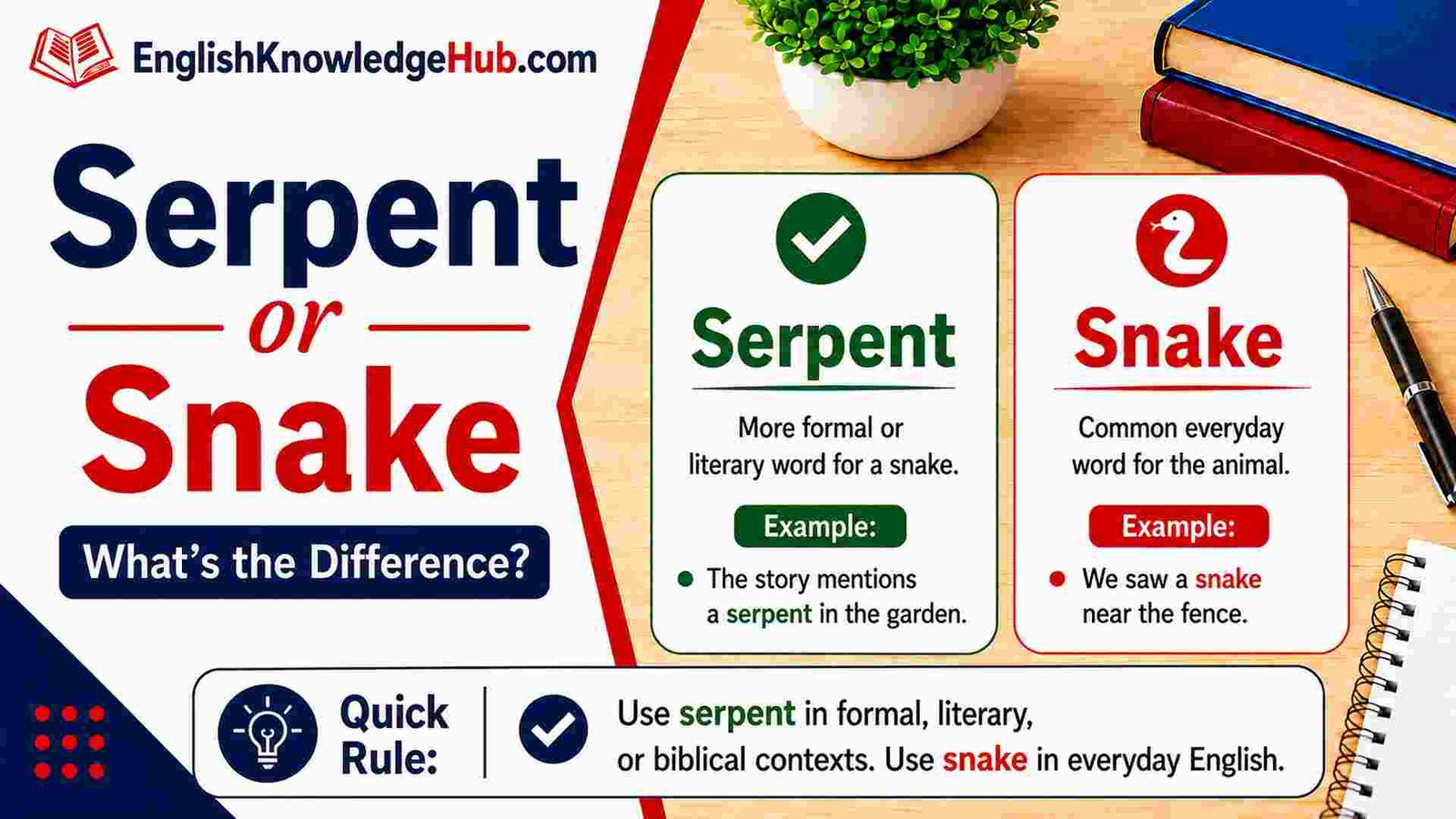
Serpent vs Snake refers mostly to a difference in style, not to two completely different animals. A snake is the normal word for a long, legless reptile. Serpent can also mean a snake, but it sounds more literary, old-fashioned, symbolic, or mythical. This guide explains when each word sounds natural and why.
If you see one of these animals near your house, you would normally say, “I saw a snake.” If you are reading an old story about a giant creature guarding a treasure, the writer may call it a “serpent.”
So, both words can point to the same kind of animal, but they do not always create the same feeling.
The Easiest Way to Tell Them Apart
Here is a simple rule:
Use snake for normal, everyday English. Use serpent when you want a more literary, ancient, dramatic, or symbolic word.
Think of it this way.
A snake may be in your garden.
A serpent may be in an old legend.
That does not mean a serpent is a special species. It simply means the word often appears in a different type of writing.
Serpent vs Snake: Here is a quick comparison:
| Point | Snake | Serpent |
|---|---|---|
| Basic meaning | A legless reptile | A snake |
| Everyday speech | Very common | Uncommon |
| Science | Common | Rare as the normal animal name |
| Stories and myths | Common | Very common |
| Literary tone | Usually neutral | Strong |
| Old-fashioned feeling | No | Sometimes |
| Symbolic use | Possible | Common |
What Does Snake Mean?
A snake is a long reptile with no legs. It is the normal word English speakers use when talking about the real animal.
You may hear it in conversations about:
- gardens
- forests
- farms
- zoos
- pets
- wildlife
- snake bites
- venom
- animal studies
For example:
- A small snake moved across the road.
- We saw a brown snake near the stream.
- The farmer found a snake beside the old shed.
- The children watched the snake from behind the glass.
All of these sentences sound natural in modern English.
The word snake is simple, direct, and neutral.
What Does Serpent Mean?
A serpent can also mean a snake, but the word often carries a stronger feeling.
You are more likely to see it in:
- myths
- legends
- poetry
- fantasy stories
- religious writing
- old texts
- symbolic descriptions
- art and history
For example:
- The old tale tells of a silver serpent beneath the lake.
- A stone serpent was carved above the temple door.
- The prince dreamed of a serpent wrapped around a golden tree.
- The painting shows a serpent beside the fallen crown.
Notice how these examples feel more dramatic than normal daily conversation.
That is the main difference between Serpent vs Snake. The animal may be the same, but the tone changes.
Is a Serpent a Different Kind of Snake?
No. This is one of the most common misunderstandings.
A serpent is not automatically:
- a bigger snake
- a more dangerous snake
- a poisonous snake
- a sea snake
- a mythical snake only
The word itself does not tell us the animal’s size, species, or danger level.
For example:
Incorrect:
A serpent is a special type of large poisonous snake.
Correct:
Serpent is another word for snake, especially in literary or symbolic language.
Explanation:
The difference is mainly about style and context. “Serpent” does not name one special biological group in normal English.
Why Does “Serpent” Sound More Dramatic?
Words can carry feelings beyond their basic meanings.
Compare these sentences:
- A snake was lying near the rock.
- A serpent was lying beside the ancient stone gate.
The first sentence sounds like a normal wildlife report.
The second feels as if something important, mysterious, or dangerous may happen.
Writers choose words for mood as well as meaning. “Serpent” can make a scene feel older, darker, more powerful, or more magical.
That is why fantasy writers and storytellers often prefer it.
When Should You Use “Snake”?
Use snake when you are speaking or writing normally about the animal.
In Daily Conversation
- I saw a snake near the fence.
- There may be a snake under those leaves.
- My cousin is afraid of snakes.
- We found a tiny snake in the yard.
These sound natural because the situation is ordinary.
At Work
Imagine a worker spots one near a building.
Natural:
- Please report any snake seen near the storage area.
Less natural:
- Please report any serpent seen near the storage area.
The second sentence is not grammatically wrong, but it sounds too dramatic for a simple safety notice.
In School or Academic Writing
- The class studied how a snake moves.
- The researcher recorded the snake’s feeding behavior.
- Some snake species live in dry areas.
- The students compared several types of snakes.
In scientific or factual writing, snake is normally the clearer choice.
When Should You Use “Serpent”?
Use serpent when the setting has a literary, mythical, symbolic, historical, or religious tone.
In a Story
- The warrior followed the serpent into the dark cave.
- A red serpent guarded the bridge in the legend.
In Myth or Fantasy
- The villagers believed a sea serpent lived beyond the cliffs.
- A winged serpent appeared above the castle.
In Art
- The artist painted a green serpent around the old tree.
- Two carved serpents decorated the sides of the chair.
In Formal or Symbolic Writing
- The serpent became a symbol of danger in the story.
- The ancient design shows a serpent forming a circle.
Here, “serpent” adds meaning that goes beyond simply naming an animal.
A Simple Classroom Trick
If you are unsure which word to choose, ask yourself one question:
Am I talking about a real animal in a normal situation?
If yes, use snake.
If the animal appears in a legend, symbol, old story, poem, or fantasy scene, serpent may sound better.
For example:
Real situation:
- A snake crossed the hiking path.
Story-like situation:
- A serpent rose from the mist beside the ruined tower.
This quick test works well for most learners.
Serpent vs Snake: Common Mistakes to Avoid
Understanding Serpent vs Snake becomes easier when you know what not to assume.
Mistake 1: Thinking a Serpent Must Be Huge
Incorrect:
We know it is a serpent because it is very large.
Correct:
We saw a very large snake near the river.
Explanation:
Size does not decide whether the word “serpent” is correct. A large snake is still normally called a snake in everyday English.
Mistake 2: Using Serpent in Normal Conversation
Less natural:
A serpent entered our garage this morning.
More natural:
A snake entered our garage this morning.
Explanation:
“Serpent” is possible, but it sounds literary or dramatic. “Snake” fits an ordinary event better.
Mistake 3: Thinking Serpent Always Means Evil
Incorrect:
Serpent always means an evil snake.
Correct:
Serpent can simply mean snake, although it often appears in stories and symbols.
Explanation:
Some traditions give serpents negative meanings, but the word itself does not always mean evil.
Mistake 4: Using Serpent as a Scientific Species Name
Less suitable:
The scientist discovered a new serpent in the forest.
Better:
The scientist discovered a new snake species in the forest.
Explanation:
Scientific writing usually needs clear and exact animal terms. “Snake” is more natural here.
Snake and Serpent in Figurative Language
Both words can move beyond their literal animal meaning.
Snake as an Insult
In informal English, snake can describe a person who is dishonest or cannot be trusted.
For example:
- He acted like a snake and lied to both of his friends.
This is figurative language. The person is not really a reptile.
Serpent in Symbolic Writing
“Serpent” can also stand for danger, temptation, fear, wisdom, power, or other ideas depending on the culture or story.
For example:
- In the novel, the serpent represents hidden danger.
The meaning depends on the context. You should not assume the same symbol appears in every story.
Is “Serpent” an Old-Fashioned Word?
It can sound old-fashioned in normal speech, but it is still used today.
You may still find “serpent” naturally in:
- novels
- games
- fantasy books
- films
- mythology
- religious discussions
- poetry
- artwork descriptions
- names and titles
So it is not a dead word.
It simply has a more limited role than “snake.”
Calling a real animal in your backyard a serpent may sound unusual. Calling a magical creature in a fantasy novel a serpent can sound perfectly natural.
What About “Serpentes”?
Learners sometimes notice the word Serpentes in scientific writing.
Do not confuse it with the normal English noun serpent.
Serpentes is the scientific taxonomic name used for the group that contains snakes.
For example:
- Snakes belong to the suborder Serpentes.
That does not mean scientists normally use “serpent” instead of “snake” in regular sentences.
British and American English
There is no important British and American difference in this case.
British English speakers normally use snake for the animal in everyday speech.
American English speakers do the same.
In both forms of English, serpent is more likely to appear in literary, mythical, symbolic, or older-style language.
You do not need to learn two separate rules.
Formal and Informal Use
“Snake” works in both informal and formal settings.
Informal:
- There is a snake outside!
Formal:
- The report lists several snake species found in the area.
“Serpent” can also appear in formal writing, but usually when the topic involves history, literature, religion, mythology, or symbolism.
Formal:
- The sculpture shows a serpent wrapped around a staff.
So “serpent” is not simply a more formal replacement for “snake.” The context must support it.
Serpent or Snake: Which Is Correct?
Both words are correct.
The better choice depends on what you mean and how you want the sentence to feel.
Choose snake when:
- talking about the real animal
- having a normal conversation
- writing about wildlife
- discussing science
- giving safety advice
- describing a pet
Choose serpent when:
- writing a fantasy story
- talking about mythology
- describing an old symbol
- discussing literature
- creating a dramatic image
- referring to a traditional or legendary creature
The main lesson in Serpent vs Snake is simple: choose by context, not by the animal’s size or danger.
Quick Examples to Compare
Look at these pairs:
Everyday:
- We spotted a snake beside the garden wall.
Literary:
- A pale serpent curled around the forgotten statue.
Academic:
- The students observed how the snake moved across sand.
Mythical:
- The story describes a serpent living below the mountain.
Workplace:
- Staff should report any snake near the main entrance.
Symbolic:
- The serpent in the painting represents a hidden threat.
These pairs show how the same basic idea can sound different depending on the word you choose.
FAQs
Are a serpent and a snake the same?
Yes, “serpent” can mean a snake. However, “snake” is the normal everyday word, while “serpent” often sounds literary, symbolic, or old-fashioned.
Is a serpent bigger than a snake?
No. The word “serpent” does not tell you the animal’s size. A serpent is not automatically bigger than another snake.
Is a serpent poisonous?
Not necessarily. Calling something a serpent does not mean it is poisonous or venomous.
Can I call any snake a serpent?
You can in a general sense, but it may sound strange in normal conversation. “Snake” is usually the better everyday word.
Why do fantasy stories use “serpent”?
“Serpent” creates a more mysterious, ancient, or powerful feeling, which fits fantasy and mythology well.
Is serpent an old English word?
It has a long history in English and can sound old-fashioned today, but people still use it in literature, art, religion, mythology, and fantasy.
Which word should I use in science?
Use “snake” in most scientific or factual sentences. Scientists may also use exact species names or the taxonomic term “Serpentes” when needed.
Final Thoughts
The difference in Serpent vs Snake is mainly about tone and context. “Snake” is the normal word for the real animal in daily speech, school writing, and scientific discussion. “Serpent” means a snake too, but it often gives the sentence a literary, mythical, ancient, or symbolic feeling.
If you are not sure which one to use, choose snake. It is the safest and most natural choice in everyday English.
For more easy word comparisons, grammar lessons, and clear English explanations, visit EnglishKnowledgeHub.com.
