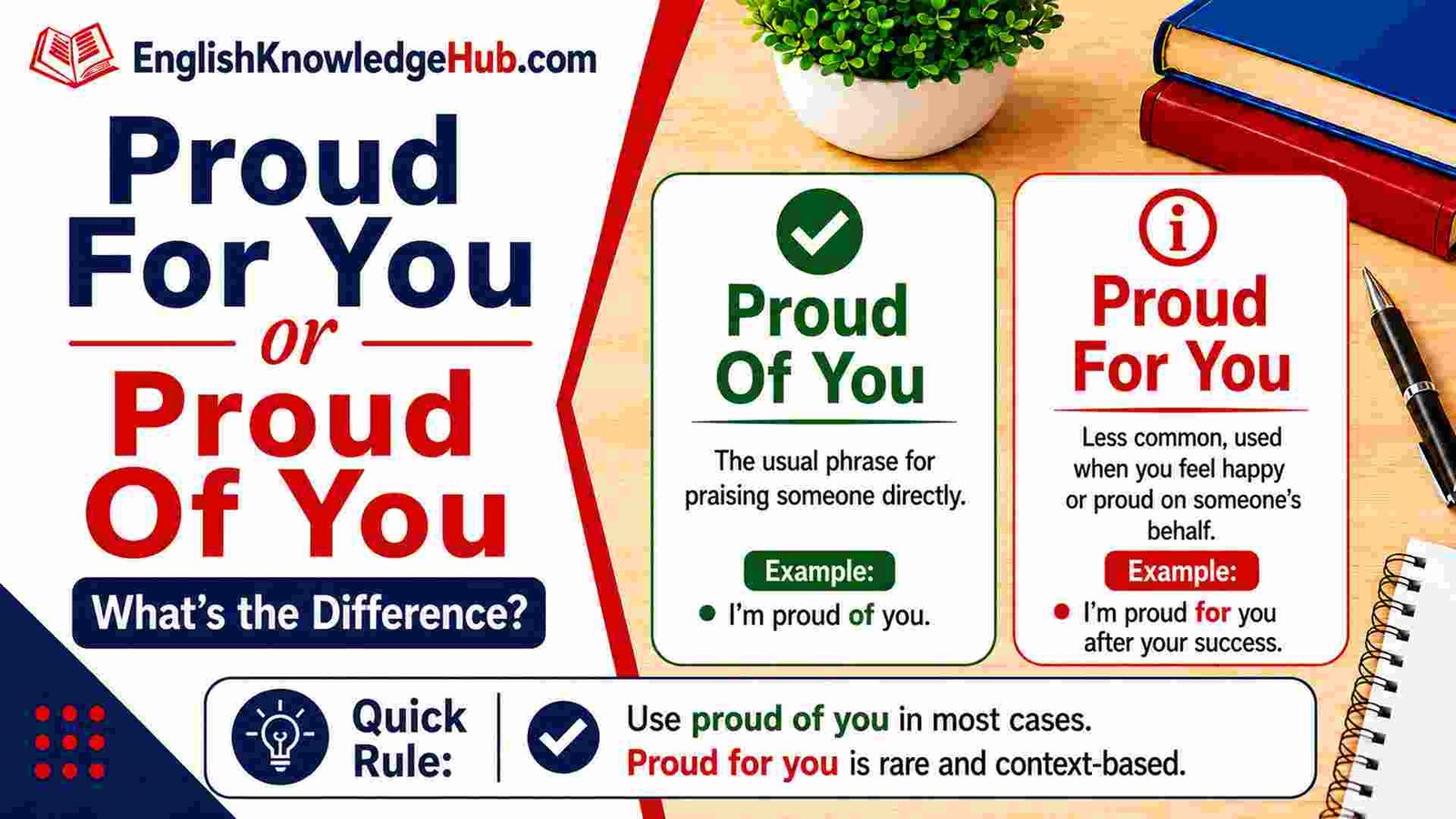
Proud For You vs Proud Of You has a simple answer: “proud of you” is the correct and natural phrase when you admire someone for what they did, how they behaved, or how much they improved. “Proud for you” is understandable, but it sounds unusual in standard English. This guide explains the difference and shows you how to use both “of” and “for” correctly.
The small words of and for can completely change how natural a sentence sounds.
We normally say:
“I’m proud of you.”
We do not normally say:
“I’m proud for you.”
However, the word for can still appear in a sentence with proud. The key is knowing where it belongs.
For example:
“I’m proud of you for helping your friend.”
Here, of you tells us who we are proud of, while for helping your friend tells us the reason.
What Does “Proud of You” Mean?
When you say “I’m proud of you,” you mean that you feel happy, pleased, or impressed because of something the other person did.
You may feel proud because someone:
- worked hard
- improved at something
- stayed brave
- made a good choice
- helped another person
- reached a goal
- learned from a mistake
- did something kind
For example:
“You practiced the song each day, and now you can perform it on your own.””
The speaker feels pride because of the other person’s effort and progress.
Another example:
“You told the truth even though it was difficult. I’m proud of you.”
Here, the pride comes from the person’s honest behavior.
Why Do We Say “Proud of You”?
The adjective proud commonly goes with the preposition of when we name the person or thing that gives us a feeling of pride.
The basic pattern is:
proud + of + person or thing
Examples:
- proud of you
- proud of him
- proud of her
- proud of my children
- proud of our team
- proud of my work
- proud of the result
- proud of myself
Look at these sentences:
“Maria is proud of her son.”
“I am proud of my progress.”
“The coach was proud of the whole team.”
In each sentence, of connects the feeling of pride to a person, group, or achievement.
Why Does “Proud for You” Sound Unusual?
The main difference in Proud For You vs Proud Of You comes from normal English word combinations.
English speakers commonly say:
happy for you
but:
proud of you
That is why learners sometimes mix the two patterns.
They may think:
“Happy for you” is natural English, so some learners may think “proud for you” works the same way.
But English does not always use the same preposition after similar feelings.
Compare:
“I’m happy for you.”
This means you are pleased because something good happened to the person.
“I’m proud of you.”
This means you admire something the person did, achieved, or became.
The meanings can be close, but they are not exactly the same.
Happy for You vs Proud of You
Imagine your friend wins a free holiday in a lucky draw.
You might say:
“I’m so happy for you!”
Your friend received good news, and you are happy because something nice happened to them.
Now imagine your friend studies every night for six months and passes a difficult exam.
You might say:
“I’m really proud of you.”
You are praising the effort and success.
Sometimes both phrases can work:
“I’m really happy for you, and I’m proud of everything you did to make this happen.”
Here, the speaker feels both happiness and pride.
| Phrase | Main idea | Example |
|---|---|---|
| Proud of you | I admire you or something you did | I’m proud of you for finishing the course. |
| Happy for you | I am pleased about your good news | I’m happy for you and your new job. |
| Proud for you | Uncommon in standard use | Better to use “proud of you” in most cases. |
Where Does “For” Belong?
The word for is useful with proud, but usually after the person.
A very helpful pattern is:
proud of + person + for + action
For example:
“I’m proud of you for trying again.”
Break it into two parts:
of you = the person
for trying again = the reason
More examples:
“We are proud of Liam for finishing the race.”
“Her parents are proud of her for putting so much effort into her work.”
“I’m proud of myself for speaking in front of the class.”
“The manager was proud of the team for solving the problem quickly.”
This pattern is one of the easiest ways to avoid mistakes.
Everyday Conversation Examples
Here are some natural examples you may hear in normal conversation:
“You made dinner all by yourself. I’m proud of you.”
“I’m proud of you for staying calm during the test.”
“Your English has improved a lot. You should be proud of yourself.”
“Grandma was proud of me when I learned to ride a bicycle.”
“We are proud of our daughter for helping her younger brother.”
These sentences sound warm and natural.
Workplace Examples
You can also use proud of at work.
“I’m proud of the way our team handled the customer complaint.”
“Your presentation was clear and well prepared. I’m proud of your progress.”
“The manager was proud of Nina for training the new staff member.”
“We are proud of the results the sales team achieved this month.”
In formal workplaces, people may sometimes choose less personal words.
Instead of:
“I’m proud of you.”
A manager might say:
“You did excellent work on this project.”
Or:
“Your improvement has been impressive.”
These versions sound more formal, but proud of you is still correct.
Academic and School Examples
Teachers, parents, and students often use this expression.
“I’m proud of you for improving your spelling.”
“The teacher was proud of the class for finishing the reading task.”
“Aisha felt proud of herself after giving her first speech.”
“The professor was proud of the students for asking thoughtful questions.”
“My parents were proud of my final project.”
Notice that pride does not always depend on getting the highest grade.
We can also feel proud of effort, courage, honesty, and improvement.
Formal Writing Examples
The phrase also appears in more formal English, although writers may choose slightly different wording.
“The organization is proud of its volunteers for their continued support.”
“We are proud of the progress made by our students this year.”
“The university is proud of its graduates and their achievements.”
“Our department is proud of the work completed during the research program.”
These examples show that proud of can refer to people, work, progress, and results.
Common Mistakes to Avoid
Understanding Proud For You vs Proud Of You becomes much easier when you see the common mistakes.
Mistake 1
Incorrect:
“I am proud for you because you passed the exam.”
Correct:
“I am proud of you because you passed the exam.”
Explanation:
Use of before the person who makes you feel proud.
Mistake 2
Incorrect:
“My family is proud me.”
Correct:
“My family is proud of me.”
Explanation:
The preposition of is needed before me.
Mistake 3
Incorrect:
“I’m proud for you working so hard.”
Correct:
“I’m proud of you for working so hard.”
Explanation:
Use of you for the person and for working for the reason.
Mistake 4
Incorrect:
“She is proud of I.”
Correct:
“She is proud of me.”
Explanation:
After a preposition such as of, use the object pronoun me, not I.
Say:
- proud of me
- proud of him
- proud of her
- proud of us
- proud of them
“Proud of You” vs “Proud of What You Did”
Both expressions are correct, but they focus on slightly different things.
“I’m proud of you.”
This focuses more on the person.
“I’m proud of what you did.”
This focuses more on the action.
Imagine your friend finds a lost phone and returns it to the owner.
You could say:
“I’m proud of you.”
You are praising your friend.
You could also say:
“I’m proud of what you did.”
Now you are putting more attention on the honest action.
Both sound natural.
Can You Say “Proud of Myself”?
Yes.
You can feel proud of yourself when you achieve something or do something that required effort.
For example:
“I’m proud of myself for finishing the book.”
“He was proud of himself for staying calm.”
“You should be proud of yourself for not giving up.”
Feeling proud of yourself does not always mean you are showing off. It can simply mean you feel pleased with your effort, growth, or behavior.
Proud of vs Proud to
There is another useful grammar pattern.
Use:
proud of + noun or pronoun
Examples:
“I am proud of my family.”
“She is proud of her work.”
“We are proud of you.”
But we can also use:
proud to + verb
Examples:
“I am proud to be part of this team.”
“She is proud to represent her school.”
“We are proud to support this program.”
The meaning stays connected to pride, but the grammar after proud changes.
Is There a British and American English Difference?
No important difference exists here.
Both British and American English normally use:
“I’m proud of you.”
You do not need to learn one form for the United States and another for the United Kingdom.
The same basic rule works in both.
An Easy Memory Trick
If you forget the rule, remember this short line:
Proud OF a person. Happy FOR a person.
Then add the reason with for:
“I’m proud of you for trying.”
Think of the sentence as three simple parts:
I’m proud + of you + for trying
Feeling + person + reason.
This pattern can help you build many correct sentences.
Frequently Asked Questions
1. Which is correct, proud for you or proud of you?
Proud of you is the normal and correct expression when you admire someone or something they have done.
2. Is “I am proud for you” completely wrong?
It may be understood, but it sounds unusual in standard English. In most situations, say “I am proud of you.”
3. What does “I’m proud of you” mean?
It means you admire someone because of their effort, behavior, progress, or achievement.
4. Can I say “I’m proud of you for doing this”?
Yes. This is a natural pattern.
Example:
“I’m proud of you for helping your classmate.”
5. What is the difference between “happy for you” and “proud of you”?
Happy for you means you are pleased about another person’s good news. Proud of you means you admire something they did or achieved.
6. Is “so proud of you” correct?
Yes. It is very common.
For example:
“You worked hard for this. I’m so proud of you.”
The word so makes the feeling stronger.
7. Can a teacher say “I’m proud of you” to a student?
Yes. A teacher can use it to praise effort, improvement, good behavior, honesty, or achievement.
8. What is the easiest rule for Proud For You vs Proud Of You?
Remember:
Be proud OF someone, but be happy FOR someone.
If you want to explain the reason, say:
“I’m proud of you for working hard.”
Final Thoughts
The difference in Proud For You vs Proud Of You comes down to one small preposition. Use proud of you when you admire a person, their effort, their behavior, or their success. Use for later when you want to explain the reason, as in “I’m proud of you for trying.”
A simple rule is enough:
Proud of someone. Happy for someone. Proud of someone for doing something.
For more simple grammar lessons, clear word comparisons, and practical English examples, visit EnglishKnowledgeHub.com and keep building your English one rule at a time.
