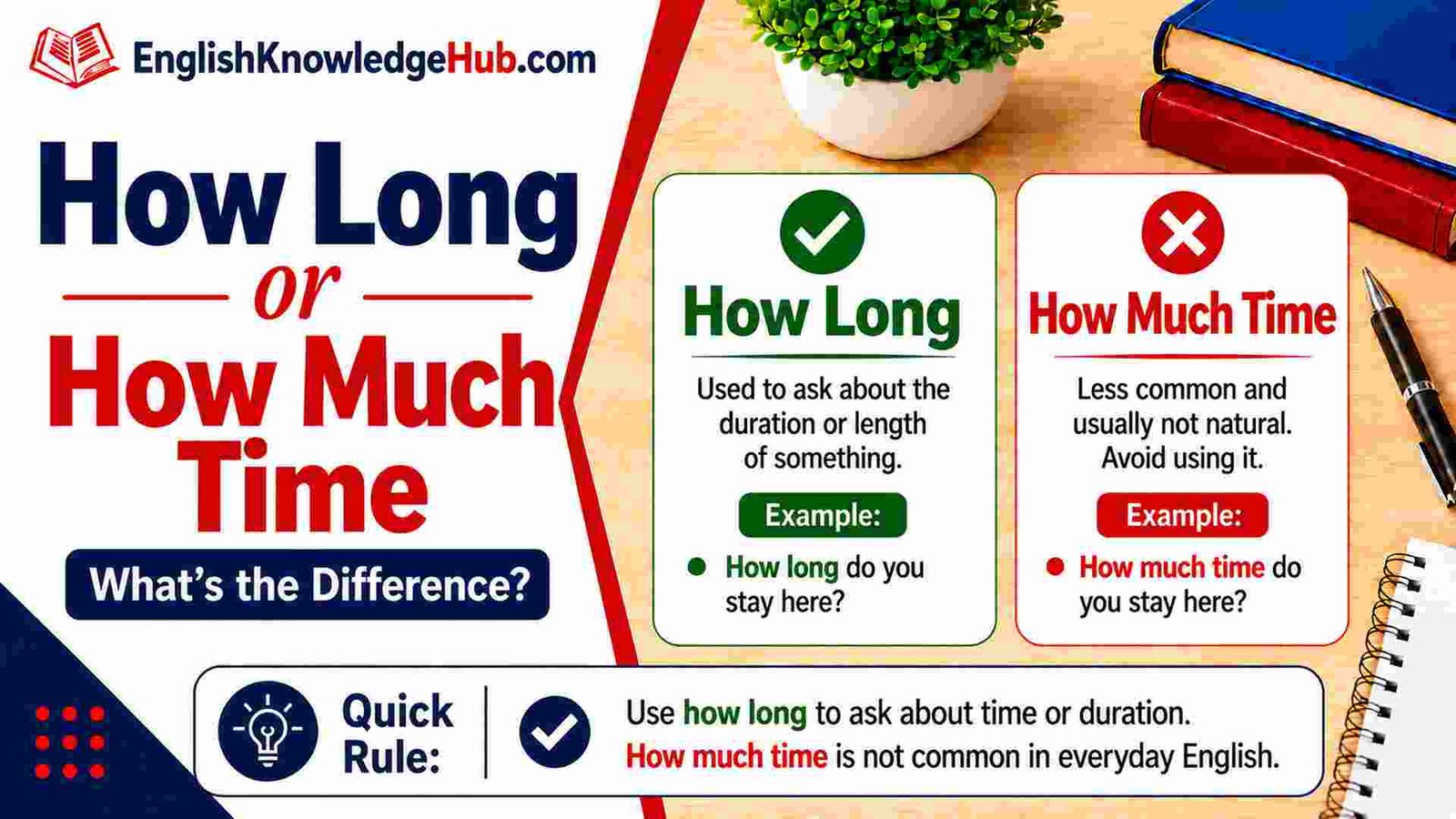
How Long or How Much Time are both correct, but they are used in slightly different ways. Use “how long” when you want to know the duration of an action, event, or situation. Use “how much time” when you want to ask about the amount of time available, needed, or spent.
The difference is small, so learners often use one where the other sounds more natural. The good news is that the rule becomes easy once you focus on what you really want to ask.
How Long vs How Much Time: The Simple Difference
Think about these two ideas:
How long = duration
How much time = amount of time
For example:
“How long will the meeting last?”
This asks about the length of the meeting.
“How much time do we have before the meeting?”
This asks about the amount of time available.
How Long vs How Much Time: That is the main difference.
| Phrase | Main Use | Example |
|---|---|---|
| How long | Ask about duration | How long will the lesson take? |
| How much time | Ask about an amount of time | How much time do you need to study? |
| How long | Ask about an ongoing situation | How long have you worked here? |
| How much time | Ask about available time | How much time do we have left? |
| How long | Ask about physical length | How long is this table? |
When to Use “How Long”
Use how long when you want to know the duration of something.
You can use it for:
- an activity
- a journey
- an event
- a situation
- a process
- a period of waiting
For example:
“How long did your dentist appointment take?”
“How long will you stay in Lahore?”
“How long was the school trip?”
“How long does it take for this rice to be ready?”
In each question, the speaker wants to know how much time something lasts.
Asking About the Past
You can ask about something that already happened.
“How long did the power cut last?”
“How long were you at the library?”
“How long did the interview continue?”
Possible answers might be:
“About twenty minutes.”
“Two hours.”
“Until noon.”
Asking About the Future
You can also use it for future plans.
“How long will the repair take?”
“How long are you staying with your cousins?”
“How long will the ceremony last?”
Again, the focus is duration.
When to Use “How Much Time”
Use how much time when you want to know the amount of time someone has, needs, uses, or can give.
For example:
“How much time do you have before work?”
“How much time do you need to complete the report?”
“How much time should I spend on this exercise?”
“How much time can you give me tomorrow?”
These questions treat time like an amount.
You are not simply measuring an event. The question asks how much time is available or needed.
How Long vs How Much Time: A Small Change Can Change the Meaning
Compare these two questions:
“How long will you be at the office?”
“How much time do you have at the office?”
They look similar, but they do not ask exactly the same thing.
The first means:
“What is the duration of your office stay?”
The second means:
“What amount of time do you have available while you are there?”
This is why understanding the idea behind the question matters more than memorizing one phrase.
Can Both Phrases Be Correct?
Yes. Sometimes both are possible.
For example:
“How long will the job take?”
“How much time will the job take?”
Both sentences are understandable.
However, the first one usually sounds more natural because the speaker is simply asking about duration.
Now look at this:
“How much time do you need to complete the task?”
This sounds very natural because the speaker is asking about the amount of time required.
So, when deciding between How Long or How Much Time, think about the focus of the question.
If you are asking about length or duration, choose how long.
If you are asking about an amount that someone has or needs, choose how much time.
Why Do We Say “Much Time”?
The noun time is often uncountable when it means an amount.
That is why we use much, not many.
We say:
“How much time do you have?”
Not:
“How many time do you have?”
Compare it with other uncountable nouns:
“How much water do you need?”
“How much money did you spend?”
“How much information did she give you?”
The same grammar pattern works with time.
“How Much Time” and “How Many Times” Are Different
This is a very common learner mistake.
How much time asks about duration or an amount.
How many times asks about the number of occasions.
Compare:
“How much time did you spend working out at the gym?”
This asks about duration.
A possible answer is:
“One hour.”
Now compare:
“How many times did you visit the gym this week?”
This asks about frequency.
A possible answer is:
“Three times.”
The word time changes meaning in these two questions.
Use “How Long” With Ongoing Situations
When something started in the past and is still true now, how long is usually the natural choice.
For example:
“How long have you lived in this city?”
“How long has Emma worked at the bank?”
“How long have they known each other?”
“How long have you studied English?”
These questions ask about the duration of a continuing situation.
Common Mistake
Incorrect:
“How much time have you lived in this city?”
Correct:
“How long have you lived in this city?”
Explanation:
The question is about the length of an ongoing situation, so how long is the natural form.
However, you can say:
“How much time have you spent staying in this city?”
This works because time is the thing being spent.
“How Long” Can Also Ask About Physical Length
There is one important difference between the two phrases.
How long does not always refer to time.
It can also ask about physical length.
For example:
“How long is the rope?”
“How long is your desk?”
“How long should the curtain be?”
“How long is the swimming pool?”
In these examples, the answer might be in meters, feet, or centimeters.
You cannot use how much time for physical length.
Incorrect:
“How much time is the rope?”
Correct:
“How long is the rope?”
Explanation:
The question is about the length of an object, not time.
Common Mistakes With How Long or How Much Time
Mistake 1: Saying “How Long Time”
Incorrect:
“How long time do you need?”
Correct:
“How much time do you need?”
Also Correct:
“How long do you need?”
Explanation:
How long time is not the normal structure in standard English. Use how long or how much time.
Mistake 2: Using “How Much Time” for Physical Length
Incorrect:
“How much time is this bridge?”
Correct:
“How long is this bridge?”
Explanation:
The question asks about distance or length, so use how long.
Mistake 3: Using “How Many Times” for Duration
Incorrect:
“How many times did you wait for the doctor?”
Correct:
“How long did you wait for the doctor?”
Explanation:
The speaker wants to know the duration of the wait, not the number of visits.
Mistake 4: Using “How Much Time” in an Unnatural Ongoing Question
Incorrect:
“How much time have you known Sam?”
Correct:
“How long have you known Sam?”
Explanation:
Knowing someone is an ongoing state, so how long is the natural choice.
Daily Conversation Examples
Here are some natural examples you may hear in everyday speech.
“How long are you staying at your friend’s house?”
“How much time do we have before the movie starts?”
“How long did you wait for the bus?”
“How much time do you need to get ready?”
“How long is your lunch break?”
“How much time can you stay today?”
Notice how how long often measures duration, while how much time often focuses on available or needed time.
Workplace Examples
The same rule works in professional settings.
“How long will the software update take?”
“How much time do you need to check the figures?”
“How long was the client meeting?”
“How much time can we spend on this task?”
“How long have you worked for this company?”
“How much time is left before the deadline?”
These examples sound natural because the phrase matches the meaning of the question.
Academic Examples
Students and teachers also use both forms.
“How long did the experiment run?”
“How much time were you given for the test?”
“How long have researchers studied this problem?”
“How much time should students spend reading each day?”
“How long will the presentation last?”
“How much time is available for questions?”
Again, the difference is mainly between duration and amount.
Formal Writing Examples
Both phrases can appear in polite and professional writing.
“Could you tell me how long the review process normally takes?”
“Please confirm how much time applicants have to submit the missing documents.”
“We would like to know how long the inspection will last.”
“Could you explain how much time is required to complete the registration?”
There is no strict rule saying one phrase is formal and the other is informal. The meaning of the sentence matters more.
How Long vs How Much Time: An Easy Memory Trick
Imagine two questions.
First:
“How long is the road?”
You are measuring length.
Now imagine:
“How much time is in the clock?”
That does not sound natural, but it helps you remember that how much time focuses on an amount of time, not physical length.
A simpler rule is:
How long = How many minutes, hours, days, or years does it last?
How much time = How much time is available, needed, allowed, or spent?
This quick check works in most situations.
FAQs
Is “how long” correct for asking about time?
Yes. It is very common when asking about duration.
For example:
“How long did the class last?”
Is “how much time” grammatically correct?
Yes. It is correct when asking about an amount of time.
For example:
“How much time do you need?”
Which is more natural, “how long will it take” or “how much time will it take”?
Both can be correct, but how long will it take? usually sounds more natural for a simple duration question.
Can I say “how long time”?
Usually, no.
Say:
“How long will you stay?”
or:
“How much time do you have?”
What is the difference between “how much time” and “how many times”?
How much time asks about duration or amount.
How many times asks about frequency.
Should I say “how long have you been here” or “how much time have you been here”?
Use:
“How long have you been here?”
It is the natural way to ask about the duration of an ongoing situation.
Can “how long” describe an object?
Yes. It can ask about physical length.
For example:
“How long is the dining table?”
Final Thoughts
The easiest way to understand How Long or How Much Time is to look at what the speaker wants to measure. Use how long for duration and physical length. Use how much time when you want to ask about an amount of time that is available, needed, allowed, or spent.
If both forms seem possible, ask yourself one question: “Am I measuring how long something lasts, or am I asking how much time someone has?” That simple check will usually lead you to the right choice.
For more easy grammar lessons, clear word comparisons, and practical English examples, visit EnglishKnowledgeHub.com.
