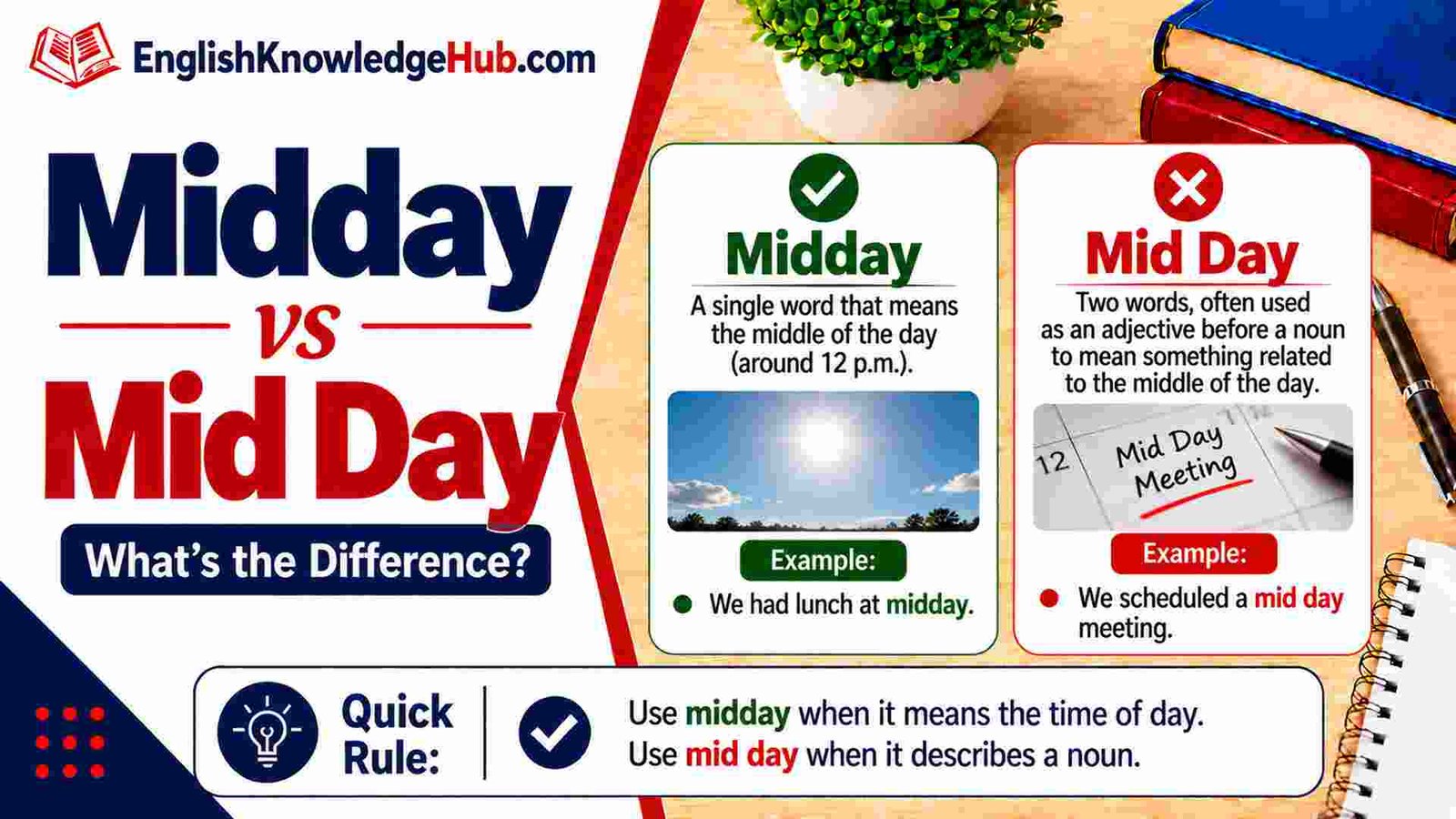
Midday vs Mid Day has a clear answer: midday, written as one word, is the standard spelling in modern English. It usually means noon or the period around 12 o’clock. Below, you will learn why the one-word form is correct, how midday differs from noon, and how to use it naturally in everyday, workplace, academic, and formal writing.
The Short Answer: Write “Midday” as One Word
If you are writing an email, assignment, report, message, article, or exam answer, use midday. The spaced form mid day is not the standard spelling when you mean the middle of the day. You may occasionally see mid-day in older writing, but the closed form midday is the normal modern choice.
| Form | Status | Best choice? |
|---|---|---|
| midday | Standard modern spelling | Yes |
| mid day | Nonstandard for this meaning | No |
| mid-day | Older or uncommon spelling | Usually no |
The Cambridge Dictionary lists midday as the word for twelve o’clock in the middle of the day, and its learner entry also notes that it can refer to the period around that time. Merriam-Webster likewise defines midday as the middle of the day and shows it as one word.
Why “Mid Day” Looks Reasonable but Still Causes Trouble
The confusion behind Midday vs Mid Day makes sense. Learners can clearly see two familiar pieces: mid and day. That can make the two-word spelling feel logical.
English compound words do not all behave the same way, though. Some remain open, some use a hyphen, and some become a single closed word. Midday belongs to the last group. Modern English treats it as one established word, just as it treats midnight as one word.
A useful habit is to learn the standard word as a complete unit rather than rebuilding it every time you write. That same habit helps with many spelling problems. For example, our guide to Useing or Using explains why simply joining the visible parts of a word can sometimes lead to the wrong spelling.
What Does “Midday” Actually Mean?
Midday means the middle of the day. In many situations, that is noon, or 12:00 p.m. However, everyday English can also use midday for a short period around noon rather than one exact minute.
Compare these examples:
- The ceremony starts at midday. This can mean 12:00 p.m. exactly, especially if the event follows a schedule.
- The streets became busier around midday. Here, midday means a general period near noon.
This is why context matters. A timetable may use midday precisely. A casual comment about weather, traffic, or lunch may use it more loosely.
Midday vs Noon: Are They the Same?
Midday and noon overlap strongly, but they are not always equally natural in every sentence. Noon often feels more exact because speakers commonly use it for 12:00 p.m. Midday can also mean 12:00 p.m., but it often works well for the wider middle part of the day.
| Situation | Natural choice | Example |
|---|---|---|
| Exact appointment at 12:00 p.m. | Noon or midday | The interview begins at noon. |
| Weather around the middle of the day | Midday | The clouds should clear by midday. |
| Describing another noun | Midday | We took a midday break. |
| Very precise deadline | Exact clock time | Submit the form by 12:00 p.m. |
If one exact minute matters, a clock time is often clearer than either word. If you simply mean the middle portion of the day, midday sounds natural and accurate.
How to Use “Midday” Naturally
Knowing the spelling is useful, but readers usually need more than that. The next step is learning which small words naturally appear with midday.
Use “at midday” for a point in time
- The museum tour begins at midday.
- I usually take a short walk at midday.
- The technician said she would return at midday.
Use “by midday” for a deadline or expected completion time
- Please send the revised file by midday.
- The road should reopen by midday.
- We hope to finish the first round of testing by midday.
Use “around midday” when the time is approximate
- My cousin reached the station around midday.
- The café becomes busiest around midday.
- The temperature rose quickly around midday.
Use “midday” before a noun
Midday can also describe another noun by telling us when something happens or what part of the day it belongs to.
- We took a short midday walk.
- The midday sun made the pavement hot.
- Our team has a midday meeting on Friday.
- She listened to the midday news during lunch.
You do not need to add a hyphen in phrases such as midday meal, midday break, or midday meeting.
Is “Mid-Day” Wrong?
The hyphenated form mid-day is not the form I would recommend for ordinary modern writing. However, it can appear in older books, historical material, names, quotations, or texts that preserve an older spelling style.
That distinction matters. Seeing mid-day in an old source does not automatically mean the writer made a careless error. English spelling changes over time, and older print often preserves forms that are no longer the usual choice.
If you are quoting an older source, keep the original spelling inside the quotation. If you are writing your own modern sentence, use midday.
What About “Mid Day” as Two Separate Words?
For normal writing about noon or the middle part of the day, mid day should be corrected to midday. Here are the kinds of mistakes learners often make.
Incorrect:
We stopped for lunch at mid day.
Correct:
We stopped for lunch at midday.
Explanation:
The established time word is written as one closed compound.
Incorrect:
The mid day heat made the room uncomfortable.
Correct:
The midday heat made the room uncomfortable.
Explanation:
The spelling stays midday even when the word comes before a noun.
Incorrect:
Please call me around mid day.
Correct:
Please call me around midday.
Explanation:
Words such as around, at, and by do not change the spelling.
Real Examples for Different Kinds of English
A good spelling rule should still feel natural outside a textbook. Here is how midday appears in different situations.
Daily conversation
- I should be home by midday.
- Do you want to meet around midday?
- I was still tired at midday because I worked late last night.
Workplace English
- The manager moved the briefing to midday.
- Please check the shared folder again by midday.
- We have a midday call with the design team.
Academic English
- The students recorded the temperature at midday for five days.
- The field survey began in the morning and ended shortly after midday.
- The researchers compared morning and midday measurements.
Formal notices
- The east entrance will remain closed until midday.
- Registration will pause at midday and resume at 1:00 p.m.
- The public session is expected to conclude by midday.
The spelling stays the same whether the tone is casual, professional, academic, or formal.
“At Midday” vs “In the Middle of the Day”
These expressions are related, but they are not perfect replacements for each other.
At midday points closely to noon or the period around noon:
The shop becomes quiet at midday.
In the middle of the day is more flexible. Depending on the situation, it can simply mean the daytime period between morning and evening without pointing closely to 12:00 p.m.:
I avoid long drives in the middle of the day during summer.
If the exact time matters, use wording that gives your reader the clearest possible picture.
Does American English Spell “Midday” Differently?
No. There is no important British-versus-American split in Midday vs Mid Day. Major British and American dictionary sources use midday as the standard modern spelling.
So you do not need to write mid day for American English or mid-day for British English. This makes the choice simpler than spelling pairs that genuinely change by region.
A Simple Memory Trick That Takes Five Seconds
When you hesitate, remember this:
middle of the day = midday
You can also test your sentence by temporarily replacing midday with noon. If the sentence still makes basic sense, midday is probably the word you need.
- We will meet at noon. → We will meet at midday.
- The package should arrive by noon. → The package should arrive by midday.
The test is not a grammar law, but it is a handy learner shortcut.
One Spelling Habit Worth Keeping
Many spelling mistakes happen when we try to build a familiar word from smaller pieces instead of remembering its accepted form. Midday is a good example. You can see mid and day, but standard English stores the result as one word.
Time words cause similar doubts elsewhere. If you have ever wondered whether an informal-looking spelling can replace a standard one, our Tonite vs Tonight guide is a useful next read.
Frequently Asked Questions
Is midday one word or two?
Midday is one word. Use it when you mean noon or the middle part of the day.
Is “mid day” correct?
Not as the standard spelling for noon or the middle of the day. In normal modern writing, use midday.
Is “mid-day” acceptable?
You may see mid-day in older writing or quoted material. For your own present-day writing, midday is the safer standard form.
Is midday exactly 12:00 p.m.?
It can mean exactly noon, but it can also refer to the period around noon. The sentence and situation tell you how precise the meaning is.
What is the difference between midday and noon?
Noon strongly points to 12:00 p.m. Midday can mean noon or, in some contexts, the broader middle period of the day.
Should I write “midday meeting” or “mid-day meeting”?
Write midday meeting. The standard word remains closed when it comes before another noun.
Do British and American English use the same spelling?
Yes. Midday is standard in both British and American English.
Final Thought
The Midday vs Mid Day question becomes easy once you stop treating mid and day as two separate spelling choices. When you mean noon or the middle part of the day, write midday. If precision matters, use noon or an exact clock time.
For more practical English explanations built around the questions learners actually ask, explore EnglishKnowledgeHub.com.
