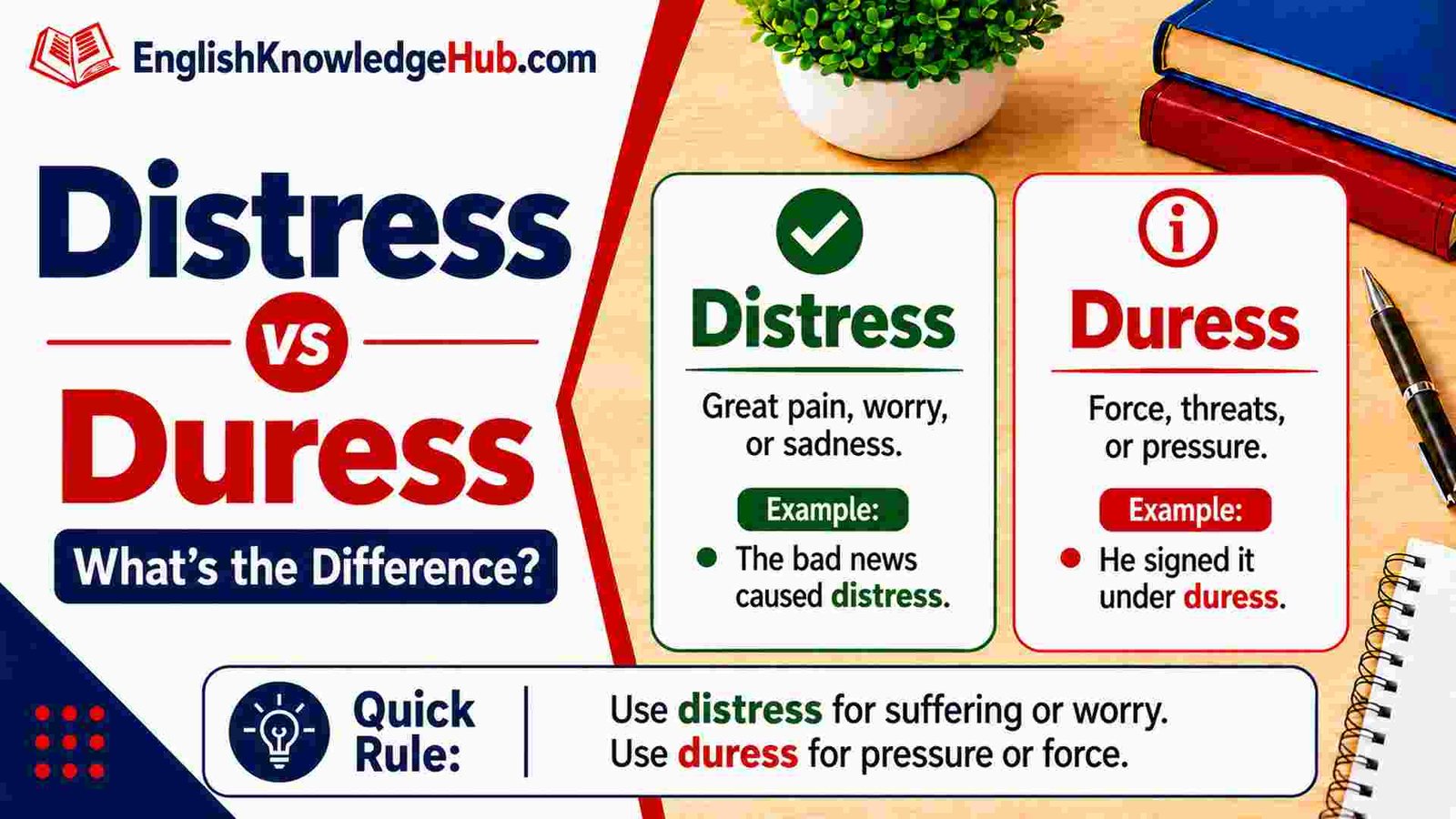
Distress means serious suffering, worry, pain, or danger, while duress means being forced or pressured to act, usually through threats or coercion. In simple terms, distress describes a difficult state; duress describes pressure that takes away free choice. This guide explains both words, their common phrases, legal uses, pronunciation, and the mistakes learners make most often.
Distress vs Duress in One Simple Picture
If you remember only one idea, make it this:
Distress = suffering or danger.
Duress = force or coercion.
| Word | Main idea | Common phrase | Example |
|---|---|---|---|
| distress | Serious worry, pain, suffering, or danger | in distress | The child was clearly in distress. |
| duress | Threats or pressure that force someone to act | under duress | He said he signed the document under duress. |
Cambridge defines distress as extreme worry, sadness, pain, or a situation of danger and urgent need. It defines duress as threats used to force a person to do something.
The Difference Is Not “Feeling vs No Feeling”
A popular shortcut says distress is a feeling and duress is pressure. That is useful, but it is not the whole story.
Distress can describe emotional suffering, physical suffering, financial hardship, or a dangerous situation. A ship can be in distress even though the word is not describing the ship’s emotions.
Duress focuses on coercion. Someone acts because another person’s threat, force, or improper pressure leaves them without a genuinely free choice.
So the better question is:
- Is the sentence about suffering, hardship, or danger? Choose distress.
- Is the sentence about someone being forced to act? Choose duress.
What Does Distress Mean in Everyday English?
Distress is both a noun and a verb. As a noun, it usually refers to serious mental or physical suffering, hardship, or danger. As a verb, it means to make someone very worried or upset.
Emotional or mental distress
- The sudden news caused her considerable distress.
- He showed signs of emotional distress after the argument.
- The family felt deep distress while waiting for information.
In these examples, the word describes strong emotional suffering, not ordinary annoyance.
Physical or medical distress
- The nurse noticed that the patient was in respiratory distress.
- The injured hiker appeared to be in serious distress.
- The animal showed clear signs of distress in the heat.
Here, distress means serious physical difficulty or suffering.
Financial or economic distress
- The small business entered a period of financial distress.
- Families facing economic distress may delay large purchases.
- The company sold several assets after months of financial distress.
In business and finance, distress can describe severe money problems. This is why the word appears in phrases such as financial distress and economic distress.
Danger and urgent need
- The coast guard responded to a boat in distress.
- The pilot sent a distress signal before making an emergency landing.
- Rescuers located the climbers after receiving their distress call.
In these sentences, distress means danger and an urgent need for help.
Distress as a verb
- I did not mean to distress you with that message.
- The photographs deeply distressed the family.
- It distressed him to see the shop standing empty.
The related forms are distressed and distressing. A person can feel distressed, while an event or piece of news can be distressing.
What Does Duress Mean?
Duress is mainly a formal noun. It refers to force, threats, or coercive pressure used to make someone do something they would not freely choose to do.
- She said she agreed to the demand under duress.
- The witness claimed the statement was made under duress.
- He argued that he had transferred the money under duress.
The important idea is lack of free choice because of coercion.
In legal contexts, the exact requirements for proving duress depend on the type of case and the jurisdiction. Cornell Law School’s Legal Information Institute explains duress as coercive conduct or unlawful threats that cause a person to do something they otherwise would not do. That makes the legal meaning narrower than simply feeling nervous, pressured, or stressed.
“In Distress” and “Under Duress” Are the Phrases to Remember
This is one of the easiest ways to solve Distress vs Duress in real sentences.
Use in distress when someone or something is suffering, in serious difficulty, or in danger:
- The caller sounded as though she was in distress.
- A vessel in distress requested immediate assistance.
- The charity supports families in distress.
Use under duress when a person acts because they are being forced or threatened:
- He said he signed under duress.
- The employee claimed the resignation was submitted under duress.
- A statement made under duress may raise serious legal questions.
“Under distress” is not the normal phrase for emotional suffering in standard everyday English. If you mean serious worry or pain, in distress is usually the natural choice.
Can Someone Be in Distress Because They Are Under Duress?
Yes. The two ideas can happen at the same time.
Imagine someone receives a serious threat and is forced to sign a paper. The threat and coercion create duress. The fear, anxiety, or suffering the person experiences may be distress.
In other words:
Duress can be the pressure.
Distress can be one result of that pressure.
This is why the words sometimes appear in the same serious situation even though they are not synonyms.
Stress vs Distress vs Duress
Readers often confuse all three words because each can appear in difficult situations.
| Word | Basic meaning | Typical situation |
|---|---|---|
| stress | Mental or physical strain or pressure | A busy week, an exam, a deadline |
| distress | Serious suffering, hardship, or danger | Emotional pain, medical difficulty, financial hardship |
| duress | Coercion or threats that force action | A forced confession, agreement, payment, or decision |
A deadline can put you under stress. Terrible news can put you in distress. A threat that forces you to sign something can mean you acted under duress.
If you are also working on nearby word pairs where one small choice changes the meaning of a sentence, our Affect vs Effect guide uses the same kind of practical comparison.
Distress vs Duress in Legal English
The legal meanings deserve special care because both words can appear in law, but they do different jobs.
Duress in contracts
In contract law, duress can be relevant when improper threats or coercion affect whether an agreement was made freely. Cornell LII notes that duress can make a contract voidable under U.S. law. The exact test is a legal question and can vary, so “I felt pressured” does not automatically prove legal duress.
Duress in criminal law
Duress can also appear as a legal defense in some criminal cases. Again, ordinary stress or fear is not automatically enough. The legal requirements can be strict and depend on jurisdiction.
Emotional distress
Emotional distress is also a recognized legal phrase. It refers to serious emotional suffering, but it is a different concept from duress. A person can claim emotional distress without claiming that someone forced them to act.
A less common legal meaning of “distress”
Older and specialist legal usage also gives distress a property or debt-related meaning involving seizure of goods. Most everyday learners will rarely need that sense, but it explains why legal dictionaries sometimes list a meaning that looks completely different from emotional suffering.
Duress, Consent, and Free Choice
Duress matters because it can undermine the idea that a person freely agreed to something. If a person says “yes” only because of threats or coercion, the apparent agreement may not represent a genuinely free choice.
That is a useful connection when reading legal, workplace, or formal writing. It is also why under duress sounds much more serious than “under pressure.” If you are reviewing the spelling of the related word, see our guide to Consentual vs Consensual.
Pronunciation: They Sound Similar, but Not the Same
The similarity in sound is one reason Distress vs Duress causes confusion.
- distress: roughly di-STRESS, /dɪˈstres/
- duress: roughly doo-RESS in American English; British English may have a slight “y” sound, /djuˈres/
Both words place strong stress near the end, but distress starts with a clear di- sound, while duress begins with a doo-/dyoo- sound.
Common Mistakes That Change the Meaning
Mistake 1: Using distress for forced action
Incorrect:
He signed the agreement under distress.
Correct:
He signed the agreement under duress.
Explanation:
The sentence is about being forced or coerced, so duress is the right word.
Mistake 2: Using duress for emotional suffering
Incorrect:
She felt great duress after hearing about the accident.
Correct:
She felt great distress after hearing about the accident.
Explanation:
The sentence describes emotional suffering, not coercion.
Mistake 3: Calling ordinary work pressure “duress”
Less suitable:
I am under duress because I have three deadlines this week.
Better:
I am under a lot of stress because I have three deadlines this week.
Explanation:
Deadlines may create stress. Duress normally suggests threats, force, or serious coercion.
Mistake 4: Treating duress like a common verb
Awkward:
They duressed him into accepting the deal.
Natural:
They coerced him into accepting the deal.
Explanation:
In standard modern usage, duress is mainly used as a noun, especially in the phrase under duress.
A Fast Meaning Test
When you are unsure, ask what the sentence is really about.
- Is someone suffering, struggling, hurt, or in danger? Use distress.
- Is someone being forced to do something because of threats or coercion? Use duress.
- Is it ordinary pressure from work, study, or life? You probably mean stress.
This three-question test is more reliable than choosing by sound.
Frequently Asked Questions
What is the main difference between distress and duress?
Distress is serious suffering, hardship, pain, or danger. Duress is force, threats, or coercion used to make someone act against their free choice.
Which is correct: in distress or under distress?
In distress is the normal phrase when someone is very upset, suffering, or in danger. Under distress is not the usual everyday expression for that meaning.
Which is correct: in duress or under duress?
Under duress is the standard expression. It means a person acted because of force, threats, or coercive pressure.
Does duress just mean stress?
No. Stress can come from normal pressure such as work or deadlines. Duress is much stronger and usually involves coercion, threats, or force.
Can duress cause distress?
Yes. A person who is threatened or forced may experience fear, anxiety, or emotional suffering. The coercion is duress; the suffering can be distress.
Is duress only a legal word?
It is strongly associated with legal and formal English, but people also use under duress outside courtrooms to describe serious coercion. Casual exaggeration is possible, but the core meaning remains being forced or constrained.
Can a company be in distress?
Yes. A company can be in financial distress when it has serious money problems or difficulty meeting financial obligations.
Is emotional distress the same as duress?
No. Emotional distress is serious emotional suffering. Duress is coercive pressure that makes someone act. They can occur together, but one does not automatically mean the other.
Final Takeaway
The easiest way to settle Distress vs Duress is to look for the source of the problem. If the sentence is about suffering, hardship, pain, or danger, choose distress. If it is about threats or coercion forcing someone to act, choose duress. Remember the natural pairings in distress and under duress, and most real-life sentences become much easier.
For more clear English explanations built around the questions learners genuinely struggle with, continue exploring EnglishKnowledgeHub.com.
