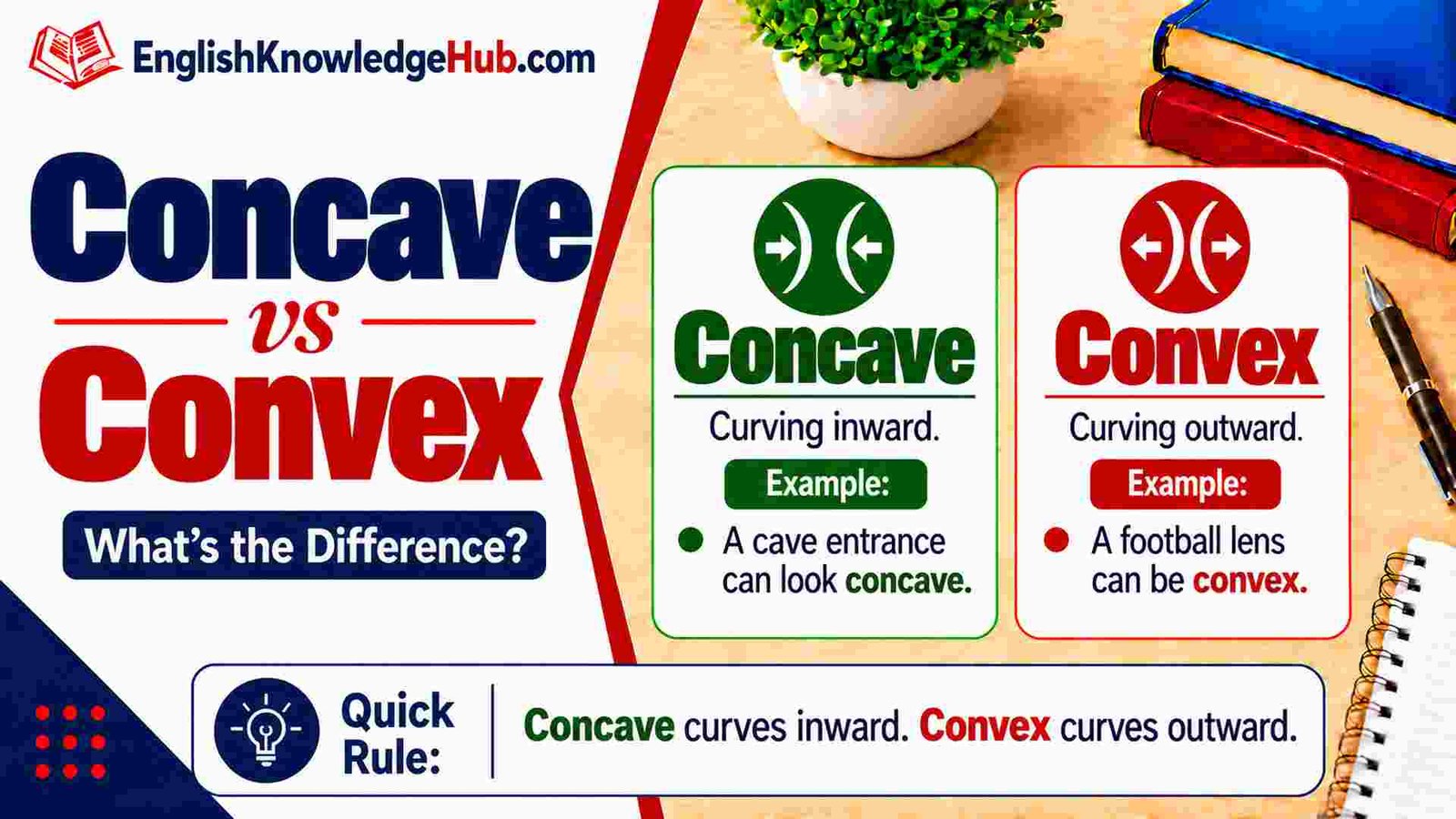
Concave means curved inward, while convex means curved outward. In Concave Vs Convex, think of a dent and a bump. A concave shape has a part that goes inward. A convex shape pushes outward. This guide will show you the difference, easy examples, mirrors, lenses, shapes, and the correct way to use both words.
Both words are correct English words. You choose the right one by looking at the direction of the curve.
The Main Difference Is Very Simple
The easiest way to understand these words is to look at a curve.
A concave surface goes inward.
A convex surface comes outward.
Think about a soft ball.
If you press your finger into the ball, you make a dent. That dent is concave.
The normal round outside of the ball is convex.
| Word | Simple Meaning | Think Of |
|---|---|---|
| Concave | Curves inward | A dent |
| Convex | Curves outward | A bump |
This is the main Concave Vs Convex rule to remember.
What Does Concave Mean?
Concave means that something bends, dips, or curves inward.
Imagine the inside of a bowl. The middle goes down and creates a hollow space. That inside surface is concave.
You can also think about a small dent in a metal door. The dent goes inward, so that part is concave.
Common uses include:
- concave shape
- concave mirror
- concave lens
- concave surface
- concave curve
Easy Concave Examples
Daily conversation:
“The middle of the old tray looks concave.”
Workplace:
“The designer made a concave space for the button.”
School:
“The student drew a concave shape on the board.”
Formal writing:
“The object has a small concave area near the center.”
In each example, the shape moves inward.
What Does Convex Mean?
Convex means that something bends or curves outward.
Think about the outside of a basketball. Its round surface pushes outward. That surface is convex.
A rounded car mirror can also have a convex surface.
Common uses include:
- convex shape
- convex mirror
- convex lens
- convex surface
- convex curve
Easy Convex Examples
Daily conversation:
“The lid has a convex top.”
Workplace:
“The case has a smooth convex front.”
School:
“The teacher showed us a convex shape.”
Formal writing:
“The cover has a slightly convex surface.”
In all these examples, the shape moves outward.
Try the Dent and Bump Trick
A good way to remember Concave Vs Convex is to think about two simple things.
Think of a dent for concave.
Think of a bump for convex.
If the middle goes inward, it is concave.
If the middle pushes outward, it is convex.
This trick works well when you look at bowls, balls, mirrors, glass, tools, walls, and many other objects.
Can One Object Be Both?
Yes.
One object can have a concave side and a convex side.
A spoon is a good example.
The part of the spoon that holds food curves inward. That side is concave.
Turn the spoon over. The back side curves outward. That side is convex.
So do not only ask, “What object is this?”
Ask:
“Which side am I looking at?”
That question helps you choose the right word.
Concave and Convex Shapes
These two words are also used in math.
A convex shape does not have a part that cuts inward.
A concave shape has at least one part that goes inward.
Imagine a simple star-like shape with an inward corner. That inward part makes the shape concave.
Now imagine a square. A normal square has no inward dent, so it is convex.
For young learners, you can use this rule:
No inward dent = convex
Has an inward dent = concave
The math meaning may become more detailed in higher classes, but this simple rule works well for beginners.
Concave and Convex Mirrors
You may also see these words in science.
A concave mirror curves inward.
It looks a little like the inside of a bowl.
A convex mirror curves outward.
It looks more like the outside of a ball.
The two mirrors do different things with light.
A concave mirror can make an image look bigger in some situations. It can also form different kinds of images depending on how far the object is from the mirror.
A convex mirror gives a wider view. This is why convex mirrors are useful when people need to see a larger area.
For example, you may see convex mirrors in shops, parking areas, or near road corners.
The most important Concave Vs Convex rule does not change here:
Concave mirror = curves inward
Convex mirror = curves outward
What About Concave and Convex Lenses?
Lenses also use these two words.
A concave lens is usually thinner in the middle.
A convex lens is usually thicker in the middle.
A concave lens spreads light rays apart.
A convex lens can bring light rays closer together.
Do not worry if the light part sounds difficult. The shape rule is still the best place to start.
Look at the middle.
If the lens gets thinner in the middle, it is often concave.
If it gets thicker in the middle, it is often convex.
How to Use Concave and Convex in English
Both words are usually used as adjectives.
An adjective describes a noun.
For example:
“She touched the concave side of the bowl.”
Here, concave describes the word side.
Another example:
“The mirror has a convex surface.”
Here, convex describes the word surface.
You can also use the words after verbs such as is, looks, or appears.
“The center is concave.”
“The glass looks convex.”
“The metal became concave after the hit.”
“The front appears convex.”
Both words are normal in science, math, design, medicine, and everyday descriptions.
Common Mistakes Learners Make
Mistake 1: Mixing Up Inward and Outward
Incorrect:
“The dent is convex.”
Correct:
“The dent is concave.”
Explanation:
A dent goes inward. Concave is the correct word for an inward curve.
Mistake 2: Calling Every Curve Convex
Incorrect:
“The inside of the bowl is convex because it is curved.”
Correct:
“The inside of the bowl is concave because it curves inward.”
Explanation:
Both words describe curves. The direction of the curve tells you which word to use.
Mistake 3: Forgetting Which Side You Mean
Incorrect:
“The spoon is concave.”
Correct:
“The inside of the spoon is concave.”
Explanation:
A spoon has two sides. One side curves inward, and the other side curves outward. Say which side you mean.
Mistake 4: Thinking One Word Is More Correct
Incorrect:
“Convex is the correct word, and concave is another form.”
Correct:
“Concave and convex are two different words.”
Explanation:
Both words are correct. They describe opposite kinds of curves.
Is Concave the Opposite of Convex?
Yes, in most shape descriptions, they are opposites.
Concave points inward.
Convex points outward.
This is why people often learn the two words together.
The Concave Vs Convex difference is mainly about direction.
You do not need a long rule.
Just check where the curve goes.
Are the Meanings Different in British and American English?
No important difference exists in the basic meaning.
In both British and American English:
concave means curved inward.
convex means curved outward.
The words may sound more common in science or math lessons, but both are standard English words.
A Quick Check Before You Choose
When you are not sure which word to use, ask yourself three questions.
- Does the shape go inward?
- Does it push outward?
- Which side of the object am I describing?
If it goes inward, use concave.
If it pushes outward, use convex.
This simple check can help you avoid most mistakes.
More Simple Examples
Here are a few more sentences to make the difference clear.
“The child pressed the clay and made a concave hole.”
“The toy has a convex roof.”
“The inner wall of the cup is concave.”
“The rounded cover is convex.”
“The artist added a concave dip to the model.”
“The machine has a convex glass window.”
“The two sides look different because one is concave and the other is convex.”
These examples show that the words can be used for many different objects.
Frequently Asked Questions
What is the simple difference between concave and convex?
Concave curves inward. Convex curves outward. Think of a dent for concave and a bump for convex.
Which one is correct, concave or convex?
Both are correct. Use concave for an inward curve. Use convex for an outward curve.
Is a bowl concave or convex?
The inside of a bowl is usually concave. The outside may be convex.
Is a ball concave or convex?
The outside of a normal ball is convex because it curves outward.
Is a spoon concave or convex?
It can be both. The inside of the spoon is concave. The back of the spoon is convex.
Which mirror gives a wider view?
A convex mirror gives a wider view. This is why it is useful in places where people need to see a larger area.
How can I remember Concave Vs Convex?
Think of a dent and a bump. A dent goes inward, so it is concave. A bump goes outward, so it is convex.
Final Takeaway
The difference is easy once you focus on the direction of the curve.
Concave goes inward. Convex goes outward.
Think of a dent for concave and a bump for convex. Then look at the side or surface you are describing.
Once you remember this simple idea, Concave Vs Convex becomes much easier to understand in everyday English, math, mirrors, lenses, and shapes.
For more easy word differences, grammar lessons, and clear English guides, visit EnglishKnowledgeHub.com.
