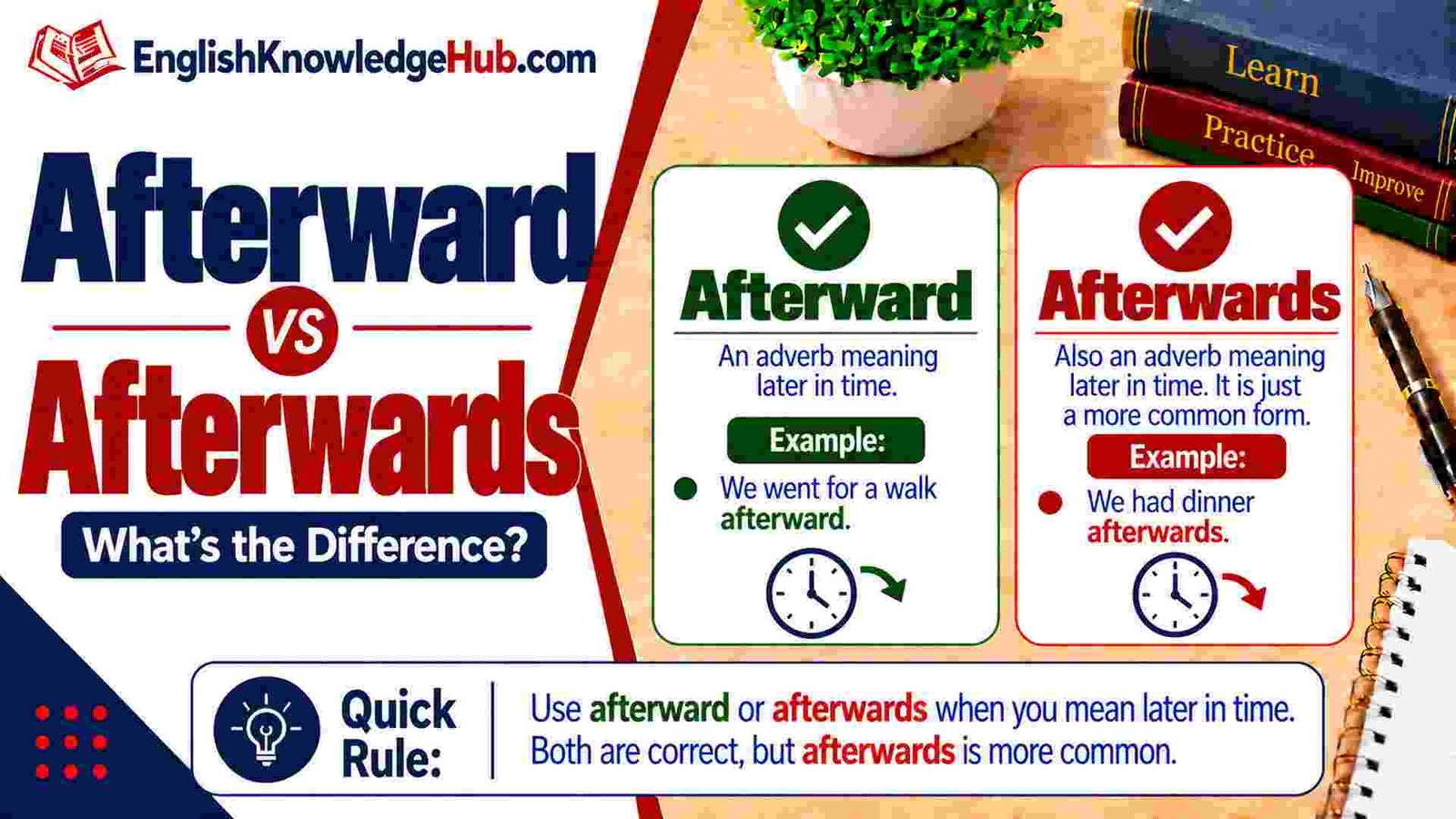
Afterward Vs Afterwards are both correct and mean “later” or “after something has happened.” The main difference is regional usage. Afterward is more common in American English, while afterwards is more common in British English. Their meaning and grammar are the same. You only need to choose the form that fits your style of English.
That small final s causes more confusion than it deserves. Once you understand the regional difference, the choice becomes very easy.
The Main Difference in One Simple Rule
The easiest way to remember Afterward Vs Afterwards is this:
American English usually uses “afterward.”
British English usually uses “afterwards.”
Both words tell us that something happens later than another event.
For example:
American English:
We finished lunch and went for a walk afterward.
British English:
We finished lunch and went for a walk afterwards.
Both sentences have the same meaning.
There is no change in time, tone, or grammar. Only the preferred regional form changes.
What Does Afterward Mean?
Afterward is an adverb. It means later, after that, or at a later time.
Example:
Maya finished her homework and watched a movie afterward.
The word tells us that watching the movie happened after the homework was finished.
Another example:
The doctor spoke with the patient and wrote a report afterward.
Again, the second action happened later.
You will see afterward most often in American writing and speech.
What Does Afterwards Mean?
Afterwards has the same meaning as afterward.
Example:
We visited the museum and had coffee afterwards.
The coffee happened after the museum visit.
Another example:
Leo completed the interview and sent a thank-you email afterwards.
Nothing changes in meaning if we write afterward instead.
The form with s is simply more common in British English.
Afterward Vs Afterwards at a Glance
| Word | Meaning | Common Region | Part of Speech |
|---|---|---|---|
| afterward | later, after that | American English | Adverb |
| afterwards | later, after that | British English | Adverb |
This is one of those cases where two forms are correct, but different English-speaking regions prefer different versions.
Why Does One Form Have an “S”?
The s in afterwards does not make the word plural.
That is important because some learners see the final s and think it changes the meaning. It does not.
Compare:
We spoke afterward.
We spoke afterwards.
Both mean that the conversation happened later.
The final s is simply part of a traditional form that became especially common in British English.
You can see a similar pattern with words such as toward/towards in some varieties of English.
Where Can You Put These Words in a Sentence?
Both words are flexible. They often appear at the end of a sentence, but they can also appear at the beginning or middle.
At the end:
The meeting ended, and we talked afterward.
At the beginning:
Afterward, we stopped at the bakery.
In the middle:
The manager afterward explained why the schedule had changed.
The middle position is possible, but it can sound less natural in everyday English. In most cases, putting the word at the end or beginning sounds smoother.
For learners, this is a safe pattern:
Event + and + action + afterward/afterwards.
Example:
We finished the test and checked our answers afterward.
Afterward Is Not the Same as After
This is where a real grammar difference appears.
After can come before a noun or a clause.
Examples:
after dinner
after the meeting
after I arrived
But afterward and afterwards normally stand alone as adverbs.
Correct:
We talked after dinner.
Correct:
Dinner ended, and we talked afterward.
Incorrect:
We talked afterward dinner.
Why?
Because afterward cannot normally introduce the noun dinner. Use after before the noun.
This difference matters much more than the choice between afterward and afterwards.
Simple Examples From Daily Life
Here are some natural examples you might hear in normal conversation.
I need to finish this call, but I can help you afterward.
Sara bought groceries and visited her sister afterwards.
We watched the game and ordered pizza afterward.
The rain stopped, and we went outside afterwards.
He cleaned the kitchen and rested afterward.
Each sentence shows one event followed by another event.
Workplace Examples
The same rule works in professional English.
The team presented the plan and discussed the budget afterward.
Nadia sent the proposal and called the client afterwards.
We completed the safety check and signed the form afterward.
The manager reviewed the complaint and spoke to the staff afterwards.
If you are writing for an American company, afterward may look more natural. In British business writing, afterwards may feel more familiar.
Academic and Formal Examples
Both forms also work in academic and formal writing.
The students completed the experiment and recorded their results afterward.
The samples were tested and stored in a secure room afterwards.
The committee approved the change and published its decision shortly afterward.
The witnesses were interviewed separately and contacted again afterwards.
Neither word is automatically informal.
You do not have to replace it with a harder word just because you are writing formally.
Afterward Vs Afterwards: Common Mistakes Learners Make
Mistake 1: Using Afterward Before a Noun
Incorrect:
We went home afterward the lesson.
Correct:
We went home after the lesson.
Explanation:
Use after before a noun phrase such as the lesson.
Mistake 2: Thinking Afterwards Means “More Than Once”
Incorrect idea:
Afterwards must mean several later events because it ends in s.
Correct:
Afterwards has the same meaning as afterward.
Explanation:
The s is not a plural ending.
Mistake 3: Treating One Form as Grammatically Wrong
Incorrect idea:
Afterwards is bad English.
Correct:
Both forms are standard English.
Explanation:
The difference is mostly regional, not grammatical.
Mistake 4: Mixing American and British Style Without a Reason
Less consistent:
I checked the email afterward and replied to the message afterwards.
Better in American English:
I checked the email afterward and replied to the message afterward.
Better in British English:
I checked the email afterwards and replied to the message afterwards.
Mixing the two is not a serious grammar error, but consistent writing usually looks cleaner.
Which Form Should You Use in American English?
In American English, afterward is normally the best choice.
For example:
We met the new neighbors and invited them over afterward.
The class ended, and I spoke with the teacher afterward.
American readers will still understand afterwards, but afterward usually sounds more natural.
Which Form Should You Use in British English?
In British English, afterwards is the more common form.
For example:
We went to the theatre and had dinner afterwards.
She finished the report and sent it to her manager afterwards.
British readers understand afterward as well, but afterwards often fits local style better.
Does the Choice Affect Formality?
No major difference exists in formality.
Both forms can appear in:
- conversation
- emails
- reports
- essays
- news writing
- academic work
The main question is not “Which one is more formal?”
The better question is:
Which variety of English am I using?
If you follow American spelling and style, choose afterward.
If you follow British spelling and style, choose afterwards.
A Quick Memory Trick
Here is an easy way to remember Afterward Vs Afterwards:
American English: afterward
British English: afterwards
Think:
U.S. = no final s
U.K. = final s is common
That simple memory trick is enough for most learners.
Afterward Vs Afterwards: Frequently Asked Questions
Is afterward or afterwards correct?
Both are correct. Afterward is more common in American English, while afterwards is more common in British English.
Do afterward and afterwards mean the same thing?
Yes. Both mean later, after that, or at a later time.
Is afterwards incorrect in American English?
No. It is correct and understandable, but American writers usually prefer afterward.
Is afterward incorrect in British English?
No. British readers understand it, but afterwards is more common in British usage.
Can I use afterward at the beginning of a sentence?
Yes.
Afterward, we drove back to the hotel.
This is completely natural.
Can I say “afterward the meeting”?
No. Say after the meeting instead.
Correct:
We talked after the meeting.
Or:
The meeting ended, and we talked afterward.
Is afterward formal or informal?
It can be used in both formal and informal English. The sentence and context decide the overall tone.
Final Takeaway
The difference in Afterward Vs Afterwards is mainly about regional preference, not meaning. Both words mean that something happens later. American English usually prefers afterward, while British English usually prefers afterwards.
Remember one more important rule: use after before a noun or clause, but use afterward or afterwards when the word stands on its own as an adverb.
For more simple grammar explanations, word comparisons, and practical English lessons, keep learning with EnglishKnowledgeHub.com.
