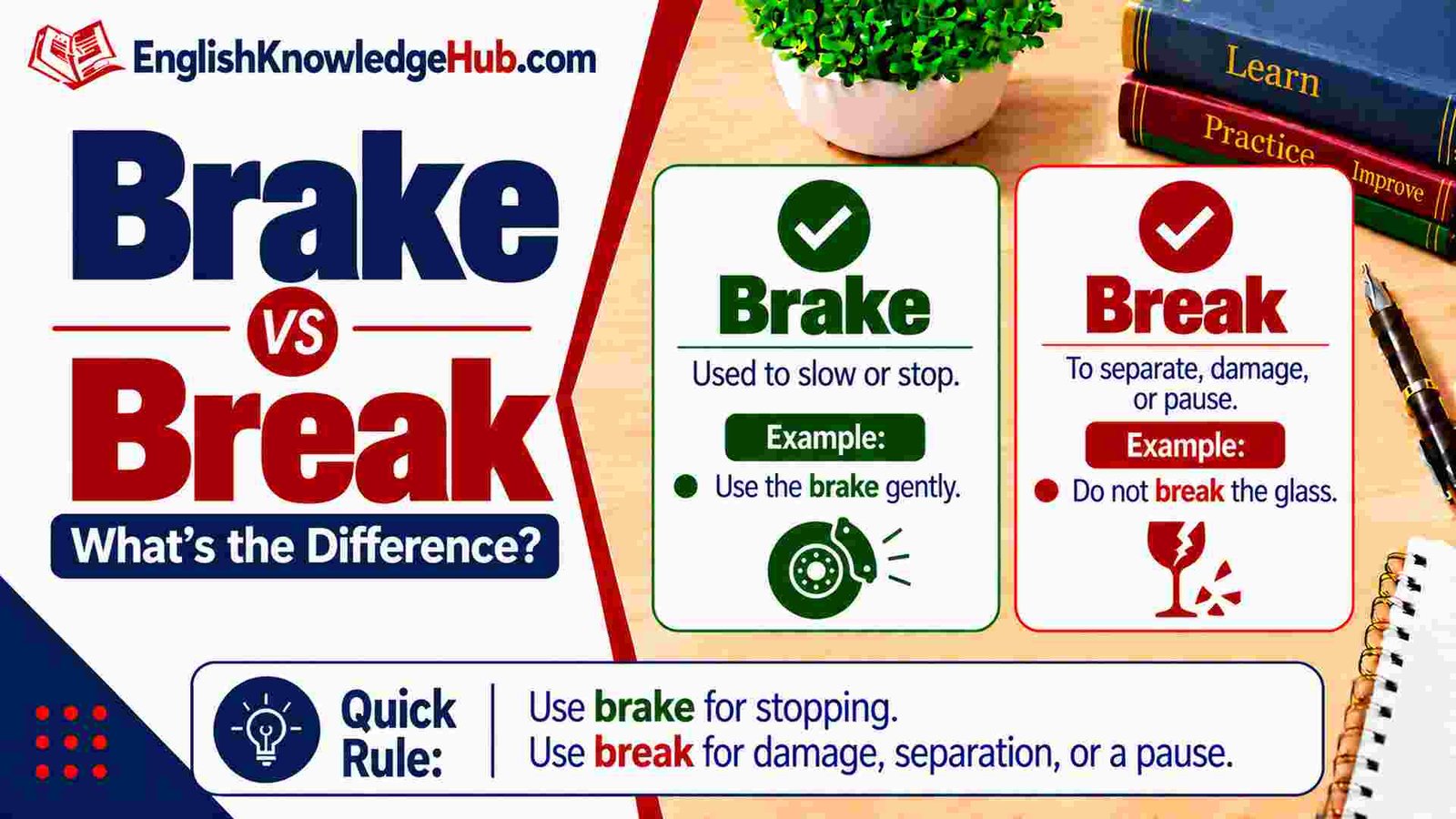
Brake Vs Break is easy to understand when you focus on meaning. Brake means to slow or stop a vehicle, or the part used to do that. Break means to damage something, separate it, stop an activity, disobey a rule, or take a short rest. Both words sound the same, but they are used very differently.
You may press the brake while driving, but you take a break when you need some rest. You can also break a cup, break a promise, or break a rule.
The sound will not help you choose the correct spelling. The meaning of the sentence will.
The Main Difference Between Brake and Break
The simplest rule is this:
Use brake when you are talking about slowing or stopping movement.
Use break when you are talking about damage, separation, interruption, rest, or not following something.
Here is a quick comparison:
| Word | Main Meaning | Example |
|---|---|---|
| Brake | A device that slows or stops movement | The bike needs a new brake. |
| Brake | To slow or stop a vehicle | Brake before the narrow turn. |
| Break | To damage or separate something | Do not break the glass. |
| Break | A short rest | We took a break after lunch. |
| Break | To disobey something | Never break a safety rule. |
This one table covers the basic difference in Brake Vs Break, but each word has a few important uses worth learning.
What Does Brake Mean?
Brake is usually connected with vehicles, machines, wheels, and movement.
As a noun, a brake is a part that helps slow down or stop something.
Examples:
- The front brake on my bicycle feels weak.
- Mia pressed the brake when the light turned red.
- The mechanic checked the car’s brakes before our trip.
- Please test the emergency brake before driving.
As a verb, brake means to slow down or stop by using the brakes.
Examples:
- Brake gently on wet roads.
- The driver braked when a child stepped near the street.
- The bus is braking as it reaches the station.
- He braked too late and passed the parking space.
The verb forms are simple:
brake → braked → braked
The -ing form is:
braking
Brake Can Also Mean “Slow Something Down”
Sometimes brake is used in a wider sense.
It can mean stopping or slowing progress.
For example:
- High costs could put the brakes on the project.
- The company put the brakes on new hiring.
- Poor sales may brake the firm’s expansion.
There is no real vehicle in these sentences. The idea of slowing down remains the same.
What Does Break Mean?
Break has many more meanings than brake.
One common meaning is to damage something.
- Do not break the wooden handle.
- Sam broke his old phone screen.
- The branch may break if you stand on it.
It can also mean to separate something into parts.
- Break the chocolate into four pieces.
- She broke the bread in half.
- We broke the large task into smaller steps.
Another common meaning is to stop following a rule, promise, law, or agreement.
- You should not break the rules.
- He never wants to break a promise.
- Anyone who breaks the agreement may lose access.
As a noun, break can mean a pause or period of rest.
- I need a short break.
- We have a lunch break at one o’clock.
- The students took a five-minute break.
The verb break is irregular.
Its forms are:
break → broke → broken
Examples:
- I do not want to break the chair.
- She broke the chair yesterday.
- The chair has been broken for a week.
Do not use breaked as the past tense.
A Simple Memory Trick
Here is an easy way to remember Brake Vs Break.
Think about a car.
A brake keeps the car from moving too fast.
Think about a glass.
A break can turn one whole glass into several pieces.
So:
Brake = slow or stop.
Break = damage, divide, pause, or disobey.
You can also remember that brake has the letter a, just like car has the letter a. It is not a grammar rule, but it can help you remember the spelling.
Take a Break or Take a Brake?
The correct phrase is:
take a break
A break means a short period when you stop working, studying, exercising, or doing another activity.
Examples:
- Let’s take a break after this chapter.
- I took a short break from cleaning the kitchen.
- The workers usually take a break at 10:30.
Incorrect:
We should take a brake after the meeting.
Correct:
We should take a break after the meeting.
Explanation:
The sentence means that people need a short rest. A brake is used to slow or stop movement.
Brake Pedal or Break Pedal?
The correct term is:
brake pedal
A brake pedal is the pedal you press to slow or stop a vehicle.
Examples:
- Her foot was already on the brake pedal.
- Press the brake pedal gently.
- The mechanic inspected the brake pedal.
Incorrect:
Press the break pedal before the corner.
Correct:
Press the brake pedal before the corner.
Explanation:
The sentence refers to a part of a vehicle, so brake is correct.
Other common vehicle terms include:
- brake light
- brake pad
- brake fluid
- brake system
- brake disc
- brake lever
Hit the Brakes or Hit the Breaks?
The correct expression is:
hit the brakes
It means to use the brakes quickly, usually because you need to slow down or stop.
Example:
- The driver hit the brakes when a deer appeared ahead.
- I had to hit the brakes when the traffic suddenly stopped.
Incorrect:
She hit the breaks near the crossing.
Correct:
She hit the brakes near the crossing.
Explanation:
The sentence is about a vehicle’s braking system. Therefore, brakes is the right spelling.
Braking Vs Breaking
The difference between braking and breaking follows the same rule.
Braking means slowing or stopping movement.
Examples:
- Hard braking can make passengers uncomfortable.
- The driver started braking before the sharp turn.
- Smooth braking is useful on wet roads.
Breaking means damaging, separating, interrupting, or violating something.
Examples:
- The child is breaking the biscuit into small pieces.
- You are breaking the rules.
- The workers are breaking the old wall apart.
Here is an example using both:
The driver was braking carefully to avoid breaking the boxes in the back.
The first word is about slowing the vehicle. The second is about damaging the boxes.
Break Down or Brake Down?
The normal expression is:
break down
A car, machine, or system breaks down when it stops working.
Examples:
- Our car broke down on the way home.
- The old printer may break down again.
- The heating system broke down during the night.
Break down can also mean to divide something into easier parts.
- The teacher broke down the grammar rule into three steps.
- Let me break down the cost for you.
It can also describe the failure of talks, communication, or a relationship.
- Communication broke down between the two teams.
Do not normally use brake down for these meanings.
Brake Vs Break in Everyday English
Daily conversation gives us many easy examples.
- I need a break after cleaning the house.
- Please brake before you reach the gate.
- Be careful not to break my mug.
- The bicycle brake needs fixing.
- We took a coffee break before noon.
- The driver braked when the cat crossed the road.
Notice that brake stays close to the idea of slowing movement, while break has several different jobs.
Workplace Examples
Both words can appear in professional English.
- The team took a short break before the presentation.
- Management put the brakes on unnecessary spending.
- Do not break company safety rules.
- The driver must brake slowly when carrying fragile goods.
- A system failure could break the normal workflow.
- We will have a 15-minute break between the two sessions.
Academic Examples
Students may also see these words in academic writing.
- The force helps brake the moving wheel.
- Researchers took a short break between the tests.
- Too much pressure may break the sample.
- The professor broke the problem into smaller parts.
- The experiment included a short break after each stage.
The same meanings remain clear even in formal or academic sentences.
Formal Writing Examples
Formal English does not change the basic rule.
- Staff members must not break the terms of the agreement.
- New limits may put the brakes on rapid spending.
- A short break in service is expected during maintenance.
- Drivers should brake gradually near the entrance.
- Any attempt to break the seal should be reported.
The word choice depends on meaning, not formality.
Common Mistakes With Brake and Break
Mistake 1
Incorrect:
I need a brake from work.
Correct:
I need a break from work.
Explanation:
You are talking about rest, so use break.
Mistake 2
Incorrect:
The mechanic changed the front breaks.
Correct:
The mechanic changed the front brakes.
Explanation:
Vehicle stopping parts are called brakes.
Mistake 3
Incorrect:
Please do not brake the plate.
Correct:
Please do not break the plate.
Explanation:
You are talking about damaging the plate.
Mistake 4
Incorrect:
The driver breaked suddenly.
Correct:
The driver braked suddenly.
Explanation:
The action means slowing a vehicle. The past tense of brake is braked.
Mistake 5
Incorrect:
She braked her promise.
Correct:
She broke her promise.
Explanation:
We say break a promise. The past tense of break is broke.
Do American and British English Use Them Differently?
There is no important difference in the main use of these words.
Both American and British English use brake for slowing or stopping a vehicle and break for damage, rest, interruption, or rule violations.
For example, both varieties use:
- brake pedal
- brake light
- take a break
- lunch break
- break a rule
- break a promise
So you do not need to learn separate American and British spellings for these common meanings.
FAQs About Brake Vs Break
Is it “give me a break” or “give me a brake”?
Give me a break is correct. It can mean “stop bothering me,” “be reasonable,” or simply allow someone some rest.
Is it coffee break or coffee brake?
Coffee break is correct. It means a short pause for coffee or rest.
Is it lunch break or lunch brake?
Use lunch break. The word break refers to a pause from work, school, or another activity.
Is it brake light or break light?
Brake light is correct when talking about the light on the back of a vehicle that comes on when the brakes are used.
What is the difference between brakes and breaks?
Brakes usually refers to parts that slow or stop a vehicle. Breaks can mean pauses, interruptions, or forms of the verb break.
Example:
The car’s brakes are new.
She takes two breaks during her shift.
Is it break a rule or brake a rule?
Use break a rule. Here, break means to disobey or violate the rule.
Why are brake and break easy to mix up?
They are homophones. This means they have the same pronunciation but different spellings and meanings. You must use the sentence’s meaning to choose the right word.
Final Thoughts
The easiest way to understand Brake Vs Break is to remember one clear difference. Use brake when something slows or stops movement. Use break for damage, separation, interruption, rest, or disobeying a rule.
A driver presses the brake. A worker takes a break. A child may break a toy. These simple examples show how different the two words really are.
For more easy English lessons, commonly confused words, grammar rules, and practical examples, explore EnglishKnowledgeHub.com and keep building your English one clear rule at a time.
