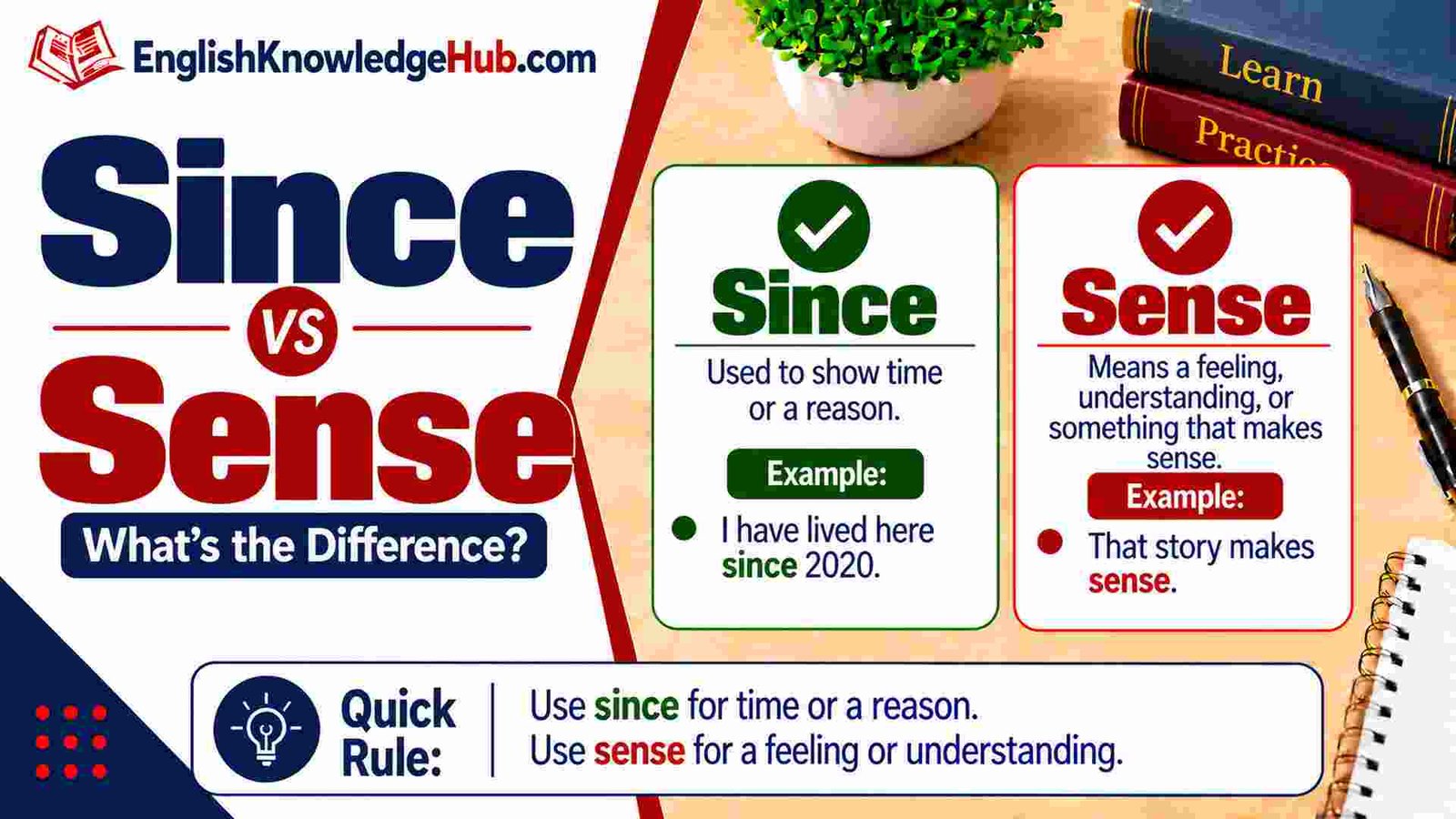
Since and sense are both correct English words, but they mean different things. “Since” usually talks about a starting time or gives a reason. “Sense” means understanding, feeling, judgment, meaning, or the ability to notice something. This guide explains the difference between Since Vs Sense with simple rules and clear examples.
The spelling difference is small, so it is easy to choose the wrong word when writing quickly. Their meanings, however, are not close at all.
A useful shortcut is:
Since = time or reason
Sense = understanding, feeling, or noticing
Look at these two sentences:
- I have lived here since May.
- That idea makes sense.
The first sentence is about time. The second is about understanding.
Once you know what your sentence means, the correct word is usually easy to choose.
Since Vs Sense: The Basic Difference
Here is a simple comparison:
| Word | Main Use | Example |
|---|---|---|
| Since | Starting point in time | I have waited since noon. |
| Since | Reason, similar to “because” | Since it is raining, we will stay inside. |
| Sense | Understanding or logic | Your answer makes sense. |
| Sense | Feeling or awareness | I had a sense that something was missing. |
| Sense | To notice or detect | She could sense his worry. |
The biggest thing to remember is that since often connects to time, while sense often connects to the mind, body, or understanding.
How “Since” Works With Time
One of the most common uses of since is to show when something started.
It points to a starting moment.
For example:
- since Monday
- since 7 a.m.
- since last winter
- since 2022
- since lunch
- since I moved here
Think of since as a finger pointing at a spot on a timeline.
Examples in everyday English
- I have known Maya since primary school.
- Dad has been outside since breakfast.
- We have not used that room since January.
- The dog has been sleeping since we came home.
In each example, since tells us when something began.
“Since” can come before a full sentence part
You can also put a clause after since.
For example:
- My reading has improved since I started practicing every night.
- The garden looks better since we planted new flowers.
- He has been happier since he changed jobs.
The words after since tell us the event that started the time period.
“Since” Can Also Give a Reason
Many learners only connect since with time. However, it can also mean something close to because.
For example:
Since the library is closed, we will study at home.
This means:
Because the library is closed, we will study at home.
More examples:
- Since you already know the answer, you can explain it to the group.
- Since the weather is good, we can eat outside.
- Since the printer is not working, I will email the file.
This use is correct in both formal and everyday English.
However, sometimes because is clearer.
Compare:
Since Omar arrived, the office has become busier.
This may mean that the office became busier from the time Omar arrived.
It could also sound as if Omar caused the office to become busier.
If you mean the second idea, because Omar arrived may make the reason clearer.
What Does “Sense” Mean?
The word sense has several uses, but they are connected by one general idea: understanding, feeling, noticing, or knowing.
This is one of the main points learners need when studying Since Vs Sense.
“Sense” can mean understanding
The phrase make sense is very common.
If something makes sense, it is clear or logical.
Examples:
- Your answer makes sense.
- The last sentence does not make sense to me.
- It makes sense to carry an umbrella when rain is expected.
- Her plan made perfect sense after she explained it.
Remember:
Correct: It makes sense.
Incorrect: It makes since.
“Sense” Can Mean Good Judgment
We also use sense when talking about good decisions or practical thinking.
Examples:
- Leo had the good sense to save his work before restarting the computer.
- Use common sense near a busy road.
- Her business sense helped the small shop make better choices.
- A little common sense can prevent many simple mistakes.
In these sentences, sense refers to judgment or practical understanding.
“Sense” Can Describe a Feeling
Sometimes sense means a feeling or awareness that is hard to explain.
For example:
- I had a sense that the room had changed.
- She felt a strong sense of relief after submitting the project.
- The old photograph gave him a sense of comfort.
- There was a sense of excitement before the school show.
Here, sense is not about time. It describes a feeling or awareness.
“Sense” and the Five Senses
The word is also used when talking about sight, hearing, smell, taste, and touch.
Examples:
- A fox has a strong sense of smell.
- Her sense of hearing is very sharp.
- Taste is one of the five traditional senses.
- Cold weather can affect the sense of touch in your fingers.
This meaning is easy to remember because all five senses help us notice the world around us.
“Sense” Is Also a Verb
Another useful difference in Since Vs Sense is that sense can be used as a verb.
As a verb, it means to notice, feel, or detect something.
Examples:
- I could sense that Ben was tired.
- The cat sensed movement under the table.
- She sensed a problem before anyone spoke.
- The machine can sense when the door is open.
You can often replace the verb sense with words such as notice, feel, or detect, depending on the sentence.
For example:
I sensed that something was wrong.
means roughly:
I felt that something was wrong.
Since Vs Sense in Different Situations
Seeing the words in real situations can make the rule easier to remember.
Daily conversation
Since:
I have not seen Ali since Saturday.
Sense:
That joke does not make sense to me.
At work
Since:
We have used this software since March.
Sense:
Your new schedule makes sense for the team.
At school
Since:
Lina has studied French since sixth grade.
Sense:
The paragraph gives the reader a clear sense of the writer’s opinion.
Formal writing
Since:
Since the payment was received late, the order was processed the following morning.
Sense:
The report gives a clear sense of how the project developed.
These examples show that the right choice depends on meaning, not just spelling.
Common Since and Sense Mistakes
These two words are often mixed up because their spelling and pronunciation are close.
Here are some common errors.
Mistake 1
Incorrect:
I have lived here sense 2020.
Correct:
I have lived here since 2020.
Explanation:
The sentence gives a starting point in time. Use since.
Mistake 2
Incorrect:
Your idea makes since.
Correct:
Your idea makes sense.
Explanation:
The fixed expression is make sense, which means to be logical or understandable.
Mistake 3
Incorrect:
I had a strange since of danger.
Correct:
I had a strange sense of danger.
Explanation:
The sentence describes a feeling or awareness, so sense is correct.
Mistake 4
Incorrect:
I can since that she is upset.
Correct:
I can sense that she is upset.
Explanation:
The word means “notice” or “feel,” so you need the verb sense.
Mistake 5
Incorrect:
We have been friends sense childhood.
Correct:
We have been friends since childhood.
Explanation:
Childhood is the starting point of the friendship.
Since and For Are Different Too
Learners who are checking Since Vs Sense often also have trouble with since and for.
The rule is simple:
Since = starting point
For = length of time
Compare:
- I have worked here since 2023.
- I have worked here for three years.
The first sentence tells us when the job started.
The second tells us how long the person has worked there.
More examples:
- since Tuesday
- for two days
- since 9 o’clock
- for five hours
- since childhood
- for many years
Ask yourself:
When did it start? → use since
How long did it last? → use for
A Quick Memory Trick
Here is an easy way to remember Since Vs Sense.
Think:
Since → Start
Both words begin with s, and since often shows when something started.
Then think:
Sense → See, smell, think, feel
All of these ideas connect to noticing or understanding.
You can also imagine:
Since = a calendar
Sense = a brain
The calendar reminds you of time.
The brain reminds you of understanding, thought, and awareness.
Do Since and Sense Sound the Same?
They sound similar, but they are not normally pronounced exactly the same.
Since has the vowel sound heard in words like sit.
Sense has the vowel sound heard in words like set.
In fast speech, the difference may be difficult to hear. That is why some spelling mistakes happen.
When you are writing, do not depend only on sound. Check the meaning of the sentence.
British and American English
There is no important British versus American difference in the basic use of these two words.
Both British and American English use:
- since for a starting point in time
- since to introduce a reason
- sense for meaning or understanding
- sense for feelings and perception
- sense as a verb meaning to notice or detect
The spelling also stays the same in both varieties of English.
An Easy Test Before You Choose the Word
When you are unsure, ask what the sentence is talking about.
If it is about a starting time, choose since.
If it gives a reason, since may also be correct.
If it is about meaning, choose sense.
If it is about judgment, choose sense.
If it is about a feeling, choose sense.
If someone is noticing or detecting something, choose sense.
Try these:
I have been awake ___ five this morning.
The sentence gives a starting time.
Correct: since
His explanation does not make ___.
The sentence is about meaning.
Correct: sense
I could ___ that everyone was nervous.
The word means “notice” or “feel.”
Correct: sense
Frequently Asked Questions
Is “ever since” or “ever sense” correct?
Ever since is correct.
Example:
She moved here in 2021 and has lived here ever since.
The phrase refers to the time from a past event until now or another later point.
Is it “make sense” or “make since”?
The correct phrase is make sense.
Example:
Your explanation makes sense now.
Here, sense refers to logic or understanding.
Can since mean because?
Yes. Since can introduce a reason.
Example:
Since everyone is ready, we can begin.
Here, since means something close to because.
Is sense a noun or a verb?
It can be both.
As a noun:
He has a good sense of direction.
As a verb:
She sensed that something had changed.
Is “since two years” correct?
Normally, no.
Use for two years because this describes a length of time.
Correct:
I have studied English for two years.
Use since with a starting point:
I have studied English since 2024.
Can I say “since yesterday”?
Yes.
Example:
I have felt tired since yesterday.
Yesterday gives the starting point.
Since Vs Sense: What is the easiest difference?
Remember this rule:
Since = time or reason.
Sense = meaning, judgment, feeling, or noticing.
Final Takeaway
The difference between since and sense becomes simple when you focus on meaning.
Use since when you are talking about a starting point:
We have lived here since June.
You can also use it to give a reason:
Since you are finished, you may go home.
Use sense when you mean understanding, judgment, feeling, perception, or noticing something:
Your idea makes sense.
I could sense that she was worried.
The easiest memory rule is simple: since points to time or reason, while sense relates to what you understand, feel, notice, or perceive.
Keep learning simple English rules, commonly confused words, and practical grammar with EnglishKnowledgeHub.com.
