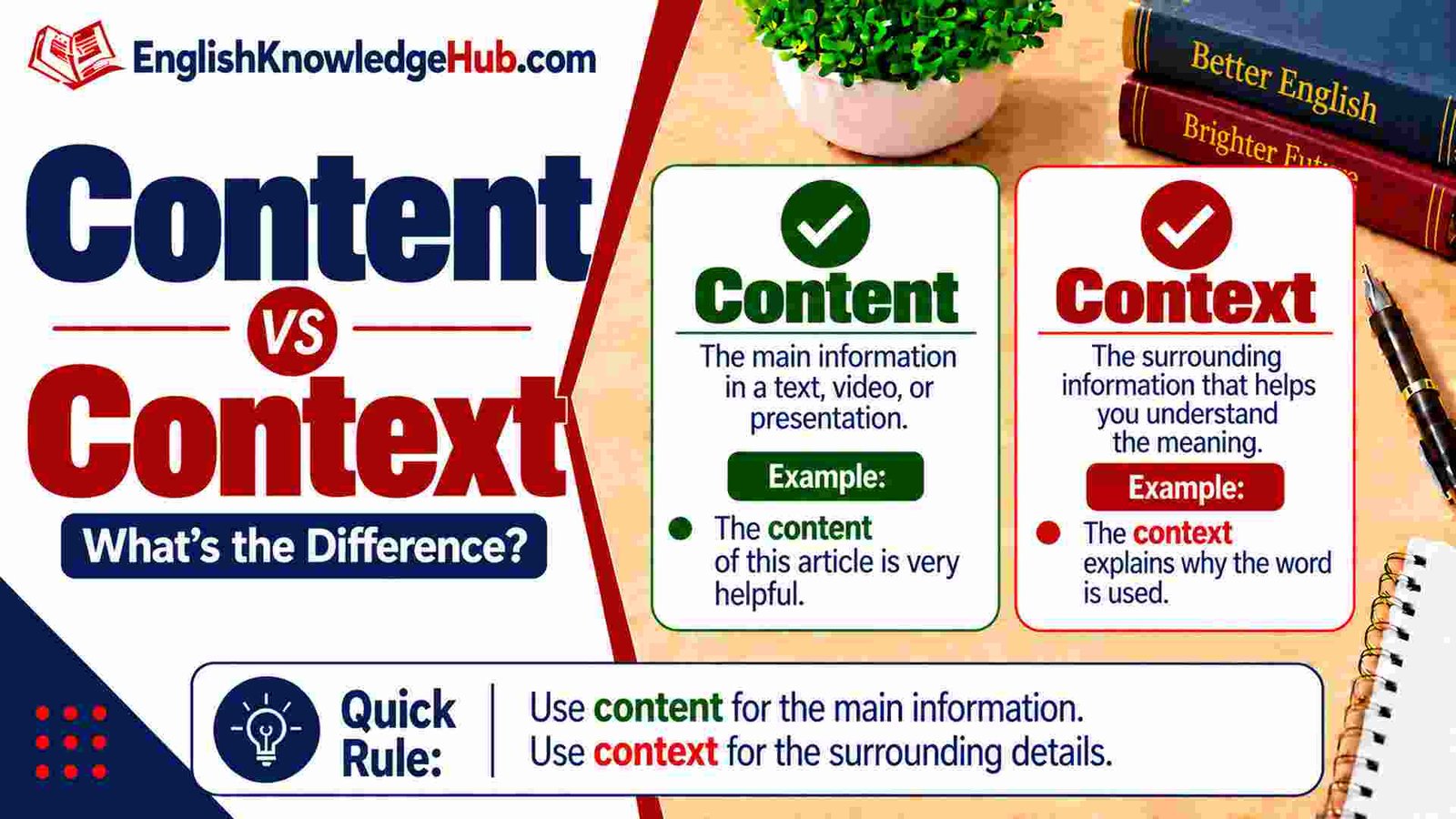
Content vs Context: Content is the actual information, ideas, words, pictures, or material being shared, while context is the situation or background that helps you understand that material correctly. In simple terms, content tells you what is there, while context helps you understand what it means in that particular situation.
The difference becomes much easier when you stop thinking of these words as two definitions to memorize. Think instead about a message and the situation around it.
Someone says:
“Nice work.”
The words nice work are the content.
Now imagine that your teacher says this after you get every answer correct. The words are praise.
But imagine your friend says the same words after you accidentally drop a cake on the floor. The words may be sarcastic.
The content stayed the same. The context changed.
That simple idea explains most cases of Content vs Context.
Think of a Picture and Its Frame
Here’s an easy way to understand Content vs Context.
Imagine a photograph hanging on a wall.
The photograph itself is like content. It contains the thing you are looking at.
The frame, label, date, location, and story behind the photograph are like context. They help you understand what you are seeing.
For example, a photo may show a large crowd standing in a street.
The content of the photo is the visible crowd, buildings, signs, and other details.
But you may still ask:
Why are the people there?
What year was the photo taken?
Which city is this?
Is it a celebration, a protest, or a parade?
The answers provide context.
So a useful memory rule is:
Content gives you the material. Context gives that material a setting.
What Content Means in Everyday English
When content is used as a noun here, it usually means the information or material found in something.
It can include:
- words
- ideas
- facts
- photographs
- videos
- lessons
- articles
- audio
- information on a website
You might say:
The content of the email was very clear.
You are talking about the information written in the email.
Or:
Our teacher added new content to the lesson.
Here, content means the material students will learn.
Online, the word is especially common.
Articles, videos, podcasts, social media posts, and graphics may all be called content.
For example:
- Elena creates travel content for her website.
- The course has useful video content.
- I checked the content before publishing the page.
- The presentation needs more visual content.
- This book contains helpful content for new learners.
In all these examples, the word points to the actual material being presented.
Context Helps Us See the Full Meaning
Context is the background, situation, or surrounding information that helps us understand something.
That information can come from many places.
It may include:
- what happened earlier
- who is speaking
- who is listening
- where something happens
- when it happens
- the speaker’s tone
- the relationship between people
- nearby words and sentences
- cultural background
- historical events
Consider this sentence:
“I can’t believe you did that.”
By itself, you cannot be sure what the speaker means.
Maybe a friend planned a wonderful surprise.
Or someone broke an expensive lamp.
Maybe a child finished a difficult task.
The sentence is the content. The surrounding situation provides the context.
This is why context is so important in real communication. A sentence can be grammatically correct but still be unclear if we do not know enough about the situation.
Content vs Context in One Simple Table
| Point | Content | Context |
|---|---|---|
| What it means | The information or material itself | The situation or background around it |
| Main question | What is being shared? | What helps me understand it? |
| In a message | The actual words | Who said them, when, why, and how |
| In a lesson | The material being taught | Background that helps explain the lesson |
| On a website | Articles, videos, images, or other material | Information surrounding or explaining that material |
| In a story | Events, words, and ideas | Time, place, culture, history, and circumstances |
The table shows why the two words are connected but cannot normally replace each other.
See the Difference Through One Conversation
Suppose Adam receives this text from his manager:
“Please come to my office at 3:00.”
That is the content of the message.
Adam understands the words, but he may not understand the reason.
Was there a problem with his work?
Is the manager giving him a new project?
Does the manager simply need help with something?
Adam has the content but not much context.
Now imagine another coworker says:
“The manager is meeting everyone individually to explain next month’s schedule.”
That new information gives Adam context.
He can now understand the original message more accurately.
This is a useful example because it shows that understanding every word does not always mean understanding the complete message.
How Context Changes the Meaning of Words
Context is especially important when a word has more than one meaning.
Look at the word bat.
A bat flew out of the old shed.
The surrounding words suggest an animal.
Now read:
Leo carried his bat onto the field.
The new context tells us that bat means a piece of sports equipment.
The word itself has not changed. The words around it guide us toward the correct meaning.
English learners often do this naturally without noticing it.
When you do not know one word in a sentence, the surrounding sentence may give clues about its meaning. These are often called context clues.
For example:
Nora was exhausted, so she went to bed before eight.
Even if a learner does not know exhausted, the second part of the sentence suggests that it means very tired.
Where Content Is the Better Word
Choose content when you are talking about the actual material or information.
Daily conversation
I have not read the content of the message yet.
The speaker means the information inside the message.
The video has funny content.
The speaker means what appears in the video.
Workplace English
Please check the content of the report before Friday.
The employee needs to review the report itself.
We need fresh content for the company website.
The company needs new articles, images, videos, or similar material.
Academic English
The exam will cover the content from the first five lessons.
This means the material taught in those lessons.
Her essay has strong content, but the organization needs work.
The ideas and information are good even though the structure could improve.
Formal English
The committee reviewed the content of the proposal.
This means the actual information contained in the proposal.
Where Context Is the Better Word
Use context when you mean the background or situation needed to understand something.
Daily conversation
Can you give me some context before you show me the message?
The speaker wants to know what happened around the message.
His comment sounds much kinder when you know the context.
Background information changes how the words are understood.
Workplace English
The designer needs more context about the project.
The designer needs more information about the purpose, audience, or situation.
Without context, the numbers in this chart could be misleading.
The numbers need supporting information before readers can judge them properly.
Academic English
Students should study the historical context of the speech.
They should learn about the events and conditions surrounding the speech.
Formal English
The statement should be considered in its original context.
The statement should be judged together with the circumstances around it.
Common Mistakes Learners Make
Mistake 1: Asking for Content When You Need Background
Incorrect:
Can you give me more content about why Sarah left the meeting?
Correct:
Can you give me more context about why Sarah left the meeting?
Explanation:
You are asking for background information about a situation. Context is therefore the natural choice.
Mistake 2: Calling Website Material Context
Incorrect:
We need to publish more context on the blog.
Correct:
We need to publish more content on the blog.
Explanation:
Articles, videos, guides, and images published on a website are normally called content.
Mistake 3: Confusing Lesson Material With Background
Incorrect:
The context of today’s lesson includes three reading exercises.
Correct:
The content of today’s lesson includes three reading exercises.
Explanation:
The exercises are part of the lesson material. They are content.
Mistake 4: Using Content When Meaning Depends on a Situation
Incorrect:
Her reply sounds rude because I do not know the content.
Correct:
Her reply sounds rude because I do not know the context.
Explanation:
You already know what she said. What you lack is information about the situation around her reply.
“In Context” and “Out of Context”
Two very common English expressions are in context and out of context.
When something is understood in context, it is considered together with the information around it.
For example:
The sentence makes more sense in context.
Perhaps the sentences before and after it explain what the writer means.
When something is taken out of context, important information around it has been removed.
For example:
That quote sounds harsh when it is taken out of context.
The speaker may have said something before or after the quote that changes its meaning.
This expression is common when people discuss interviews, news reports, speeches, social media posts, and arguments.
Content and Context in Reading
Good readers pay attention to both ideas.
First, they notice the information directly presented by the writer.
Then they consider what surrounds that information.
Suppose a story says:
Maria pulled her coat tightly around her and hurried toward the station.
The direct content tells us what Maria does.
But the surrounding text may tell us that it is midnight, snow is falling, and she has only five minutes before the last train leaves.
Those details create context.
They help us understand why Maria is hurrying.
Without them, we can still understand the sentence, but we cannot understand the full situation as clearly.
Content and Context in Writing
Strong writers also think about both.
Imagine you write:
The company changed its policy.
The sentence gives information, but your reader may immediately have questions.
Which policy?
Why did it change?
When does the change begin?
Who will be affected?
Adding useful background can make the writing clearer:
After receiving several customer complaints about late refunds, the company changed its refund policy in June.
Now readers receive both information and useful background.
This does not mean every sentence needs a long explanation. Too much background can make writing slow and tiring.
A good writer gives enough context for the reader to understand the content without adding unnecessary details.
Content vs Context in Social Media
The difference is especially important online.
A screenshot may show exactly what someone wrote, so it contains real content.
But the screenshot might leave out earlier messages.
Imagine this exchange:
Person A: Are you free tomorrow?
Person B: No, and please stop asking.
If you see only Person B’s reply, it may appear unnecessarily rude.
But perhaps earlier messages show that Person A asked the same question ten times.
The missing conversation changes the context.
This is one reason short clips, screenshots, quotations, and social media posts can sometimes create misunderstandings. Seeing the words is not always the same as seeing the full situation.
Content and Contents Are Not Always the Same
There is another small grammar point worth learning.
When content means information, ideas, or subject matter, we usually use it as an uncountable noun.
Natural:
The website has useful content.
Not normally:
The website has many contents.
However, contents can refer to the separate things inside a container, bag, box, book, or similar object.
For example:
She emptied the contents of her backpack onto the table.
Here, contents means the things inside the backpack.
You may also see:
table of contents
This is the list of chapters or sections near the beginning of a book.
One More Meaning of Content
The word content also has another meaning that is not connected with website material or information.
As an adjective, content can mean happy or satisfied with your situation.
For example:
Jonah felt content after a quiet evening at home.
This use is pronounced differently from the noun meaning information.
In:
The content of the book is useful,
the stress is usually on the first part: CON-tent.
In:
She feels content with her life,
the stress is normally on the second part: con-TENT.
The spelling is the same, but the meaning and pronunciation are different.
A Fast Test for Choosing the Right Word
When you hesitate between the two terms, ask:
Am I talking about the actual thing being said, shown, written, or taught?
Use content.
Am I talking about information that helps explain why, when, where, or how that thing should be understood?
Use context.
For example:
The article contains five tips for saving money.
Those tips are content.
The article was written for college students living away from home for the first time.
That information gives context.
This quick test solves most cases of Content vs Context without requiring you to memorize a long rule.
British and American English
There is no important British and American English difference in the basic use of these two words.
Both content and context are standard in British and American English.
A British speaker and an American speaker may use different vocabulary in some situations, but the central distinction remains the same:
Content refers to the material or information.
Context refers to the surrounding situation or background that helps explain it.
Frequently Asked Questions
What is the simple difference between Content vs Context?
Content is what is being communicated or included. Context is the background or situation that helps you understand it correctly.
Can content and context mean the same thing?
No. The ideas are connected, but they are not synonyms. One refers to the material itself, while the other refers to what surrounds or explains that material.
What does “give me some context” mean?
It means “give me more background information so I can understand the situation.”
For example, if someone shows you an angry message without explaining what happened before it, you may ask for context.
What is content on a website?
Website content can include articles, images, videos, guides, product descriptions, audio, and other material provided to visitors.
What does “out of context” mean?
It means that words, actions, or information have been separated from important surrounding details. Removing those details may change how something appears or sounds.
Is a sentence content or context?
A sentence can be content if it is the information being communicated. Other sentences around it may provide context that helps explain its meaning.
What are context clues?
Context clues are hints in nearby words or sentences that help you understand the meaning of an unfamiliar word or phrase.
For example:
The path was slippery because heavy rain had covered it with mud.
The words about rain and mud help explain what slippery means.
Final Reminder
The key idea behind Content vs Context is simple: content is the information or material itself, while context is the surrounding information that helps you understand that material properly.
If you remember only one picture, think of a message sitting inside a larger situation. The message is the content. The situation around it is the context.
Knowing this difference will help you understand conversations, essays, news reports, workplace messages, social media posts, and English vocabulary more accurately.
For more clear grammar lessons, word comparisons, and practical English explanations, continue learning with EnglishKnowledgeHub.com.
