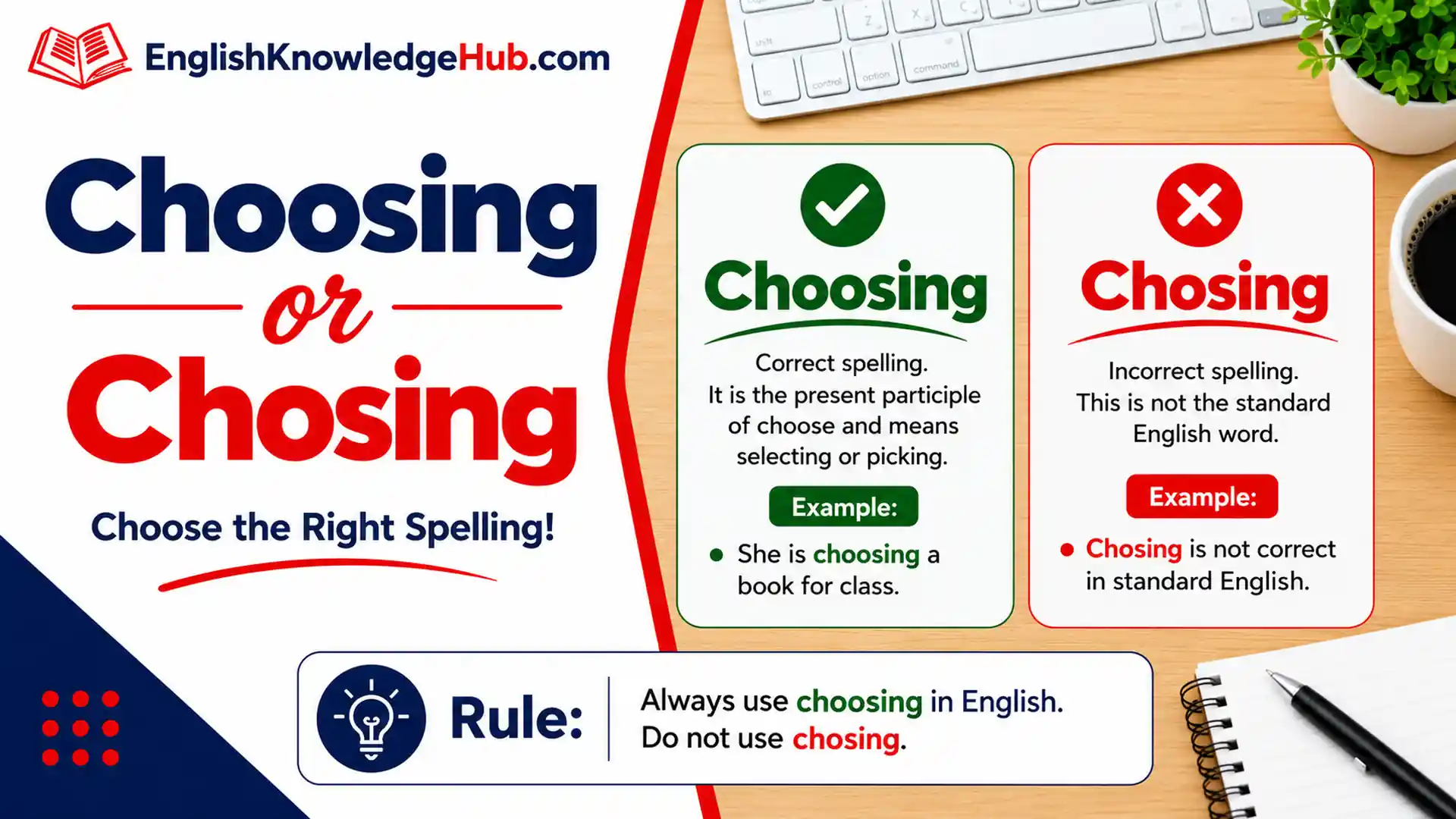
Choosing or Chosing: Choosing is the correct spelling, while chosing is incorrect. The word comes from choose. When you add -ing, you remove the final silent e, but you keep both o’s. This gives you choosing. Below, you will learn the spelling rule, meaning, grammar use, and the difference between choose, chose, chosen, and choosing.
Many learners make this spelling mistake because chose is also a correct English word. However, chose is the past tense of choose. It is not the word we use to build the -ing form.
Once you see how the word changes, the spelling becomes much easier to remember.
Why Choosing Is the Correct Spelling
The base verb is:
choose
To make its -ing form, remove the final e:
choose → choos
Then add -ing:
choos + ing = choosing
Only the final e disappears. The two o’s remain because they are part of the main spelling of choose.
This pattern is similar to other verbs ending in a silent e:
- write → writing
- move → moving
- save → saving
- use → using
- choose → choosing
You do not remove extra letters from the middle of the word.
That is why chosing is not the correct form.
The Mistake Usually Comes From the Word Chose
One reason learners struggle with Choosing or Chosing is the word chose.
Chose is a real English word, but it has a different grammatical job.
Compare these sentences:
I choose the quiet table whenever I work here.
I chose the quiet table yesterday.
I am choosing a table now.
The first sentence uses the present form.
The second uses the past form.
The third describes an action happening now.
A learner may see chose and think that adding -ing gives chosing. It does not.
You form choosing from choose, not from chose.
A useful way to remember this is:
choose → choosing
not:
chose → chosing
What Does Choosing Mean?
Choosing means deciding which person, object, action, or option you want from two or more possibilities.
You might be choosing a shirt, choosing a college, choosing a new phone, or choosing what to say during an important conversation.
For example:
Nina is choosing a birthday gift for her father.
She has several possible gifts and is deciding which one to buy.
Another example:
Choosing a quieter room helped Sam study better.
Here, the word refers to the act of selecting one room from several options.
The meaning is closely connected to selecting, picking, and deciding between options.
How Choosing Works in a Sentence
The word can perform more than one grammatical function.
Choosing as Part of a Continuous Verb
We often use it after a form of be when an action is in progress.
I am choosing a new pair of glasses.
The committee is choosing a chairperson this afternoon.
They were choosing paint colors when I arrived.
In these examples, the act of deciding is happening over a period of time.
Choosing as a Gerund
The word can also act like a noun. In this use, it names the activity of making a choice.
Choosing a strong password takes only a few minutes.
Choosing carefully can prevent unnecessary costs.
Her favorite part of the project was choosing the photographs.
The spelling does not change. Context tells us how the word works in the sentence.
Choose, Chose, Chosen, and Choosing
These four forms come from the same verb, but you should not use them interchangeably.
| Word | Grammar Form | Main Use | Example |
|---|---|---|---|
| choose | Base or present form | Present decisions | I choose tea when I need less caffeine. |
| chose | Simple past | Finished past decisions | I chose tea at breakfast. |
| chosen | Past participle | Used with have, has, had, or in passive forms | We have chosen a new team leader. |
| choosing | Present participle or gerund | Ongoing action or activity | We are choosing a new team leader. |
The form that causes the most spelling trouble is choosing because learners often connect it with chose.
Keep the base verb choose in mind instead.
A Simple Teacher’s Trick for Remembering the Spelling
When you forget whether to write Choosing or Chosing, look at choose first.
The word already has two o’s.
Your only job before adding -ing is to remove the final e.
Think:
Keep the double o. Drop the final e. Add ing.
So:
choose
becomes:
choosing
You can also remember the sound. The first part of choosing still sounds like choose.
That connection can help you avoid copying the spelling of chose by mistake.
Choosing and Chose Do Not Sound the Same
The spelling difference also appears in pronunciation.
Choose sounds roughly like chooz.
Choosing begins with the same sound:
CHOO-zing
But chose has a different vowel sound:
chohz
Compare these sentences aloud:
I choose the bus most mornings.
I chose the bus yesterday.
I am choosing the bus today because it is raining.
Hearing the difference can help you remember which form fits your sentence.
Daily Conversation Examples
You will often use this word when talking about ordinary decisions.
We’re choosing a restaurant for Friday night.
Ella spent ages choosing a color for her bedroom.
Are you still choosing between those two jackets?
I’m choosing the smaller bag because it is easier to carry.
He had trouble choosing what to order for lunch.
These examples all involve a person making a selection.
Workplace Examples
The word also appears naturally in professional English.
The sales team is choosing a new system for managing customer accounts.
Choosing the lowest price is not always the best business decision.
Our supervisor spent the morning choosing staff for the new project.
We considered delivery speed before choosing a supplier.
The company is choosing between two locations for its next office.
In professional writing, correct spelling matters. A spelling mistake in an email, proposal, or report can distract the reader from your message.
Academic Examples
Students and researchers often use the word when talking about topics, courses, evidence, or methods.
Choosing a focused research question can make an essay easier to organize.
The students compared several sources before choosing the strongest evidence.
Choosing the correct formula is the first step in solving the problem.
She asked her adviser for help before choosing her final course.
The researchers considered cost and accuracy when choosing their method.
These uses are standard in both school and university writing.
Formal Writing Examples
You can also use the word in formal documents.
Applicants should consider travel time when choosing an interview location.
The board reviewed several proposals before choosing the final contractor.
Care should be taken when choosing materials for outdoor use.
The panel considered experience and leadership skills when choosing the successful candidate.
The word is suitable for both formal and informal English. You do not need a different spelling or special alternative in professional writing.
Common Mistakes and How to Correct Them
Mistake 1: Dropping One O
Incorrect:
Maria is chosing a dress for the ceremony.
Correct:
Maria is choosing a dress for the ceremony.
Explanation:
The base verb is choose. Remove only the final e before adding -ing. Both o’s stay.
Mistake 2: Building the Word From Chose
Incorrect:
The teacher is chosing three students for the competition.
Correct:
The teacher is choosing three students for the competition.
Explanation:
Chose is the simple past form. The -ing form comes from choose, not from chose.
Mistake 3: Using Choosing for a Finished Past Event
Incorrect:
I choosing that hotel last summer.
Correct:
I chose that hotel last summer.
Explanation:
The action finished in the past, so the simple past form chose is correct.
Mistake 4: Using Chose After Am, Is, or Are
Incorrect:
We are chose a new name for the club.
Correct:
We are choosing a new name for the club.
Explanation:
When am, is, or are forms a continuous tense, the main verb normally needs its -ing form.
Is Chosing Ever Correct?
For the verb choose, chosing is an incorrect spelling in standard English.
It is not a special American form, British form, informal spelling, or older standard variation that learners need to use.
Write choosing in schoolwork, emails, articles, reports, applications, social media posts, messages, and professional documents.
If you type chosing, many spell-checking tools will also flag it as an error.
Choosing or Chose: What Is the Difference?
These words belong to the same verb, but they express different time relationships.
Use chose for a completed action in the past:
Liam chose the blue bicycle last week.
Use choosing when the decision is in progress:
Liam is choosing a bicycle now.
You can also use choosing as the name of an activity:
Choosing a bicycle takes time when several models are available.
Look at the time of the action. That usually tells you which form you need.
Choosing vs. Chosen
Learners also sometimes mix up choosing and chosen.
Use choosing when someone is making a selection:
We are choosing the winners this morning.
Use chosen when the selection has already been made or when the word appears with have, has, or had:
We have chosen the winners.
Another example:
The chosen design will appear on the front cover.
Here, chosen describes the design that was selected.
Choosing vs. Choice
Choosing and choice are related, but they have different grammatical roles.
Choosing refers to the act of making a decision.
Choice usually refers to the decision itself or to an available option.
Compare:
Choosing a seat took longer than expected.
My first choice was the seat beside the window.
You can also compare these three forms:
I need to choose a seat.
I am choosing a seat.
That seat is my first choice.
Understanding this word family can improve both spelling and sentence structure.
Do American and British English Use the Same Spelling?
Yes. Both American English and British English use choosing.
There is no regional spelling difference here.
For example:
American English:
We are choosing a new apartment.
British English:
We are choosing a new flat.
The noun may change from apartment to flat, but the spelling of choosing stays the same.
One Quick Check Before You Write
If you are unsure about the spelling, return to the base verb.
Ask yourself:
What is the original verb?
The answer is choose.
Then remove the final e and add -ing.
choose → choosing
Do not use chose as your spelling guide because chose belongs to the past tense.
That small check can save you from the most common error.
FAQs About Choosing or Chosing
Is choosing or chosing correct?
Choosing is correct. Chosing is a spelling error when you mean the -ing form of choose.
Why does choosing have two o’s?
The base verb choose already contains two o’s. When you add -ing, you remove the final e, not one of the o’s.
Is it chooseing or choosing?
Choosing is correct. English normally drops the final silent e before adding -ing in this word.
What is the past tense of choose?
The simple past tense is chose.
Example:
I choose carefully.
I chose carefully yesterday.
What is the past participle of choose?
The past participle is chosen.
Example:
They have chosen a new captain.
Can choosing start a sentence?
Yes. It can act as a gerund and name an activity.
Choosing a reliable mechanic can save you money later.
Is chosing acceptable in informal messages?
No. Informal writing does not change the standard spelling. Use choosing in casual messages as well as formal writing.
What is the easiest way to remember choosing?
Start with choose, keep both o’s, remove the final e, and add -ing:
choose → choosing
Final Takeaway
When deciding between Choosing or Chosing, use choosing. The spelling comes directly from choose. Remove the final silent e, keep both o’s, and add -ing.
Remember the four main forms:
choose, chose, chosen, choosing
Once you know which form expresses the time and meaning you need, both your spelling and grammar become much easier to control.
For more simple lessons on spelling, grammar, confusing words, and everyday English usage, visit EnglishKnowledgeHub.com.
