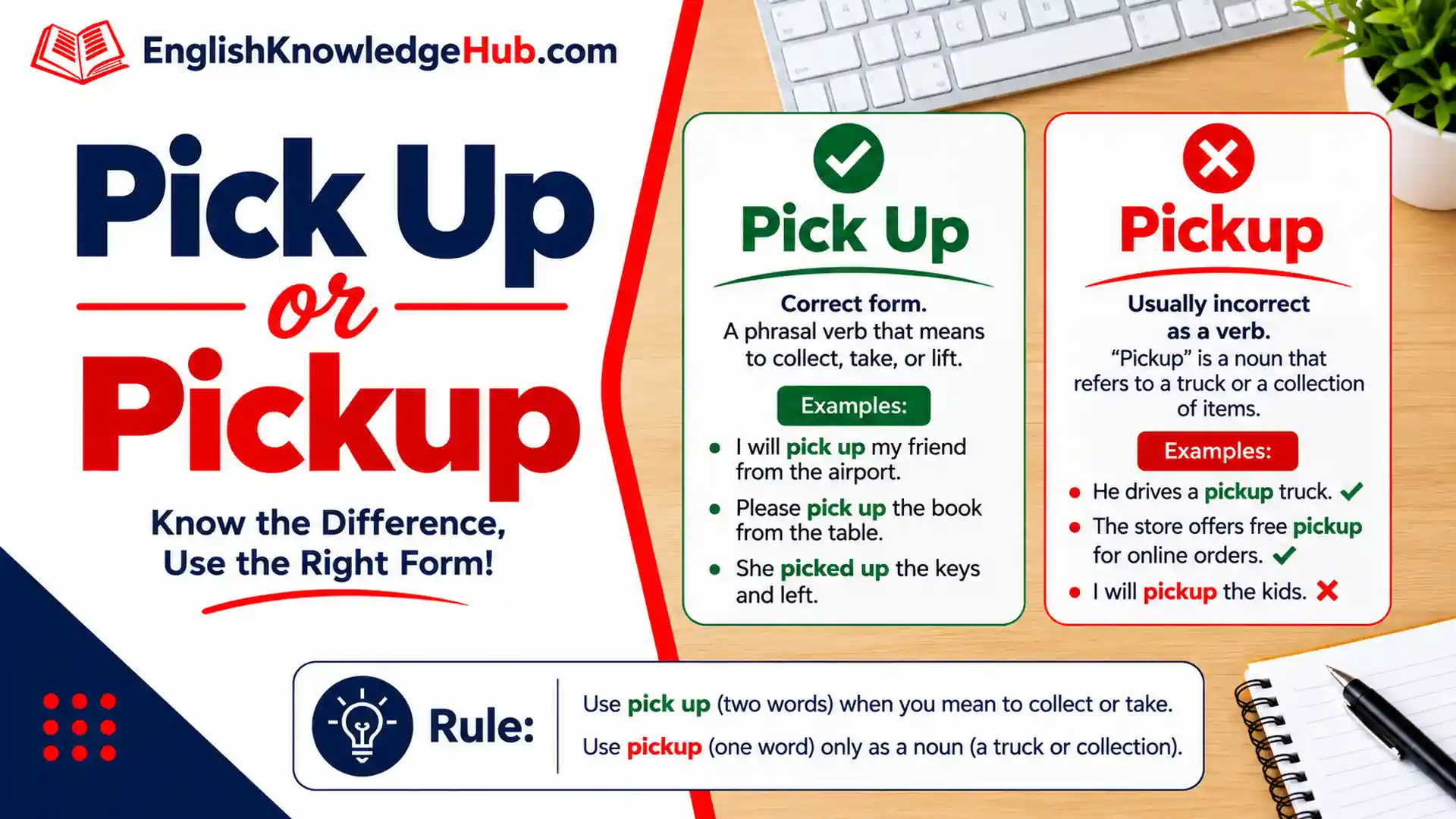
Pick up and pickup are both correct, but they have different grammar jobs. Use pick up as a verb when someone performs an action, such as collecting a person or lifting an object. Use pickup as a noun or adjective, such as in “package pickup” or “pickup truck.” This article explains the difference with simple examples.
The easiest way to remember the rule is to think about action and naming.
If someone is doing something, use two words: pick up.
If you are naming something or describing another noun, use one word: pickup.
Pick Up or Pickup: The Main Difference
The difference depends on how the words work in a sentence.
Pick up is usually a phrasal verb. It describes an action.
Pickup is usually a noun or adjective. It names something or describes a type of thing.
Compare these sentences:
- I will pick up the parcel after lunch.
- Your parcel is ready for pickup.
In the first sentence, someone will perform an action.
In the second sentence, pickup names the collection of the parcel.
Here is a simple comparison:
| Form | Grammar Use | Example |
|---|---|---|
| pick up | Verb | I will pick up the keys. |
| pickup | Noun | The pickup is at 5 p.m. |
| pickup | Adjective | Use the pickup area. |
This small grammar difference decides which spelling you need.
When to Use Pick Up as a Verb
Use pick up when the words describe an action.
The meaning can change depending on the sentence, but the form stays as two words when it works as a verb.
Pick Up Meaning to Lift Something
You can use it when someone lifts an object.
- Please pick up the cup from the table.
- Noah picked up the fallen book.
- I bent down to pick up my pen.
In each example, a person performs an action.
Incorrect:
Please pickup your bag.
Correct:
Please pick up your bag.
Explanation:
The sentence tells someone to perform an action, so the verb should be written as two words.
Pick Up Meaning to Collect Someone
It can also mean going somewhere to collect a person.
- I will pick up Sara after school.
- Can you pick me up from the station?
- Leo picked up his brother after practice.
This use is common when talking about cars, airports, offices, schools, and other places.
Incorrect:
Dad will pickup me at six.
Correct:
Dad will pick me up at six.
Explanation:
The expression is a verb. Also, when the object is a pronoun such as me, it normally goes between pick and up.
Pick Up Meaning to Collect an Item
You can also use the two-word form when collecting something from a store, office, restaurant, or other place.
- I need to pick up my medicine.
- She will pick up the documents tomorrow.
- We stopped to pick up our food order.
Again, the phrase describes what someone does.
Pick Up Can Have More Than One Meaning
The phrasal verb has several common meanings in English.
Understanding them helps you recognize why the two words stay separate.
To Learn Something Naturally
Sometimes it means learning something through experience.
- Mina picked up a few Italian words on her trip.
- Children often pick up phrases from adults.
- I picked up a useful editing trick from my coworker.
The person is still doing or experiencing an action, so use two words.
To Improve
It can also mean becoming stronger or more active.
- Business began to pick up in April.
- Sales may pick up before the holiday.
- The wind started to pick up after sunset.
Here, pick up means increase or improve.
To Answer a Phone
In everyday speech, it can mean answering a phone call.
- I called twice, but he did not pick up.
- Please pick up when your phone rings.
- She finally picked up after the third call.
This use is informal and very common in conversation.
When to Use Pickup as One Word
Use pickup when it works as a noun or adjective.
This is where many learners make mistakes because both forms sound the same when spoken.
Pickup as a Noun
As a noun, pickup can refer to the act or time of collecting someone or something.
Examples:
- The hotel offers airport pickup.
- Your grocery pickup is ready.
- The driver confirmed the morning pickup.
- School pickup begins at 3 p.m.
Notice that pickup names an event or service.
Compare:
- I will pick up the package.
- The package is ready for pickup.
The first is an action.
The second is a noun.
Pick Up or Pickup an Order?
This is one of the most common learner questions.
Use pick up when someone performs the action.
- I will pick up my order tonight.
- Can you pick up the food on your way home?
- She picked up her order before work.
Use pickup when you name the collection service or option.
- My order is ready for pickup.
- Choose store pickup at checkout.
- Pickup is available until 8 p.m.
A helpful memory trick is:
You pick up an order, but an order is ready for pickup.
That simple sentence shows both forms clearly.
Pickup Truck Is One Word
When talking about the vehicle, write pickup as one word.
Examples:
- My uncle drives a red pickup truck.
- They loaded the boxes into the pickup.
- A pickup was parked near the gate.
Do not write pick up truck.
Incorrect:
We rented a pick up truck.
Correct:
We rented a pickup truck.
Explanation:
Here, pickup names a type of vehicle. It is not an action.
Pickup Before Another Noun
The one-word form can also describe another noun.
Common examples include:
- pickup point
- pickup service
- pickup time
- pickup area
- pickup location
- pickup truck
- pickup game
Example sentences:
- Please wait at the pickup point.
- Our pickup time is 4:30.
- The store has a separate pickup counter.
- We played a pickup basketball game after class.
In these examples, pickup helps describe the noun that follows it.
How Pronouns Work With Pick Up
This point is important because the phrasal verb is often separable.
With a full noun, both positions may be possible in many sentences.
- Pick up the box.
- Pick the box up.
Both are natural.
But with a pronoun such as it, him, her, me, or them, place the pronoun in the middle.
Correct:
- Pick it up.
- I will pick her up.
- Can you pick me up?
- We picked them up after dinner.
Incorrect:
- Pick up it.
- I will pick up her.
- Can you pick up me?
The object pronoun belongs between the two parts of the phrasal verb.
Daily Conversation Examples
Here are some natural examples from everyday speech:
- Can you pick up some bread after work?
- I will pick you up near the entrance.
- My coffee is ready for pickup.
- Please pick up your coat before leaving.
- The pickup area is behind the building.
- Did anyone pick up the phone?
These sentences show that grammar, not pronunciation, controls the spelling.
Workplace Examples
The same rule applies in professional situations.
- The courier will pick up the files at noon.
- Please arrange a pickup for Thursday.
- Sales started to pick up after the campaign.
- The pickup location has changed.
- I picked up a useful shortcut during training.
The two-word form stays a verb even in formal or business English.
Academic Examples
You may also see both forms in school or academic writing.
- Students can pick up new vocabulary through regular reading.
- Enrollment began to pick up in late August.
- The report showed a pickup in student attendance.
- The device can pick up weak signals from nearby equipment.
Notice the difference in these two examples:
- Attendance picked up in March.
- There was a pickup in attendance in March.
The first uses a verb.
The second uses a noun.
Formal Writing Examples
In formal writing, pick up is still correct when it describes an action.
However, writers sometimes choose more formal verbs such as collect, retrieve, improve, or increase.
Everyday:
- I will pick up the documents tomorrow.
More formal:
- I will collect the documents tomorrow.
Everyday:
- Demand began to pick up.
More formal:
- Demand began to increase.
This does not mean the phrasal verb is wrong. It simply means another word may fit a formal tone better.
Common Mistakes to Avoid
Mistake 1: Writing the Verb as One Word
Incorrect:
I need to pickup my daughter.
Correct:
I need to pick up my daughter.
Explanation:
Someone is performing an action, so use the two-word verb.
Mistake 2: Writing the Noun as Two Words
Incorrect:
Your order is ready for pick up.
Correct:
Your order is ready for pickup.
Explanation:
Here, the word names a collection event or service, so the one-word noun is the better standard form.
Mistake 3: Using Two Words for the Vehicle
Incorrect:
He bought a new pick up truck.
Correct:
He bought a new pickup truck.
Explanation:
Pickup names the type of truck, so it is one word.
Mistake 4: Putting a Pronoun in the Wrong Place
Incorrect:
Can you pick up me after work?
Correct:
Can you pick me up after work?
Explanation:
With a pronoun, put the object between pick and up.
What About Pick-Up With a Hyphen?
You may sometimes see pick-up with a hyphen.
The hyphenated noun appears in some styles and varieties of English. It is not always an error.
For example, you may see:
- pick-up point
- pick-up service
However, pickup is very common in modern American English, especially for nouns and adjectives.
For clear American English writing, these forms work well:
- pickup truck
- pickup service
- pickup area
- ready for pickup
The verb should still remain two words:
- pick up the parcel
- pick me up
- pick up speed
Do not write a hyphen in the verb.
Incorrect:
I will pick-up the package.
Correct:
I will pick up the package.
American and British English
The main grammar rule is the same in American and British English.
Both use pick up as a verb.
- We will pick up the children.
- Please pick up your shoes.
The noun and adjective may sometimes appear as pickup or pick-up, depending on style and region.
If you write mainly for an American audience, pickup is usually the simplest choice for the noun and adjective.
An Easy Test You Can Use
When you are not sure which form to choose, ask yourself one question:
Is someone doing an action?
If yes, use pick up.
Example:
- I need to pick up the parcel.
Someone performs the action.
Now ask:
Am I naming the collection, thing, or type?
If yes, use pickup.
Example:
- Parcel pickup ends at 6 p.m.
Here, the word names the collection service.
You can remember it this way:
Action = pick up
Thing or description = pickup
Frequently Asked Questions
Is pick up one word or two?
Use pick up as two words when it is a verb. For example, “Please pick up the book.”
Is pickup a correct word?
Yes. Pickup is a correct noun and adjective. Examples include “airport pickup,” “pickup truck,” and “pickup location.”
Is it pick up or pickup an order?
Use pick up an order when describing the action. Use pickup when naming the service, as in “order pickup.”
Is it ready for pick up or ready for pickup?
Ready for pickup is the standard form in American English because pickup works as a noun.
Is pickup truck one word or two?
Write pickup truck. The word pickup is written as one word in this use.
Can pickup be a verb?
In standard English, use pick up as the verb. Write “I will pick up the package,” not “I will pickup the package.”
Is pick-up with a hyphen correct?
It can appear as a noun or adjective in some styles, especially outside American usage. However, pickup is common and clear in modern American English.
Which is correct, pick me up or pick up me?
Pick me up is correct. When the object is a pronoun, it goes between pick and up.
Final Takeaway
The choice between Pick Up Or Pickup becomes simple once you look at the grammar job.
Use pick up when someone performs an action:
- I will pick up the children.
- Please pick up the papers.
- Sales began to pick up.
Use pickup when naming or describing something:
- airport pickup
- pickup truck
- pickup service
- ready for pickup
The easiest rule to remember is:
Pick up is an action. Pickup is a thing or description.
Keep practicing this pattern, and the difference will soon feel natural. For more clear grammar lessons, word comparisons, and practical English examples, visit EnglishKnowledgeHub.com.
