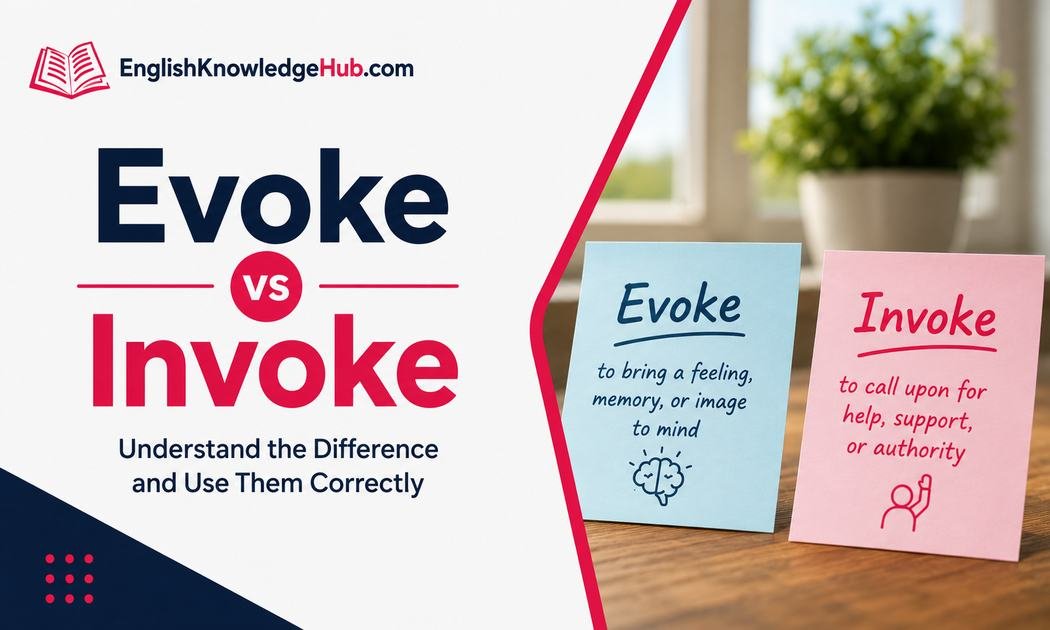
Evoke vs Invoke is a common word pair that can be confusing because both words sound similar but have different meanings. Evoke means to bring a feeling, memory, thought, or image into someone’s mind. Invoke usually means to call on, use, or ask for something, such as a law, rule, authority, or higher power. The easiest way to remember the difference is this: evoke brings something to mind, while invoke calls something into use.
In this guide, you will learn the difference between these two words, when to use each one, common mistakes, and simple examples that make the meanings easy to remember.
Evoke vs Invoke at a Glance
Here is the simplest comparison:
| Word | Simple Meaning | Commonly Used With | Example |
|---|---|---|---|
| Evoke | Bring a feeling, memory, or image to mind | memories, feelings, emotions, images | The song evoked happy memories. |
| Invoke | Call on, use, or ask for something | laws, rules, rights, authority, help | The lawyer invoked the law. |
Cambridge defines evoke as making someone remember something or feel an emotion. Oxford also explains it as bringing a feeling, memory, or image into the mind.
Invoke often means using a law or rule, mentioning something as support, asking someone or a higher power for help, or starting a computer process.
What Does Evoke Mean?
Evoke means to cause a memory, feeling, thought, or mental image to appear in someone’s mind.
You do not directly ask for that memory or feeling. Something causes it to appear naturally.
For example:
- The smell of fresh bread evoked memories of my grandmother’s kitchen.
- Her speech evoked feelings of hope.
- The old photo evoked childhood memories.
- The music evoked a peaceful mood.
- The story evoked images of village life.
Notice the pattern?
Something happens first, such as hearing music, seeing a photo, or smelling food. That thing then brings a memory, emotion, or image into your mind.
Common Things That Evoke Something
You will often see evoke with words such as:
| Evoke + | Example |
|---|---|
| memories | The smell evoked old memories. |
| emotion | The film evoked strong emotion. |
| feelings | Her words evoked feelings of joy. |
| sympathy | His story evoked sympathy. |
| an image | The poem evoked an image of the sea. |
| a response | The comment evoked an angry response. |
| nostalgia | The old song evoked nostalgia. |
Cambridge gives memory and emotion as central uses of the word, while Oxford includes feelings, memories, and mental images.
What Does Invoke Mean?
Invoke usually means to call on, use, mention, or ask for something because you want its power, help, support, or effect.
This word often appears in formal English.
For example:
- The lawyer invoked a legal rule.
- She invoked her right to remain silent.
- The speaker invoked history to support his point.
- They invoked God’s help during the ceremony.
- The command invoked the computer program.
Oxford lists several uses of invoke, including using laws or rules, citing people or ideas as support, asking for help, and starting a computer program.
Common Things That People Invoke
| Invoke + | Example |
|---|---|
| a law | The court invoked the law. |
| a rule | The manager invoked a company rule. |
| a right | She invoked her legal rights. |
| authority | He invoked his authority as director. |
| a principle | The writer invoked a basic principle. |
| God’s help | They invoked God’s help. |
| a name | She invoked his name to support her claim. |
| a program | The command invokes the program. |
Cambridge also notes that invoke can mean bringing a law into use or asking someone, especially a god, for help.
Evoke vs Invoke: What Is the Main Difference?
The main difference is simple:
Use evoke when something brings a feeling, memory, thought, or image into the mind. Use invoke when someone calls on, uses, or appeals to a rule, law, authority, person, idea, or power.
Think about the direction of the action.
Evoke Brings Something Out
A song can bring a memory out of your mind.
That means it evokes the memory.
The song evoked memories of school.
Invoke Calls Something In
A lawyer can call a law into use.
That means the lawyer invokes the law.
The lawyer invoked a law to support the case.
This small idea can help you choose the correct word in most situations.
Easy Memory Trick 🧠
Want a fast way to remember them?
Think:
Evoke = Emotion
Both start with E.
If something brings an emotion, memory, or image to mind, evoke will often be the right word.
Now think:
Invoke = Involve or call into use
If someone brings a law, rule, authority, or power into use, think invoke.
One Line Memory Rule
Evoke brings something to mind. Invoke brings something into action or use.
This rule will work in most everyday cases.
Evoke vs Invoke Examples
Seeing the words side by side makes the difference much clearer.
| Evoke | Invoke |
|---|---|
| The smell evoked memories of home. | The lawyer invoked a legal rule. |
| The photo evoked sadness. | She invoked her right to remain silent. |
| The music evoked a feeling of peace. | The leader invoked his authority. |
| The painting evoked images of summer. | They invoked God’s protection. |
| His story evoked sympathy. | The writer invoked history to support the claim. |
Ask yourself one question:
Is something creating a memory or feeling, or is someone calling on something for help or support?
If it creates a memory or feeling, choose evoke.
If someone calls on or uses something, choose invoke.
Evoke and Invoke Can Sometimes Overlap
Here is where things get a little tricky.
Some dictionaries recognize invoke as meaning to cause a feeling or mental image. Cambridge includes this meaning, and Oxford lists it too. However, Oxford notes that some people prefer evoke for this use.
For example:
The speech invoked memories of the past.
You may see this sentence.
However, this version usually sounds more natural:
The speech evoked memories of the past.
So, when you mean bring a memory, image, or feeling to mind, evoke is usually the safer and clearer choice.
Evoke vs Invoke in Emotional Writing
Use evoke when talking about emotional effects.
For example:
- The movie evokes fear.
- The poem evokes sadness.
- Her voice evokes comfort.
- The photo evokes nostalgia.
- The story evokes sympathy.
The related adjective evocative also describes something that brings strong memories, ideas, or images to mind. Cambridge defines it as something that makes you remember or imagine something.
For example:
The novel contains evocative descriptions of country life.
Here, evocative tells us that the descriptions strongly bring images or memories to mind.
Evoke vs Invoke in Law
In legal English, invoke is very common.
To invoke a law, right, rule, or legal protection means to use it or formally rely on it.
For example:
- The company invoked a clause in the contract.
- She invoked her legal rights.
- The court invoked an earlier ruling.
- The lawyer invoked the rule during the case.
Cambridge describes this meaning as using a law to achieve something, while Oxford describes it as mentioning or using a law or rule as a reason for an action.
You would not normally say:
The lawyer evoked the law.
That would sound wrong if you mean the lawyer used the law.
The correct choice is:
The lawyer invoked the law.
Evoke vs Invoke in Religion
Invoke can also mean asking a god or higher power for help.
For example:
- They invoked God’s blessing.
- The prayer invoked divine help.
- The ceremony invoked the protection of the gods.
This meaning comes from the idea of calling upon someone or something.
Cambridge describes invocation as a request or appeal for help, especially from a god.
Evoke has a different role.
A religious song might evoke peace or hope because it causes those feelings.
Compare:
The prayer invoked God’s help.
The prayer evoked feelings of hope.
The first sentence calls for help.
The second sentence describes an emotional effect.
Evoke vs Invoke in Computers
You may also see invoke in computer and software writing.
In computing, invoke can mean to start or call a program, command, function, or process.
For example:
- This command invokes the program.
- The system invokes the function when the user clicks the button.
- The script invokes another process.
Oxford lists starting a program as a computing meaning of invoke, and Cambridge gives the same use in business and IT English.
Evoke does not normally have this meaning.
Common Mistakes With Evoke and Invoke
Because the words look and sound similar, people often mix them up.
Mistake 1: Using Invoke for a Simple Memory
Less natural:
The smell invoked memories of my childhood.
Better:
The smell evoked memories of my childhood.
Why?
The smell caused memories to appear. It did not call on those memories for help or support.
Mistake 2: Using Evoke With a Law
Incorrect in normal legal use:
The lawyer evoked the law.
Correct:
The lawyer invoked the law.
The lawyer used the law as support.
Mistake 3: Using Evoke for a Right
Incorrect:
He evoked his right to remain silent.
Correct:
He invoked his right to remain silent.
A person invokes a right because they choose to use or rely on it.
Mistake 4: Thinking the Words Are Exact Synonyms
They can overlap in a few cases, but they are not fully interchangeable.
Evoke mainly deals with feelings, memories, responses, and mental images.
Invoke mainly deals with calling on, using, citing, or asking for something.
Evoked vs Invoked
The same difference applies to the past tense forms.
Evoked means brought a feeling, memory, image, or response to mind.
Her letter evoked many memories.
Invoked means called on, used, or appealed to something.
The lawyer invoked a legal protection.
Cambridge confirms that evoked is the past form of evoke and invoked is the past form of invoke.
Evoking vs Invoking
The present forms also follow the same rule.
Evoking means causing a feeling, image, memory, or response.
The music is evoking memories of summer.
Invoking means calling on, using, or referring to something.
The lawyer is invoking a legal rule.
This distinction stays the same even when the verb form changes.
Evocation vs Invocation
The nouns can also confuse people.
Evocation
Evocation means the act of bringing a feeling, memory, idea, or image to mind.
The book is a beautiful evocation of childhood.
Cambridge describes evocation as making someone remember or imagine something.
Invocation
Invocation means the act of calling on, using, mentioning, or appealing to something.
It can refer to a law, idea, authority, or prayer.
His invocation of the law changed the case.
The ceremony began with an invocation.
Cambridge includes both the use of a law or idea and a request for help from a higher power in its meaning of invocation.
Quick Test: Which Word Should You Use?
Try these sentences before checking the answers.
- The old song _____ memories of school.
- The lawyer _____ a rule during the hearing.
- Her story _____ sympathy from the audience.
- The officer _____ his legal authority.
- The smell of coffee _____ memories of home.
- They _____ God’s help before the journey.
Answers
- evoked
- invoked
- evoked
- invoked
- evoked
- invoked
Did you notice the pattern?
Memories and feelings usually go with evoke.
Rules, rights, authority, and requests for higher help usually go with invoke.
Frequently Asked Questions
What is the simple difference between evoke and invoke?
Evoke means to bring a feeling, memory, thought, or image to mind. Invoke means to call on, use, or appeal to something, such as a law, rule, right, authority, or higher power.
Does evoke mean remember?
Not exactly.
Evoke means to cause a memory to appear. The person then remembers something.
For example:
The smell evoked memories of summer.
The smell caused the memories to return.
Does invoke mean call upon?
Yes.
Invoke can mean to call upon someone or something for help, power, support, or authority.
It can also mean using a law, rule, right, or computer process.
Can you invoke a memory?
You may see invoke used with memories or feelings, and some dictionaries accept this meaning. However, evoke is usually the clearer choice when you simply mean that something brings a memory or feeling to mind.
Can you evoke an emotion?
Yes.
This is one of the most common uses of evoke.
The film evoked fear and sadness.
Do you evoke or invoke a response?
Usually, evoke a response means to cause a response.
His comment evoked an angry response.
Invoke would not normally be the best choice in this sentence.
Do you evoke or invoke a law?
Use invoke a law.
To invoke a law means to use or rely on that law.
Do you evoke or invoke a right?
Use invoke a right.
For example:
She invoked her right to speak with a lawyer.
What is another word for evoke?
Depending on the sentence, similar words include:
- bring to mind
- remind
- stir
- cause
- create
- awaken
- bring back
What is another word for invoke?
Depending on the sentence, similar words include:
- call on
- appeal to
- use
- cite
- mention
- rely on
- call upon
Final Takeaway
The difference between evoke vs invoke becomes easy once you focus on what the action does.
Use evoke when something brings a memory, feeling, thought, image, or response to mind. Use invoke when someone calls on, uses, cites, or appeals to a law, rule, right, authority, idea, person, or higher power.
Just remember this simple rule: evoke brings something to mind, while invoke calls something into use.
Want to master more confusing English words without hard grammar lessons? Explore more simple word comparisons and English guides at EnglishKnowledgeHub.com.
