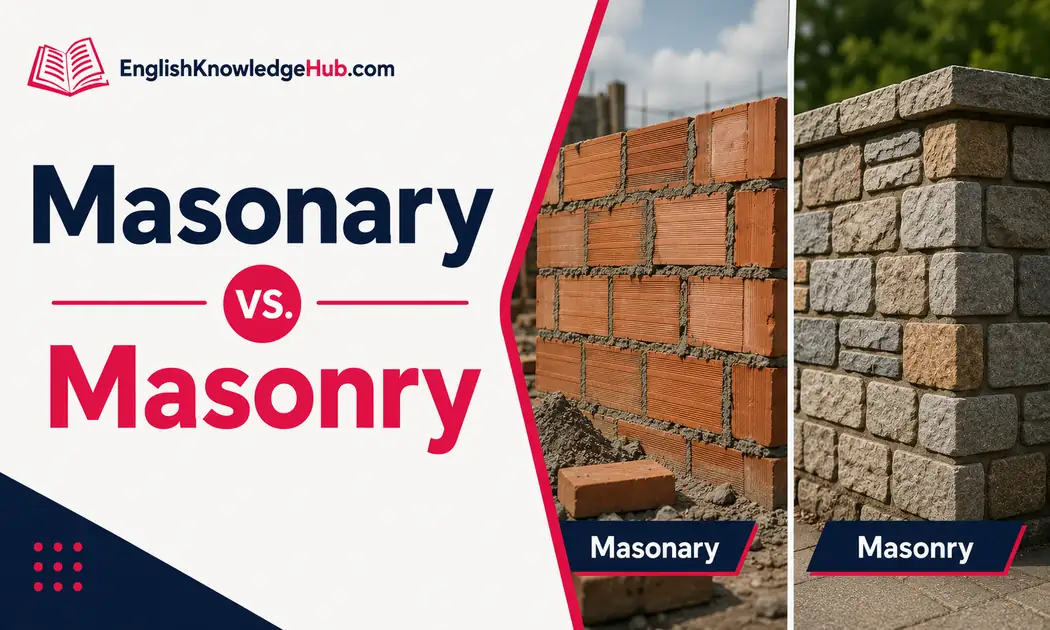
Are you confused about Masonary vs Masonry? The correct spelling is masonry. Masonary is a common spelling mistake.
Masonry is the work or trade of building with materials such as brick and stone. It can also mean structures or parts of buildings made from those materials.
This guide explains the correct spelling, meaning, pronunciation, origin, word history, usage, examples, and common mistakes in simple English.
Masonary vs Masonry: Quick Answer
Masonry is correct. Masonary is incorrect.
| Word | Correct? | Simple Meaning |
|---|---|---|
| Masonry | ✅ Yes | Work or structures made with brick, stone, or similar materials |
| Masonary | ❌ No | A misspelling of masonry |
Correct: The old house has beautiful stone masonry.
Wrong: The old house has beautiful stone masonary.
If you mean brickwork, stonework, or the work of a mason, use masonry.
What Does Masonry Mean?
Masonry is a noun.
It can mean:
- the work of building with brick or stone
- the trade or skill of a mason
- a wall or part of a building made from brick or stone
- finished building work made from these materials
For example:
The masonry around the window needs repair.
Here, masonry means the brick or stone part of the building.
Masonry as Building Work
You can use masonry when talking about building or repair work.
Example:
The house needs masonry work.
Here, the word refers to work done with brick, stone, or similar materials.
Masonry as Part of a Building
Masonry can also mean the finished part of a wall or building.
Example:
The old masonry has started to crack.
Here, the word means the brick or stone part of the structure.
Masonry as a Trade
Masonry can also mean the skill or job of a mason.
Example:
He learned masonry from an experienced worker.
What Does Masonary Mean?
Masonary is not the standard spelling. If you mean brickwork, stonework, or the trade of a mason, the correct spelling is masonry.
The incorrect form often appears because people add an extra a before the ending.
Compare these examples:
❌ masonary wall
✅ masonry wall
❌ brick masonary
✅ brick masonry
❌ masonary work
✅ masonry work
❌ masonary repair
✅ masonry repair
So, you do not need to learn a separate meaning for masonary. It is simply a spelling error.
What Is the Difference Between Masonary and Masonry?
The Masonary vs Masonry difference is simple.
Masonry is a correct English word. Masonary is not the standard spelling.
| Masonary | Masonry |
|---|---|
| Incorrect spelling | Correct spelling |
| Avoid in normal writing | Use in normal writing |
| No separate building meaning | Refers to the work, trade, or structure |
| Often caused by spelling confusion | Standard English form |
There is no special kind of construction called masonary.
If you are talking about walls, brickwork, stonework, or the work of a mason, write masonry.
Why Do People Write Masonary Instead of Masonry?
Why does this mistake happen so often?
The main reason is the word mason.
A mason is a person who works with brick or stone. Because the word ends in mason, some people think the longer word should be:
mason + ary = masonary
But that is not correct.
The correct form is:
mason + ry = masonry
The way the word sounds can also cause confusion. It does not have a strong extra vowel sound before the final letters, so people may spell it the way they think they hear it.
How Do You Spell Masonry?
The correct spelling is:
M A S O N R Y
There is no extra a.
Wrong:
M A S O N A R Y
Correct:
M A S O N R Y
A simple trick is:
MASON + RY = MASONRY
You already know how to spell mason. Just add ry.
How Do You Pronounce Masonry?
Masonry is pronounced roughly like “MAY-suhn-ree” (/ˈmeɪsənri/).
You can think of it as three easy sounds:
MAY + suhn + ree
Keeping the pronunciation simple can also help you remember the spelling.
Where Did the Word Masonry Come From?
The word masonry has been part of English for hundreds of years.
It came through older French forms linked to the word mason. A mason was a worker who shaped or built with stone.
Over time, the word masonry came to mean the work, skill, and structures linked with that kind of building.
Today, people commonly use the word for brick and stone work. Modern building work may also include concrete masonry units, often called concrete blocks.
The important spelling point has stayed the same:
masonry, not masonary.
Mason and Masonry: What Is the Difference?
These words are closely linked, but they do not mean the same thing.
Mason
A mason is a person who works with brick, stone, or similar building materials.
Example:
The mason repaired the wall.
Masonry
Masonry means the work, skill, or finished structure.
Example:
The masonry needs repair.
Here is an easy sentence to remember:
The mason repaired the masonry.
So:
- Mason = the worker
- Masonry = the work or structure
Is Masonry the Same as Brickwork?
Not exactly.
Brickwork means work done with bricks.
Masonry is a wider term. It can include brick and stone work.
For example:
- a brick wall can be masonry
- a stone wall can be masonry
- brickwork only uses bricks
So, brickwork can be a type of masonry, but masonry does not always mean brickwork.
Is Masonry Only Stone Work?
No.
Stone has a strong link to the history of masonry, but the word is not limited to stone today.
Common types include:
Brick Masonry
Brick masonry uses bricks to build walls and other parts of a structure.
Example:
The builder used brick masonry for the front wall.
Stone Masonry
Stone masonry uses natural or cut stone.
Example:
The old church has beautiful stone masonry.
Concrete Masonry
Modern construction can also use concrete masonry units, often called concrete blocks.
These blocks can be used to build walls and other parts of a structure.
Example:
The workers used concrete masonry blocks for the new wall.
This is why concrete can come up when people talk about modern masonry, even though simple dictionary meanings often focus first on brick and stone.
Common Uses of Masonry
You may see masonry in many building and repair terms.
Common phrases include:
- masonry wall
- masonry work
- masonry repair
- masonry contractor
- masonry construction
- brick masonry
- stone masonry
- concrete masonry
- masonry blocks
- masonry surface
- masonry building
- masonry cement
These phrases often appear in building work, home repair, property reports, and construction websites.
Real World Examples of Masonry
Want to see how the word works in normal sentences?
Home Repair
The masonry around the window needs repair.
Brick Wall
The builder checked the brick masonry for cracks.
Old House
The old house has beautiful stone masonry.
Repair Work
We hired a masonry contractor to fix the wall.
Property Check
The worker found damage in the outside masonry.
Learning a Trade
He wants to learn masonry as a skilled trade.
Garden Wall
The new garden wall uses brick masonry.
Building Project
The team finished the masonry before painting the wall.
These examples show how the correct word fits naturally into everyday writing.
Masonary vs Masonry in Work and Business Writing
Correct spelling matters when you write for customers, employers, or a business.
You may need masonry in:
- construction websites
- service pages
- job ads
- resumes
- bills
- quotes
- emails
- building plans
- work reports
- property reports
- repair guides
For example:
❌ We provide stone masonary services.
✅ We provide stone masonry services.
Another example:
❌ Our masonary team can repair your wall.
✅ Our masonry team can repair your wall.
Using the correct spelling makes your writing look clearer and more professional.
Common Spelling Mistakes
People may spell masonry in several wrong ways.
You may see:
- masonary
- masonery
- masnory
- masonrey
The correct form is:
✅ masonry
When you are unsure, remember that mason stays together and only ry comes after it.
Common Mistakes to Avoid
1. Adding an Extra A
This is the most common mistake.
❌ masonary
✅ masonry
Remember:
mason + ry
Not:
mason + ary
2. Mixing Up Mason and Masonry
Do not use mason when you mean the work.
❌ The house needs mason repair.
✅ The house needs masonry repair.
A mason is the worker. Masonry is the work or structure.
3. Thinking Masonary Has Another Meaning
Masonary is not a different type of building work.
It is simply an incorrect spelling of masonry.
4. Copying the Wrong Spelling Online
You may see masonary on websites, social media, or business pages.
That does not make it correct.
Use masonry in standard English.
5. Using the Wrong Capital Letter
For normal building work, use a small m.
Example:
The masonry needs repair.
Use a capital letter only when normal grammar requires it, such as at the start of a sentence, or when referring to Masonry in the sense of Freemasonry.
Does Masonry Have Another Meaning?
Yes.
Masonry, with a capital M, can also refer to Freemasonry.
This meaning is different from building work.
Compare:
Building meaning:
The old masonry wall needs repair.
Freemasonry meaning:
The book talks about the history of Masonry.
The sentence around the word usually makes the meaning clear.
Easy Trick to Remember Masonary vs Masonry
Still worried you might forget the spelling?
Use this short rule:
A MASON does MASONRY.
Look closely:
MASON + RY = MASONRY
There is no extra a.
You can also remember this sentence:
The mason fixes masonry.
It shows both the spelling and the difference between the two words.
Quick Spelling Check
Before you finish writing, check the word once:
✅ masonry
❌ masonary
Ask yourself:
Did I add only “ry” after mason?
If yes, you have the correct spelling.
Final Thoughts
When choosing between Masonary vs Masonry, always use masonry. Masonary is a spelling mistake.
Masonry means the work or trade of building with materials such as brick and stone. It can also mean the walls, structures, or parts of buildings made from those materials. Modern construction may also use concrete masonry units.
The easiest spelling trick is:
MASON + RY = MASONRY
Want simple answers to more confusing English words? Visit EnglishKnowledgeHub.com for easy spelling, meaning, and grammar guides that help you use the right word with confidence.
