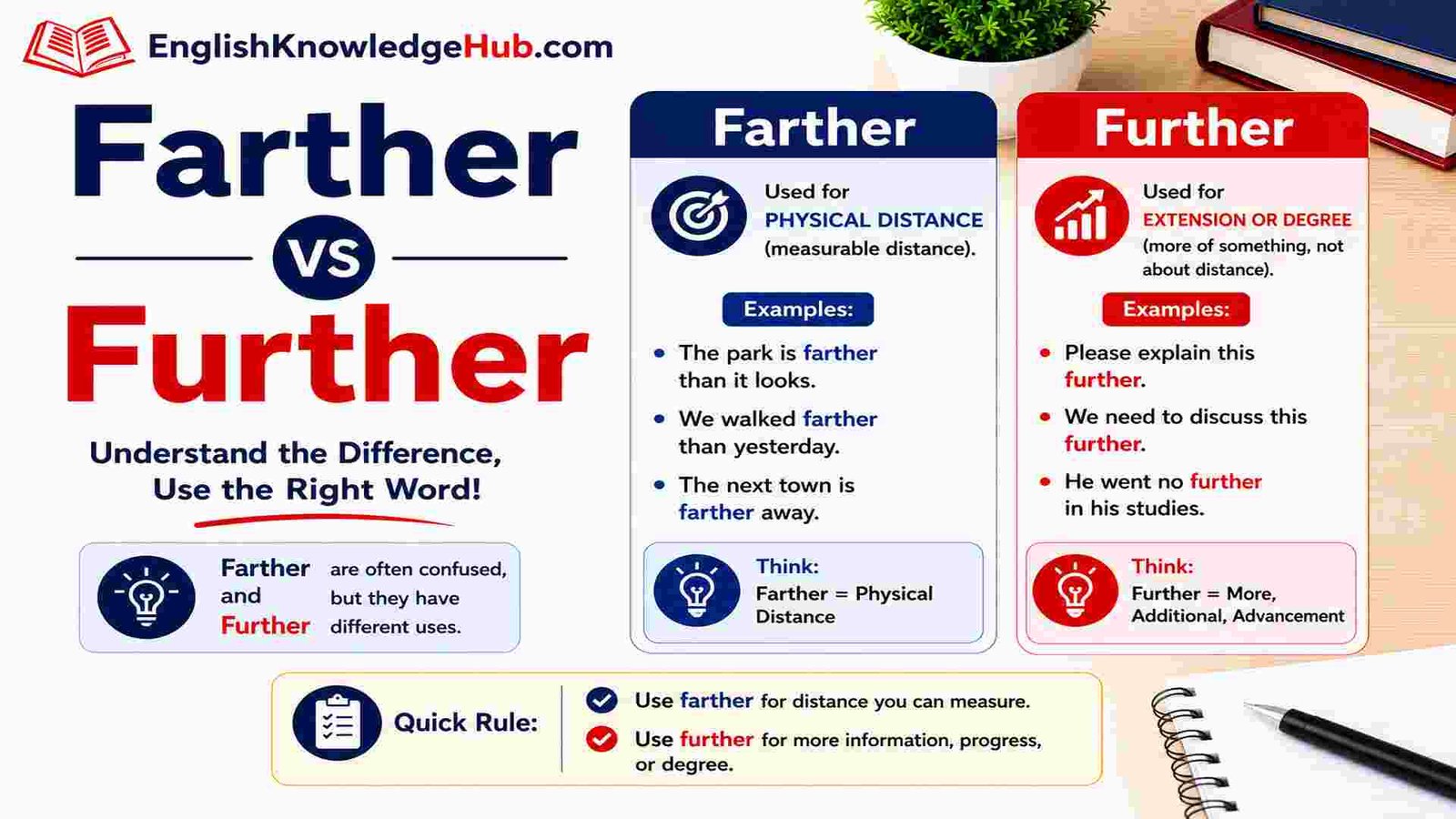
Farther vs Further is easier to understand when you look at the idea behind the sentence. Use farther mainly for physical distance, such as miles, meters, or how far one place is from another. Use further for additional information, more discussion, greater progress, or a deeper degree. In some distance sentences, both words can be correct.
For example:
- Our hotel is farther from the beach than the one you booked.
- We need to discuss this matter further.
The first sentence talks about distance. The second talks about continuing a discussion.
That is the basic difference, but there are a few useful details that will help you choose the right word with confidence.
Farther vs Further :The Simple Rule to Remember
A quick way to choose between the two words is:
Farther = physical distance
Further = more, extra, or continued
Examples:
- The bus stop is farther than I expected.
- We need further information before we decide.
- She wants to study the topic further.
This rule works well in most everyday situations.
However, English is flexible. Further can also be used for physical distance, especially in British English.
What Does Farther Mean?
Farther usually describes a greater physical distance.
You can use farther in situations that involve:
- roads
- buildings
- cities
- rooms
- travel
- walking
- driving
- physical space
Examples:
- The second shop is farther down the street.
- We walked farther than the rest of the group.
- His house is farther from the office than mine.
- The school is farther from here than I thought.
A helpful test is to ask:
Can this distance be measured?
If you could measure it in miles, kilometers, meters, or feet, farther is often a good choice.
For example:
- The airport is 15 kilometers farther from the city center.
The sentence clearly describes measurable distance.
What Does Further Mean?
Further has a wider meaning.
It can mean:
- more
- additional
- extra
- to a greater degree
- to a later stage
- to continue something
Examples:
- Please send me further details.
- We should look into the problem further.
- The company needs further approval.
- Her new course may help her progress further.
- I have no further questions.
Here, there is no physical distance. The word means more or additional.
Farther vs Further at a Glance
| Use | Best Choice | Example |
|---|---|---|
| Physical distance | Farther | The station is farther away. |
| Additional information | Further | We need further details. |
| More discussion | Further | We can discuss it further. |
| Greater progress | Further | She wants to develop further. |
| Distance in general | Farther or further | We walked farther/further along the path. |
The easiest way to remember the difference is that farther has a more limited use, while further can be used in several different ways.
Can Farther and Further Both Mean Distance?
Yes.
This is one of the most important points to understand.
Both words can describe physical distance in many sentences.
For example:
- How much farther do we need to drive?
- How much further do we need to drive?
Both are acceptable.
You can also say:
- The cabin is farther up the hill.
- The cabin is further up the hill.
The meaning is almost the same.
Still, using farther for clear physical distance can make your meaning easier to understand, especially for learners.
When You Should Use Further
There are many situations where further is the natural choice and farther would sound wrong.
For Additional Information
Correct:
Please send me further information about the course.
Incorrect:
Please send me farther information about the course.
Explanation:
You are asking for more information, not information that is physically farther away.
For More Discussion
Correct:
We can talk about the issue further tomorrow.
Incorrect:
We can talk about the issue farther tomorrow.
Explanation:
The meaning is to continue the discussion, so further is correct.
For Additional Action
Correct:
No further action is needed.
Incorrect:
No farther action is needed.
Explanation:
Here, further means additional.
For Greater Study or Investigation
Correct:
The researchers decided to examine the results further.
Incorrect:
The researchers decided to examine the results farther.
Explanation:
The sentence means they will study the results more deeply.
Further Can Also Be a Verb
Further can be used as a verb.
As a verb, it means to help something develop, improve, or move forward.
Examples:
- She joined the training program to further her career.
- The new project could further scientific research.
- He took another course to further his education.
You would not normally use farther in these sentences.
Incorrect:
He took another course to farther his education.
Correct:
He took another course to further his education.
Daily Conversation Examples of Farther vs Further
Here are some simple examples from normal conversations.
Physical Distance
- Is the supermarket much farther from here?
- We had to park farther away.
- I do not want to walk any farther tonight.
- Their new house is farther from town.
More or Additional Meaning
- Can you explain that further?
- I do not want to discuss it any further.
- Do you need any further help?
- We will talk about the plan further tomorrow.
These examples show the difference clearly.
Workplace Examples of Farther vs Further
The difference is also useful in professional English.
- Please provide further details about the payment.
- The manager will review the complaint further.
- Our new warehouse is farther from the main road.
- We cannot move forward without further approval.
- The second office is farther from the train station.
In business writing, further is common because phrases such as further details, further information, further action, and further discussion appear often.
Academic Examples
In academic writing, further is also very common.
Examples:
- Further research may provide a clearer answer.
- The results require further analysis.
- The theory should be tested further.
- The writer explains the idea further in the final section.
For physical distance, farther can still be useful:
- The plants growing farther from the road were taller.
- Samples taken farther from the river contained less moisture.
Formal Writing Examples
Formal writing often uses further when it means additional.
Examples:
- No further information is available at this time.
- The matter will receive further consideration.
- Please contact our office if you require further assistance.
- The committee requested further evidence.
These phrases are common in professional and official English.
British vs American English
There is a small regional difference in preference.
In American English, farther is commonly used for physical distance.
Example:
- How much farther is the restaurant?
In British English, further is often used for distance too.
Example:
- How much further is the restaurant?
Both forms are correct.
So, this is not a strict British versus American grammar rule. It is mostly a difference in preference.
Common Mistakes
Mistake 1: Using Farther for Additional Information
Incorrect:
We need farther details before signing the contract.
Correct:
We need further details before signing the contract.
Explanation:
The word means additional, so further is the correct choice.
Mistake 2: Thinking Further Is Wrong for Distance
Incorrect belief:
“The hotel is further away” is wrong.
Correct:
The hotel is further away.
Also correct:
The hotel is farther away.
Explanation:
Both can describe physical distance.
Mistake 3: Using Farther for an Abstract Idea
Incorrect:
We should investigate this problem farther.
Correct:
We should investigate this problem further.
Explanation:
The sentence talks about deeper investigation, not physical distance.
An Easy Memory Trick
Here is a simple way to remember the difference.
Farther contains the word “far.”
That can remind you of physical distance.
Think:
FARther = FAR distance
Then use further when you mean something like:
- more information
- more discussion
- more research
- more progress
- more action
This trick is not a perfect grammar rule, but it works well in most situations.
Farther and Further as Adjectives and Adverbs
Both words can work as adverbs.
Examples:
- We walked farther.
- We traveled further.
They can also work before nouns in some cases.
Example with further:
- We need further information.
However, farther is much less common before nouns unless the meaning involves physical distance.
Example:
- They moved to the farther side of the field.
This is one reason further appears in more kinds of sentences.
What About Farthest and Furthest?
Farthest and furthest are related forms.
They mean “at the greatest distance” or “to the greatest degree.”
Examples:
- Her house is the farthest from the school.
- Which point is furthest from the entrance?
- That idea was the furthest thing from my mind.
For clear physical distance, farthest often feels natural.
For figurative meaning, furthest is often more common.
Farther or Further: Which One Is Correct?
The answer depends on the meaning.
Use farther when you want to emphasize physical distance.
Use further when you mean:
- more
- additional
- extra
- continued
- to a greater degree
If the sentence is about actual distance, both words may be correct.
For example:
- We drove farther than expected.
- We drove further than expected.
Both sentences work.
Frequently Asked Questions
Is farther or further correct for physical distance?
Both can be correct. Farther is especially common for physical distance, while further is also widely used.
Should I say farther away or further away?
Both are correct. Farther away clearly emphasizes physical distance, while further away is also natural.
Is “further information” correct?
Yes. Further information means additional information.
Can I say “farther information”?
No. That phrase is not natural because information is not a physical distance.
What is the difference between farther and further?
Farther mainly refers to physical distance. Further can mean additional, more, or to a greater degree, and it can also describe distance.
Is further more formal?
Not always, but further appears often in formal phrases such as further details, further assistance, and further research.
Can further be used as a verb?
Yes. It can mean to help something develop or progress, as in “further your career.”
Final Thoughts
The easiest way to understand Farther vs Further is to connect farther with physical distance and further with more, additional, or continued ideas.
Remember that both words can sometimes describe distance, so a sentence with further is not automatically wrong just because it talks about space.
If you are unsure, ask yourself one simple question: “Am I talking about actual distance, or do I mean more or additional?” That question will help you choose the right word in most situations.
For more simple grammar lessons, word comparisons, and practical English guides, visit EnglishKnowledgeHub.com.
