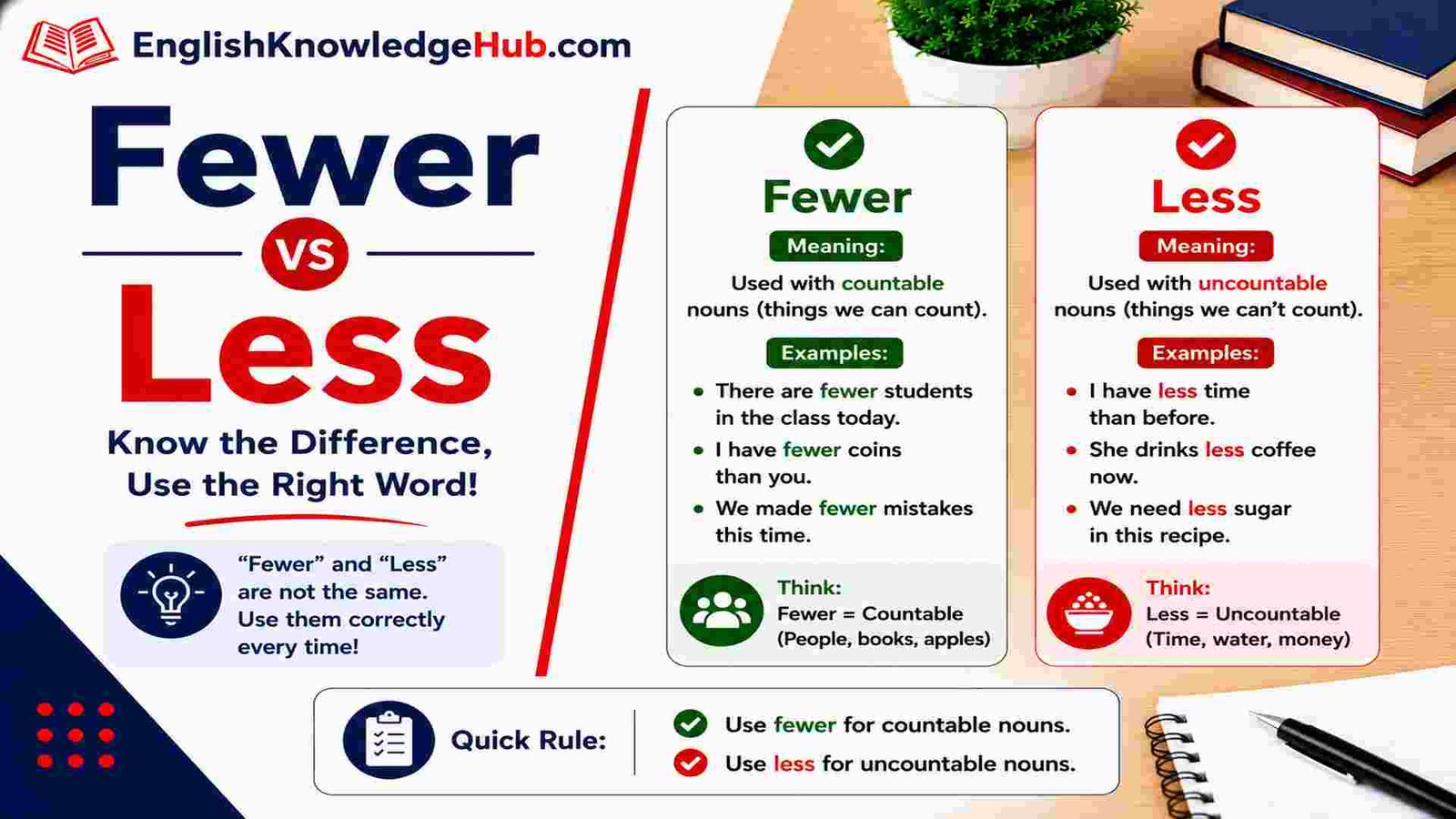
Fewer vs Less is easy to understand once you know one simple rule. Use fewer for things you can count, such as books, people, or mistakes. Use less for things you usually measure as an amount, such as water, time, money, or traffic. There are also a few common exceptions.
Many learners mix these two words because both mean that something has gone down in number or amount.
Fewer vs Less : The difference is mainly about the noun that comes after them.
If you can count the noun one by one, fewer is usually the right choice.
If you cannot normally count the noun one by one, less is usually correct.
Fewer vs Less : The Simple Rule
Use fewer with countable nouns.
Examples:
- fewer cars
- fewer students
- fewer questions
- fewer mistakes
- fewer tickets
Use less with uncountable nouns.
Examples:
- less water
- less time
- less money
- less traffic
- less work
Fewer vs Less : Table Difference
| Use | Meaning | Example |
|---|---|---|
| Fewer | A smaller number | We have fewer chairs. |
| Less | A smaller amount | We have less space. |
When to Use “Fewer”
Use fewer when you are talking about people or things that you can count separately.
You can say:
one chair, two chairs, three chairs
So you can also say:
We need fewer chairs in this room.
You can count each chair.
The same rule works with people, books, messages, mistakes, and many other plural nouns.
Simple examples
- Fewer people came to the party this year.
- I made fewer mistakes in my final test.
- We bought fewer bottles than last week.
- She has fewer classes on Friday.
- There were not as many cars on the road this morning.
Workplace examples
- We received fewer emails today.
- The company hired fewer workers this month.
- Our team had fewer meetings last week.
- The new form has fewer questions.
- Fewer customers asked for refunds.
School and study examples
- Fewer students joined the extra class.
- The second test had fewer questions.
- I made fewer spelling errors this time.
- Fewer books were needed for the course.
In all these examples, the noun can be counted.
When to Use “Less”
Use less when you are talking about an amount of something that is not normally counted one by one.
For example, we usually do not say:
one water, two waters, three waters
when talking about water itself.
So we say:
I need less water.
Other common uncountable nouns include:
- money
- time
- traffic
- work
- information
- sugar
- noise
- energy
Simple examples
- I drink less coffee at night.
- We had less traffic today.
- She has less free time now.
- Please use less sugar in my tea.
- This machine makes less noise.
Workplace examples
- The new system needs less training.
- We have less paperwork now.
- The office uses less electricity at night.
- She has less work this week.
- The project needs less money than expected.
Formal examples
- The new process creates less waste.
- The company used less energy this year.
- The second plan requires less preparation.
An Easy “How Many or How Much?” Trick
Here is a useful way to choose between fewer and less.
Ask yourself:
How many?
If this question sounds right, use fewer.
How many books?
Fewer books.
How many mistakes?
Fewer mistakes.
How many customers?
Fewer customers.
Now ask:
How much?
If this question sounds right, use less.
How much water?
Less water.
How much money?
Less money.
How much time?
Less time.
This trick works in most everyday situations.
Why We Say “Less Time” but “Fewer Hours”
This is one of the most common questions about Fewer vs Less.
We say:
I have less time today.
This is correct because time is usually treated as an amount.
But we also say:
I have fewer hours today.
This is correct because hours can be counted.
For example:
one hour, two hours, three hours
So the noun changes the grammar.
Compare:
- less time
- fewer hours
- less money
- fewer coins
- less food
- fewer sandwiches
- less work
- fewer tasks
The meaning can be similar, but the word you choose depends on the noun.
Why “Less Than 10 Minutes” Is Correct
You may wonder why we say:
less than 10 minutes
instead of:
fewer than 10 minutes
Minutes are countable, so the second form may seem logical.
However, when we talk about time, money, distance, weight, and other measurements, English often uses less because we are thinking about the total amount.
Examples:
- less than 20 minutes
- less than $50
- less than five miles
- less than two kilograms
- less than 10 percent
For example:
The trip took less than an hour.
Here, we are talking about the total amount of time.
Another example:
The bag costs less than $40.
Here, the price is treated as one total amount.
Fewer People or Less People?
In standard English, say:
fewer people
People can be counted one by one.
Correct:
Fewer people attended the meeting today.
You may hear people say:
Less people attended the meeting today.
This is common in informal speech, but fewer people is the better choice in formal writing, schoolwork, exams, and professional English.
The same rule applies here:
- fewer workers
- fewer customers
- fewer students
- fewer visitors
“10 Items or Less” or “10 Items or Fewer”?
You may see signs in supermarkets that say:
10 items or less
You may also see:
10 items or fewer
Under the normal countable noun rule, 10 items or fewer is the more traditional form because items can be counted.
Still, 10 items or less is a phrase you will often see and hear in everyday English.
People often understand the number as one limit or total amount.
For formal writing, fewer is the safer choice with countable items.
For everyday signs and casual speech, both forms can appear.
Fewer vs Less: Common Mistakes
Mistake 1
Incorrect:
We bought less chairs for the office.
Correct:
We bought fewer chairs for the office.
Explanation:
Chairs can be counted, so use fewer.
Mistake 2
Incorrect:
There was fewer traffic today.
Correct:
There was less traffic today.
Explanation:
Traffic is usually treated as an uncountable noun.
Mistake 3
Incorrect:
She gave me fewer information.
Correct:
She gave me less information.
Explanation:
Information is uncountable in standard English.
You can also say:
She gave me fewer details.
Details can be counted.
Mistake 4
Incorrect:
I made less mistakes this time.
Correct:
I made fewer mistakes this time.
Explanation:
Mistakes are countable.
Mistake 5
Incorrect:
We have fewer time to finish.
Correct:
We have less time to finish.
Explanation:
Time is treated as an amount.
You can say:
We have fewer days to finish.
because days are countable.
Mistake 6
Incorrect:
I spent fewer money this month.
Correct:
I spent less money this month.
Explanation:
Money is usually uncountable.
The Same Idea Can Use Both Words
Sometimes two sentences describe almost the same situation but use different nouns.
For example:
I have fewer tasks today.
I have less work today.
Both sentences are correct.
Tasks are countable.
Work is uncountable.
Another example:
We had fewer guests at dinner.
We had less company at dinner.
The idea is similar, but the noun is different.
Another example:
She ate fewer biscuits.
She ate less food.
This shows why it is important to look at the noun, not only the general meaning.
Fewer Of and Less Of
You can also use fewer of and less of.
Use fewer of with countable groups.
Examples:
- Fewer of the students came today.
- Fewer of these boxes are damaged.
- Fewer of our clients complained.
Use less of with amounts.
Examples:
- We used less of the paint.
- I spent less of my money.
- She used less of the available space.
The same basic rule still applies.
Formal and Informal Usage
In careful writing, use:
fewer with clear countable nouns.
Examples:
- fewer cars
- fewer people
- fewer mistakes
- fewer problems
Use:
less with uncountable nouns and many measurements.
Examples:
- less traffic
- less water
- less work
- less time
- less than $100
- less than one hour
In casual speech, native speakers sometimes use less with plural countable nouns.
For example:
There are less cars today.
You may hear this, but in formal English it is better to say:
There are fewer cars today.
A Very Easy Memory Tip
Remember this:
Fewer = number
Less = amount
If you are talking about a smaller number of separate things, use fewer.
If you are talking about a smaller amount, use less.
Examples:
A smaller number of students
= fewer students
A smaller number of mistakes
= fewer mistakes
A smaller amount of water
= less water
A smaller amount of work
= less work
This simple idea can help you choose the correct word quickly.
Quick Summary
Use fewer with nouns you can count.
- fewer books
- fewer cars
- fewer students
- fewer mistakes
Use less with nouns you usually measure as an amount.
- less water
- less money
- less time
- less traffic
Also remember that less is common with measurements.
- less than five minutes
- less than $20
- less than two miles
That is the main difference between the two words.
Frequently Asked Questions
Is it fewer people or less people?
Use fewer people in standard English because people can be counted.
Is it fewer money or less money?
Use less money because money is normally uncountable.
Is it less time or fewer time?
Use less time. If you use a countable unit, say fewer hours or fewer days.
Is it fewer mistakes or less mistakes?
Use fewer mistakes because mistakes can be counted.
Is “less than ten minutes” correct?
Yes. Less than ten minutes is correct because the expression describes an amount of time.
Is it less work or fewer work?
Use less work because work is normally uncountable. You can say fewer tasks if you want a countable noun.
Can I use less with countable nouns?
You may hear it in informal speech, but in careful English, fewer is usually preferred with clear plural countable nouns.
Final Thoughts
The difference in Fewer vs Less becomes simple when you focus on the noun.
Use fewer when you are talking about separate things you can count, such as people, books, cars, and mistakes.
Use less when you are talking about an amount, such as water, money, traffic, work, or time.
And remember that less is also common with measurements such as time, price, distance, and weight.
A quick way to check yourself is to ask: “How many?” or “How much?” That one question will help you choose the correct word in most situations.
For more simple grammar lessons, word comparisons, and practical English guides, visit EnglishKnowledgeHub.com.
