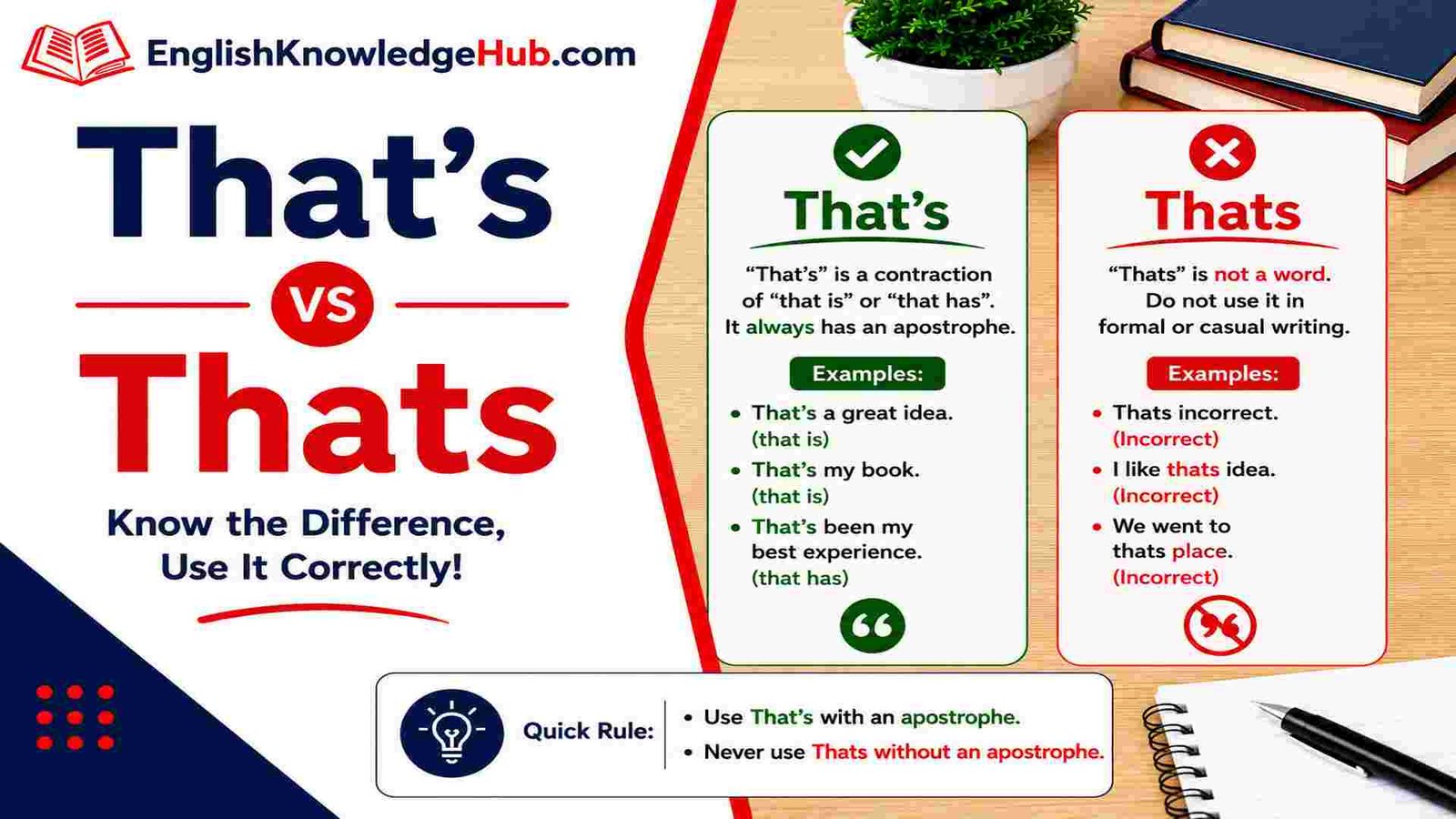
That’s or Thats has a simple answer: that’s is the correct form when you mean that is or that has. The apostrophe shows that letters have been removed to create a contraction. Thats without an apostrophe is not standard English. Below, you’ll learn how the rule works, when to use the contraction, and how to catch mistakes quickly.
You may hear no difference when the word is spoken. That is exactly why this mistake appears so often in writing.
The sound stays the same. The spelling does not.
The Apostrophe Has a Job
Think of the apostrophe as a small sign that says, “Some letters used to be here.”
When we shorten that is, we remove the letter i:
that is → that’s
When we shorten that has, we remove the letters ha:
that has → that’s
The apostrophe marks the place where those missing letters were.
For example:
That’s my umbrella by the door.
The full sentence is:
That is my umbrella by the door.
Now look at this one:
That’s been our busiest month so far.
The full form is:
That has been our busiest month so far.
The spelling stays the same, but the meaning of the contraction depends on the sentence.
That’s or Thats: Quick Comparison
This small table shows the difference clearly.
| Form | Correct? | Meaning | Example |
|---|---|---|---|
| that’s | Yes | that is / that has | That’s the room we booked. |
| thats | No in standard writing | Not a standard contraction | Thats the room we booked. |
You might see thats in fast text messages, comments, usernames, or social media posts. People often leave out punctuation when typing quickly.
That does not make it the correct spelling in standard English.
For schoolwork, professional writing, articles, emails, applications, and other polished writing, use that’s.
Use “That’s” When You Mean “That Is”
The most common meaning of that’s is that is.
We use it when pointing something out, describing something, identifying something, or reacting to an idea.
Examples:
That’s the bus I take every morning.
That’s a clever way to solve the problem.
That’s your phone ringing in the kitchen.
That’s why I changed the appointment.
You can test each sentence by replacing the contraction with that is.
That is the bus I take every morning.
That is a clever way to solve the problem.
Both sentences still make sense.
That tells you the contraction is correct.
“That’s” Can Also Mean “That Has”
Many learners know the that is meaning but forget that that’s can also stand for that has.
Look at these examples:
That’s happened three times this week.
Full form:
That has happened three times this week.
Another example:
That’s become a serious problem for the team.
Full form:
That has become a serious problem for the team.
And:
That’s been my favorite café for years.
Full form:
That has been my favorite café for years.
Words such as been, happened, changed, become, improved, started, and grown can often help you notice the that has meaning.
A Fast Test You Can Use While Writing
If you are unsure whether you need the apostrophe, do not stare at the spelling.
Expand the word.
Ask yourself:
Can I replace it with “that is” or “that has”?
If yes, write that’s.
Example:
That’s a strange noise.
Try:
That is a strange noise.
Correct.
Another example:
That’s improved since last semester.
Try:
That has improved since last semester.
Correct again.
This method works because it checks meaning rather than relying on memory alone.
Why “Thats” Looks Possible Even Though It Is Wrong
The mistake is understandable because punctuation disappears when we speak.
When someone says:
“That’s amazing.”
you hear one smooth sound. You do not hear an apostrophe.
That can make thats look reasonable when you type the word.
But written English uses punctuation to show grammatical information that speech does not show visually.
Compare:
I’m = I am
we’re = we are
don’t = do not
isn’t = is not
that’s = that is / that has
Writing thats is similar to writing dont instead of don’t in standard English.
The message may still be understandable, but the spelling is incorrect.
Common Mistakes Learners Make
Leaving Out the Apostrophe
Incorrect:
Thats the document I printed yesterday.
Correct:
That’s the document I printed yesterday.
Explanation:
The sentence means “That is the document I printed yesterday.” Because that is has been shortened, the apostrophe is required.
Missing the “That Has” Meaning
Incorrect:
Thats changed since our last meeting.
Correct:
That’s changed since our last meeting.
Explanation:
Here, that’s means that has. The full sentence is “That has changed since our last meeting.”
Thinking the Apostrophe Shows Ownership
Some students learn possessive apostrophes first:
Maria’s notebook
the manager’s office
They then assume the apostrophe in that’s must also show possession.
It does not.
In that’s, the apostrophe forms a contraction.
For example:
That’s my notebook.
means:
That is my notebook.
The apostrophe does not show that something belongs to “that.”
How “That’s” Works in Everyday Conversation
The contraction is extremely natural in spoken English.
Imagine you are choosing a table at a café.
Someone asks:
“Should we sit near the window?”
You answer:
“Yes, that’s perfect.”
You could say:
“Yes, that is perfect.”
Both are grammatically correct.
The shorter version simply sounds more conversational.
Another example:
“Which coat belongs to Emma?”
“That’s hers.”
Again, that’s means that is.
Workplace Examples
Contractions also appear naturally in normal workplace communication.
That’s the version the client approved.
That’s been our strongest sales region this year.
That’s why the deadline was moved.
That’s become the main issue in the project.
In internal emails, chats, meetings, and everyday office communication, these sentences sound normal.
The first and third examples use that is.
The second and fourth use that has.
Academic Writing: Should You Use the Contraction?
Grammatically, yes. Stylistically, it depends.
Consider:
That’s one possible explanation for the result.
There is nothing grammatically wrong with this sentence.
However, a formal academic paper may prefer:
That is one possible explanation for the result.
The expanded form can sound more formal and deliberate.
This is a question of tone, not correctness.
Do not label contractions as “bad grammar.” They are standard English. They are simply more common in speech and less formal writing.
Formal Writing Examples
A business report might say:
That is the primary reason for the decrease in revenue.
A legal or highly formal document might also prefer the full form.
In a friendly business email, however, this would be completely natural:
That’s the main point I wanted to clarify.
So the choice between that’s and that is often depends on how formal you want the sentence to sound.
The choice between that’s and thats, however, is different. One is standard spelling and the other is not.
British and American English
There is no special British-versus-American rule for this contraction.
Both standard British English and standard American English use:
that’s
The apostrophe is required when the word represents that is or that has.
You do not need to change the spelling for readers in the United States, the United Kingdom, Canada, Australia, or other major English-speaking regions.
Is “Thats” Ever Acceptable?
In standard prose, no.
However, you may encounter it in places where normal spelling rules are intentionally relaxed, such as:
- usernames
- hashtags
- brand names
- casual online comments
- very fast text messages
- stylized creative writing
For example, a social media username could contain thats because usernames often cannot use punctuation.
That is a technical or stylistic exception. It does not change the normal grammar rule.
If you are writing a sentence, the standard contraction remains that’s.
Don’t Mix Up Contractions and Possessives
Apostrophes have more than one job in English, which is why they can feel confusing.
Compare:
Liam’s bicycle
Here, the apostrophe can show possession.
But:
That’s a bicycle.
Here, the apostrophe creates a contraction.
A useful question is:
Can I expand the word?
If that’s becomes that is or that has, you are dealing with a contraction.
This meaning test is often more useful than memorizing punctuation labels.
A Simple Memory Trick
When That’s or Thats makes you pause, imagine pulling the word apart.
That’s → That is
or
That’s → That has
If the expanded version works, the apostrophe belongs there.
Try it:
That’s our new teacher.
→ That is our new teacher.
Correct.
That’s already been discussed.
→ That has already been discussed.
Correct.
The apostrophe is easier to remember when you connect it to the missing words.
FAQs
Is that’s a real word?
Yes. That’s is a standard contraction of that is or that has.
Which is correct, that’s or thats?
In standard English, that’s is correct when you mean that is or that has. Thats without an apostrophe is normally a spelling mistake.
What does that’s mean in a sentence?
It can mean that is or that has. The surrounding sentence tells you which meaning is intended.
Can that’s mean that has?
Yes.
That’s been difficult.
means:
That has been difficult.
Why does that’s need an apostrophe?
The apostrophe shows that letters were removed when the words were shortened into a contraction.
Can I use that’s in an essay?
Yes, unless the essay requires a very formal style. In highly formal academic writing, that is or that has may sound more appropriate.
Is thats acceptable in texting?
People sometimes omit the apostrophe in casual texts, but thats is still not the standard spelling. Use that’s when correct spelling matters.
Is the rule different in American and British English?
No. Both use that’s as the standard contraction.
Final Takeaway
The That’s or Thats question becomes easy once you focus on what the word represents. That’s is a contraction of that is or that has, so it needs an apostrophe to show that letters have been removed. Thats may appear in casual typing, but it is not the standard spelling in normal sentences.
When you are unsure, expand the word. If that is or that has fits, write that’s.
For more simple explanations of grammar, spelling, contractions, and commonly confused English words, visit EnglishKnowledgeHub.com.
