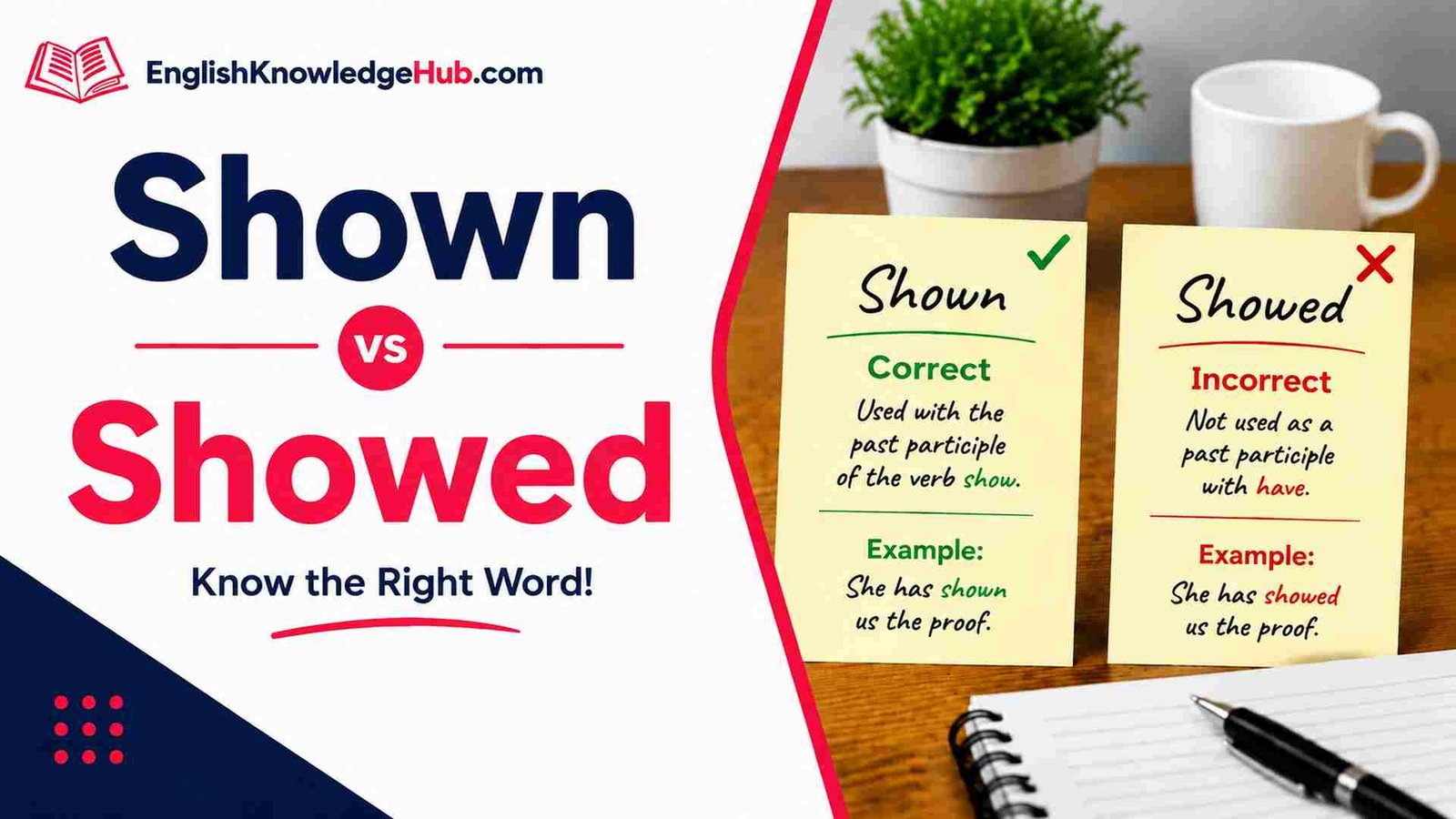
Showed is the usual simple past form of show, while shown is the most common past participle used with has, have, had, or be. Write “She showed me the photo” and “She has shown me the photo.” Some dictionaries also record showed as a past participle, but shown is the safest standard choice for learners.
In this article, you’ll learn Shown vs Showed through simple past, perfect tenses, passive voice, regional variation, and natural examples from conversation and formal writing. Merriam-Webster lists show as showed; shown or showed, which explains why real usage is slightly more flexible than a strict school rule suggests.
The Main Difference Between Shown and Showed
Use showed when you need the ordinary past tense.
Use shown when you need the past participle, especially after helping verbs such as has, have, and had, or in passive constructions such as was shown.
| Form | Grammar job | Example |
|---|---|---|
| show | Base verb | They show visitors the workshop. |
| showed | Simple past | They showed us the workshop yesterday. |
| shown | Past participle | They have shown us the workshop before. |
Here is another way to see the difference:
Showed = past action
Mia showed me her new camera.
Shown = participle used with another verb
Mia has shown me her new camera.
The meaning is similar, but the grammar is different.
When Showed Is the Right Choice
Use showed when something happened at a finished time in the past.
You do not normally need has, have, or had before it.
Examples:
- Daniel showed me his garden after lunch.
- Our instructor showed us a faster way to solve the problem.
- The receptionist showed the visitors where to sit.
- The figures showed a slight rise in monthly sales.
- My sister showed me the message on her phone.
Notice how each sentence can stand naturally with showed as the main verb.
Showed in Everyday Conversation
You might say:
- I showed Ben the new coffee shop yesterday.
- She showed me where she keeps the spare key.
- We showed our tickets before entering.
- Dad showed me an old family photograph.
These are finished past events.
If someone asks, “What happened yesterday?” showed will often be the form you need.
When Shown Is the Right Choice
Shown is the standard past participle of show.
It commonly appears after:
- has
- have
- had
- been
- forms of be in passive sentences
Examples:
- I have shown you this menu before.
- She has shown remarkable patience.
- They had shown us the plan before the meeting began.
- The evidence was shown to the committee.
- The final price is shown at the bottom of the page.
Unlike showed, the word shown normally does not act alone as the simple past verb.
Incorrect:
Lena shown me the room yesterday.
Correct:
Lena showed me the room yesterday.
Also correct:
Lena has shown me the room.
The presence of has changes the grammar and makes shown necessary in standard English.
A Useful Shortcut: Look at the Word Before It
When you are unsure whether to choose shown or showed, look just before the verb.
If you see:
has, have, or had
choose:
shown
For example:
- has shown
- have shown
- had shown
If you are simply describing something that happened in the past, use:
showed
For example:
- She showed us the house.
- They showed their passports.
- I showed him the email.
This shortcut will solve a large percentage of learner mistakes.
Why “Have Shown” Is Standard English
The present perfect tense uses:
have/has + past participle
Because shown is the standard past participle of show, we normally write:
- I have shown
- you have shown
- he has shown
- she has shown
- we have shown
- they have shown
Examples:
- I have shown the receipt to the cashier.
- Ava has shown great improvement this term.
- The company has shown interest in the proposal.
- Several studies have shown similar patterns.
The same principle applies to the past perfect:
had + shown
Examples:
- We had shown them the schedule before they booked.
- The teacher had shown the class the method earlier.
- I had already shown Sam the address.
Is “Have Showed” Ever Correct?
For learners, the best rule is simple:
Use have shown, not have showed, in standard modern English.
Major dictionaries recognize shown as the usual past participle. Some dictionaries also record showed as a rare past participle.
That distinction matters.
It means have showed should not be described as a completely invented form, but it is uncommon enough that ESL learners should avoid it in normal writing.
Prefer:
The team has shown steady progress.
Rather than:
The team has showed steady progress.
For schoolwork, exams, business emails, reports, and everyday standard English, has shown and have shown are the safest forms.
Showed vs Shown With a Finished Time
A finished past-time expression often points toward showed.
Examples of finished past times include:
- yesterday
- last night
- last week
- in 2024
- two hours ago
- on Monday
Compare:
Correct:
Sara showed me the document yesterday.
The word yesterday refers to a completed past time.
Now compare:
Correct:
Sara has shown me the document already.
Here, the focus is on the present result. I have seen the document now.
This distinction is not only about the verb form. It also involves the tense of the whole sentence.
I Showed You vs I Have Shown You
Both expressions are correct.
They simply use different tenses.
I showed you
This normally points to a completed past event.
I showed you the password this morning.
The action belongs to a clear past time.
I have shown you
This connects the past action with the present situation.
I have shown you the password twice already.
The exact time matters less. The important idea is that the action has already happened.
Compare another pair:
The trainer showed me the exercise on Tuesday.
The trainer has shown me the exercise several times.
The first tells us about a specific finished occasion.
The second looks at experience up to the present.
Why “Was Shown” Is Correct
Learners sometimes see was shown and wonder why showed is not used.
The reason is passive voice.
Compare:
Active:
The manager showed the report to the staff.
Passive:
The report was shown to the staff.
In the active sentence, the manager performs the action.
In the passive sentence, the report receives the action.
Passive structures use a form of be + past participle, so we use shown.
More examples:
- The video was shown during the meeting.
- The photographs were shown to the jury.
- The instructions are shown on the screen.
- The updated design will be shown tomorrow.
- The results have been shown to all department heads.
So remember:
showed = active simple past
was/were shown = passive past
Why “As Shown” Is Used in Reports and Essays
In academic and formal writing, you will often see expressions such as:
- as shown below
- as shown above
- as shown in the table
- as shown in Figure 1
- as shown by the results
Use shown, not showed, in these expressions.
For example:
As shown in the chart, attendance increased in March.
The phrase is related to a passive structure:
As is shown in the chart…
The word is can be understood even when it is not written.
That is why this sentence is not standard:
As showed in the chart, attendance increased in March.
Use:
As shown in the chart…
Shown vs Showed in Workplace English
Professional communication uses both forms regularly.
Use showed for a completed event
- The analyst showed the team three possible outcomes.
- Our supplier showed us the new material on Friday.
- The presentation showed where costs were increasing.
- Rachel showed the client an early version of the design.
Use shown with perfect tenses
- The analyst has shown that the estimate needs revision.
- Our supplier has shown us several new samples.
- Recent reports have shown stronger demand.
- Rachel has shown excellent attention to detail.
Use shown in passive writing
- The revised figures were shown during the review.
- The final design has been shown to the client.
- The payment terms are shown on page three.
The underlying grammar does not change just because the writing becomes more formal.
Shown and Showed in Academic Writing
Academic writing often uses show to mean indicate, demonstrate, or provide evidence of something.
For a completed study:
The experiment showed a clear difference between the two groups.
When referring to a body of research up to the present:
Several studies have shown a similar effect.
When describing information in a figure:
The distribution is shown in Figure 3.
When referring to an earlier stage of a study:
The preliminary analysis had shown an unexpected pattern.
These distinctions help academic writing sound precise.
British vs American English
There is no important everyday British versus American difference in the standard pattern.
Both varieties commonly use:
show → showed → shown
So in both British and American standard English, you would normally write:
- She showed me yesterday.
- She has shown me already.
- The film was shown last night.
Regional speech may contain different forms, and rare past-participle uses of showed exist, but shown remains the normal choice learners should use after has, have, and had.
Common Mistakes With Shown and Showed
Mistake 1
Incorrect:
He shown me his passport at the desk.
Correct:
He showed me his passport at the desk.
Explanation:
The sentence needs the simple past. Shown cannot normally replace showed by itself.
Mistake 2
Incorrect:
I have showed my teacher the new draft.
Correct:
I have shown my teacher the new draft.
Explanation:
After have, standard English uses the past participle shown.
Mistake 3
Incorrect:
The photographs were showed to the audience.
Correct:
The photographs were shown to the audience.
Explanation:
This is passive voice. Passive constructions use a form of be plus the past participle.
Mistake 4
Incorrect:
As showed below, the second option costs less.
Correct:
As shown below, the second option costs less.
Explanation:
As shown is the standard reduced passive expression used when referring to a chart, example, table, image, or explanation.
Mistake 5
Incorrect:
She has shown me the apartment last Saturday.
Correct:
She showed me the apartment last Saturday.
Explanation:
Last Saturday refers to a specific finished past time, so the simple past showed fits naturally.
Does Showed Always Mean Someone Displayed Something?
No.
The verb show has several related meanings.
It can mean physically letting someone see something:
Theo showed me his train ticket.
It can mean demonstrating how something works:
The technician showed us how to restart the system.
It can mean revealing information:
The scan showed a small crack in the pipe.
It can mean displaying a quality:
She showed great courage during the emergency.
It can also mean indicating a result:
The survey showed strong support for the proposal.
Whether you use shown or showed still depends on grammar, not on which meaning of show you choose.
What About Showed Up and Shown Up?
The same rule applies to the phrasal verb show up.
Use showed up for the simple past:
- Liam showed up before everyone else.
- Only twelve guests showed up for the event.
- A strange error showed up during testing.
Use shown up after helping verbs:
- Liam has shown up early all week.
- Several errors have shown up since the update.
- She had shown up before the doors opened.
Adding up does not change the verb pattern.
A Three-Line Memory Rule
When you need a fast answer, remember these three patterns:
Past action:
showed
I showed her the letter.
Perfect tense:
has/have/had + shown
I have shown her the letter.
Passive voice:
be + shown
The letter was shown to her.
If you can recognize those three structures, you can handle most shown vs showed questions confidently.
Quick Practice: Shown or Showed?
Choose the correct word.
- Our guide _____ us a quiet path through the park.
- I have _____ this receipt to two employees already.
- The final score was _____ on the large screen.
- Her research has _____ a link between the two factors.
- The teacher _____ the class a short video yesterday.
- The photographs had already been _____ to the editor.
- The graph _____ a sharp drop in June.
- As _____ below, the two methods produce different results.
Answers
- showed
- shown
- shown
- shown
- showed
- shown
- showed
- shown
Frequently Asked Questions
Is it shown or showed?
Both are correct. Use showed as the simple past and shown as the standard past participle.
Is it “I shown you” or “I showed you”?
Use I showed you when there is no helping verb.
Correct:
I showed you the answer yesterday.
You can also say:
I have shown you the answer.
Is shown the past tense of show?
Shown is the past participle. Showed is the simple past tense.
The standard pattern is:
show, showed, shown
Is “has shown” correct?
Yes. Has shown is the standard present perfect form.
Example:
The new system has shown better results.
Is “has showed” wrong?
Has shown is the normal standard form and the best choice for learners. Some dictionaries record showed as a rare past participle, but it is uncommon in standard modern usage.
Is it “was shown” or “was showed”?
Use was shown.
Example:
The recording was shown during the hearing.
The sentence is passive, so it needs the past participle shown.
Is “as shown below” correct?
Yes. As shown below is standard English, especially in instructions, reports, essays, and academic writing.
What is the difference between “showed me” and “shown me”?
Showed me can work as the simple past:
She showed me the photograph.
Shown me normally needs a helping verb:
She has shown me the photograph.
Final Thoughts on Shown vs Showed
The easiest way to understand shown vs showed is to stop treating them as interchangeable words. They are different forms of the same verb and perform different grammatical jobs.
Use showed for a straightforward completed past action:
The instructor showed us the correct method.
Use shown after has, have, or had:
The instructor has shown us the correct method.
And use shown in passive structures:
The correct method was shown to us.
Remember the pattern show, showed, shown, and check the words surrounding the verb before choosing your form.
For more clear, practical lessons on confusing words, verb forms, spelling, and everyday grammar, explore EnglishKnowledgeHub.com and strengthen your English one useful rule at a time.
