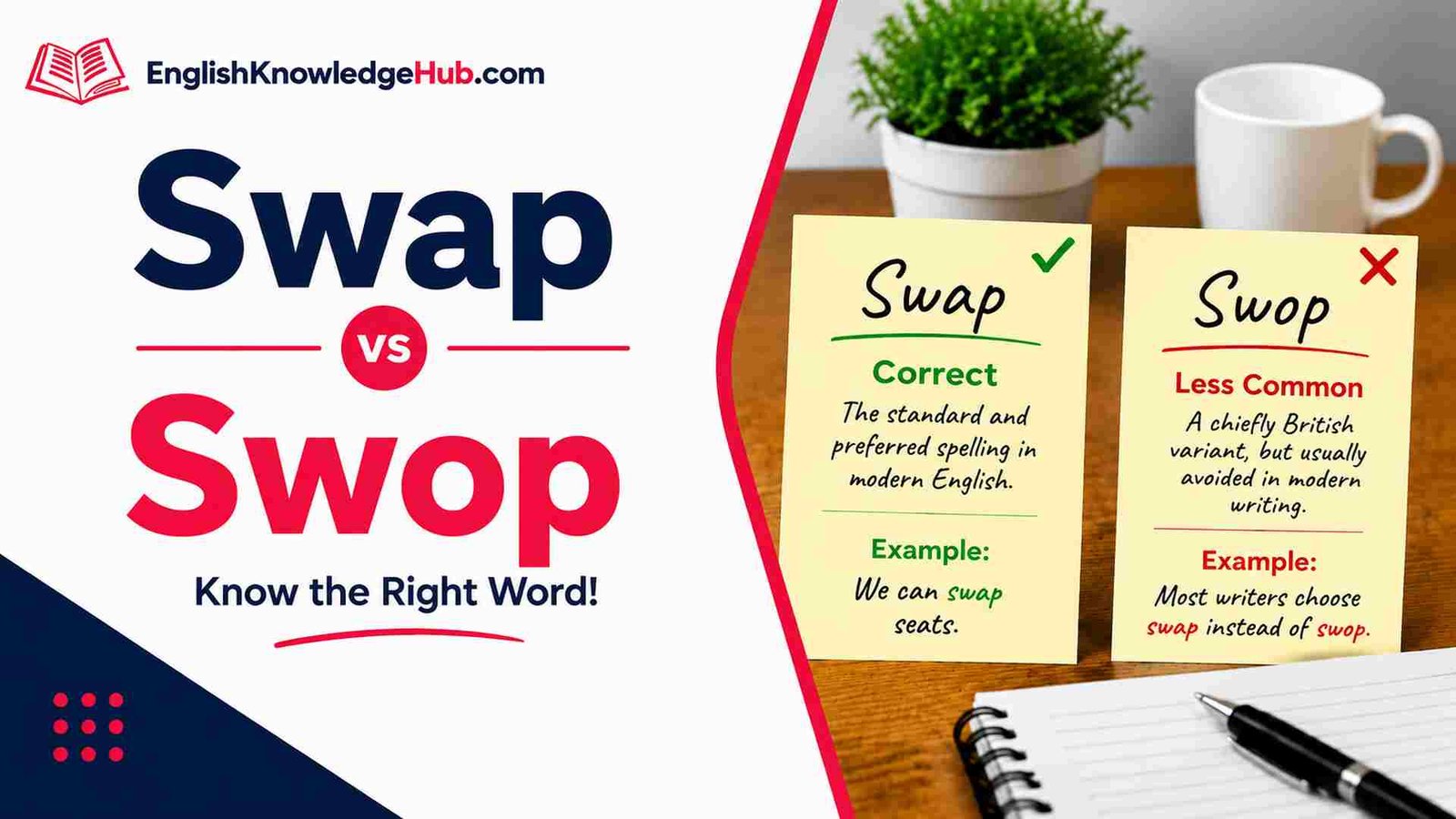
Swap and swop are both correct spellings for exchanging one thing for another, but swap is the more widely used form. Swop is mainly British and is less common in general modern writing. If you have no house style or regional reason to choose otherwise, swap is the safest spelling for an international audience.
In this article, you’ll learn Swap vs Swop through British and American usage, verb and noun forms, swapped/swopped, common phrases such as swap places, and natural examples. Cambridge identifies swop as mainly UK for swap, while Merriam-Webster labels it chiefly British.
Swap and Swop Describe the Same Basic Action
Think of two people holding different books.
You give your book to the other person, and they give theirs to you.
You have made an exchange.
In most English, you would say:
We swapped books.
In some British writing, you might also see:
We swopped books.
The action is exactly the same.
So, swop is not a separate word with a different meaning. It is an alternative spelling of swap, used mainly in British English.
Here is the simplest comparison:
| Word | Correct? | Typical Usage | Recommended Default |
|---|---|---|---|
| swap | Yes | British, American, international | Yes |
| swop | Yes | Mainly British | Only if you prefer that regional spelling |
This is an important distinction for learners.
Swop is uncommon outside British English, but uncommon does not mean incorrect.
What Does Swap Mean?
As a verb, swap means to exchange, replace, or change one thing for another.
You can swap:
- seats
- clothes
- shifts
- books
- phones
- jobs
- tasks
- positions
- ideas
- belongings
For example:
I swapped my seat with Marcus so he could sit beside his daughter.
Priya swapped her Friday shift for a Monday shift.
The students swapped notebooks after the exercise.
We swapped bedrooms while the upstairs room was being painted.
In each sentence, one person, thing, or position changes places with another.
Swap Can Also Be a Noun
Swap does not only describe an action. It can also name the exchange itself.
Compare these sentences:
Leo swapped shifts with Nina.
Here, swapped is a verb.
Leo and Nina arranged a swap.
Here, swap is a noun.
More noun examples:
- The manager approved the shift swap.
- We organized a clothing swap at school.
- Their office swap lasted for two weeks.
- The book swap begins at noon.
This noun use is common in everyday and workplace English.
What Does Swop Mean?
Swop means the same thing as swap.
It can also work as a verb or noun.
Examples:
We swopped places halfway through the journey.
Ella swopped her red scarf for a blue one.
The children arranged a card swop during lunch.
You are most likely to see this spelling in British English.
For many learners, the easiest strategy is:
Use swap when writing. Understand swop when reading.
That keeps your spelling simple without treating a valid regional form as an error.
Swap vs Swop in British English
British English can use both spellings.
These are both possible:
We swapped desks.
We swopped desks.
A common mistake is to think that British English requires swop.
It does not.
Swap is also correct in British English, so British writers can use it without any problem.
This is useful for international learners because you do not need to change your spelling every time you write for a British audience.
Swap vs Swop in American English
In American English, swap is the normal spelling.
Write:
We swapped contact details after the meeting.
rather than:
We swopped contact details after the meeting.
An American reader would probably understand swop, but it may look unusual because it is strongly associated with British usage.
So the practical rule is simple:
American English: use swap.
Which Form Should You Use in International Writing?
If your audience includes readers from different countries, use swap.
It is the safest choice for:
- websites
- business emails
- academic assignments
- online articles
- international communication
- ESL writing
- professional documents
Using swap does not make your writing specifically American because British English also accepts it.
That makes it the most flexible form.
The Verb Forms of Swap
When swap changes tense, the final p doubles before -ed and -ing.
| Form | Word |
|---|---|
| Base form | swap |
| Third-person singular | swaps |
| Past tense | swapped |
| Past participle | swapped |
| Present participle | swapping |
Examples:
I swap recipes with my neighbor.
She swaps shifts every few weeks.
We swapped tables yesterday.
They have swapped responsibilities before.
The students are swapping worksheets.
Pay attention to these two spellings:
swap + ed = swapped
swap + ing = swapping
Not:
swaped
or:
swaping
The Verb Forms of Swop
If you choose the British variant swop, its forms normally follow the same doubling pattern.
| Form | Word |
|---|---|
| Base form | swop |
| Third-person singular | swops |
| Past tense | swopped |
| Past participle | swopped |
| Present participle | swopping |
Examples:
They swopped rooms last night.
The children are swopping cards.
She often swops books with her cousin.
For consistency, it is usually better to stay with one spelling family.
Use:
swap, swapped, swapping
or:
swop, swopped, swopping
Swap For or Swap With?
This is one of the most useful grammar points to learn.
Both patterns are correct, but they express different parts of the exchange.
Swap Something for Something
Use for when one thing is replaced by another.
I swapped my large suitcase for a smaller one.
The large suitcase is what you gave up.
The smaller suitcase is what you received instead.
More examples:
- He swapped his evening appointment for a morning slot.
- I swapped coffee for tea.
- Maya swapped her old desk for a standing desk.
- The company swapped its old software for a newer system.
A useful pattern is:
swap A for B
A is replaced by B.
Swap Something With Someone
Use with when you name the other person involved in the exchange.
I swapped seats with Daniel.
More examples:
- Nina swapped shifts with Owen.
- I swapped books with my classmate.
- Zara swapped lunch duties with Mia.
- He swapped jackets with his brother.
Here, with introduces the person taking part in the exchange.
An Easy Way to Remember It
Think of it this way:
for = what replaces something
with = who takes part in the exchange
That rule will help you form natural sentences.
You Can Also Swap Two Things Directly
Sometimes no preposition is needed.
For example:
Swap the first and second paragraphs.
We swapped rooms.
The teacher swapped the two groups.
Please swap these labels.
The meaning is already clear because both things being exchanged are mentioned directly.
Swap, Exchange, Switch, and Trade
These words can overlap, but they are not always interchangeable.
Swap
Swap often describes two things changing places or being exchanged.
We swapped seats.
Exchange
Exchange can sound broader or more formal.
The researchers exchanged information after the conference.
In this context, exchanged information sounds more natural than swapped information.
Switch
Switch often focuses on changing from one option, position, system, or state to another.
I switched to a different internet provider.
Compare that with:
I swapped laptops with my colleague.
The first sentence describes a change.
The second describes an exchange.
Trade
Trade often means giving something in return for something else.
Liam traded his spare card for one he needed.
It also has special meanings in business, commerce, and sports.
The best word depends on the type of change or exchange you want to describe.
Everyday Conversation Examples
Here are some natural examples of swap in ordinary speech:
- Can we swap chairs? This one hurts my back.
- I picked up your umbrella by mistake. Shall we swap?
- We swapped desserts because she preferred mine.
- Could we swap places for a few minutes?
- The twins swapped hats before the photo.
- I will swap you my chocolate bar for your crisps.
The word sounds natural because the exchange is simple and direct.
Workplace Examples
Swap is especially common when discussing schedules, duties, or equipment.
- Can you swap shifts with me on Friday?
- The manager swapped our meeting times.
- We swapped desks during the office renovation.
- Tariq and I swapped presentation sections.
- The two teams swapped responsibilities for the afternoon.
These uses are common in professional conversation and workplace messages.
Academic Examples
Students and teachers also use the word naturally.
- Please swap papers with the student beside you.
- The groups swapped research topics after the first discussion.
- The lecturer asked us to swap partners.
- The researchers swapped the order of the test questions.
- Students may swap presentation dates with permission.
In highly formal academic writing, a more exact verb such as exchange, reverse, replace, alternate, or reassign may sometimes fit better.
Formal Writing Examples
Swap can appear in formal writing when the meaning is straightforward.
The two departments agreed to swap office space during the renovation.
The organizations approved a temporary swap of staff responsibilities.
The revised schedule allows participants to swap session times.
There is nothing grammatically informal about these sentences.
However, formal writing often values precision.
Instead of:
The committee swapped the documents.
you might prefer:
The committee exchanged the documents.
if exchange describes the action more accurately.
Common Mistakes With Swap and Swop
Mistake 1: Calling Swop Incorrect
Incorrect:
Swop is not a real English spelling.
Correct:
Swop is a mainly British variant of swap.
Explanation:
It is a recognized regional spelling. It is less widely used than swap, but that does not make it wrong.
Mistake 2: Writing Swaped
Incorrect:
We swaped seats before class.
Correct:
We swapped seats before class.
Explanation:
The final p doubles before -ed.
The correct past tense is swapped.
Mistake 3: Writing Swaping
Incorrect:
The students are swaping books.
Correct:
The students are swapping books.
Explanation:
The final p also doubles before -ing.
Mistake 4: Using Swop as the Default American Spelling
Less suitable:
The employees swopped shifts.
Correct for normal American English:
The employees swapped shifts.
Explanation:
Swop is mainly British. American English normally uses swap.
Mistake 5: Confusing For and With
Less suitable:
I swapped my old phone with a newer phone.
Better:
I swapped my old phone for a newer phone.
Explanation:
Use for when one thing replaces another.
Now compare:
I swapped phones with my brother.
Here, with is correct because it identifies the other person involved.
Mistake 6: Mixing Spellings
Inconsistent:
We swopped desks and started swapping files.
Better:
We swapped desks and started swapping files.
Or:
We swopped desks and started swopping files.
Explanation:
The mixed version is understandable, but consistent spelling makes your writing cleaner.
Is Swop Old-Fashioned?
It is better to describe swop as regional rather than simply old-fashioned.
It is mainly associated with British English, and many writers now use swap instead.
That does not make swop obsolete.
The important distinction is:
- incorrect means the form breaks standard English rules
- uncommon means it is rarely used
- regional means it is linked to a particular variety of English
- outdated means it belongs mainly to older usage
Swop is regional.
That is the most accurate label.
Is Swap Formal or Informal?
Swap is common in conversation, but it is not limited to informal English.
Compare:
Everyday:
Can we swap seats?
Workplace:
Can we swap shifts next Tuesday?
Formal:
The departments agreed to swap office space during the renovation.
All three can be correct.
The level of formality depends more on the full sentence and context than on the word swap itself.
Still, words such as exchange, replace, substitute, transfer, or reassign may sometimes sound more precise in formal documents.
A Simple Teacher’s Rule
If you remember only one thing from this article, use this:
Write swap unless you have a specific reason to use swop.
Why?
Because swap works naturally in British, American, and international English.
You can also remember:
Swap is universal. Swop is mainly British.
That is not a grammar rule. It is simply a useful memory aid.
FAQs About Swap vs Swop
Is it swap or swop?
Both are correct. Swap is the more widely used spelling, while swop is mainly a British variant.
Is swop a real word?
Yes. Swop is a recognized alternative spelling of swap, especially in British English.
Is swap correct in British English?
Yes. British English uses swap as well as swop.
Is swop correct in American English?
It may be understood, but it is not the normal American spelling. Use swap in American English.
What is the past tense of swap?
The past tense is swapped.
Example:
We swapped rooms yesterday.
Is it swapping or swopping?
Both forms exist. Swapping comes from swap, while swopping comes from swop. For general international English, swapping is the safer choice.
Do swap and swop have different meanings?
No. They have the same basic meanings. The main difference is spelling and regional preference.
Should I use swap or swop in professional writing?
Use swap unless your style specifically prefers the British variant swop. Swap is more widely recognized and works well for international readers.
Final Thoughts
The question of swap vs swop is mainly about regional spelling, not grammar or meaning.
Both forms can mean to exchange one thing for another. Swap is the broader spelling and works naturally in British English, American English, and international communication. Swop is also correct, but it is mainly associated with British usage.
For clear everyday writing, remember:
swap
swapped
swapping
Use swap A for B when one thing replaces another, and use swap with someone when you name the other person involved.
That gives you the spelling, grammar, and sentence pattern you need.
For more clear explanations of spelling differences, commonly confused words, grammar rules, and everyday English usage, visit EnglishKnowledgeHub.com.
