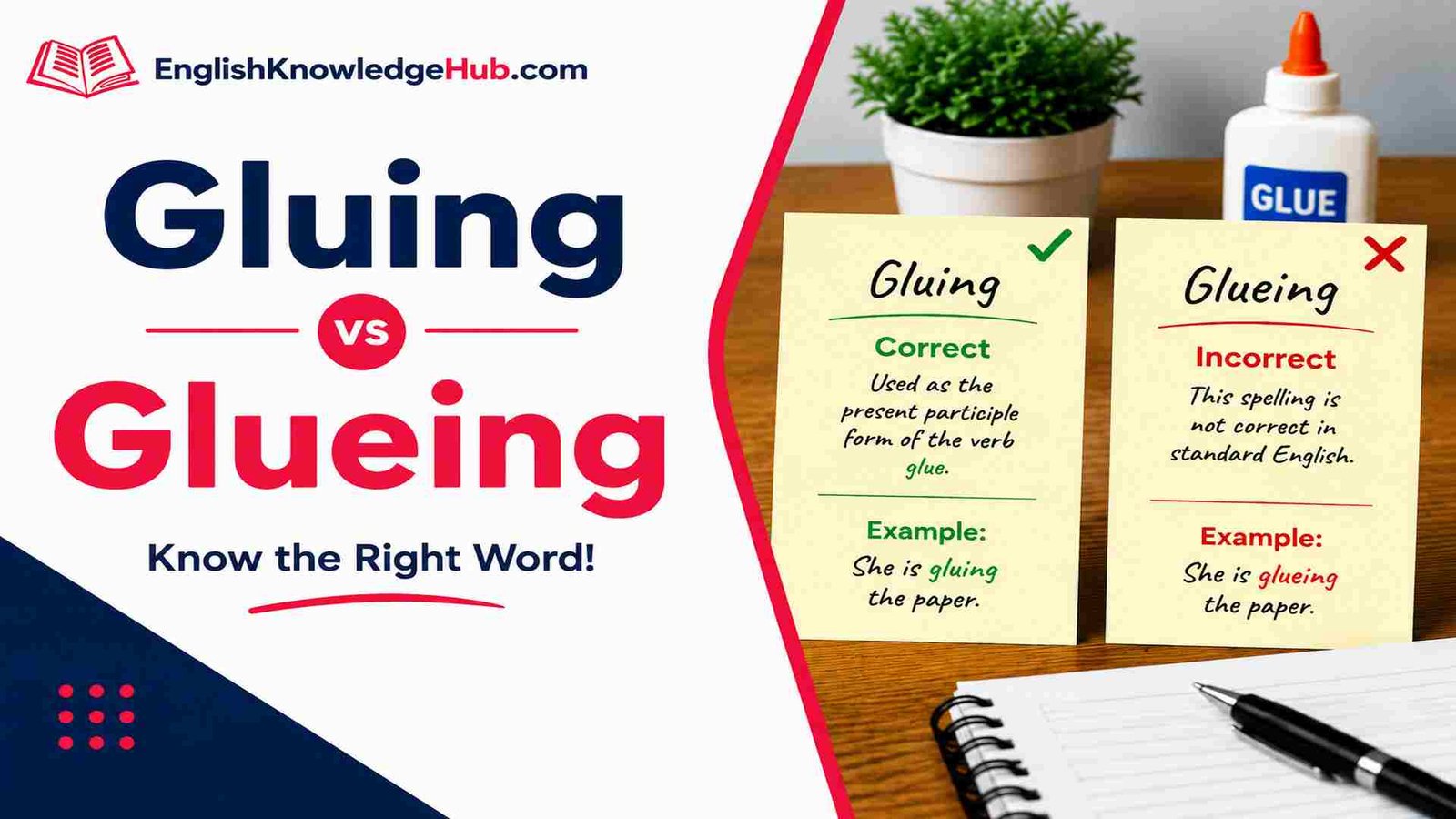
Both gluing and glueing are accepted spellings, but gluing is the better default for most modern writing. The usual pattern drops the final e from glue before adding -ing, giving gluing. Glueing is still recognized by major dictionaries, so it is a variant rather than a completely invented spelling.
In this article, you’ll learn Gluing or Glueing through spelling rules, dictionary variation, pronunciation, related forms such as glued, and examples from crafts, repairs, and formal instructions. Merriam-Webster lists the verb glue with the forms glued; gluing also glueing.
Gluing vs Glueing: The Quick Answer
Here is the easiest way to make the choice:
| Form | Status | Best Advice |
|---|---|---|
| gluing | Correct and widely used | Best default spelling |
| glueing | Accepted alternative | Correct, but less useful as your regular choice |
| glueeing | Incorrect | Avoid this form |
| glued | Correct | Past tense and past participle |
Both accepted spellings have the same meaning.
They do not describe different types of glue, different actions, or different levels of formality.
For most learners, the practical rule is simple:
When you are unsure, use gluing.
Why Does Glue Become Gluing?
The spelling comes from a common English rule.
When many verbs end in a final silent e, we normally remove the e before adding -ing.
For example:
- make → making
- hope → hoping
- move → moving
- write → writing
- use → using
- glue → gluing
So we do not simply attach -ing to the complete spelling of glue.
Instead, think of the change as:
glue → glu + ing → gluing
The temporary form glu is not a separate English word. It only helps show how the spelling changes when the suffix is added.
Compare Glue With Move
A useful teaching trick is to compare glue with a word you probably already spell correctly.
You write:
move → moving
not:
move → moveing
Now use the same pattern:
glue → gluing
This comparison is often easier to remember than a long spelling explanation.
Why Is Glueing Also Accepted?
If the normal rule produces gluing, it is reasonable to wonder why glueing exists at all.
English sometimes allows more than one established spelling of the same word form. Glueing is one of those alternatives.
The important distinction is between incorrect and alternative.
An incorrect form would be something like:
glueeing
That form adds letters incorrectly and should be avoided.
By contrast:
glueing
is an established alternative form.
However, learners do not need to alternate between the two spellings. Using one form consistently makes writing cleaner and easier to read.
For most situations, gluing is the simpler choice.
Do Gluing and Glueing Have Different Meanings?
No.
Both spellings represent the -ing form of the verb glue.
The verb glue means to attach, join, or fix things using glue or a similar adhesive material.
For example:
Ava is gluing the paper flowers onto the card.
You could encounter the alternative spelling in the same grammatical position:
Ava is glueing the paper flowers onto the card.
The action has not changed.
The spelling difference does not mean:
- one form uses stronger glue
- one form refers to permanent attachment
- one form belongs only to crafts
- one form belongs only to industrial work
- one form is more formal in meaning
They refer to the same action.
What Does Gluing Mean in a Sentence?
Gluing can describe an action taking place now or refer to the activity of joining things with adhesive.
Consider:
Theo is gluing the broken corner back onto the frame.
Here, is gluing describes an action in progress.
Now compare:
Gluing the small pieces requires a steady hand.
Here, gluing refers to the activity itself.
Understanding this grammatical difference can help you use the word naturally instead of simply memorizing its spelling.
How Gluing Works as a Verb Form
The word can appear with different forms of be to create continuous verb forms.
Present Continuous
Use am, is, or are + gluing for an action happening around the present time.
- I am gluing the label onto the jar.
- Rosa is gluing the loose fabric back into position.
- They are gluing the model pieces together.
Past Continuous
Use was or were + gluing for an action that was in progress in the past.
- We were gluing the decorations when the bell rang.
- Ethan was gluing the final panel when he noticed a crack.
Future Continuous
You can also use the word for an action expected to be in progress later.
- The team will be gluing the final components tomorrow.
- I will be gluing the display pieces after lunch.
The spelling stays the same in each construction.
Everyday Examples of Gluing
You may use the word when discussing crafts, repairs, furniture, school projects, clothing, packaging, or household tasks.
Examples:
- I’m gluing the loose cover back onto my notebook.
- Are you gluing those photographs into the album?
- Noah is gluing the toy wheel back into place.
- We spent an hour gluing paper shapes onto the display.
- She is gluing a decorative strip around the box.
- I finished cutting the pieces and started gluing them together.
These sentences sound natural in everyday conversation.
Workplace Examples
The word also appears in manufacturing, packaging, design, construction, repairs, and product assembly.
- The packaging team is gluing labels onto the sample containers.
- Check the edges carefully before gluing the panels together.
- The technician is gluing a protective strip around the frame.
- We tested several adhesives before gluing the rubber section in place.
- The workers finished measuring before gluing the final pieces.
- The supervisor reviewed the gluing process after noticing several loose seals.
In professional documents, consistency is especially important. Choose one accepted spelling and use it throughout the same document.
Academic Examples
Students and researchers may also use the word when describing projects, procedures, experiments, or methods.
- The students prepared the display by gluing each diagram onto card.
- The experiment involved gluing a small sensor to the test surface.
- Researchers avoided gluing labels directly onto the original material.
- The class compared stitching and gluing as methods of joining fabric.
- The project required measuring, folding, cutting, and gluing several pieces.
- Careful positioning was necessary before gluing the final section.
These examples show that the word is not limited to informal craft activities.
Formal and Technical Writing Examples
In formal instructions, the main goal is clarity.
Examples:
- Clean both surfaces thoroughly before gluing the components.
- The procedure requires gluing the protective layer to the inner panel.
- Avoid moving the parts immediately after gluing.
- Accurate positioning during gluing can improve the finished result.
- The operator should inspect each surface before gluing begins.
- Protective gloves should be worn when gluing these materials.
The spelling gluing fits naturally in instructions, reports, manuals, and other professional documents.
Is Gluing vs Glueing a US and UK Difference?
Not in a strict sense.
You may encounter explanations that present the forms as:
American English: gluing
British English: glueing
That is too simple.
Gluing can be used in both American and British English. Glueing also occurs as an accepted alternative and may be more noticeable in British-oriented usage.
The safer way to understand the distinction is:
- gluing works in American English
- gluing also works in British English
- glueing is an accepted alternative
- the meaning does not change
- international writers can comfortably use gluing
You do not need to change gluing to glueing simply because your readers are British.
Which Spelling Should Students Use?
Students should generally use gluing.
There are three practical reasons.
First, it follows the familiar rule used in words such as making, moving, and writing.
Second, it gives learners one consistent spelling instead of asking them to switch between two acceptable alternatives.
Third, it works well in both informal and formal writing.
For example:
The students are gluing the photographs onto the presentation board.
This spelling is clear and easy to recognize.
Which Spelling Should You Use in an Essay?
Use gluing unless your teacher, editor, or required style guide specifically prefers another form.
It works naturally in:
- essays
- reports
- research papers
- assignments
- business documents
- formal letters
- instructions
- website articles
The most important point after choosing an accepted spelling is consistency.
Avoid writing:
The gluing process takes ten minutes. After glueing the edges, leave the material to dry.
Instead, write:
The gluing process takes ten minutes. After gluing the edges, leave the material to dry.
The second version looks more controlled and consistent.
Common Mistakes With Gluing and Glueing
Most Gluing vs Glueing errors come from applying the spelling rule incorrectly or assuming the two accepted forms have different meanings.
Mistake 1: Writing Glueeing
Incorrect:
She is glueeing the ribbon around the box.
Correct:
She is gluing the ribbon around the box.
Explanation:
Do not add another e before -ing. Glueeing is not a standard form.
Mistake 2: Saying Glueing Is Always Wrong
Incorrect:
Glueing is not a real spelling.
Correct:
Glueing is an accepted alternative to gluing.
Explanation:
Calling an accepted variant completely incorrect gives learners the wrong idea. It is more accurate to recommend one spelling while recognizing the other.
Mistake 3: Giving the Spellings Different Meanings
Incorrect:
Use gluing for paper and glueing for wood.
Correct:
Use gluing for either material if that is your chosen spelling.
Explanation:
The spelling does not depend on the object, material, or type of adhesive.
Mistake 4: Keeping the E Because the Base Word Has One
Incorrect:
The word must be glueing because the base word is glue.
Correct:
The normal final-e pattern produces gluing.
Explanation:
Many verbs lose final e before -ing, such as move → moving and write → writing.
Mistake 5: Switching Between Both Forms
Incorrect:
We began gluing the panels at noon and finished glueing them at two.
Correct:
We began gluing the panels at noon and finished gluing them at two.
Explanation:
Using one spelling consistently makes your writing look more polished.
The Final-E Rule Has Exceptions
“Drop the final e before adding -ing” is a useful rule, but it does not apply to every English verb.
Many words follow it:
- take → taking
- move → moving
- hope → hoping
- write → writing
- smile → smiling
- glue → gluing
Other words keep an e:
- see → seeing
- agree → agreeing
- flee → fleeing
- dye → dyeing
This is why spelling rules should be treated as strong patterns rather than rules with no exceptions.
Why Do We Write Dyeing but Gluing?
Compare these two verbs:
die → dying
dye → dyeing
Keeping the e in dyeing makes the spelling visually different from dying.
Now consider:
glue → gluing
There is no similar common word that requires the e to remain for clarity.
So the regular final-e pattern works naturally.
You do not need to memorize complicated theory here. Remember the familiar comparison:
move → moving
glue → gluing
Glue, Glues, Glued, and Gluing
Learning the whole verb family can prevent several spelling mistakes.
| Form | Use | Example |
|---|---|---|
| glue | Base form | Please glue the corner carefully. |
| glues | Third-person singular | Maya glues every label by hand. |
| glued | Past tense | We glued the pieces yesterday. |
| glued | Past participle | They have glued the panel securely. |
| gluing | -ing form | He is gluing the final part now. |
| glueing | Alternative form | Glueing is also accepted. |
Notice that the past tense is:
glued
not:
glueed
Because glue already ends in e, you simply add d:
glue + d = glued
The -ing form follows a different pattern:
glue → gluing
Gluing vs Glued
These forms are related but perform different jobs.
Use gluing when describing an action in progress:
Lena is gluing the pieces together.
Use glued for a completed past action:
Lena glued the pieces together yesterday.
You can also use glued as a past participle:
Lena has glued every piece into place.
A simple learner reminder is:
gluing = action in progress
glued = past or completed form
Is Gluing a Verb or a Noun?
The answer depends on how it appears in the sentence.
As Part of a Verb
Ryan is gluing the cardboard onto the frame.
Here, gluing forms part of is gluing, which describes an action.
As the Name of an Activity
Gluing the cardboard requires careful alignment.
Here, the phrase refers to an activity.
You may also see gluing before another noun:
- gluing process
- gluing method
- gluing equipment
- gluing technique
- gluing surface
For example:
The factory introduced a faster gluing method for lightweight packaging.
What Does “Glued to” Mean?
The word glue also appears in figurative expressions.
If someone is glued to something, they are paying very close attention to it or seem unable to look away.
Examples:
- The children were glued to the screen during the final scene.
- Maya stayed glued to her phone while waiting for the result.
- Everyone was glued to the scoreboard during the last minute.
Notice the grammar.
We normally say:
He was glued to the television.
We do not normally say:
He was gluing to the television.
The expression uses glued to, not the ordinary continuous form.
A Quick Way to Check Your Spelling
When you hesitate between the two spellings, use this short test.
Step 1: Start With the Verb
glue
Step 2: Add the -ing Meaning
You want to describe an ongoing action.
Step 3: Remember Move
move → moving
Then copy the same pattern:
glue → gluing
This gives you a reliable spelling without requiring you to memorize a long explanation every time.
Frequently Asked Questions About Gluing vs Glueing
Is it gluing or glueing?
Both are accepted spellings. Gluing is the more practical default because it follows the normal final-e pattern and works well in most types of writing.
Is glueing incorrect?
No. Glueing is an accepted alternative spelling. However, learners can usually keep things simpler by consistently using gluing.
Why is gluing spelled without the e?
Many verbs ending in a final e drop that letter before -ing. This gives us forms such as move → moving, write → writing, and glue → gluing.
What does Gluing vs Glueing mean for learners?
It means you may encounter two accepted spellings of the same verb form. You do not need to learn two different meanings. Using gluing consistently is usually the easiest approach.
Is gluing American English?
It is standard in American English, but it is not limited to American usage. British English also uses gluing.
Is glueing British English?
It can occur in British English, but it is not the only British form. Gluing is also acceptable, so the distinction should not be treated as a strict US-versus-UK rule.
What is the past tense of glue?
The past tense is glued.
Example:
Marcus glued the loose section back into place.
Do not write glueed.
Should I use gluing in formal writing?
Yes. Gluing is a clear choice for essays, reports, instructions, professional documents, and other formal writing.
Final Thoughts
Both spellings can appear in correct English, but gluing is the form most learners should make their regular choice. It follows the familiar pattern of removing final e before adding -ing, and it works naturally in everyday, academic, and professional contexts.
The safest answer to Gluing vs Glueing is therefore simple: use gluing as your default, recognize glueing as an accepted alternative, and avoid switching between the two without a reason.
For more practical explanations of confusing spellings, grammar rules, and commonly mixed-up English words, continue learning with EnglishKnowledgeHub.com.
