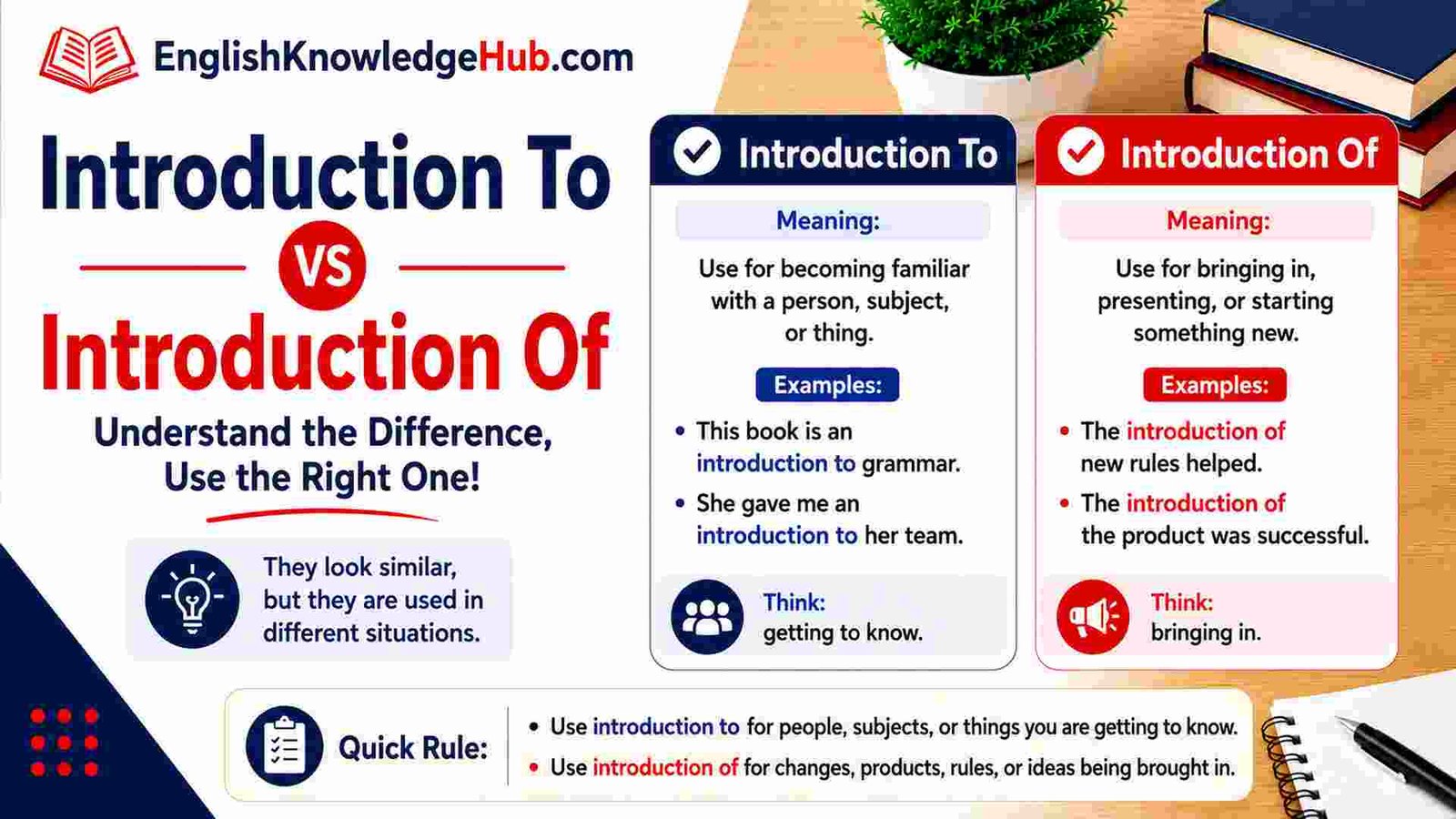
Use “introduction to” when someone starts learning about, meeting, or experiencing something. Use “introduction of” when something itself is being presented, started, added, or brought into use. Both phrases are correct, but they are used for different meanings.
For example:
- The class gave us an introduction to graphic design.
- The introduction of new design software made the work faster.
In the first sentence, people are learning about graphic design.
In the second sentence, new software is being brought into use.
The easiest way to understand Introduction To vs Introduction Of is to ask:
Is someone being introduced to something, or is something itself being introduced?
That one question can help you choose the right phrase in most situations.
The Difference in Simple Words
Think of to as pointing toward something.
A person moves toward a new subject, person, idea, or experience.
For example:
- an introduction to photography
- an introduction to our new teacher
- an introduction to office life
- an introduction to basic accounting
Now think of of as showing the thing that is being introduced.
For example:
- the introduction of a new rule
- the introduction of electric cars
- the introduction of better security
- the introduction of the guest speaker
Here is a very simple rule:
Introduction to = what someone learns about, meets, or experiences
Introduction of = what is being introduced
This rule works well in everyday English, school, college, and workplace writing.
When to Use “Introduction To”
Use introduction to when a person starts learning about something, meets someone, or experiences something for the first time.
Learning About a Subject
This is one of the most common uses of introduction to.
You may see course names like:
- Introduction to History
- Introduction to Business
- Introduction to Programming
- Introduction to Psychology
The subject comes after to because it is the thing the student is starting to learn about.
Examples:
- This lesson gives beginners an introduction to English grammar.
- The book offers an introduction to personal finance.
- Our first class was an introduction to web design.
- The teacher gave us an introduction to report writing.
If you are talking about a beginner course, basic lesson, or first look at a subject, to is usually the right choice.
A First Experience
You can also use introduction to when someone experiences something new for the first time.
Examples:
- My first job was my introduction to customer service.
- The school trip was his introduction to farm life.
- That small project became my introduction to teamwork.
- Her first visit to Italy was an introduction to a new culture.
Here, the focus is on the person having a new experience.
Meeting a Person
Introduction to can also describe meeting someone for the first time.
Examples:
- Could you arrange an introduction to your manager?
- Sara gave me an introduction to one of her clients.
- I asked for an introduction to the event organizer.
In normal conversation, people often use the verb introduce instead.
For example:
- Could you introduce me to your manager?
This sounds very natural in everyday English.
When to Use “Introduction Of”
Use introduction of when the sentence focuses on the thing that is being introduced.
That thing might be:
- a rule
- a system
- a product
- a service
- a person
- a method
- a policy
- a new idea
A New Rule or Policy
Examples:
- The introduction of a new dress code surprised the staff.
- Parents supported the introduction of healthier school meals.
- The introduction of new parking rules reduced traffic problems.
- Workers discussed the introduction of a new leave policy.
Look at what follows of.
A dress code is introduced.
Healthier meals are introduced.
Parking rules are introduced.
A leave policy is introduced.
So of is the correct choice.
A New Product, Service, or System
Use the same pattern when a business or organization starts using something new.
Examples:
- The introduction of online payments made shopping easier.
- The introduction of home delivery attracted more customers.
- The introduction of new software changed the way the team worked.
- The introduction of self-checkout machines reduced waiting time.
These sentences are not about someone learning about the new thing.
They are about the new thing being started or brought into use.
Introduction To vs Introduction Of: Quick Comparison
| Meaning | Use | Example |
|---|---|---|
| Learning about a subject | Introduction to | The course is an introduction to journalism. |
| First experience | Introduction to | The trip was my introduction to camping. |
| Meeting someone | Introduction to | She arranged an introduction to the director. |
| Starting a new rule | Introduction of | The introduction of the rule caused debate. |
| Bringing in a new system | Introduction of | The introduction of the system improved service. |
| Starting a new service | Introduction of | The introduction of home delivery increased sales. |
The basic difference is simple.
Use to when someone is moving toward new knowledge, a person, or an experience.
Use of when something itself is being introduced.
The Same Noun Can Follow Both Phrases
This is one of the most important parts of Introduction To vs Introduction Of.
Sometimes the same noun can come after both phrases.
Both sentences may be correct, but their meanings are different.
Look at these examples:
The trainer gave us an introduction to the new software.
This means the trainer explained the software to us.
Now compare:
The introduction of the new software caused a few problems.
This means the company started using the software.
The word software appears in both sentences.
But the first sentence is about learning about the software.
The second sentence is about bringing the software into use.
Here is another example:
The teacher gave the class an introduction to the new exam system.
This means the teacher explained the system.
Now compare:
The introduction of the new exam system worried some students.
This means the school started using the new system.
So do not choose to or of only by looking at the noun.
Look at the full meaning of the sentence.
Can “Of” and “To” Be Used Together?
Yes.
A useful pattern is:
the introduction of X to Y
Here:
X = the person or thing being introduced
Y = the person, group, place, or situation receiving it
Examples:
- The introduction of tablets to the classroom changed many lessons.
- The introduction of Ali to the new team went well.
- The introduction of solar lights to the village reduced energy costs.
- The introduction of the new coach to the players happened before training.
Look at this sentence:
The introduction of Ali to the new team went well.
Ali is the person being introduced.
The team is the group he is introduced to.
That is why both of and to can appear in the same sentence.
Common Mistakes and How to Fix Them
Mistake 1: Using “Of” for a Subject
Incorrect:
The course gives an introduction of computer science.
Correct:
The course gives an introduction to computer science.
Explanation:
Students are starting to learn about computer science. They are being introduced to the subject.
Mistake 2: Using “To” When a New System Starts
Incorrect:
The introduction to the new payment system caused delays.
Correct:
The introduction of the new payment system caused delays.
Explanation:
The sentence means the payment system was brought into use. The system itself is being introduced, so of is correct.
However, this sentence is also correct:
The manager gave us an introduction to the new payment system.
Why?
Because here the manager is teaching the workers how the system works.
The meaning has changed.
Mistake 3: Thinking “Introduction Of” Is Wrong
Incorrect idea:
Only “introduction to” is correct English.
Correct idea:
Both phrases are correct.
Explanation:
They simply have different meanings.
Use to when someone learns about, meets, or experiences something.
Use of when something is presented, started, or brought into use.
Everyday Examples
Here are some natural examples with introduction to:
- My brother gave me an introduction to chess.
- The museum visit was our introduction to local history.
- That short class was my introduction to baking.
- I asked Emma for an introduction to her photographer.
Now compare them with introduction of:
- The introduction of parking fees upset local shoppers.
- The introduction of a morning bus service helped workers.
- The café welcomed the introduction of mobile ordering.
- The introduction of recycling boxes reduced waste.
The first group is about learning, meeting, or experiencing.
The second group is about something new being brought in.
Workplace and Business English
This difference is very useful in professional English.
Imagine that a company gets a new employee system.
You could say:
Monday’s training will give staff an introduction to the new system.
This means the workers will learn how the system works.
You could also say:
The introduction of the new system will begin on Monday.
This means the company will start using it.
The noun is the same, but the meaning is different.
More workplace examples:
- The training gives workers an introduction to customer service rules.
- My supervisor arranged an introduction to the regional manager.
- The introduction of digital invoices reduced paper use.
- The introduction of flexible working hours helped many employees.
- The introduction of a new support service improved customer care.
Using the correct phrase can make emails, reports, and workplace messages much clearer.
Academic and Formal Writing
Students also see both forms in essays, reports, and research papers.
Use introduction to when talking about basic learning or an opening section.
Examples:
- The first unit gives an introduction to modern poetry.
- Students received an introduction to research methods.
- The introduction to the report explains the main problem.
Use introduction of when something new is added, started, or used.
Examples:
- The introduction of digital records changed the research process.
- The study looked at the introduction of new teaching methods.
- The introduction of stricter rules affected several schools.
In academic writing, introduction of often appears when writers talk about new systems, methods, rules, or technology.
“Introduction to a Book” or “Introduction of a Book”?
Usually, use introduction to a book when talking about the opening section or a guide to the book.
Examples:
- I read the introduction to the book before Chapter One.
- The introduction to the novel explains its historical setting.
Here, to connects the introduction with the book.
Introduction of a book has a different meaning.
It may mean that the book itself is being presented, launched, or brought into use.
For example:
- The introduction of the new textbook into local schools took several months.
In this sentence, the textbook itself is being introduced.
Is There a British and American English Difference?
There is no major difference between British and American English in this case.
Both forms are used in both varieties of English.
The correct choice depends mainly on meaning.
Use to for learning, meeting, or first experience.
Use of for something being presented, started, added, or brought into use.
A Very Easy Test
Here is a simple trick you can use when you are not sure.
Change introduction into the verb introduce.
Look at this sentence:
The introduction of online tickets made entry faster.
Change it to:
They introduced online tickets.
What was introduced?
Online tickets.
So of works.
Now look at this sentence:
The class gave me an introduction to digital drawing.
Think of it like this:
The class introduced me to digital drawing.
What was I introduced to?
Digital drawing.
So to works.
This small test makes Introduction To vs Introduction Of much easier to understand.
Frequently Asked Questions
Is “introduction to” correct?
Yes.
Use it when someone starts learning about, meeting, or experiencing something.
Example:
The lesson was an introduction to public speaking.
Is “introduction of” correct?
Yes.
Use it when something is being started, presented, added, or brought into use.
Example:
The introduction of online booking saved customers time.
Is it “introduction to the topic” or “introduction of the topic”?
Usually, use introduction to the topic when someone is learning about that topic.
Introduction of the topic can be correct when you mean bringing the topic into a conversation or discussion.
Is “introduction to a person” correct?
Yes.
It means someone helps you meet that person.
Example:
I asked for an introduction to the company director.
Can I say “introduction of a person”?
Yes, but it has a different meaning.
It usually means presenting that person to other people.
Example:
The host prepared the introduction of the guest speaker.
In everyday English, it may sound more natural to say:
The host introduced the guest speaker.
Is “introduction to the company” correct?
Yes.
Example:
The first training day gives new employees an introduction to the company.
This means they learn basic information about the company.
Which is correct, “introduction to technology” or “introduction of technology”?
Both can be correct.
Introduction to technology means someone starts learning about technology.
Introduction of technology means technology is being brought into a place, company, school, or system.
Final Thoughts
The easiest way to understand Introduction To vs Introduction Of is to look at what the sentence is trying to say.
Use introduction to when someone starts learning about something, meets someone, or has a first experience.
Use introduction of when something itself is being presented, started, added, or brought into use.
Remember this simple rule:
TO = what you learn about, meet, or experience
OF = what is being introduced
If you remember this difference, choosing the right phrase becomes much easier.
For more easy grammar lessons, word comparisons, and clear English examples, visit EnglishKnowledgeHub.com.
