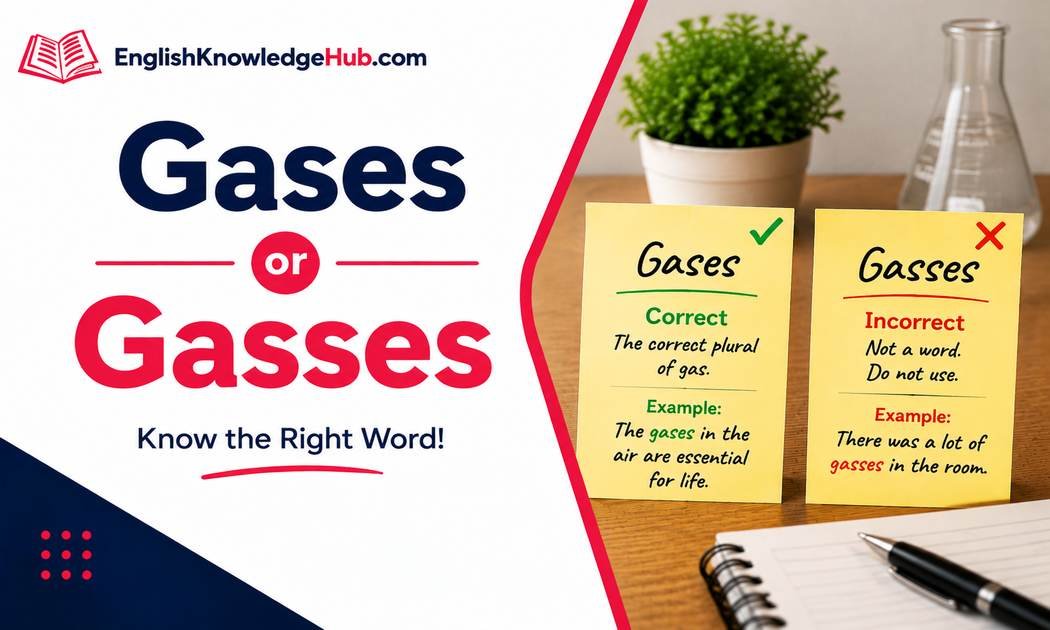
Both “gases” and “gasses” can be correct, but “gases” is the preferred plural of the noun gas in most modern, scientific, academic, and professional writing. Major dictionaries also recognize gasses as a less common plural. Separately, gasses can be the third-person singular form of the verb gas. The sentence meaning tells you which use you have.
Gases or Gasses: Quick Answer
| Form | Use | Best advice |
|---|---|---|
| gases | Plural noun | Preferred for more than one gas |
| gasses | Less common plural noun | Accepted by some major dictionaries, but usually avoid when gases will do |
| gasses | Verb form | Correct when a singular subject performs the verb gas |
Merriam-Webster lists the noun plural as gases also gasses. Cambridge also records both plural forms in its dictionary material. That means it is too strong to call plural gasses simply wrong. In edited English, however, gases is the clearest default, especially in science.
You can verify the entries at Merriam-Webster and Cambridge Dictionary.
When “Gases” Is the Best Choice
Use gases when you mean two or more gases or different types of gas.
- Oxygen and nitrogen are gases.
- The laboratory measures several gases in the sample.
- Greenhouse gases trap heat in the atmosphere.
- Some gases are colorless and odorless.
This is the spelling readers expect most often in textbooks, research papers, school assignments, technical reports, and general professional writing.
Can “Gasses” Be a Plural Noun?
Yes. This is the point many simplified spelling guides miss.
Gasses appears as an accepted alternative plural in major dictionaries. You may also find it in published writing. Still, gases is much more useful as your default because it is widely preferred and immediately recognizable in scientific and formal contexts.
So instead of thinking:
gases = correct, gasses = wrong
use this more accurate rule:
gases = preferred plural
gasses = accepted but less common plural
When “Gasses” Is a Verb
Gasses can also be the third-person singular present form of the verb gas.
The verb can have several meanings depending on context, including exposing something to gas, supplying something with gas, or, in older informal usage, talking at length.
- The technician gasses the chamber before the test.
- The system gasses the sealed container according to the procedure.
- He gasses for hours about old stories. This conversational sense is old-fashioned.
Here, gasses is an action, not a plural noun.
Why the Two Spellings Cause Confusion
The base word gas ends in s, so several spelling patterns compete in a learner’s mind. English also doubles final consonants in some verb forms:
- gas → gassed
- gas → gassing
That makes gasses look natural. And it is natural in some uses. The important point is not to decide by appearance alone.
Ask what job the word is doing in the sentence.
Noun or Verb? A Fast Test
Try this two-step check:
- If the word means more than one gas, choose gases as your safest default.
- If it means does the action of gassing, use gasses.
Compare:
| Sentence | Form | Why |
|---|---|---|
| The sensor detects harmful gases. | Plural noun | More than one gas or type of gas |
| The machine gasses the chamber. | Verb | The machine performs an action |
| Several greenhouse gases were measured. | Plural noun | Science writing normally prefers gases |
| The unit gasses each sample for ten seconds. | Verb | Third-person singular of gas |
Gas, Gases, Gasses, Gassed, and Gassing
| Word | Grammar job | Example |
|---|---|---|
| gas | Singular noun / base verb | Helium is a gas. |
| gases | Preferred plural noun | Air contains several gases. |
| gasses | Less common plural noun or present-tense verb | The unit gasses the container. |
| gassed | Past tense / past participle | The room was gassed before inspection. |
| gassing | -ing form | They are gassing the chamber now. |
Which Spelling Should You Use in Science?
Use gases.
It is the standard-looking and dominant form in scientific communication:
- noble gases
- greenhouse gases
- blood gases
- exhaust gases
- atmospheric gases
Writing greenhouse gasses may be defensible under dictionaries that accept the variant plural, but greenhouse gases is the much safer editorial choice.
Common Mistakes to Avoid
Mistake 1: Saying plural “gasses” is always incorrect
Too absolute:
Gasses can never be the plural of gas.
Better:
Gases is the preferred plural, while some major dictionaries also accept gasses as a less common plural.
Mistake 2: Using “gases” for the verb
Incorrect:
The machine gases the chamber every hour.
Correct:
The machine gasses the chamber every hour.
Explanation: When the verb gas takes a third-person singular ending, the final consonant is doubled in this form.
Mistake 3: Choosing the rare form when clarity matters
If you are writing a science report, assignment, article, or professional document, use gases for the plural. Even where gasses is accepted, the preferred form avoids distracting readers.
American and British English
You do not need a simple US-versus-UK rule here. Dictionaries on both sides of the Atlantic show variation, but gases works safely in both American and British English.
That is why learners should treat gases as the default plural rather than trying to memorize a regional split.
Frequently Asked Questions
What is the plural of gas?
Gases is the preferred plural. Some major dictionaries also accept gasses as an alternative plural.
Is “gasses” a real word?
Yes. It can be a less common plural of gas, and it can also be the third-person singular form of the verb gas.
Should I write “greenhouse gases” or “greenhouse gasses”?
Write greenhouse gases. It is the normal and preferred form in scientific and professional writing.
Why is the verb spelled “gasses”?
The verb forms include gassed, gassing, and gasses. The doubled s belongs to that verb pattern.
Are “gases” and “gasses” pronounced differently?
The plural forms are normally pronounced alike. Grammar and spelling, not pronunciation, tell you how the word is functioning.
Which form should a student use?
Use gases for the plural noun. It is the clearest choice for schoolwork and exams.
Final Takeaway
The accurate answer to Gases or Gasses needs one important nuance. Gases is the preferred plural of gas, but gasses is also recognized as a less common plural by major dictionaries. Gasses can additionally function as a verb. For simple, professional, and scientific writing, choose gases when you mean more than one gas.
For more careful explanations of English spelling and usage, explore EnglishKnowledgeHub.com.
