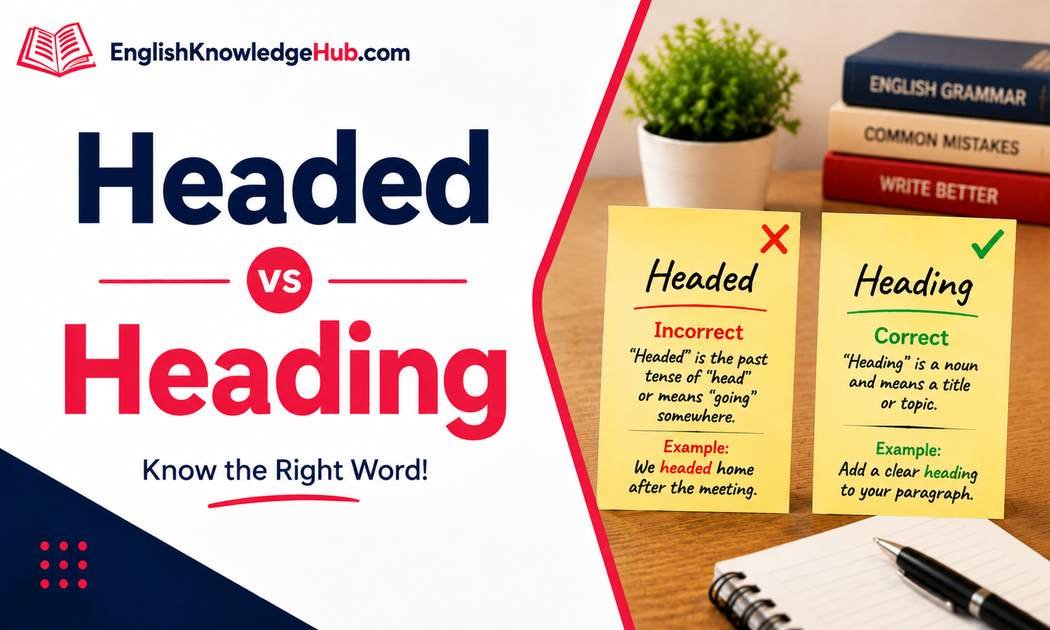
Headed and heading can both describe movement toward a place, but they usually show different viewpoints. “Heading” normally presents the movement as happening now or around the present time, while “headed” can describe direction as a past action or, especially in American English, a current state of being on the way somewhere.
In this article, you’ll learn how headed vs heading works in real sentences, why both “I’m heading home” and “I’m headed home” can be correct, and which form sounds natural in different situations.
The difference is more about viewpoint than destination
Suppose a coworker sees you picking up your bag and asks where you are going. You could say, “I’m heading to the station.” The -ing form puts attention on the action or movement. In American English, “I’m headed to the station” is also very natural. Here, headed works almost like an adjective describing your present direction.
The important point is that headed is not simply the past tense alternative to heading. Context matters.
| Sentence | What it suggests |
|---|---|
| I’m heading home. | I am going toward home now. |
| I’m headed home. | I am on my way toward home. |
| We headed home at six. | We started or made our way home in the past. |
| Where are you heading? | What direction or destination are you going toward? |
When “heading” is the easiest choice
Use heading when you want to emphasize an action in progress. “The research team is heading back to campus.” “I’m heading into a meeting.” “The storm is heading north.” These sentences feel active because they focus on movement or development.
It also works naturally in questions: “Where are you heading after class?” In everyday conversation, that often sounds smoother than asking “Where are you headed?”, although both are common.
When “headed” fits better
As a normal past-tense verb, headed is straightforward: “After the conference, Maya headed to the airport.” No helping verb is needed because the action happened in the past.
But consider “Maya is headed to the airport.” That sentence refers to the present, not the past. In this construction, be + headed describes direction or destination. Merriam-Webster records headed in the sense of having a heading or direction, which helps explain why this pattern is normal English.
See the Merriam-Webster entry for headed for dictionary usage.
A mistake learners often make
Incorrect: Yesterday we heading toward the museum.
Correct: Yesterday we headed toward the museum.
Explanation: Yesterday places the completed movement in the past, so the simple past form headed is needed.
Now compare: “We were heading toward the museum when it started raining.” Here were heading is correct because the sentence shows an action already in progress when another event occurred.
Headed for and headed to
Both patterns are useful. “Headed to” normally introduces a destination: “She is headed to Lahore.” “Headed for” can do the same, but it also appears figuratively: “The project is headed for trouble.” In that sentence, nobody is physically travelling. The phrase predicts an outcome.
If tense choices are the part that trips you up, our guide to flew or flown shows the same idea of choosing a verb form according to the grammar around it.
FAQs
Is “I am headed home” correct?
Yes. It is especially common in American English and means you are on your way home.
Is “I am heading home” correct?
Yes. It presents the movement toward home as an action in progress.
Can headed refer to the present?
Yes. In a phrase such as “is headed toward the coast,” headed describes present direction.
What is the past tense of head?
The simple past is headed: “They headed inside when the rain began.”
Which should I use in formal writing?
Either can be correct. Choose the form that expresses the time and viewpoint you mean rather than replacing one mechanically with the other.
Final thought
For headed vs heading, think about the sentence, not just the ending. Heading usually highlights movement in progress. Headed is the simple past of head, but be + headed can also describe a current direction. Once you notice that distinction, sentences such as “I’m heading out” and “I’m headed out” stop looking contradictory.
Keep exploring practical English choices at EnglishKnowledgeHub.com, where the goal is to help you understand why a form works, not merely memorize an answer.
