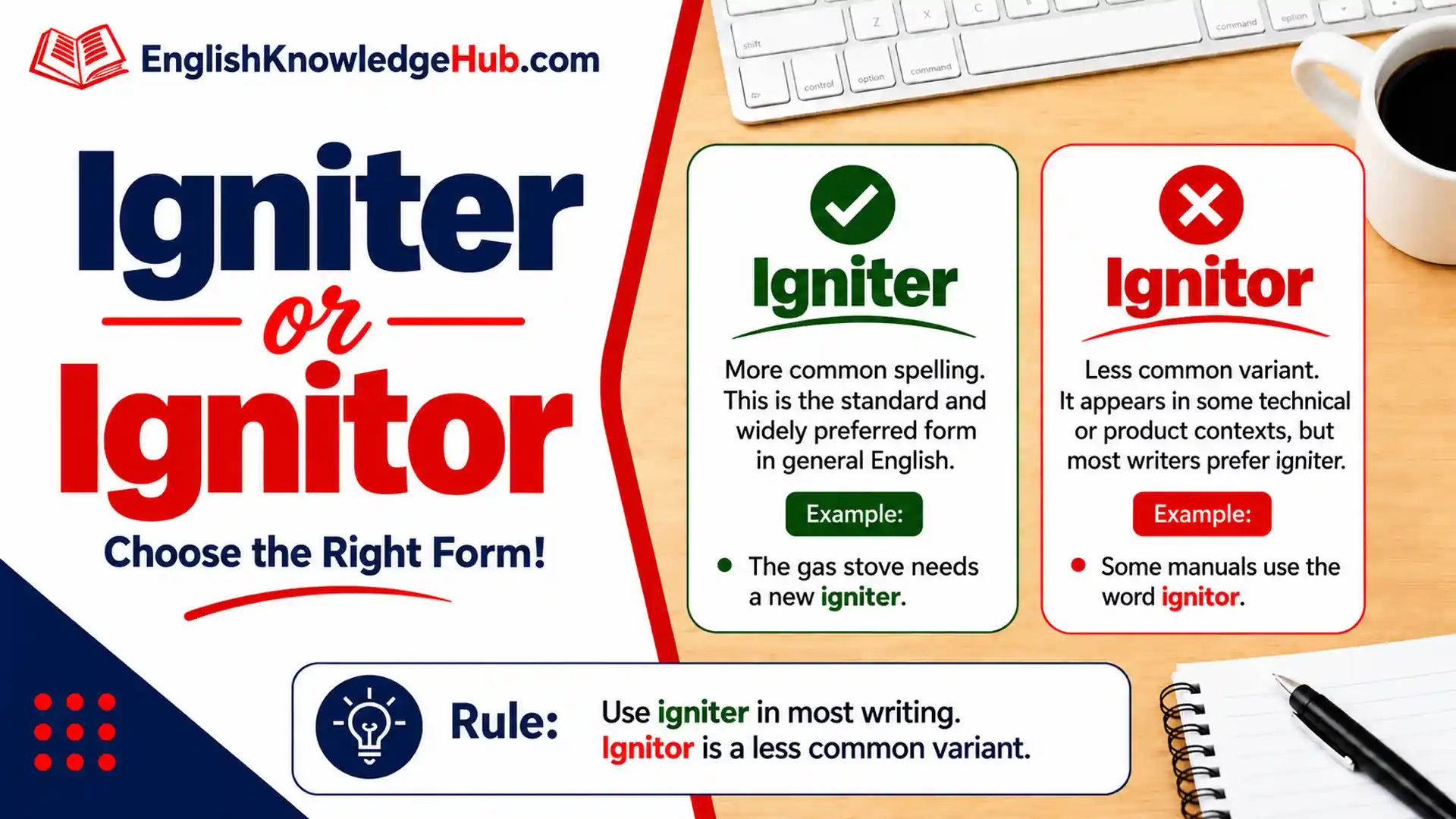
Igniter is the standard and more common spelling, while ignitor is a less common variant. Both can refer to a person or device that starts a fire, flame, or combustion process. In normal English, igniter is the safer choice. Use ignitor when a product name, company, or technical document uses that spelling.
The two forms look very similar, so many learners wonder if one is wrong. The answer is more useful than a simple right-or-wrong rule. One spelling is preferred in general English, while the other still appears in technical settings.
Why Igniter Is the Better General Spelling
The word igniter comes from the verb ignite.
A simple way to understand it is:
ignite + er = igniter
The ending -er often names a person or thing that performs an action.
For example:
- a heater heats
- a starter starts
- a printer prints
- an igniter ignites
This pattern makes igniter easy to understand and easy to remember.
If you are writing an essay, article, report, email, or general explanation, this is usually the best form to choose.
Example:
The gas stove needs a new igniter.
The sentence tells us that the stove needs a part that helps start the flame.
What Does Igniter Mean?
An igniter is something that starts burning or begins combustion.
It may create:
- a spark
- heat
- a small flame
- another source of ignition
You may find one in a stove, furnace, oven, grill, engine, or other machine that needs a controlled start.
Here are some simple examples:
“The oven igniter is not working.”
“The mechanic tested the engine igniter.”
“The grill made a clicking sound, but the igniter did not spark.”
In each case, the word refers to the part that helps start the flame or burning process.
Is Ignitor Wrong?
No. Ignitor is not always wrong.
It is a less common spelling, but it still appears in technical language and product names.
This is important because learners sometimes assume that a less common spelling must be a spelling mistake. That is not true here.
You may see ignitor in:
- furnace manuals
- appliance parts
- repair guides
- product labels
- technical catalogs
If a company officially names a part with this spelling, you should usually keep it.
For example:
Hot Surface Ignitor Assembly
If that is the official product name, changing it may make the name less accurate.
Ignitor vs Igniter at a Glance
| Word | Status | Best Use |
|---|---|---|
| Igniter | Standard and more common | General English, essays, articles, reports |
| Ignitor | Less common variant | Technical labels, product names, manufacturer wording |
| Meaning | Usually the same | A person or device that causes ignition |
The main difference is spelling preference, not meaning.
When Should You Use Igniter?
Use igniter when you are writing in your own words and do not need to follow a special product label.
It works well in:
Daily Conversation
“The stove igniter is making a clicking sound.”
“I think the barbecue igniter needs a new battery.”
“The oven igniter stopped working this morning.”
Workplace Writing
“The technician replaced the damaged igniter.”
“Please inspect the burner igniter before restarting the machine.”
“The maintenance team found a fault in the igniter system.”
Academic Writing
“The fuel was exposed to an electric igniter.”
“The experiment began when the igniter produced a spark.”
“The researchers recorded the time between activation and ignition.”
Formal Writing
“The faulty igniter should be replaced before the unit is returned to service.”
“The inspection found signs of wear around the igniter.”
“The equipment should not be used if the igniter fails to operate.”
When Should You Use Ignitor?
Use the less common spelling when there is a clear reason.
For example, keep ignitor when:
- it is part of an official part name
- the manufacturer uses it
- the technical manual uses it consistently
- the workplace requires that spelling
- the product label uses it
Imagine that a furnace manual lists this item:
Model X45 Hot Surface Ignitor
In that case, keeping the official spelling is sensible.
But if you are simply explaining how the furnace works, you can normally use the standard form.
Do Ignitor and Igniter Mean Different Things?
Usually, no.
The spelling does not normally change the basic meaning.
Both can describe something that causes ignition.
You should not assume that one means a spark device and the other means a heat device.
That difference comes from the type of equipment, not from the spelling.
For example, one system may use a spark, while another may use a heated surface. Both can still be called an igniter.
Common Mistakes Learners Make
One common mistake is treating the two spellings as completely different words.
Incorrect:
The ignitor uses heat, while the igniter only uses a spark.
Correct:
An igniter may use heat or a spark, depending on the system.
Explanation:
The spelling does not tell you how the device works.
Another mistake is changing the spelling inside the same paragraph for no reason.
Incorrect:
The technician removed the ignitor and installed a new igniter.
Correct:
The technician removed the igniter and installed a new igniter.
Explanation:
Use one spelling consistently unless you are copying an official product name.
A third mistake is confusing igniter with ignition.
Incorrect:
The mechanic replaced the ignition because the small heating part was damaged.
Correct:
The mechanic replaced the igniter because the small heating part was damaged.
Explanation:
An igniter is a part or device. Ignition is the act, process, or system connected with starting combustion.
Ignite, Igniter, and Ignition
These words are related, but they do different jobs.
Ignite is usually a verb.
Example:
“The spark will ignite the gas.”
Igniter is a noun.
Example:
“The igniter creates the spark.”
Ignition is also a noun, but it usually refers to the process or system.
Example:
“The ignition process took several seconds.”
A simple memory trick is:
ignite = action
igniter = thing
ignition = process
This small pattern helps many learners keep the words separate.
Is There a British and American English Difference?
Not a clear one.
This pair does not work like:
- color and colour
- center and centre
- traveled and travelled
You should not treat one spelling as fully British and the other as fully American.
The standard form is still the better choice in general writing.
The other version appears more because of technical tradition, product naming, or company preference.
How to Choose the Right Form Quickly
Use this simple rule:
If you are writing your own sentence, choose igniter.
If you are copying a product name or technical label, keep the spelling used by the manufacturer.
That rule works well in most situations.
For example:
General sentence:
“The furnace igniter needs to be replaced.”
Official product name:
“Order the SuperHeat Hot Surface Ignitor Model 220.”
Both can be correct because the context is different.
Why Consistency Matters
Good writing should make the reader’s job easy.
If you write one spelling in the first sentence and the other in the next, some readers may think you are talking about two different parts.
That can create confusion, especially in technical writing.
Choose one form and stay with it unless there is a good reason to change.
Consistency is often more important than forcing every technical label into one spelling style.
More Original Examples
“The pilot flame failed because the igniter did not receive power.”
“Our repair team cleaned the igniter before testing the burner.”
“The engineer checked the wire leading to the igniter.”
“The camping stove uses a push-button igniter.”
“The heater started normally after the new igniter was installed.”
“The report noted that the ignition system was working, but the igniter was weak.”
These examples show how naturally the word fits into everyday and professional English.
FAQs
Which is correct, ignitor or igniter?
Both can be used, but igniter is the standard and more common spelling.
Is ignitor a spelling mistake?
Not always. It is a less common variant and often appears in technical product names and repair language.
What does igniter mean?
It means a person or device that starts ignition, usually by creating heat, a spark, or a flame.
Should I use ignitor in school writing?
Usually not. Igniter is the safer and more standard choice for essays and academic work.
Why do some furnace parts use ignitor?
Some manufacturers and technical industries use that spelling as part of their own product terminology.
Are igniter and ignition the same word?
No. An igniter is the device or part. Ignition is the process or system.
Can both spellings appear in technical English?
Yes. Technical companies may use either form, so always check the official label when naming a specific part.
Final Answer
When choosing between ignitor or igniter, use igniter in normal English. It is the standard and more common spelling. The other form is still used, especially in technical labels and product names, so it should not automatically be treated as an error.
A good rule is simple: use the standard form in your own writing, but keep the manufacturer’s spelling when you are naming an official part.
For more easy grammar, spelling, and word-choice lessons, visit EnglishKnowledgeHub.com.
