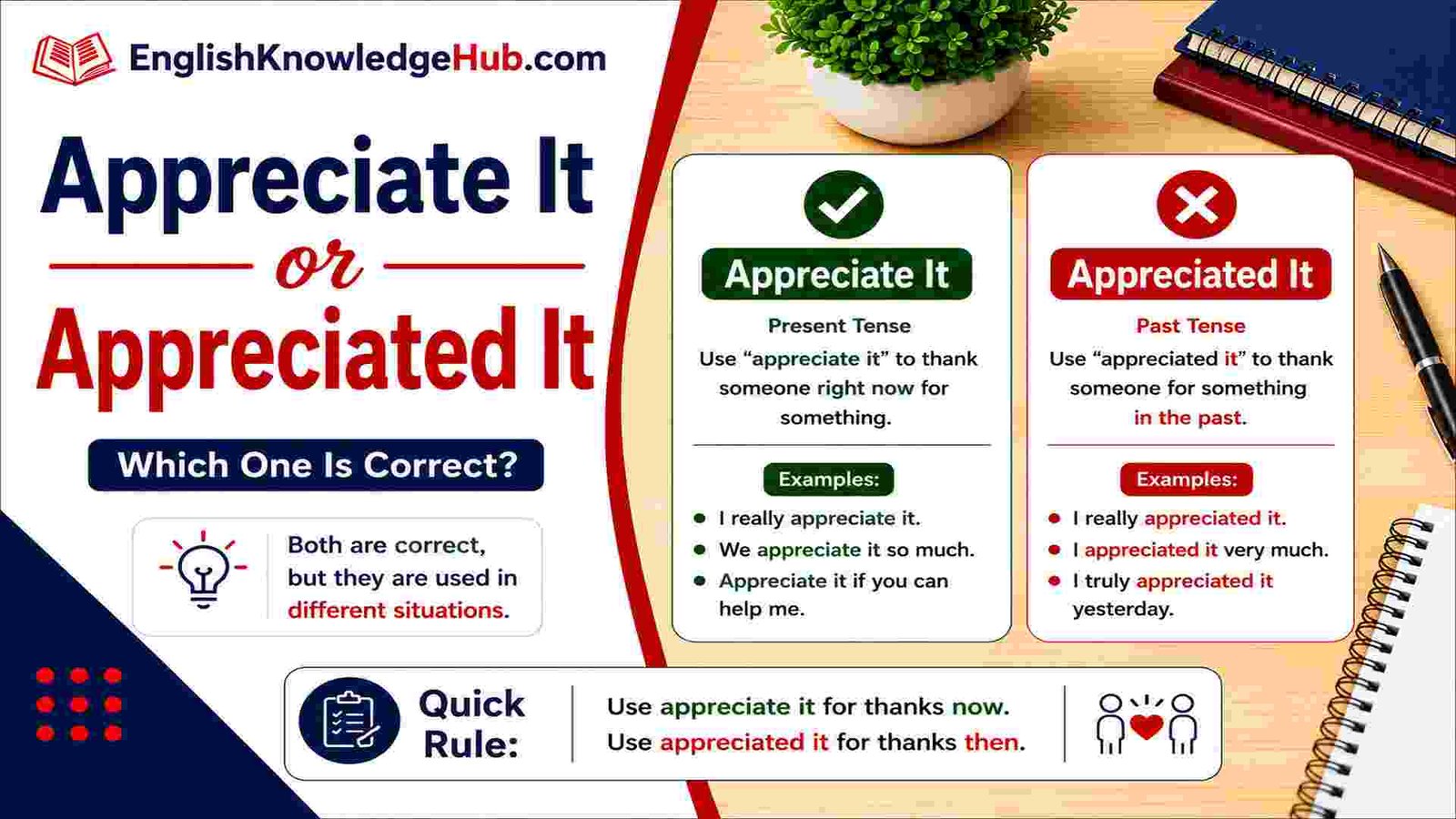
“Appreciate it” and “appreciated it” are both correct, but they are used for different times. Use “I appreciate it” when you feel thankful now. Use “I appreciated it” when you are talking about gratitude you felt in the past. The right choice depends mainly on whether your sentence is about the present or the past.
This small tense change can make a big difference. Once you understand the time behind each phrase, choosing between appreciate it or appreciated it becomes much easier.
The Main Difference in Simple Words
The easiest rule is this:
I appreciate it = I am thankful now.
I appreciated it = I was thankful then.
Look at these examples:
“Thanks for helping me with these boxes. I appreciate it.”
Here, the person is thankful now.
“You helped me with those boxes yesterday. I appreciated it.”
Here, the person is talking about a past situation.
| Phrase | Time | Simple Meaning | Example |
|---|---|---|---|
| I appreciate it | Present | I am thankful | Thanks for your help. I appreciate it. |
| I appreciated it | Past | I was thankful | You helped me yesterday. I appreciated it. |
That time difference is the main rule behind appreciate it or appreciated it.
What Does “I Appreciate It” Mean?
“I appreciate it” means that you are grateful for something someone has done, said, offered, or given.
It often works like a warmer version of “thank you.”
For example:
“Thanks for saving me a seat. I appreciate it.”
“You checked the report for me. I really appreciate it.”
“Thanks for calling before you came over. I appreciate it.”
In each sentence, the speaker feels thankful at the present moment.
The word appreciate is in the present tense. That is why it fits a current feeling.
What Does “It” Mean in “I Appreciate It”?
The word it refers to something already understood from the conversation.
For example:
“Can I help you carry those bags?”
“Yes, please. I appreciate it.”
Here, it means the offer to help.
Another example:
“I emailed the notes you missed.”
“Thanks. I appreciate it.”
Here, it refers to sending the notes.
English speakers often use “it” because repeating the full action would sound unnecessary.
Instead of saying:
“I appreciate your emailing the notes to me.”
you can simply say:
“I appreciate it.”
What Does “I Appreciated It” Mean?
“I appreciated it” means that you felt thankful during a past situation.
The verb appreciated is the past form of appreciate.
For example:
“You stayed with me until the bus came. I appreciated it.”
“My teacher gave me extra time last week, and I appreciated it.”
“They invited me to join their study group. I appreciated it.”
These examples describe gratitude connected to something that already happened.
Using the past tense does not always mean you are no longer thankful. It simply places the feeling inside a past story.
For example:
“My uncle gave me good career advice when I finished school. I appreciated it.”
You may still value the advice today. The sentence is simply describing your feeling at that past time.
A Quick “Now or Then” Test
If you cannot decide between appreciate it or appreciated it, use this simple test.
Ask yourself:
Am I thankful now?
Use:
“I appreciate it.”
Ask yourself:
Am I describing how I felt then?
Use:
“I appreciated it.”
For example:
“Thanks for bringing me some water.”
The gratitude is happening now.
Correct:
“I appreciate it.”
Now compare:
“You brought me water when I was sick last month.”
The speaker is looking back.
Correct:
“I appreciated it.”
This “now or then” test works in most situations.
When “I Appreciate It” Sounds Most Natural
“I appreciate it” is very common when someone has just helped you.
You may use it in daily conversations, emails, text messages, school, or work.
Daily Conversation
“Thanks for looking after my cat while I was away. I appreciate it.”
“Thanks for waiting for me. I appreciate it.”
“You remembered my coffee order. I appreciate it.”
Workplace Examples
“Thanks for sending the sales figures so quickly. I appreciate it.”
“You fixed the schedule before the meeting. I really appreciate it.”
“Thanks for explaining the new system. I appreciate it.”
Academic Examples
“Thank you for checking my references. I appreciate it.”
“You explained the formula again. I appreciate it.”
“Thanks for giving me feedback on my draft. I appreciate it.”
Formal Writing
In formal writing, people often say exactly what they appreciate.
For example:
“I appreciate your prompt response.”
“I appreciate your assistance with this request.”
“I appreciate the time you spent reviewing my application.”
These versions often sound more polished than simply writing “I appreciate it.”
When “I Appreciated It” Fits Better
Use “I appreciated it” when the whole situation belongs clearly to the past.
Past-time words can help you notice this.
Examples include:
yesterday
last week
last year
at the meeting
when I was younger
during the course
when we worked together
Look at these sentences:
“You introduced me to everyone on my first day. I appreciated it.”
“My neighbor drove me to the airport last Saturday. I appreciated it.”
“The professor stayed after class to explain my doubts, and I appreciated it.”
“Our manager gave us more time to get ready for the presentation. We appreciated it.”
The gratitude belongs inside a past event.
“I Still Appreciate It” Connects the Past to the Present
Sometimes an action happened long ago, but you remain thankful today.
In that case, “I still appreciate it” is often the best choice.
For example:
“You helped me take the first step in my career, and I still appreciate it.”
“My teacher encouraged me when I wanted to quit. I still appreciate it.”
“You were there for our family during a hard time, and I still appreciate it.”
The helpful action happened in the past, but the gratitude continues now.
This is an important detail when learning appreciate it or appreciated it.
Compare:
“I appreciated your guidance when I first began the job.”
This focuses on the past.
“I still appreciate the support you gave me when I was new at work.”
This tells us the gratitude continues today.
Is “Appreciate It” Correct Without “I”?
Yes. In informal English, people often drop the word I.
For example:
“Thanks, appreciate it.”
“Really appreciate it.”
“Appreciate it, mate.”
These forms are common in casual speech, texts, chats, and short workplace messages.
The full sentence is:
“I appreciate it.”
Leaving out “I” makes the expression shorter and more casual.
For formal writing, it is usually better to include the subject:
“I appreciate it.”
or
“I appreciate your help.”
Is “Appreciated It” Correct Without “I”?
You may sometimes hear someone say:
“Appreciated it.”
However, it is less natural as a standalone sentence than “Appreciate it.”
Standard English usually sounds better with the subject:
“I appreciated it.”
For example:
Less natural:
“You helped a lot yesterday. Appreciated it.”
More natural:
“You helped a lot yesterday. I appreciated it.”
The second sentence sounds clearer and more complete.
“Really Appreciate It” and “Really Appreciated It”
The word really makes the feeling stronger.
It does not change the tense rule.
“I really appreciate it” means you are very thankful now.
“I really appreciated it” means you were very thankful in a past situation.
For example:
“Thanks for coming early. I really appreciate it.”
“You came early to help us yesterday. I really appreciated it.”
Both are correct. The only difference is time.
Is “Much Appreciated” Correct?
Yes. “Much appreciated” is a common short way to express thanks.
For example:
“Thanks for sending the updated file. Much appreciated.”
“Your help with this issue is much appreciated.”
You often see this phrase in workplace messages and emails.
It is different from “I appreciated it.”
Compare:
“Much appreciated.”
This is a short expression of thanks.
“I appreciated it.”
This tells us that the speaker felt grateful during a past situation.
What Does “Would Appreciate It” Mean?
“I would appreciate it” usually appears when someone wants to make a polite request.
For example:
“I would appreciate it if you could reply by Monday.”
“I would appreciate it if you kept the door closed.”
“I would appreciate it if you sent the final version today.”
Here, would appreciate does not mean “was thankful.”
It is a courteous way to request that someone take a certain action.
Compare:
“Send the document today.”
This sounds direct.
“I would appreciate it if you could send the document today.”
This sounds more polite.
Common Mistakes to Avoid
Mistake 1: Using Past Tense for Immediate Thanks
Incorrect:
“Thanks for opening the window. I appreciated it.”
Correct:
“Thanks for opening the window. I appreciate it.”
Explanation:
The speaker is thanking the person now, so the present tense sounds more natural.
Mistake 2: Using Present Tense Inside a Finished Past Story
Incorrect:
“When I joined the company three years ago, my manager helped me a lot, and I appreciate it.”
Correct:
“When I joined the company three years ago, my manager helped me a lot, and I appreciated it.”
Explanation:
The whole story belongs to a past time, so “appreciated” fits naturally.
However, the present tense becomes correct if you mean the gratitude continues now:
“When I joined the company three years ago, my manager helped me a lot, and I still appreciate it.”
Mistake 3: Thinking “Appreciated” Always Means the Gratitude Ended
Incorrect idea:
“I appreciated it” does not mean that your gratitude has ended.”
That is not necessarily true.
The past tense tells us when the feeling is being described. It does not automatically tell us how you feel today.
Appreciate It or Appreciated It in Emails
Both phrases can appear in emails, but they serve different purposes.
If someone has just completed a task for you:
“Thanks for sending the revised document. I appreciate it.”
If you are referring to help from an earlier event:
“Thank you once more for the support you gave during last week’s meeting.”
For more formal emails, you can be more specific:
“I appreciate your quick response.”
“I appreciated your guidance during the project.”
“I appreciate your continued support.”
Specific wording usually sounds clearer and more professional.
Does British and American English Change the Rule?
No major difference exists here.
Both British and American English use appreciate for present gratitude and appreciated for past gratitude.
The level of formality may change from person to person, but the basic tense rule stays the same.
For example, both are standard:
“I appreciate your help.”
“I appreciated your help yesterday.”
One More Useful Difference: “I Was Appreciated”
Be careful with this sentence:
“I was appreciated.”
It does not mean the same thing as:
“I appreciated it.”
Compare:
“I appreciated the support.”
This means I felt thankful.
“I was appreciated by my coworkers.”
This means my coworkers valued me.
The direction of the meaning changes completely.
That is why the way a sentence is structured is important.
The Best Way to Remember the Difference
Think of two simple time labels:
NOW = appreciate
THEN = appreciated
So:
“Thanks for helping me now. I appreciate it.”
“You helped me yesterday. I appreciated it.”
And when the help happened before but the gratitude remains:
“You helped me years ago, and I still appreciate it.”
That one small rule covers most situations where learners wonder about appreciate it or appreciated it.
Frequently Asked Questions
Is “I appreciate it” grammatically correct?
Yes. It is a natural and correct way to tell someone that you are thankful for something they have done.
Is “I appreciated it” correct?
Yes. Use it when you are talking about gratitude connected to a past event or situation.
Should I say “appreciate it” or “appreciated it” after someone helps me?
Use “I appreciate it” if you are thanking them now. Use “I appreciated it” when talking later about the help they gave.
Can I say “appreciate it” instead of “thank you”?
Yes. “Appreciate it” is common in informal English and often works as a friendly way to say thanks.
What does “I still appreciate it” mean?
It means the helpful action happened earlier, but you remain thankful for it today.
Is “much appreciated” professional?
Yes. It is common in workplace messages and short emails. For a more formal tone, you can write, “I greatly appreciate your assistance.”
Is “I would appreciate it” past tense?
Not usually. It is commonly used to make a polite request, as in, “I would appreciate it if you could respond today.”
Final Thoughts
The difference between appreciate it or appreciated it is mainly about time. Use “I appreciate it” when your gratitude is present. Use “I appreciated it” when you are describing gratitude in a past situation. If you are still thankful for something that happened earlier, “I still appreciate it” clearly connects the past action with your present feeling.
Keep this simple rule in mind: appreciate means now, appreciated means then.
For more clear and practical English grammar lessons, visit EnglishKnowledgeHub.com.
