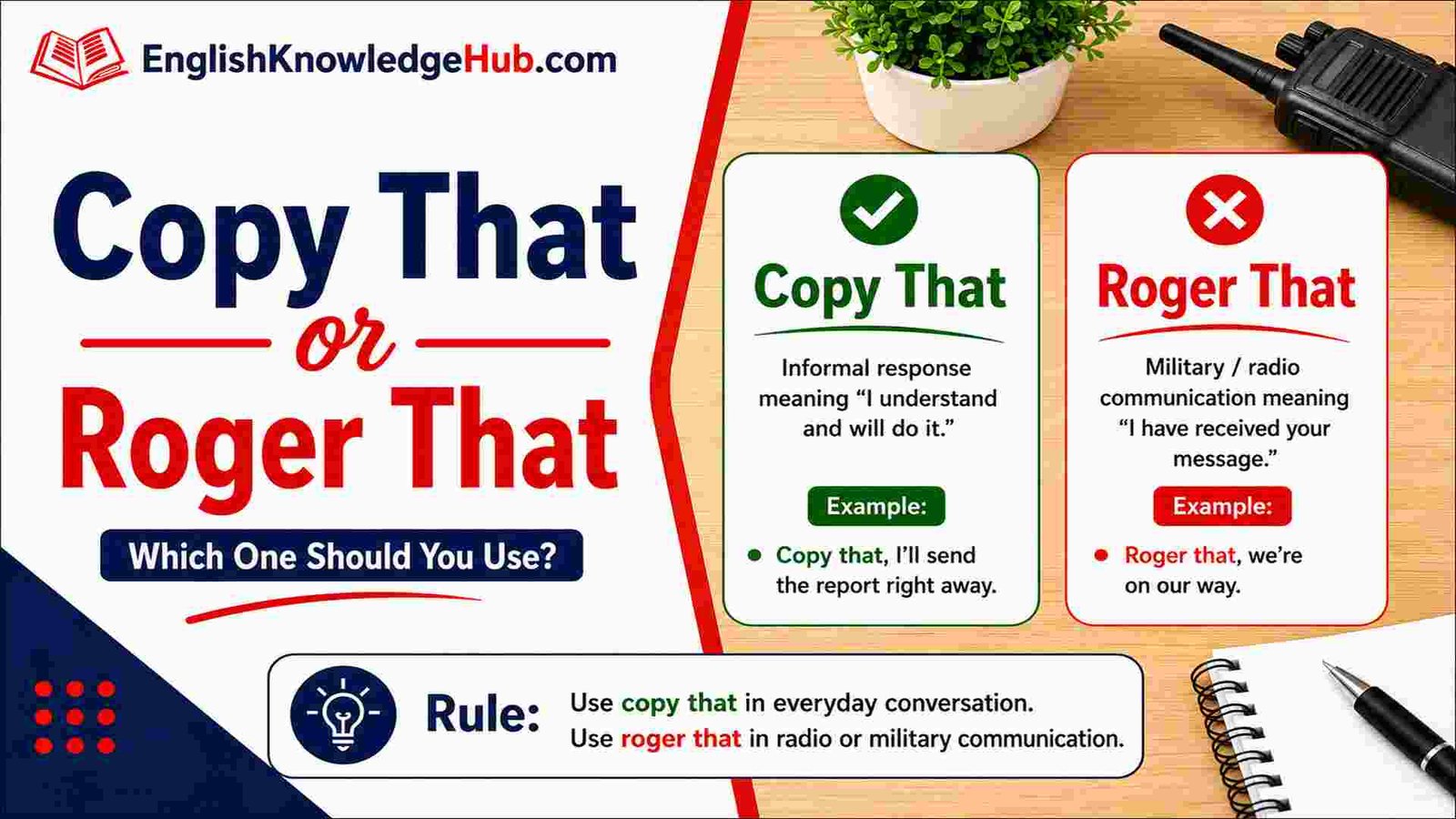
Copy That or Roger That are both correct phrases. Both can show that you heard and understood a message. However, they are not exactly the same in every situation. “Copy that” is more common in casual or work talk, while “roger that” has a stronger link with radio communication.
Both phrases are short ways to say, “I got your message.” In this guide, you will learn what each phrase means, how they are different, when to use them, and which one sounds more natural.
Copy That or Roger That: Quick Answer
The easiest way to understand the difference is this:
- Copy that means “I heard you and understood.”
- Roger that means “I received and understood your message.”
- Roger that sounds more like radio, aviation, military, or emergency talk.
- Copy that can sound more natural in work teams and casual speech.
Here is a simple comparison:
| Phrase | Simple Meaning | Usual Tone | Common Situation |
|---|---|---|---|
| Copy that | I got your message | Informal | Work, teams, casual talk |
| Roger that | Message received and understood | Radio-like | Radio, aviation, military-style talk |
| Got it | I understand | Very natural | Everyday speech |
| Understood | I understand | Neutral | Work and formal situations |
So, neither phrase is wrong. The best choice depends on the situation.
What Does “Copy That” Mean?
Copy that means that you heard a message and understood it.
For example:
“Please meet me near the front desk at 3:00.”
“Copy that.”
The reply means:
“I heard you.”
“I understand.”
“I got the message.”
The word copy has many meanings in English. It can mean making another version of something, but in this phrase, it has a communication meaning.
You are not saying that you will make a copy of anything.
You are simply showing that the message reached you.
Daily Conversation Examples
“Bring your jacket. It may get cold tonight.”
“Copy that.”
Another example:
“Remember to collect the keys before you head out.”
“Copy that. I’ll get them.”
In daily speech, “copy that” can sound playful because most people would normally say:
- Okay
- Got it
- Sure
- I understand
What Does “Roger That” Mean?
Roger that also means that you received and understood a message.
It has a much stronger connection with radio communication.
For example:
“Team four, return to the main gate.”
“Roger that.”
The reply shows that the speaker received the message.
You may often hear this phrase in:
- Radio communication
- Aviation
- Military-style communication
- Security work
- Emergency teams
- Movies and TV shows
People also use it as a joke in normal conversations.
For example:
Parent: “Finish your homework before playing games.”
Child: “Roger that.”
Here, the child is using radio-style language in a normal home conversation.
What Is the Main Difference?
The difference between Copy That or Roger That is mostly about tone and setting.
“Copy that” sounds like:
“I heard your information.”
“Roger that” sounds like:
“Your radio message came through and I understood it.”
Their meanings overlap, but they do not always create the same feeling.
Look at these examples.
Workplace:
“Please move the boxes to room five.”
“Copy that.”
This sounds short and direct.
Radio:
“Vehicle six, stop near the north entrance.”
“Roger that.”
This sounds more natural in radio-style communication.
Is “Copy That” More Informal?
Yes. In most situations, copy that feels informal.
It works well when people need to share short instructions.
For example:
Manager: “The meeting has moved to the second floor.”
Worker: “Copy that.”
This response is clear and easy.
However, in a very formal office, you may choose:
“Understood.”
“Thank you. I understand.”
“I have received the information.”
Those phrases usually sound more professional.
Is “Roger That” Formal?
Not exactly.
It may sound serious because people connect it with pilots, soldiers, radios, and emergency services.
However, it is not the same as normal formal business English.
For example:
Less suitable in a formal email:
“Roger that. I will send the report tomorrow.”
Better:
“Understood. I will send the report tomorrow.”
“Roger that” is correct English, but its radio-style tone may sound strange in a business email.
Does “Roger That” Mean Yes?
No. This is an important point.
Roger that does not simply mean yes.
It means that the message was received and understood.
Imagine someone asks:
“Did you lock the door?”
If you answer:
“Roger.”
The answer may not clearly tell the person whether the door is locked.
A clearer reply would be:
“Yes, I locked it.”
So, use yes when you need to answer a yes-or-no question clearly.
Does “Roger That” Mean “I Will Do It”?
Not always.
This is another common misunderstanding.
“Roger that” mainly tells someone that you received and understood the message.
It does not always mean:
“I promise to do it.”
For example:
“Please check the back door.”
“Roger that.”
The speaker has shown that the instruction was heard.
In everyday English, people may understand the reply as agreement too, but the basic radio meaning is about receiving the message.
“Roger” vs “Wilco”
You may also hear the word wilco in radio communication.
These two words do not mean exactly the same thing.
Roger means:
“I received and understood the message.”
Wilco means:
“I received the message, understood it, and will follow the instruction.”
Here is the simple difference:
| Word | Meaning |
|---|---|
| Roger | I received and understood |
| Wilco | I received, understood, and will do it |
This difference is useful when communication needs to be very clear.
“Copy That” in Everyday English
You can use “copy that” when someone gives you information or an instruction.
For example:
“Meet us outside the café at eight.”
“Copy that.”
Another example:
“Please bring the blue folder, not the black one.”
“Copy that.”
The phrase sounds short, clear, and confident.
However, it may sound a little dramatic in a normal family conversation.
For example:
“Please put your shoes by the door.”
“Copy that.”
This is correct, but “okay” would sound more normal.
“Roger That” in Everyday English
People sometimes use “roger that” in casual speech for fun.
For example:
Friend: “No spicy food tonight.”
You: “Roger that.”
Another example:
Brother: “Don’t tell Mom about the surprise.”
You: “Roger that.”
These examples are informal and playful.
The speakers are not using real radio communication. They are borrowing the phrase because it sounds short and serious.
Copy That or Roger That: Which Phrase Should You Use at Work?
It depends on your workplace.
In jobs where people use radios, both phrases may sound normal.
For example:
Supervisor: “Check the west entrance first.”
Worker: “Copy that.”
Or:
“Unit two, move to the parking area.”
“Roger that.”
In a normal office, you may sound more natural by saying:
- Got it
- Understood
- Sure
- I’ll handle it
- I understand
For example:
“Please send the document before lunch.”
Natural reply:
“Got it.”
Also correct:
“Copy that.”
More radio-like:
“Roger that.”
Can You Use These Phrases in Formal Writing?
Usually, no.
They are better in spoken communication than formal writing.
Incorrect or less suitable:
“Copy that. The company accepts the new plan.”
Correct:
“The company understands and accepts the new plan.”
Another example:
Less suitable:
“Roger that. We received your application.”
Better:
“We have received your application.”
The first versions are not grammatically wrong. They simply do not match formal writing very well.
Can Students Use Them in Academic Writing?
Students normally should not use these phrases in essays or school reports unless they are talking about the phrases themselves.
Less suitable:
“Copy that, the experiment showed a clear result.”
Better:
“The experiment showed a clear result.”
However, this is fine:
“The phrase ‘copy that’ can show that a speaker understood a message.”
Here, you are discussing the phrase itself, so using it is correct.
Copy That or Roger That: Common Mistakes to Avoid
Mistake 1: Using “Roger” Instead of “Yes”
Incorrect:
“Did you finish the task?”
“Roger.”
Correct:
“Yes, I finished the task.”
Explanation:
“Roger” shows that you received the message. It does not always give a clear yes answer.
Mistake 2: Thinking “Copy That” Means Making a Copy
Incorrect idea:
“Copy that” means “make another copy.”
Correct meaning:
“Copy that” can mean “I heard and understood the message.”
Explanation:
The meaning changes because of the communication context.
Mistake 3: Using Radio Language in Formal Emails
Less suitable:
“Roger that. I will attend the meeting.”
Correct:
“Thank you. I will attend the meeting.”
Explanation:
“Roger that” sounds too radio-like for most formal emails.
Mistake 4: Thinking Both Phrases Mean a Promise
Incorrect idea:
“Copy that” and “roger that” always mean “I will do it.”
Correct idea:
They mainly show that the message was received and understood.
Explanation:
Understanding an instruction and promising to complete it are not always the same thing.
A Very Easy Memory Trick
Use this simple trick:
Copy = I caught your message.
Roger = Radio message received.
You can also remember:
Roger does not automatically mean yes.
This makes the difference much easier to remember.
Copy, Roger, Got It, or Understood?
The best phrase depends on where you are speaking.
| Situation | Best Choice |
|---|---|
| Normal conversation | Got it |
| Casual work team | Copy that |
| Radio-style communication | Roger that |
| Professional office | Understood |
| Formal writing | I understand / We have received your message |
There is no need to use radio language when a simple phrase works better.
Good English is not just about choosing a correct word. It is also about choosing a phrase that fits the situation.
British and American English
There is no major difference between British and American English here.
People in both forms of English can understand “copy that” and “roger that.”
The bigger difference comes from the situation.
A pilot, security worker, office worker, and student may all choose different phrases because they communicate in different settings.
So, focus more on context than country.
Which One Sounds More Natural?
For normal daily conversation, neither phrase is as common as “got it.”
For example:
“Please call me when you arrive.”
Most natural:
“Got it.”
Possible:
“Copy that.”
Playful or radio-like:
“Roger that.”
All three can communicate understanding, but the tone changes.
This is why you should not ask only, “Which phrase is correct?”
A better question is:
“Which phrase sounds right in this situation?”
Final Answer: Which One Should You Choose?
When choosing between Copy That or Roger That, remember that both phrases can show that you received and understood a message.
Use copy that for short, informal communication.
Use roger that when you want a radio-style response or when the setting naturally uses radio communication.
Use got it for simple everyday speech.
Use understood when you want a more professional tone.
The biggest mistake is thinking that “roger” always means “yes.” It does not. It mainly confirms that the message was received and understood.
FAQs
Is “copy that” correct English?
Yes. “Copy that” is correct. It means that you heard and understood a message.
Is “roger that” correct English?
Yes. “Roger that” is a correct expression, especially in radio-style communication.
What is the difference between copy that and roger that?
Both show that a message was received. “Copy that” sounds more informal, while “roger that” has a stronger radio communication meaning.
Does “roger that” mean yes?
No. It means that you received and understood the message. Use “yes” when a clear yes answer is needed.
Can I say “copy that” at work?
Yes. It can sound natural in teams that use short instructions. In formal offices, “understood” or “got it” may sound better.
Can I use “roger that” in normal conversation?
Yes, but it may sound playful or dramatic because people connect it with radio communication.
Which is more common, “copy that” or “roger that”?
It depends on the setting. “Copy that” is often easier to use in casual work talk, while “roger that” is strongly linked with radio-style communication.
Is “got it” better than both?
For normal everyday conversation, “got it” is often the easiest and most natural choice.
Final Thoughts
The choice between Copy That or Roger That is mainly about context. Both can show that you understood a message, but they create a different tone. “Copy that” feels more casual, while “roger that” sounds more connected with radio communication.
Want to make more English phrases easy to understand? Visit EnglishKnowledgeHub.com for simple grammar, word comparisons, and practical English guides.
