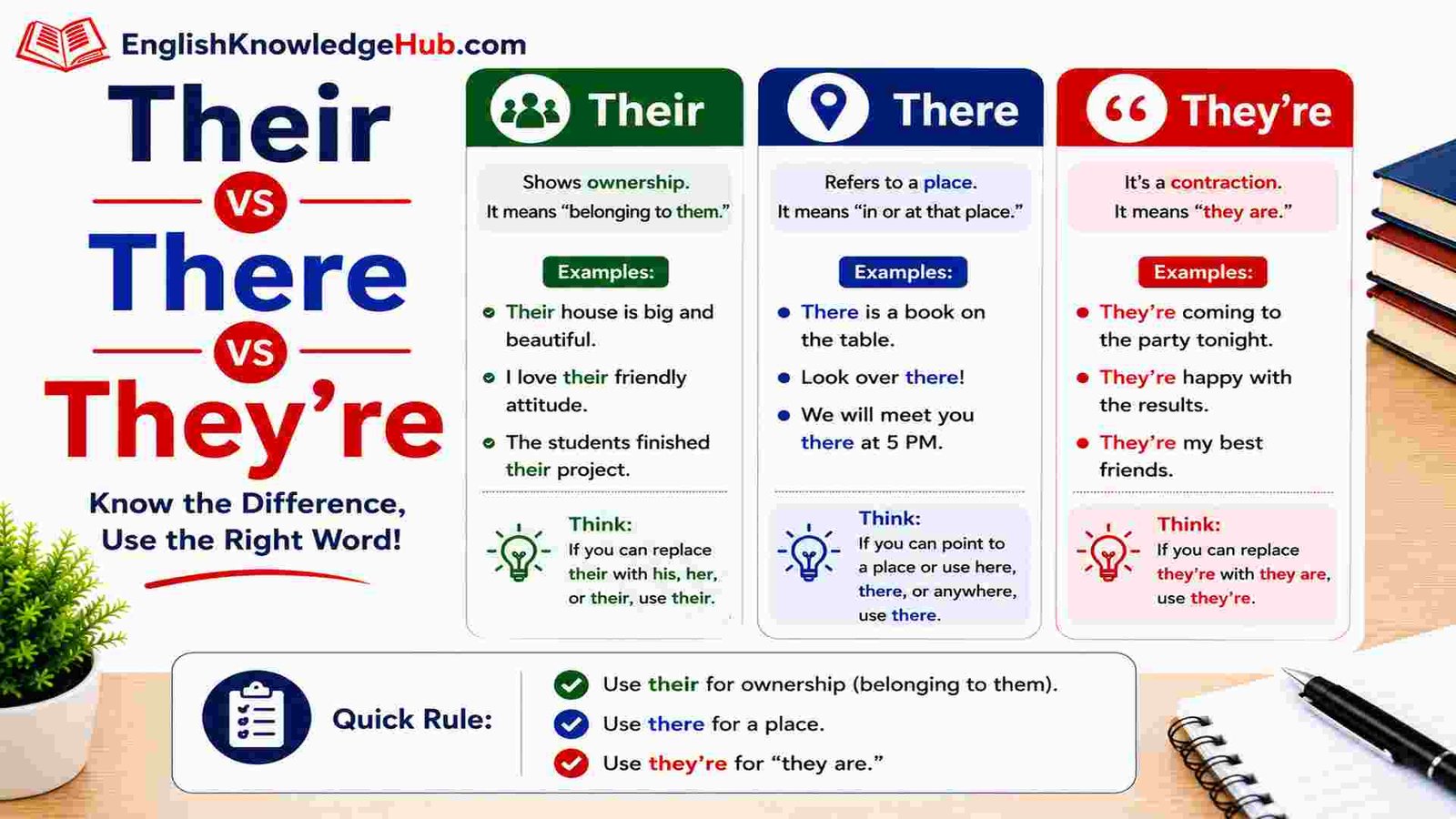
Their vs There vs They’re is easy to understand when you look at the job of each word. Their shows that something belongs to someone. There talks about a place or says that something exists. They’re is the short form of they are. This guide will show you how to use all three correctly.
Here is the short answer:
- Their = belongs to them
- There = a place, or something exists
- They’re = they are
Look at these examples:
Their dog is very friendly.
Your keys are over there.
They’re coming after lunch.
All three words may sound similar when we speak, but they have very different meanings.
Their vs There vs They’re: Why Do People Mix Up These Words?
The main problem is sound.
In normal speech, their, there, and they’re often sound almost the same. Because of this, many people choose the wrong spelling when they write quickly.
But you do not need to remember a difficult grammar rule.
You only need to ask:
What job is the word doing in this sentence?
If it shows ownership, use their.
If it talks about a place or something that exists, use there.
If it means they are, use they’re.
That is the main idea behind Their vs There vs They’re.
What Does “Their” Mean?
Use their when something belongs to people, animals, or sometimes one person.
It normally comes before a noun.
Examples:
- their house
- their books
- their teacher
- their car
- their idea
- their lunch
Look at this sentence:
The children packed their bags.
The bags belong to the children.
Another example:
Ali and Hamza finished their homework.
The homework belongs to, or is connected with, Ali and Hamza.
Here is one more:
The workers cleaned their tools before leaving.
The tools belong to the workers.
A simple question can help:
Whose thing is it?
If the answer is “theirs,” you may need their before a noun.
“Their” Can Also Be Used for One Person
Many learners think their can only talk about two or more people.
That is not always true.
English also uses their for one person when we do not know the person’s gender, when gender is not important, or when the person uses they as a pronoun.
Example:
Someone left their phone on the table.
We do not know who the person is.
Another example:
Every student should bring their notebook.
This use is normal in modern English.
So, their can refer to more than one person or, in the right context, one person.
What Does “There” Mean?
Use there when you talk about a place.
Example:
Your shoes are there beside the door.
The word tells us where the shoes are.
Another example:
Please put the box over there.
Again, there points to a place.
You can often connect there with the idea of where.
Both words contain the letters here:
- there
- where
This can help you remember that there often has a connection with place.
“There” Can Also Show That Something Exists
There does not always point to a place.
Sometimes we use it to say that something exists, happens, or is present.
Example:
There is a cup on the desk.
This sentence tells us that a cup exists in that place.
Another example:
There are six students in the room.
The sentence tells us that six students are present.
More examples:
There was a loud noise outside.
There will be a test on Monday.
There are two cookies left.
In these sentences, there introduces something.
So remember:
There can talk about a location, but it can also introduce something that exists or happens.
What Does “They’re” Mean?
They’re is the easiest one to check.
It always means:
they are
That is all.
Example:
They’re tired.
This means:
They are tired.
Another example:
They’re watching a movie.
This means:
They are watching a movie.
If you are not sure whether they’re is correct, replace it with they are.
If the sentence still makes sense, they’re is correct.
For example:
They’re going to the market.
Test it:
They are going to the market.
It works.
So they’re is correct.
Now look at this:
They’re car is outside.
Test it:
They are car is outside.
That makes no sense.
The correct sentence is:
Their car is outside.
This simple test is one of the best ways to understand Their vs There vs They’re.
Their vs There vs They’re: Quick Comparison Table
| Word | Simple Meaning | Easy Check | Example |
|---|---|---|---|
| Their | Belongs to them | Is there ownership? | Their room is clean. |
| There | A place or something exists | Is it about where or existence? | The chair is there. |
| They’re | They are | Can you say “they are”? | They’re ready. |
A Simple 3-Step Trick
When you are not sure which word to use, follow these steps.
Step 1: Try “They Are”
Read the sentence with they are.
Example:
_____ waiting for the bus.
Try:
They are waiting for the bus.
It makes sense.
So the answer is:
They’re waiting for the bus.
Step 2: Look for Ownership
Example:
The girls forgot _____ lunch.
Whose lunch?
The girls’ lunch.
So the answer is:
The girls forgot their lunch.
Step 3: Look for a Place or Something Existing
Example:
Your jacket is over _____.
The sentence talks about a place.
So the answer is:
Your jacket is over there.
This method is fast and easy.
Everyday Examples
Here are some examples you may hear in normal conversation.
Their baby is sleeping.
We can meet there after dinner.
They’re playing football outside.
Their food is still on the table.
I saw your brother over there.
They’re waiting for you near the gate.
Here is one sentence with all three:
Their bags are over there because they’re getting ready to leave.
Look at each word:
Their bags = the bags belong to them.
Over there = a place.
They’re getting ready = they are getting ready.
Examples at Work
You may also see these words in emails, reports, and office conversations.
Their manager approved the plan.
The new files are there on the shared computer.
They’re speaking with the client now.
Their meeting starts at ten.
There are three names missing from the list.
They’re sending the final report today.
You can use the same rules at work that you use in daily English.
Examples for School and Academic Writing
Students often use these words in essays and assignments.
The researchers shared their findings.
There are several reasons for the change.
They’re studying how plants grow in low light.
The students checked their answers twice.
There was a small difference between the two results.
In very formal writing, some teachers or style guides may prefer they are instead of the contraction they’re.
For example:
Informal or normal:
They’re studying the results.
More formal:
They are studying the results.
Both are grammatically correct.
The second version simply sounds more formal.
Common Mistakes
Here are some of the most common mistakes with Their vs There vs They’re.
Mistake 1: Using “There” for Ownership
Incorrect:
The boys left there shoes outside.
Correct:
The boys left their shoes outside.
Explanation:
The shoes belong to the boys. We need their because the sentence shows ownership.
Mistake 2: Using “Their” for a Place
Incorrect:
Please sit their.
Correct:
Please sit there.
Explanation:
The sentence talks about a place. Use there.
Mistake 3: Using “Their” Instead of “They’re”
Incorrect:
Their coming to dinner tonight.
Correct:
They’re coming to dinner tonight.
Explanation:
The meaning is “They are coming.” Use they’re.
Mistake 4: Using “They’re” Before a Noun That Belongs to Someone
Incorrect:
They’re teacher gave them homework.
Correct:
Their teacher gave them homework.
Explanation:
The teacher is connected with them. “They are teacher” does not work in this sentence.
Mistake 5: Forgetting the Apostrophe
Incorrect:
Theyre at the shop.
Correct:
They’re at the shop.
Explanation:
They’re is a contraction of they are, so it needs an apostrophe.
Their or Theirs?
Another small point can confuse learners.
Their and theirs are both about ownership, but they work differently.
Use their before a noun.
Their car is blue.
Use theirs when the noun is not written after it.
The blue car is theirs.
Compare:
This is their room.
This room is theirs.
Do not write:
This is theirs room. ❌
That is incorrect.
Is “There” Always About Location?
No.
This is an important point.
In this sentence:
The book is there.
There shows location.
But in this sentence:
There is a book on the chair.
The word introduces the fact that a book exists or is present.
So there has more than one common use.
Is “They’re” Formal or Informal?
They’re is completely correct English.
It is common in:
- conversation
- messages
- everyday writing
- friendly emails
- informal articles
In very formal writing, some writers prefer they are.
Example:
Normal:
They’re expected to arrive tomorrow.
More formal:
They are expected to arrive tomorrow.
The meaning stays the same.
British English and American English
There is no major difference between British English and American English for these three words.
Both use:
- their for possession or connection
- there for place or existence
- they’re for they are
The pronunciation may sound a little different depending on a person’s accent, but the grammar rule stays the same.
One Sentence to Remember All Three
Here is an easy sentence:
Their coats are over there because they’re going outside soon.
Break it into parts:
Their coats
The coats belong to them.
Over there
This shows a place.
They’re going
This means they are going.
If you understand this one sentence, you already understand the main rule.
Quick Practice
Choose their, there, or they’re.
- _____ eating breakfast now.
- The children put _____ toys away.
- Your book is over _____.
- _____ are five apples in the bowl.
- I think _____ ready to begin.
- The players changed _____ shoes.
- We waited _____ for twenty minutes.
- _____ planning a trip for next month.
Answers
- They’re eating breakfast now.
- The children put their toys away.
- Your book is over there.
- There are five apples in the bowl.
- I think they’re ready to begin.
- The players changed their shoes.
- We waited there for twenty minutes.
- They’re planning a trip for next month.
Frequently Asked Questions
What is the difference between their, there, and they’re?
Their shows ownership, there talks about a place or something that exists, and they’re means they are.
Which is correct, “their going” or “they’re going”?
They’re going is correct because it means they are going.
Which is correct, “their house” or “there house”?
Their house is correct because the house belongs or relates to them.
Can “their” be used for one person?
Yes. Their can be used with one person when gender is unknown, not important, or when that person uses they pronouns.
Which is correct, “over there” or “over their”?
Use over there when you are talking about a location.
Example:
The bus stop is over there.
Is “there is” correct?
Yes. We use there is when we introduce one thing.
Example:
There is a bird on the roof.
For more than one thing, we normally use there are.
Example:
There are three birds on the roof.
How can I remember the difference quickly?
Try they are first. If it works, use they’re. If the sentence shows ownership, use their. If it talks about a place or something existing, use there.
Final Thoughts
The best way to learn Their vs There vs They’re is to remember what each word does, not just how it sounds. Use their when something belongs or relates to someone. Use there for a place or to introduce something that exists. Use they’re whenever you can replace it with they are.
Before you finish a sentence, take one second to check the meaning. That small habit can stop most mistakes.
For more simple grammar lessons, word differences, and easy English examples, visit EnglishKnowledgeHub.com and keep building your English one clear rule at a time.
