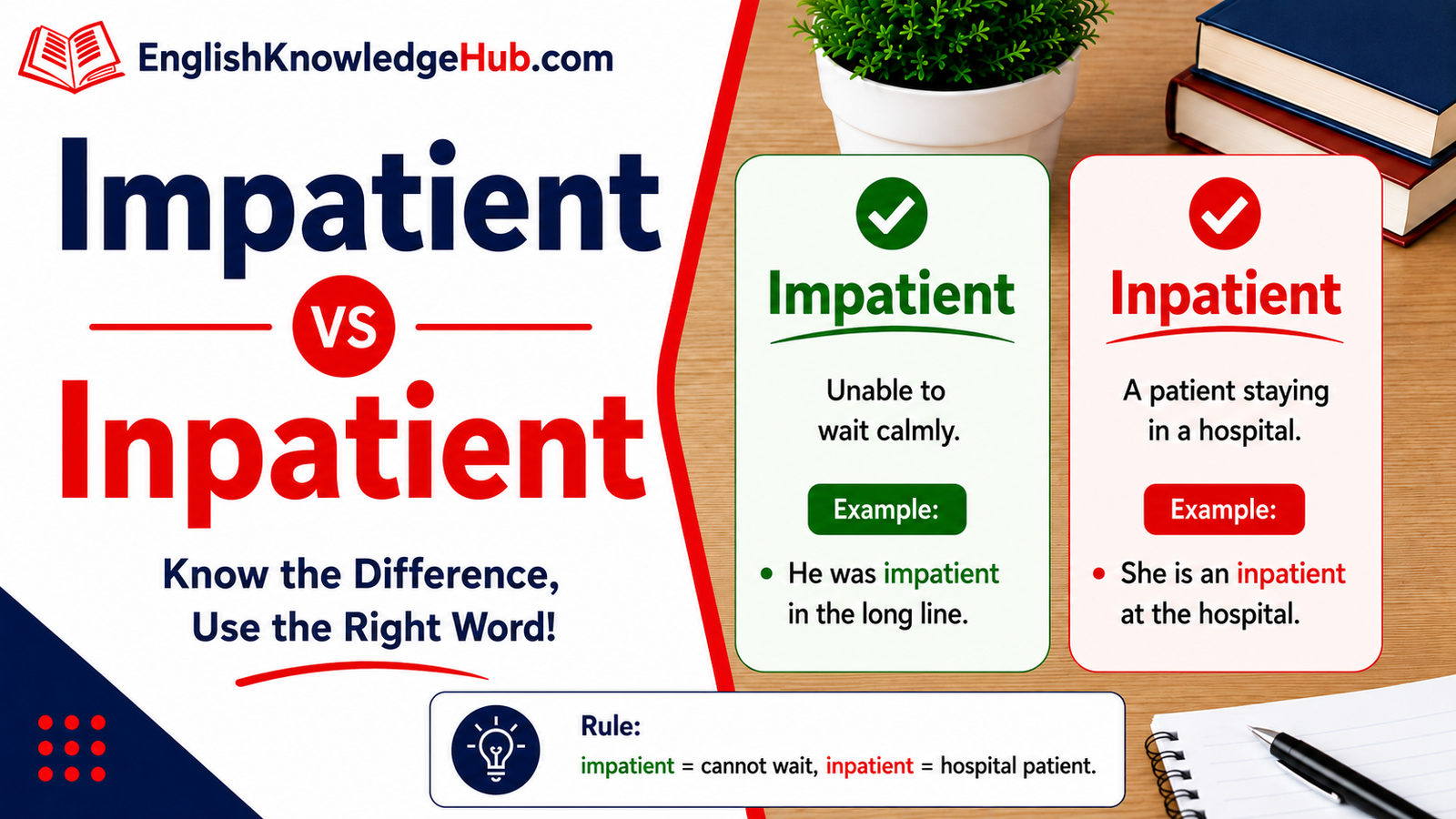
Impatient means someone does not like waiting or wants something to happen very soon. Inpatient is a medical word for a person who stays in a hospital or treatment center for care. Use impatient for feelings and behavior, and use inpatient for medical situations.
These two words look very similar, but their meanings are completely different.
For example:
- Sara became impatient while waiting for the bus.
- Sara was an inpatient for two nights after surgery.
The first sentence tells us how Sara feels.
The second sentence tells us about her medical care.
Impatient vs Inpatient: The Easiest Way to Choose the Right Word
When you are confused between Impatient vs Inpatient, ask yourself one simple question:
Am I talking about waiting or medical care?
If the sentence is about someone who does not want to wait, use impatient.
If the sentence is about someone staying in a hospital or treatment center, use inpatient.
Impatient vs Inpatient : Table Difference
| Word | Simple Meaning | Used For |
|---|---|---|
| Impatient | Not willing to wait calmly | Feelings and behavior |
| Inpatient | A person staying for medical care | Hospitals and treatment |
A quick example:
- The customer was impatient.
- The patient was an inpatient.
What Does Impatient Mean?
Impatient is an adjective.
It describes a person who becomes annoyed because something is taking too long.
It can also describe someone who is very eager for something to happen.
For example:
- Ali became impatient when the shop opened late.
- The children were impatient to see their presents.
- I get impatient when a website takes too long to load.
- Maria was impatient for the meeting to end.
In these examples, the people do not want to wait.
Sometimes they are annoyed.
Sometimes they are excited.
The situation tells you the exact feeling.
Impatient Can Show Annoyance
This is one of the most common uses.
Imagine you are standing in a line for a long time.
You check the clock again and again.
You start feeling upset because the line is not moving.
You are becoming impatient.
Examples:
- The driver grew impatient in heavy traffic.
- Dad became impatient when the repair took too long.
- The customer sounded impatient on the phone.
- My brother gets impatient when dinner is late.
Impatient Can Also Show Eagerness
Impatient does not always mean angry.
Sometimes it means someone is very excited and wants something to happen soon.
Examples:
- Emma was impatient to open the gift.
- The class was impatient to hear the results.
- We were impatient for the holiday to begin.
- Leo was impatient to meet his new teacher.
Here, the people are eager rather than angry.
Common Ways to Use Impatient
There are a few patterns that are useful to learn.
Impatient With
Use impatient with when someone gets annoyed with another person.
- Don’t be impatient with your little sister.
- The manager became impatient with the new worker.
- She was impatient with people who asked the same question again.
Impatient To
Use impatient to + verb when someone strongly wants to do something soon.
- I was impatient to leave.
- The children were impatient to start the game.
- He was impatient to hear the news.
Impatient For
Use impatient for when someone strongly wants an event or result.
- The students were impatient for the holidays.
- She was impatient for an answer.
- The team was impatient for the final decision.
What Does Inpatient Mean?
Inpatient is mainly used in medical situations.
An inpatient is a person who stays in a hospital or treatment center while receiving care.
For example:
- Ben was an inpatient for three days.
- The hospital admitted several new inpatients.
- She became an inpatient after the operation.
- The doctor said he should remain an inpatient overnight.
The important idea is that the person stays at the medical facility for treatment.
Inpatient Can Also Describe Medical Care
You may also see inpatient before another noun.
Common phrases include:
- inpatient care
- inpatient treatment
- inpatient services
- inpatient unit
- inpatient program
Examples:
- The doctor recommended inpatient care.
- She received inpatient treatment after surgery.
- The hospital added more beds to the inpatient unit.
- The insurance plan covers some inpatient services.
In these sentences, the word describes the type of medical care.
Inpatient vs Outpatient
It helps to compare inpatient with outpatient.
An inpatient stays at the hospital or treatment center.
An outpatient receives treatment and usually goes home afterward.
For example:
- Tom stayed overnight, so he received inpatient care.
- Kate had a short procedure and went home the same day as an outpatient.
A simple way to remember it is:
Inpatient = stays in
Outpatient = goes out
Why Do People Mix These Words Up?
The main reason is spelling.
Look at the words:
impatient
inpatient
Only one letter is different.
They also both contain the word patient.
That makes them easy to confuse.
But the meanings come from different situations.
Impatient is connected to waiting.
Inpatient is connected to medical care.
Do not choose the word by how it looks.
Choose it by what the sentence means.
Impatient vs Inpatient: A Simple Memory Trick
Here is an easy trick.
Think:
INpatient = stays IN for treatment
The word starts with in, which can remind you that the person stays in a hospital or treatment center.
For impatient, think:
“I’m tired of waiting.”
This can help you connect impatient with waiting.
So remember:
Waiting = impatient
Medical stay = inpatient
Daily Conversation Examples
Here are some simple everyday examples.
Impatient
- “Please don’t get impatient. Your food is coming.”
- “I’m getting impatient because the taxi is late.”
- “The kids are impatient to go outside.”
- “Why are you so impatient today?”
Inpatient
- “Will he need inpatient care?”
- “She was an inpatient for two nights.”
- “The doctor suggested inpatient treatment.”
- “The hospital offers both inpatient and outpatient care.”
Workplace Examples
You may also see both words at work.
Impatient at Work
- The client became impatient after waiting several days.
- Our manager was impatient to finish the project.
- Do not sound impatient when speaking to customers.
- The team grew impatient with the delay.
Inpatient at Work
The word is common in hospitals, clinics, insurance companies, and medical offices.
- The hospital opened a new inpatient unit.
- The policy includes inpatient coverage.
- The report listed the number of inpatients.
- The clinic does not provide inpatient services.
Academic and Formal Examples
Both words can appear in formal writing too.
Impatient
- Some students became impatient during the long test.
- The group appeared impatient when the results were delayed.
- The committee grew impatient with the slow progress.
Inpatient
- The study included people receiving inpatient care.
- Researchers compared inpatient and outpatient treatment.
- The hospital created a new inpatient recovery program.
Common Mistakes
Mistake 1
Incorrect:
The child became inpatient while waiting for lunch.
Correct:
The child became impatient while waiting for lunch.
Explanation:
The sentence is about waiting, so impatient is correct.
Mistake 2
Incorrect:
The doctor suggested impatient treatment.
Correct:
The doctor suggested inpatient treatment.
Explanation:
This is a medical situation, so inpatient is the correct word.
Mistake 3
Incorrect:
The nurse checked on an impatient in Room 8.
Correct:
The nurse checked on an inpatient in Room 8.
Explanation:
If you mean a person staying for medical care, use inpatient.
Can Someone Be Both Impatient and an Inpatient?
Yes.
Look at this sentence:
The inpatient became impatient while waiting for breakfast.
Both words are correct.
Inpatient tells us the person is staying for medical care.
Impatient tells us the person does not want to wait.
Another example:
The impatient inpatient kept asking when the doctor would arrive.
It may sound funny, but it is correct English.
Impatient, Impatience, and Impatiently
These words are related.
Impatient is an adjective.
- He became impatient.
Impatience is a noun.
- His impatience was easy to notice.
Impatiently is an adverb.
- He waited impatiently by the door.
All three words are connected to waiting or eagerness.
They are not medical words.
Is Impatient Always Negative?
No.
Sometimes it sounds negative.
- She is too impatient with new workers.
This means she gets annoyed too quickly.
But sometimes it simply shows excitement.
- He was impatient to see his new room.
Here, he is probably excited.
The meaning depends on the situation.
Is Inpatient Only Used in Hospitals?
Not always.
The word is commonly used for hospitals, but it can also be used for other treatment centers where a person stays during care.
You may see phrases such as:
- inpatient rehabilitation
- inpatient treatment
- inpatient mental health care
- inpatient recovery program
The important point is that the person stays at the facility for treatment.
Quick Practice
Choose the correct word.
- Mia became ___ because the bus was late.
Answer: impatient
- The doctor recommended ___ care for two nights.
Answer: inpatient
- The children were ___ to open the box.
Answer: impatient
- He remained an ___ after surgery.
Answer: inpatient
- The ___ became ___ while waiting for lunch.
Answer: inpatient, impatient
Frequently Asked Questions
Is it impatient or inpatient when someone cannot wait?
Use impatient. It describes someone who is annoyed by waiting or very eager for something to happen.
Is inpatient a real word?
Yes. Inpatient is a standard medical word for someone who stays at a hospital or treatment center for care.
What is the opposite of impatient?
The usual opposite is patient.
What is the opposite of inpatient?
In medical language, the usual opposite is outpatient.
Can I say inpatient care?
Yes. Inpatient care is correct and commonly used in medical settings.
Is impatient a noun?
No. Impatient is normally an adjective. The related noun is impatience.
Can a patient be impatient?
Yes. A medical patient can also be impatient if they do not like waiting.
How can I remember the difference?
Think:
INpatient = stays IN for treatment
Impatient = does not want to wait
Final Thoughts
The difference between Impatient vs Inpatient becomes much easier when you focus on meaning instead of spelling.
Use impatient when someone does not want to wait, becomes annoyed by a delay, or feels very eager.
Use inpatient when someone stays at a hospital or treatment center for medical care.
The easiest rule to remember is:
Waiting = impatient
Medical stay = inpatient
For more simple English explanations, grammar help, word comparisons, and everyday usage tips, visit EnglishKnowledgeHub.com.
