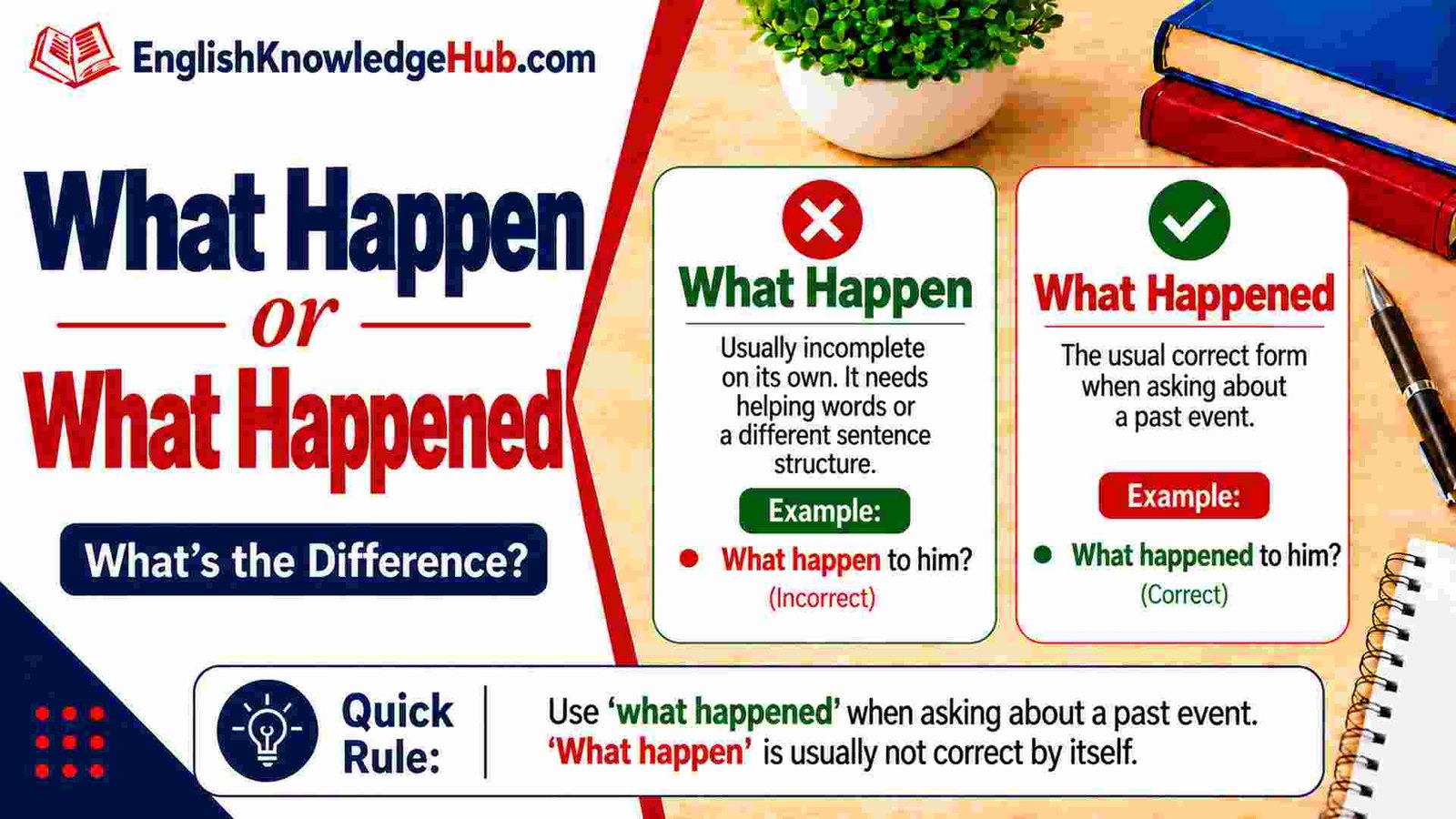
If you are choosing between What Happen or What Happened, “What happened?” is correct when you are asking about something that already took place. “What happen?” is not a correct standalone question in standard English. The difference comes from verb tense. In this guide, you will learn why happened works, when happen is correct, and how related forms such as happens, happening, and did happen are used.
If you are unsure about What Happen or What Happened, start by asking one simple question: did the event already take place?
If yes, say:
What happened?
For example, imagine that you walk into your living room and find a broken vase on the floor.
You might ask:
“What happened?”
The broken vase tells you that an event occurred before you asked the question. That is why English uses the past form happened.
The Simple Rule Behind “What Happened?”
The base verb is happen.
Its simple past form is happened.
- happen = base form
- happens = present simple form
- happened = simple past form
- happening = continuous form
So we can say:
Something happened last night.
If we do not know what that “something” was, we ask:
What happened last night?
This is the key idea behind What Happen or What Happened.
The question is about a completed event, so the past form happened is needed.
Here is a quick comparison:
| Situation | Correct form | Example |
|---|---|---|
| A past event | What happened? | What happened after dinner? |
| A usual result | What happens? | What happens when you press this button? |
| An action taking place now | What is happening? | What is happening upstairs? |
| A future event | What will happen? | What will happen tomorrow? |
| A past event connected to now | What has happened? | What has happened to the screen? |
The form changes because the time and sentence structure change.
Why Do We Say “What Happened?” Without “Did”?
This part causes a lot of confusion.
You may have learned that past simple questions use did.
For example:
Did you call him?
When did she arrive?
Why did they leave early?
So why do we say:
What happened?
instead of:
What did happen?
The answer comes from the role of what.
In “What happened?”, the word what acts as the subject of the verb.
Think about the statement:
Something happened.
Now imagine that you do not know what the “something” was.
Replace something with what:
What happened?
Because what is asking about the subject itself, we normally do not need did.
The same pattern appears in:
Someone broke the window.
Ask about the unknown person:
Who broke the window?
We do not normally say:
Who did break the window?
That version is possible only when we want special emphasis.
Compare “What Happened?” With “When Did It Happen?”
These two questions look similar, but their grammar works differently.
Look at:
What happened?
Here, what asks about the event itself.
Now look at:
When did it happen?
Here, it is already the subject.
The word when only asks about the time.
Because the sentence already has a subject, we use the normal past question structure:
did + base verb
So:
Correct: When did it happen?
Incorrect: When did it happened?
Notice that after did, we use happen, not happened.
Compare a few more examples:
Who called you?
but:
When did Sarah call you?
What broke?
but:
Why did the glass break?
This subject-question pattern explains why “What happened?” sounds natural without did.
Is “What Did Happen?” Ever Correct?
Yes.
“What did happen?” can be grammatically correct, but it usually adds emphasis.
Imagine this conversation:
Ava: “The computer did not crash.”
Leo: “The power did not go out either.”
Ava: “Then what did happen?”
Here, Ava already knows that something went wrong. She is strongly asking what the real cause was.
Compare the tone:
What happened?
This is a normal request for information.
What did happen?
This adds emphasis, contrast, surprise, or insistence.
So the phrase is not wrong. It simply serves a different purpose.
For an ordinary question, “What happened?” is the more natural choice.
Why “What Did Happened?” Is Incorrect
Another common learner error is:
Incorrect:
What did happened?
Correct:
What did happen?
Explanation:
The word did already carries the past tense. Once you use did, the next verb goes back to its base form.
Think of did as already doing the past-tense job.
You do not need to mark the main verb as past a second time.
Compare:
Incorrect: Did she went home?
Correct: Did she go home?
Incorrect: Why did he stopped?
Correct: Why did he stop?
Incorrect: What did happened?
Correct: What did happen?
This is a useful rule for nearly every past simple question that contains did.
When “Happen” Is the Correct Form
The word happen itself is perfectly correct. The problem is using it alone where another verb form is required.
Here are several situations where happen is exactly the right form.
After “will”
Use the base form after will:
What will happen if the shop closes early?
Nobody knows what will happen next week.
Not:
What will happened?
After “can,” “could,” “may,” or “might”
Modal verbs are followed by the base form.
What can happen if the battery overheats?
What could happen if we ignore the warning?
What might happen during the experiment?
After “did”
As explained earlier:
What did happen during the meeting?
The past tense is carried by did, so we use happen.
After “to”
We also use the base form in an infinitive:
I did not expect that to happen.
We cannot allow the same mistake to happen again.
So when considering What Happen or What Happened, remember that happen is not a bad form. It simply needs the right grammatical environment.
“What Happened?” vs “What Happens?”
Both are correct.
They answer different time questions.
Use what happened for one event in the past.
What happened at the restaurant yesterday?
The event has finished.
Use what happens when asking about something usual, repeated, or generally true.
What happens when you mix these two liquids?
The speaker is asking about the normal result.
Compare these two:
What happened when you opened the file?
This refers to one past occasion.
What happens when you open the file?
This asks what normally occurs.
That single -s changes the time meaning.
Why “What Happen?” Is Usually Wrong by Itself
A standalone question such as:
What happen?
does not match standard English verb agreement or past-tense grammar.
If you mean a past event, use:
What happened?
If you mean a regular or general present result, use:
What happens?
You might occasionally hear shortened or nonstandard forms in casual speech or from learners of English. That does not make “What happen?” the standard form you should use in formal writing, schoolwork, workplace communication, or normal edited English.
“What Happened?” vs “What Is Happening?”
These forms are separated mainly by whether the action is finished.
Use:
What happened?
when the event already occurred.
Use:
What is happening?
when the situation is taking place now.
Imagine you hear a loud bang. The room becomes quiet.
You ask:
“What happened?”
Now imagine you hear shouting from the hallway and people are still running around.
You ask:
“What is happening?”
The first looks backward at an event.
The second focuses on an event still in progress.
What About “What Has Happened?”
“What has happened?” is also correct.
It uses the present perfect tense.
We often use it when something happened in the past but its result matters now.
Imagine opening your laptop and seeing that all your files have disappeared.
You might say:
“What has happened to my files?”
Your main concern is the present situation.
Compare:
What happened to the files yesterday?
This asks about a finished past event at a known past time.
What has happened to the files?
This focuses more strongly on the current result.
In everyday conversation, the simple past and present perfect can sometimes appear in similar situations. The exact choice depends on the speaker’s focus and, in some cases, regional habits.
Everyday Examples of the Correct Forms
Seeing the forms in natural situations makes the rule much easier to remember.
Daily Conversation
Your friend arrives with a torn backpack.
“What happened to your bag?”
Your younger brother is staring out of the window while people are gathering outside.
“What is happening out there?”
You are testing a new coffee machine.
“What happens if I press this twice?”
Workplace English
A client unexpectedly cancels an important appointment.
“What happened with the client this morning?”
Your team is discussing a possible server failure.
“What could happen if the backup system also fails?”
Your manager sees several employees leaving the meeting room.
“What is happening with the training session?”
Academic English
A student notices an unusual result in an experiment.
“What happened during the final stage of the test?”
A teacher asks students to predict an outcome.
“What will happen if the temperature continues to rise?”
A science worksheet asks about a general process:
“What happens to ice when it absorbs enough heat?”
Formal Writing
The committee requested a detailed explanation of what happened during the inspection.
The study examines what may happen when water levels fall below the normal range.
Investigators are reviewing what has happened since the new procedure was introduced.
These examples show that choosing the correct form depends on both time and sentence structure.
Common Mistakes Learners Make
Mistake 1
Incorrect:
What happen yesterday?
Correct:
What happened yesterday?
Explanation:
Yesterday clearly refers to the past, so use the past form happened.
Mistake 2
Incorrect:
What did happened after the lights went out?
Correct:
What did happen after the lights went out?
Explanation:
After did, use the base form happen.
Mistake 3
Incorrect:
What happen when I click this icon?
Correct:
What happens when I click this icon?
Explanation:
The question asks about a general result in the present, so use happens.
Mistake 4
Incorrect:
What happened right now?
Correct:
What is happening right now?
Explanation:
If the situation is still continuing, the present continuous form usually fits better.
However, you can naturally say:
“What just happened?”
That sentence refers to an event that finished only moments ago.
Mistake 5
Incorrect:
What was happened here?
Correct:
What happened here?
Explanation:
Happen normally does not form this type of passive construction. Simply use happened.
A Fast Way to Choose the Right Form
Instead of memorizing several sentences separately, identify the time first.
Ask yourself:
Did it already occur?
Use:
What happened?
Does it usually occur?
Use:
What happens?
Is it occurring now?
Use:
What is happening?
Will it occur later?
Use:
What will happen?
Are you adding emphasis with did?
Use:
What did happen?
This little time test solves most What Happen or What Happened mistakes before they reach the page.
British and American English
There is no important British versus American difference in the basic rule.
Both standard British English and standard American English use:
What happened?
for a normal question about a past event.
Both also use:
- What happens?
- What is happening?
- What will happen?
- What has happened?
There can be differences between British and American English in how frequently speakers choose the present perfect instead of the simple past in some situations, but that does not change the basic rule for “What happened?”
Frequently Asked Questions
Is “What happen?” correct English?
No, not as a normal standalone question in standard English. Say “What happened?” for a past event or “What happens?” for a general present situation.
Is it “What happen or what happened” for something yesterday?
Use “What happened?” because yesterday refers to a completed time in the past.
Example:
What happened at school yesterday?
Is “What happened to you?” correct?
Yes. It is a natural way to ask about an event or problem that affected someone.
Example:
Your shirt is soaking wet. What happened to you?
Can I say “What did happen?”
Yes. It is grammatical when did adds emphasis.
Example:
If the alarm did not fail, what did happen?
For a normal neutral question, use “What happened?”
Why can’t I say “What did happened?”
Because did already shows past tense. The verb after did must use its base form.
Use:
did happen
not:
did happened
What is the difference between “what happened” and “what happens”?
What happened? asks about a completed past event.
What happens? asks about something that normally or regularly occurs.
Is “What has happened?” correct?
Yes. It uses the present perfect and often focuses on the present result of a past event.
Example:
What has happened to the internet connection?
Is “What was happened?” correct?
No, not in normal standard English. Use “What happened?” instead.
Final Takeaway
The What Happen or What Happened question becomes easy when you first identify the time.
For something that already took place, the normal form is:
What happened?
Do not use “What happen?” as a standard standalone question.
Remember these related forms too:
- What happened? for a finished past event
- What happens? for a usual or general result
- What is happening? for something happening now
- What will happen? for a future event
- What has happened? when a past event has a strong connection to the present
- What did happen? when you deliberately add emphasis
The most useful rule is not simply to memorize one correct sentence. Look at the time, notice whether another helping verb is present, and then choose the form of happen that fits the sentence.
For more simple, accurate, and practical English grammar lessons, continue learning with EnglishKnowledgeHub.com.
