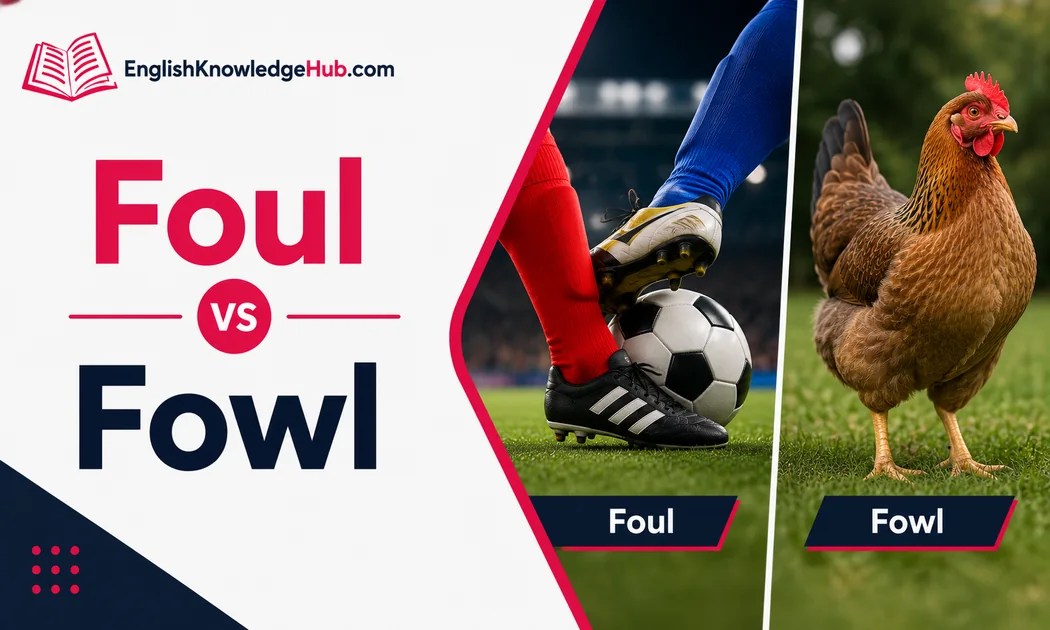
Confused about Foul vs Fowl because the two words sound exactly the same? Here is the simple answer: foul describes something dirty, unpleasant, offensive, unfair, or against the rules, while fowl refers to a bird, especially one kept for meat or eggs.
For example, you can complain about a foul smell, but a chicken is a fowl. In sports, a player may commit a foul, but you would never call that action a fowl.
This guide explains the correct spelling, meanings, pronunciation, word origins, grammar, common phrases, real-world examples, and easy ways to remember which word belongs in your sentence.
Foul vs Fowl at a Glance
Need the difference in a few seconds? Use this table.
| Word | Main Meaning | Common Use | Example |
|---|---|---|---|
| Foul | Bad, dirty, offensive, unfair, or against rules | Smells, language, weather, sports, behavior | The referee called a foul. |
| Fowl | A bird, especially a domestic bird | Chickens, ducks, poultry, birds | They raise fowl on the farm. |
Quick rule: If you are talking about a bird, choose fowl. For something unpleasant, dirty, offensive, or against sporting rules, choose foul.
Are Foul and Fowl Both Correct Spellings?
Yes. Foul and fowl are both correctly spelled English words.
The mistake happens when writers choose the correct spelling for the wrong meaning.
For example:
- ✅ foul language
- ❌ fowl language
- ✅ domestic fowl
- ❌ domestic foul
- ✅ foul ball
- ❌ fowl ball
So, the question is not which spelling exists. The real question is which spelling matches your meaning?
What Does Foul Mean?
Foul most often means unpleasant, dirty, offensive, or bad. It can also describe an action that breaks the rules of a sport.
You may see foul used for:
- a bad smell
- dirty air or water
- rude language
- terrible weather
- unfair behavior
- a rule violation in sports
- something morally wrong or shocking
Foul as an Adjective
As an adjective, foul describes a noun.
Examples:
- A foul smell came from the drain.
- He used foul language during the argument.
- We stayed inside because of the foul weather.
- The water had a foul taste.
- The boxer received a warning for a foul blow.
Merriam-Webster lists meanings connected with offensive smells, polluted conditions, offensive speech, bad weather, and actions that break sporting rules.
Foul as a Noun
In sports, a foul is an action that breaks a rule.
For example:
- The basketball player committed a foul.
- The referee called a foul near the goal.
- The team had several fouls in the first half.
Baseball also uses foul in expressions such as foul ball and foul territory.
Foul as a Verb
Foul can also work as a verb. It may mean to make something dirty, block it, pollute it, or break a sporting rule against another player.
Examples:
- Oil can foul the water.
- The defender fouled the striker.
- Dirt may foul the machine.
- The player kept fouling pitches into the stands.
The related forms include fouled, fouling, and fouls.
What Does Fowl Mean?
Fowl is mainly a noun that refers to a bird, especially a domestic bird raised for meat or eggs. Chickens commonly fall into this group. The word can also refer more broadly to certain wild or domestic birds.
Examples include:
- chickens
- hens
- roosters
- ducks
- geese
- other domestic or wild birds in suitable contexts
For example:
- The farmer keeps several fowl behind the barn.
- Chicken is a common type of domestic fowl.
- The family raised fowl for eggs and meat.
- Wild fowl gathered near the lake.
Is Fowl the Same as Chicken?
Not exactly.
A chicken is a type of fowl, but the word fowl can cover more than chickens. Depending on the context, people may use it for other domestic or wild birds as well. Merriam-Webster includes domestic cocks and hens as well as related domesticated and wild birds in its definition.
So:
chicken = a specific bird
fowl = a broader bird term
In everyday English, however, people usually say chicken when they specifically mean a chicken.
What Is the Plural of Fowl?
Both fowl and fowls can work as plural forms.
For example:
- The farmer keeps twenty fowl.
- Several different fowls live in the area.
Dictionaries recognize both forms, although the choice can depend on context and style.
You will also see fowl used as a general or collective term:
- fish and fowl
- domestic fowl
- wild fowl
Do Foul and Fowl Sound the Same?
Yes. Foul and fowl are homophones.
A homophone is a word that sounds like another word but has a different spelling or meaning.
Both words have the pronunciation /faʊl/ in British and American English.
They sound like:
foul = fowl
That identical pronunciation explains why people often confuse them in writing.
Your ears cannot tell you which spelling you need. The meaning of the sentence must guide your choice.
Foul vs Fowl: The Main Difference
The easiest way to understand Foul vs Fowl is to connect each spelling with its main idea.
Use Foul for Something Bad or Against the Rules
Think of:
- foul odor
- foul language
- foul weather
- foul mood
- foul play
- foul ball
- personal foul
Use Fowl for Birds
Think of:
- domestic fowl
- farm fowl
- wild fowl
- waterfowl
- chickens and other birds
Here is another quick comparison:
| Situation | Correct Word |
|---|---|
| Bad smell | Foul |
| Rude words | Foul |
| Sports violation | Foul |
| Bad weather | Foul |
| Chicken | Fowl |
| Farm bird | Fowl |
| Bird raised for food | Fowl |
Examples of Foul in Sentences
Want to see how foul sounds in natural English?
- A foul odor filled the kitchen.
- The referee called a foul on the defender.
- Please avoid foul language around children.
- The storm brought foul weather to the coast.
- Waste from the factory could foul the river.
- The batter hit the ball foul.
- Everyone noticed the foul taste in the water.
- The player received his third foul of the game.
Notice the pattern. None of these sentences talks about birds.
Examples of Fowl in Sentences
Now compare those sentences with fowl:
- The farm has chickens and other fowl.
- They built a safe shelter for the fowl.
- The restaurant serves fish and fowl.
- Several wild fowl rested near the water.
- The farmer keeps domestic fowl for eggs.
- The children helped feed the fowl each morning.
Every example connects the word with birds.
Common Phrases With Foul
You can avoid many spelling errors by learning common word combinations.
Foul Language
Foul language means rude, offensive, or vulgar speech.
Correct:
The teacher warned him about using foul language.
Wrong:
The teacher warned him about using fowl language.
Birds have nothing to do with the meaning, so foul is correct.
Foul Smell
A foul smell is a very unpleasant smell.
Example:
A foul smell came from the old refrigerator.
Foul Play
Foul play can mean unfair or dishonest behavior. In some contexts, it can also suggest criminal wrongdoing.
Example:
Investigators found no sign of foul play.
Cry Foul
To cry foul means to complain that something is unfair or improper.
Example:
Fans cried foul after the final decision.
The expression uses foul, not fowl.
Foul Ball
In baseball, a foul ball lands or travels outside the field’s fair territory under the rules.
Example:
He hit a foul ball into the stands.
Again, the word relates to the rules of the game, not birds.
Common Phrases With Fowl
The word fowl appears less often in everyday speech, but several terms remain common.
Domestic Fowl
Domestic fowl refers to birds people keep or raise, often for eggs or meat.
Example:
Chickens are among the most familiar domestic fowl.
Wild Fowl
Wild fowl refers to wild birds in appropriate contexts.
Example:
The wetland provides a home for wild fowl.
You may also see the closed form wildfowl.
Waterfowl
Waterfowl refers to birds linked with water, such as ducks and geese.
Notice the helpful spelling clue: fowl appears inside waterfowl because the word refers to birds.
Where Did the Word Foul Come From?
Foul has very old roots in English.
It comes from Old English fūl, a word connected with ideas such as rottenness, dirt, corruption, and things offensive to the senses. Merriam-Webster traces the English form back to Old English, while Etymonline also links the early word with meanings such as rotten, unclean, and vile.
Over time, English speakers expanded its meaning.
The word came to describe:
- unpleasant smells
- bad conditions
- rude speech
- unfair behavior
- bad weather
- rule-breaking in sports
Etymonline records the sporting sense in the late eighteenth century, while related phrases such as foul play appeared much earlier.
Where Did the Word Fowl Come From?
Fowl has a completely different history.
It comes from Old English fugel, which meant a bird. Related forms appeared across Germanic languages.
In earlier English, the word could refer to birds more generally. Over time, bird became the normal broad term, while fowl developed a narrower connection with domestic birds, especially hens and roosters. Etymonline records this narrower use by the sixteenth century.
This history matters because it shows that foul and fowl did not begin as two spellings of the same word. They come from different older words and have different meanings.
Why Do People Confuse Foul and Fowl?
The main reason is pronunciation.
You hear the same sound whether someone says foul or fowl. Without written context, you cannot hear the spelling difference.
Writers also make mistakes because fowl appears less often in everyday writing than foul.
Common errors include:
- ❌ fowl smell
- ❌ fowl language
- ❌ fowl ball
- ❌ personal fowl
- ❌ cry fowl
- ❌ domestic foul
The correct versions are:
- ✅ foul smell
- ✅ foul language
- ✅ foul ball
- ✅ personal foul
- ✅ cry foul
- ✅ domestic fowl
How to Remember Foul vs Fowl
Here is the easiest memory trick:
Fowl Contains “Owl”
Look closely:
fOWL
An owl is a bird.
So, if you can see owl inside fowl, you can remember that fowl relates to birds.
Then use foul for most other meanings involving something bad, dirty, unpleasant, unfair, or against the rules.
You can also remember this sports pair:
fair or foul
If something goes against what is fair or legal in a game, think foul.
Fowl, Bird, Poultry, and Chicken: Are They the Same?
These terms overlap, but they do not always mean exactly the same thing.
| Word | Simple Meaning |
|---|---|
| Bird | The general everyday term for feathered animals |
| Fowl | A bird, especially certain domestic birds |
| Chicken | A specific type of domestic fowl |
| Poultry | Domestic birds raised mainly for meat or eggs |
If you see a sparrow outside your window, bird sounds more natural than fowl.
If you discuss chickens raised on a farm, fowl can fit.
If you mean chickens specifically, simply say chickens.
Is It “Foul Mood” or “Fowl Mood”?
The correct phrase is foul mood.
A foul mood means a very bad or unpleasant mood. Merriam-Webster includes this use of foul among its definitions.
Example:
He woke up in a foul mood.
Fowl mood would incorrectly suggest a connection with birds.
Is It “Foul Weather” or “Fowl Weather”?
Use foul weather.
The phrase refers to bad, stormy, or unpleasant weather. Dictionaries recognize this meaning of foul.
Example:
The sailors waited for the foul weather to pass.
Is It “Foul Language” or “Fowl Language”?
Always choose foul language when you mean rude, offensive, or vulgar words.
Example:
The program contains foul language.
The spelling fowl language would only make sense as a joke about the language of birds.
Is It “Foul Play” or “Fowl Play”?
The standard expression is foul play.
Here, foul carries the idea of something unfair, dishonest, improper, or possibly criminal.
Use:
✅ foul play
Not:
❌ fowl play
Of course, writers may deliberately write fowl play as a bird-related pun, but that is wordplay rather than the normal expression.
A Simple Test Before You Write
Still unsure which spelling belongs in your sentence? Ask one question:
Am I talking about a bird?
If yes, choose:
FOWL
If no, and you mean something bad, offensive, dirty, unfair, or against sporting rules, choose:
FOUL
For example:
The referee called a ___.
Are you talking about a bird? No.
Correct answer: foul
Now try:
The farmer keeps several ___.
Are you talking about birds? Yes.
Correct answer: fowl
This quick test solves most Foul vs Fowl mistakes.
Final Thoughts on Foul vs Fowl
The difference between Foul vs Fowl becomes easy once you connect each word with its meaning. Foul usually means dirty, unpleasant, offensive, unfair, or against the rules. Fowl refers to birds, especially domestic birds such as chickens.
Remember the simple trick: fowl contains “owl,” and an owl is a bird. That one clue can help you choose the correct spelling every time.
Want to clear up more confusing English words without complicated grammar lessons? Explore more simple spelling, vocabulary, and usage guides at EnglishKnowledgeHub.com.
