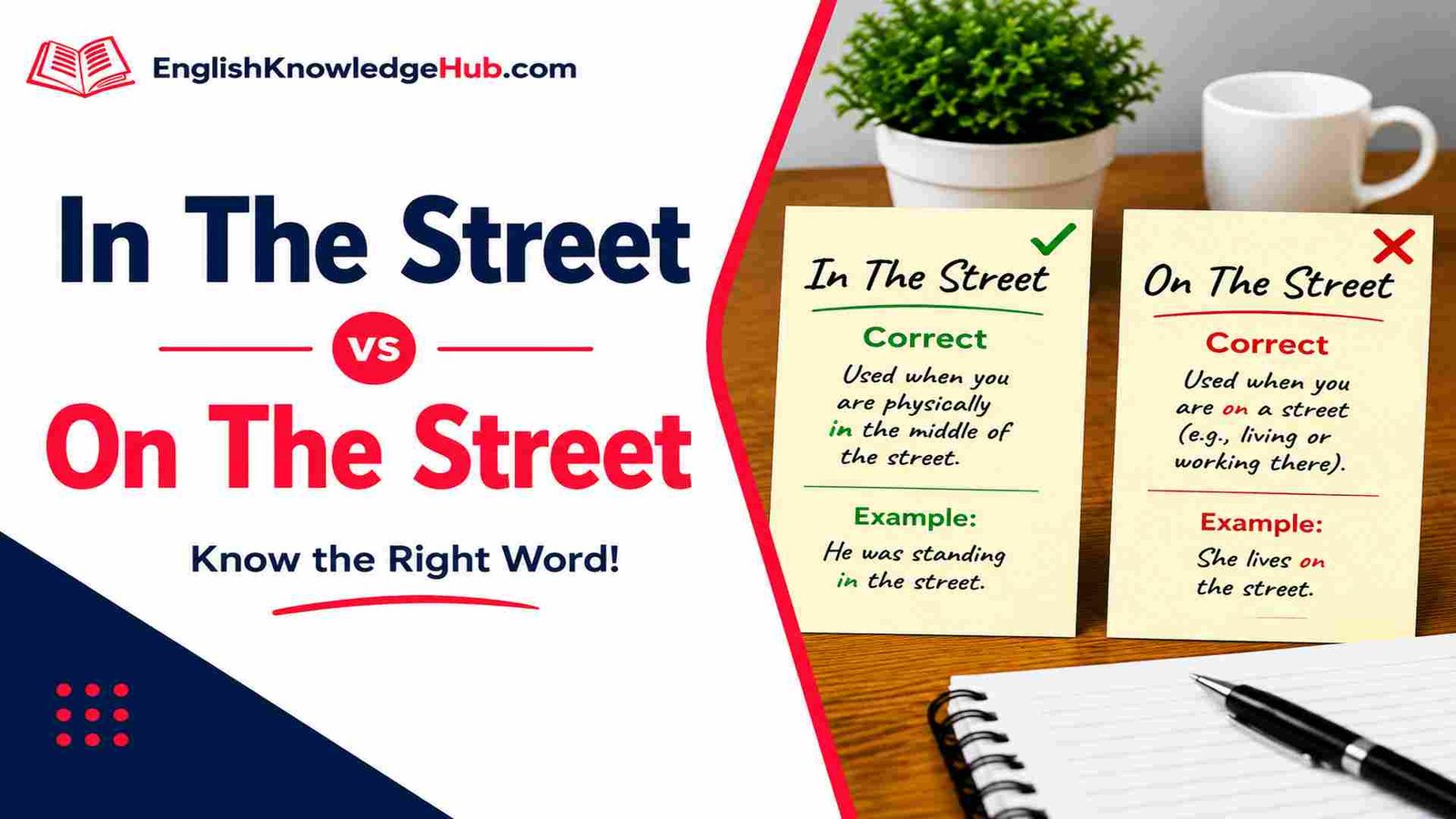
“In the street” and “on the street” are both correct, but the natural choice depends on meaning and dialect. In the street often emphasizes being physically in the roadway or public street area, while on the street is especially common in American English for locations, addresses, and people or things found along a street.
In this article, you’ll learn In The Street vs On The Street through location, street names, public-space meanings, homelessness and informal expressions, plus British and American usage. Cambridge Grammar notes that British English often uses in with street names, while American English prefers on.
The Simple Idea Behind “In” and “On”
Prepositions often depend on how English speakers picture a location.
Imagine standing beside a street:
- The road where cars travel is the street space.
- The shops, houses, offices, and people around it are located on that street.
So:
- In the street → inside the road area
- On the street → located along the street or connected to that street
Compare:
The bicycle is in the street.
→ The bicycle is lying where cars drive.
The bicycle shop is on the street.
→ The shop is located beside that street.
The noun street stays the same, but the viewpoint changes.
When to Use “In The Street”
1. When something is physically inside the road
Use in the street when a person, object, or activity occupies the actual roadway.
Examples:
- A delivery box was left in the street outside the apartment building.
- The football rolled in the street after the children kicked it too hard.
- A worker was standing in the street directing traffic.
In these examples, the street is like an open area containing something.
2. For activities happening in the roadway
Sometimes people use the street itself as a public space.
Examples:
- The neighbors organized a small celebration in the street.
- Local artists painted pictures in the street during the community event.
- Several musicians performed in the street near the town square.
The focus is not the address. The focus is the physical street area.
When to Use “On The Street”
1. When talking about a place or address
In American English, on the street is the usual expression for street locations.
Examples:
- My cousin owns a café on Willow Street.
- Their apartment is on the fifth street near the station.
- The company opened a new office on Jefferson Avenue.
The café or apartment is not sitting on the road surface. The phrase simply identifies the location.
2. When describing something happening along a street
Use on the street when the street is treated as a public area.
Examples:
- I saw an interesting art display on the street yesterday.
- There were several food stalls on the street during the festival.
- A reporter interviewed people on the street after the announcement.
The meaning is broader than the road itself.
“In The Street” vs “On The Street” Comparison
| Phrase | Main Meaning | Example |
|---|---|---|
| In the street | Inside the road area | The cat was sitting in the street. |
| On the street | Located along a street | The bookstore is on the street near my office. |
| In a street | Inside a particular street area | A parade was happening in a street downtown. |
| On a street | Located along a particular street | She lives on a quiet street outside the city. |
British English and American English Differences
One important detail is that British and American English sometimes use these phrases differently.
American English
Americans usually say:
- I live on Green Road.
- The restaurant is on Park Avenue.
For street names, on is the standard choice.
British English
British speakers may use in with some street names:
- She lives in Oxford Street.
- The shop is in Baker Street.
This is a regional difference, not a grammar mistake.
However, when talking about being physically in the road, British and American speakers can both use:
- The children were playing in the street.
- There was a bicycle lying in the street.
Common Mistakes Learners Make
Mistake 1: Using “in” for a street address in American English
Incorrect:
I live in Rose Avenue.
Correct:
I live on Rose Avenue.
Explanation:
American English normally uses on for names of streets and avenues.
Mistake 2: Using “on” when you mean the driving area
Less clear:
The car stopped because there was a person on the street.
Better:
The car stopped because there was a person in the street.
Explanation:
“In the street” clearly suggests the person was standing where vehicles travel.
Mistake 3: Thinking “on the street” always means standing on the pavement
Incorrect idea:
“On the street” only means physically standing on the road.
Correct:
The new bakery is on the street beside the library.
Explanation:
“On the street” often refers to location, not physical contact with the street surface.
Everyday Conversation Examples
Natural Daily English
Person A: Where is your new apartment?
Person B: It’s on Franklin Street, near the supermarket.
Meaning: The apartment’s location.
Person A: Why is traffic moving slowly?
Person B: Someone left furniture in the street.
Meaning: The furniture is blocking the road.
Workplace Examples
Location Example
- The marketing agency is on King Street, next to the bank.
Meaning: The agency is located there.
Road Activity Example
- The construction team placed safety barriers in the street before repairing the pipes.
Meaning: The barriers are physically in the roadway.
Academic and Formal Writing Examples
Formal Location Description
- The research center is located on University Road, close to the main campus.
Meaning: The address.
Formal Observation Description
- Researchers recorded pedestrian movement in the street during the morning commute.
Meaning: Activity inside the street environment.
Related Expression: “On the Street” vs “On the Streets”
Learners should also notice the difference between the singular and plural forms.
On the street
Usually refers to a location.
Example:
- I met my former teacher on the street yesterday.
Meaning: I met her somewhere outside along a street.
On the streets
This expression can have a different meaning.
Example:
- Many organizations help people living on the streets.
Meaning: People without permanent homes.
The plural form is often connected with homelessness.
A Quick Way to Remember the Difference
Ask yourself:
“Is it inside the road where cars go?”
If yes:
→ Use in the street
Example:
- The ball is in the street.
If you mean a location connected to that street:
→ Use on the street
Example:
- The bookstore is on the street.
This small question can help you choose naturally in everyday conversations.
Frequently Asked Questions
Is “in the street” grammatically correct?
Yes. It is correct when you mean something is physically inside the street area, especially the roadway.
Is “on the street” grammatically correct?
Yes. It is commonly used for street locations, addresses, and activities happening around a street.
Which is correct: “I live in the street” or “I live on the street”?
In American English, say “I live on the street.” In British English, some speakers may use “I live in [street name].”
Do Americans say “in the street”?
Yes. Americans use “in the street” when something is actually in the road area.
Example:
- There is a dog in the street.
Is “playing on the street” wrong?
Not always. It can be understood, but “playing in the street” is usually clearer when children are playing where cars drive.
Can I replace “in” with “on” in these phrases?
Usually not. Changing the preposition can change the meaning.
What is the difference between “in the street” and “in a street”?
“In the street” usually refers to a specific street already known. “In a street” means one street among many.
Example:
- There is a café in a street near the station.
Final Thoughts
The difference between “in the street” and “on the street” is not about memorizing two separate phrases. It is about understanding how English speakers see a street.
Use “in the street” when something is physically inside the road area. Use “on the street” when talking about a street as a location, address, or public place.
Once you focus on the image behind the words, choosing the correct preposition becomes much more natural.
For more practical grammar explanations, vocabulary lessons, and expert English learning resources, visit EnglishKnowledgeHub.com and continue building confident, accurate English skills.
