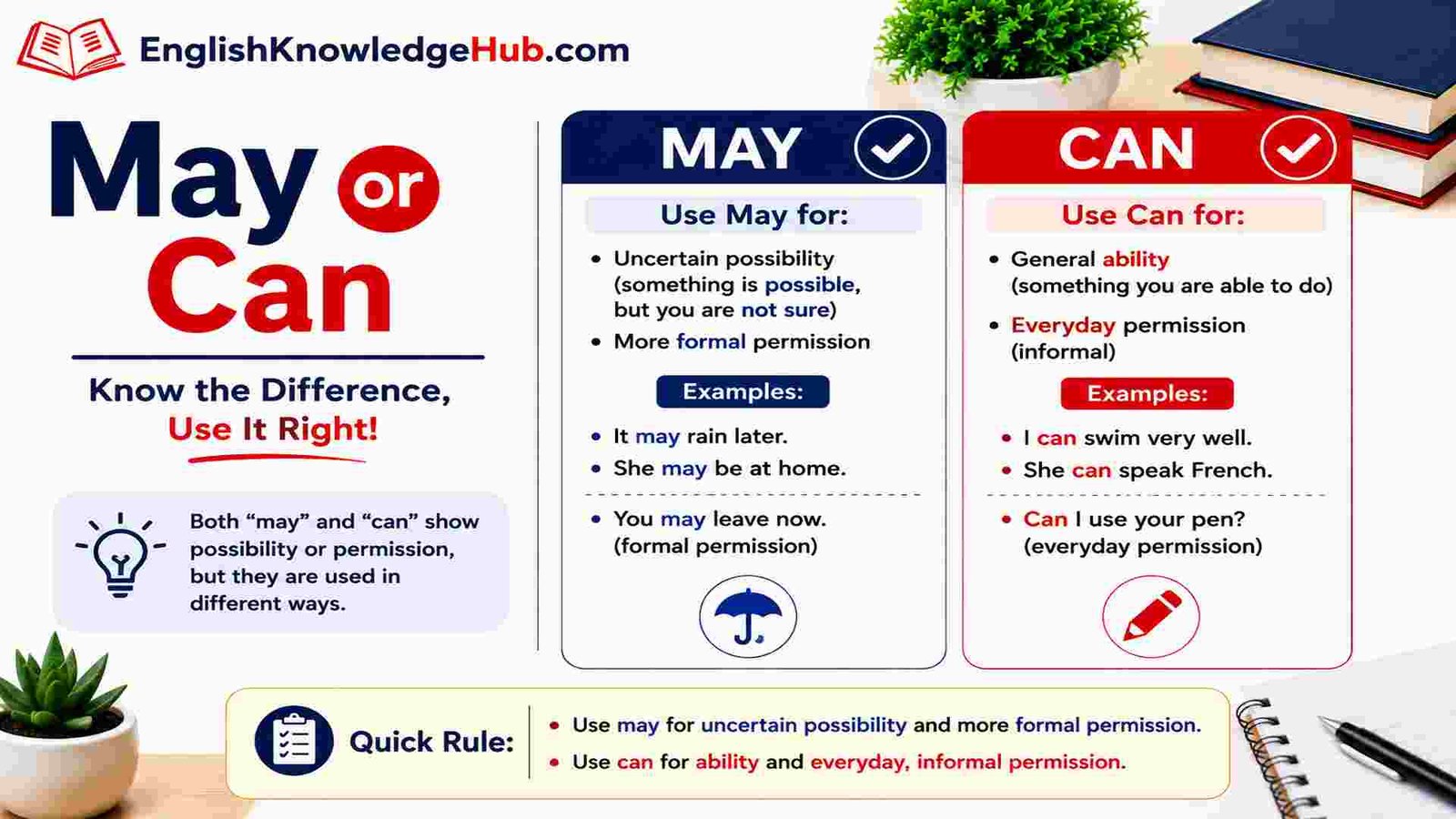
May and can can both be correct, but they are not always interchangeable. Can is the normal choice for ability and is also widely used for permission. May is common for possibility and formal permission. So “Can you swim?” asks about ability, while “May I leave early?” asks permission in a more formal way.
In this article, you’ll learn how May or Can work for ability, permission, possibility, requests, formal writing, and common negative forms. Merriam-Webster’s Can vs May usage guide confirms that both words have long been used for permission, while may is the more formal choice.
The Old School Rule Is Too Simple
Many learners were taught: “can means ability; may means permission.” That rule can help beginners notice one important difference, but it is not a complete description of modern English.
“Can I use your phone?” is normal, established English for permission. “May I use your phone?” is also correct and sounds more formal or polite. A teacher replying “I don’t know, can you?” is making a traditional joke, not correcting an actual modern grammar error.
The real distinction is broader: can is central for ability and everyday permission, while may is especially useful for possibility and formal permission.
Use “Can” for Ability
Can is the standard modal for present ability, skill, or capacity.
“She can swim.” “I can hear you.” “This laptop can run the software.” “Can you lift this box?”
In these sentences, replacing can with may would usually change the meaning or sound archaic. Modern English does not normally use may for ordinary ability.
Use “Can” for Everyday Permission
Can is very common when asking for or giving permission in conversation.
“Can I sit here?” “Can we leave now?” “You can use my charger.”
These sentences are not grammatically wrong. Merriam-Webster notes that can has been used for permission since the 19th century and is well established today. citeturn816417search3
In casual speech, can often sounds more natural than may.
Use “May” for Formal Permission
May is a good choice when you want to sound formal, polite, or deferential.
“May I ask a question?” “May we enter?” “You may begin the examination.”
Formal notices, rules, and official instructions may also use it: “Visitors may use the east entrance.”
That does not mean may is always “more correct.” It is simply more formal in many permission contexts.
Can and May Do Not Work the Same Way in Requests
When you ask permission for yourself, both can and may work: “Can I open the window?” “May I open the window?”
When you ask another person to do something, can is natural: “Can you open the window?” Cambridge notes that may is not normally used for this kind of request. citeturn458475search4
“May you open the window?” sounds unnatural if your intention is simply “Please open it.”
May for Uncertain Possibility
May is very common when something is possible but not certain.
“It may rain tonight.” “The train may be delayed.” “She may join us later.”
Here, may does not describe ability or permission. It tells the reader that the event is one possible outcome.
Can for General or Known Possibility
Can can express possibility too, especially a general fact, capacity, or something known to happen.
“Roads can be dangerous in winter.” “Even small mistakes can cause delays.” “This condition can affect sleep.”
Cambridge draws a useful contrast: can often describes general or known possibility, while may can describe uncertainty about a specific present or future event. citeturn458475search0turn458475search4
Compare “It can snow here in April” with “It may snow tomorrow.” The first says April snow is possible in general. The second says tomorrow’s snow is uncertain.
“Can Be” vs “May Be”
These short forms often cause confusion because both are grammatical.
“Working at night can be tiring” describes a general possibility or tendency. “The meeting may be tiring” describes uncertainty about this particular meeting.
That general-versus-specific distinction is often more useful than trying to label one modal “strong” and the other “weak.”
Negative Forms: Cannot, Can’t, and May Not
Cannot or can’t can describe inability or prohibition: “I can’t swim.” “You can’t park here.”
May not can describe either negative possibility or denied permission. “She may not come” can mean perhaps she will not come. “Visitors may not enter” often means they are not permitted to enter.
Because may not can have two interpretations, formal writers sometimes choose clearer wording such as “Visitors are not permitted to enter.”
May I vs Can I
Both are normal permission questions.
Can I…? sounds everyday and conversational: “Can I borrow your pen?”
May I…? sounds more formal: “May I speak with the director?”
Choose according to tone and setting rather than a fake correct-versus-incorrect rule.
Can You vs May You
Can you…? can ask about ability or make a request. “Can you drive?” asks ability. “Can you send the file?” is usually a request.
May you…? is not the normal form for requesting someone else to perform an action. In some special constructions, may can express a wish, as in “May you have a wonderful year,” but that is a different use.
Common Mistakes and Better Choices
Myth: “Can I go?” is always wrong because permission requires may.
Better understanding: “Can I go?” is standard informal permission English. “May I go?” is more formal.
Awkward request: May you send me the report?
Natural: Can you send me the report?
More polite: Could you send me the report?
Wrong for ability: She may speak three languages.
Better if ability is intended: She can speak three languages.
The first sentence normally suggests possibility: perhaps she speaks three languages. The second clearly states ability.
How They Work in Real Contexts
At home: “Can I have another slice?” is natural permission. In a formal meeting: “May I add one point?” sounds polite and controlled.
At work: “This update can improve performance” suggests a general capability. “This update may improve performance” is more cautious and says improvement is possible but not certain.
In academic writing, may is often used as a hedge: “The results may reflect differences in sample size.” That avoids turning a possible interpretation into a proven fact.
How May Relates to Might
May and might overlap strongly for possibility, while can has different central uses. If your confusion is about uncertainty rather than ability or permission, see our May or Might guide.
A Quick Decision Guide
| Meaning | Natural choice | Example |
|---|---|---|
| ability | can | She can drive. |
| everyday permission | can | Can I sit here? |
| formal permission | may | May I come in? |
| request someone to act | can/could | Can you help me? |
| specific uncertain possibility | may | It may rain tonight. |
| general possibility | can | Winter roads can be dangerous. |
Frequently Asked Questions
Is “Can I…?” wrong for permission?
No. It is established modern English. May I…? is more formal.
Which is more polite, can or may?
May usually sounds more formal and polite when asking permission.
Can may express ability?
Not normally in modern everyday English. Use can for present ability.
Can can express possibility?
Yes, especially general or known possibility: “Mistakes can happen.”
Is it “May you help me?” or “Can you help me?”
Use Can you help me? or the more polite Could you help me?
What does “may not” mean?
It can mean something possibly will not happen, or it can deny permission. Context decides.
Final Takeaway
For May or Can, use can for ability, everyday permission, and many general possibilities. Use may for uncertain possibility and more formal permission. Most importantly, do not repeat the outdated claim that can is incorrect for permission. Modern English has long accepted both forms; the difference is often tone and meaning, not grammatical correctness.
For more clear, practical modal-verb lessons, explore EnglishKnowledgeHub.com.
