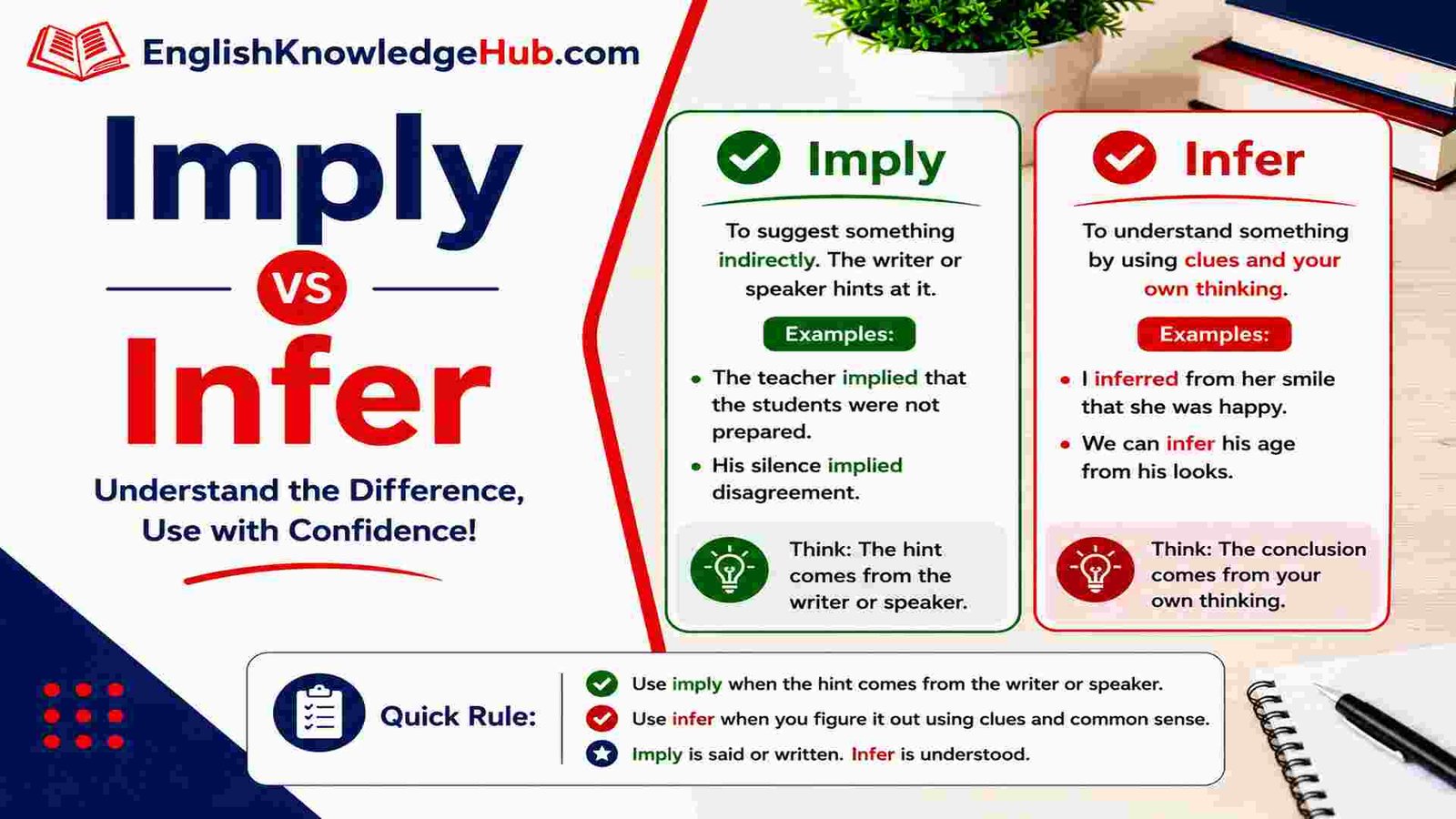
In modern careful English, a speaker or writer usually implies, while a listener or reader infers. Imply means to suggest something without stating it directly. Infer means to reach a conclusion from clues, evidence, or what was said. The message is implied by one side and inferred by the other.
In this article, you’ll learn how Imply vs Infer work in real conversations, writing, reading, and evidence-based reasoning, plus the historical overlap that makes the rule less absolute than many guides claim. Merriam-Webster defines imply as expressing something indirectly and infer mainly as deriving a conclusion from facts or premises.
The Sender Implies; the Receiver Infers
The most useful modern distinction is about direction. An implication moves out from a speaker, writer, sign, or set of facts. An inference moves into the mind of the person interpreting those clues.
Suppose a manager says, “We may need a smaller team next quarter.” The manager may be implying that staffing could change. An employee who hears the comment may infer that layoffs are possible.
Those are two parts of the same communication process, but they are not the same action.
What “Imply” Means
Imply means communicate, suggest, or indicate an idea without saying it directly. The implication can come from words, tone, behavior, design, data, or circumstances.
“Her reply implied that she was unhappy.” “The sign implies that parking is restricted after 6 p.m.” “The results imply a connection between the two variables.”
Notice that a person does not always have to deliberately hide the message. A fact or result can imply something simply because a conclusion follows naturally from it.
What “Infer” Means
Infer means draw a conclusion from available information. You observe clues, connect them, and decide what they probably mean.
“From the wet pavement, I inferred that it had rained.” “The reader can infer that the character is afraid even though the story never says so directly.” “From the missing entries, the auditor inferred that the record was incomplete.”
An inference can be strong or weak depending on the evidence. The verb itself does not guarantee that the conclusion is correct.
One Sentence Can Contain Both Actions
Seeing both verbs together makes the distinction easy.
“The email implied that the launch would be delayed, and I inferred that the team needed more testing time.”
The email sends an indirect message. The reader draws a conclusion from it.
Another example: “His silence implied disagreement, but I may have inferred too much.” This sentence also shows that the intended implication and the receiver’s inference do not always match.
Can “Infer” Ever Mean “Imply”?
This is where many short grammar guides become too absolute. Merriam-Webster notes that infer has historically overlapped with imply and even records a sense meaning “suggest” or “hint.” The overlap goes back centuries.
Still, many editors and readers strongly prefer the modern distinction: imply = suggest, infer = conclude. If your goal is clear academic, professional, or general writing, following that distinction avoids ambiguity and matches what most readers expect.
So “Are you inferring that I lied?” can be found in real English, but “Are you implying that I lied?” is the safer modern choice when you mean “Are you suggesting that?”
Imply vs Suggest
Suggest is broader. It can mean offer an idea directly: “I suggest leaving early.” It can also mean indicate something indirectly: “The evidence suggests a problem.”
Imply is especially useful when the message is indirect or unstated. If someone says, “You might want to check your figures again,” they may be implying that the figures are wrong.
That is why suggest can replace imply in some sentences, but not every use of suggest is an implication.
Infer vs Assume
Infer should normally have some basis in evidence or clues. Assume can mean accept something as true without proof, often as a starting point.
If you see smoke and conclude there is a fire, you infer from evidence. If you decide a meeting is canceled simply because nobody reminded you, you may be assuming rather than making a strong inference.
This difference matters in analytical writing because “we infer” suggests a reasoning process, while “we assume” openly states that something is being taken for granted.
Implication vs Inference
The nouns follow the same direction as the verbs. An implication is something suggested or a consequence that follows. An inference is a conclusion drawn from evidence.
“The implication of her comment was clear.” “My inference from the comment was that the deadline had changed.”
In academic reading, recognizing implications helps you see what a writer suggests. Making sound inferences helps you interpret evidence responsibly.
How These Words Work in Reading and Literature
Stories often imply more than they state. A writer may never say that a character feels jealous, but dialogue, body language, and decisions can imply it. The reader then infers the emotion.
This is closely related to literary allusion, where a writer indirectly points toward another text or idea. Our Allusion vs Illusion guide explains that type of indirect reference in more detail.
A good reading inference should be supported by the text. If there is no evidence, the interpretation may be a guess rather than a defensible inference.
How They Work With Data and Evidence
In research and analytical writing, both verbs appear often. Results may imply a relationship, while researchers may infer a conclusion from those results.
For example: “The pattern implies that demand changes seasonally.” “From this pattern, we infer that inventory planning should account for seasonal demand.”
Careful writers also distinguish between what the evidence truly supports and what they would merely like it to mean.
Common Mistakes and Better Rewrites
Less clear in modern usage: Are you inferring that I made a mistake?
Preferred: Are you implying that I made a mistake?
The speaker is asking what the other person is suggesting.
Incorrect direction: From the footprints, the detective implied that someone entered through the window.
Better: From the footprints, the detective inferred that someone entered through the window.
The detective is drawing a conclusion from evidence.
Clear: The report implies that costs will rise.
Also clear: From the report, investors may infer that costs will rise.
Both are correct because the subject changes from the source of the suggestion to the person interpreting it.
A Quick Direction Test
| Question | Choose | Example |
|---|---|---|
| Who is sending or suggesting the unstated idea? | imply | Her tone implied annoyance. |
| Who is drawing a conclusion from clues? | infer | I inferred that she was annoyed. |
| What is the unstated suggestion? | implication | The implication was obvious. |
| What conclusion did someone reach? | inference | That inference was reasonable. |
Another useful memory line is: writers imply; readers infer. It is not the only possible subject pattern, but it captures the direction clearly.
Frequently Asked Questions
What is the difference between imply and infer?
Imply means suggest indirectly. Infer means reach a conclusion from clues or evidence.
Can a person imply something?
Yes. A person can imply an idea through words, tone, behavior, or what they leave unsaid.
Can evidence imply something?
Yes. Facts, patterns, or results can imply a conclusion even without a person intentionally sending a message.
Can infer mean imply?
Dictionaries record historical overlap, but modern careful writing usually keeps the verbs distinct. Use imply for suggesting and infer for concluding.
Is inference the same as assumption?
No. An inference is normally drawn from evidence or clues. An assumption can be accepted without proof.
What is the noun form of imply?
Implication. The noun related to infer is inference.
Final Takeaway
The clearest modern rule for Imply vs Infer is directional: a person, statement, or fact implies an unstated idea; a reader, listener, or observer infers a conclusion from clues. Historical usage has allowed some overlap, but keeping the two actions separate makes your writing easier to understand and matches what most modern readers expect.
For more practical explanations of confusing English word pairs, explore EnglishKnowledgeHub.com.
