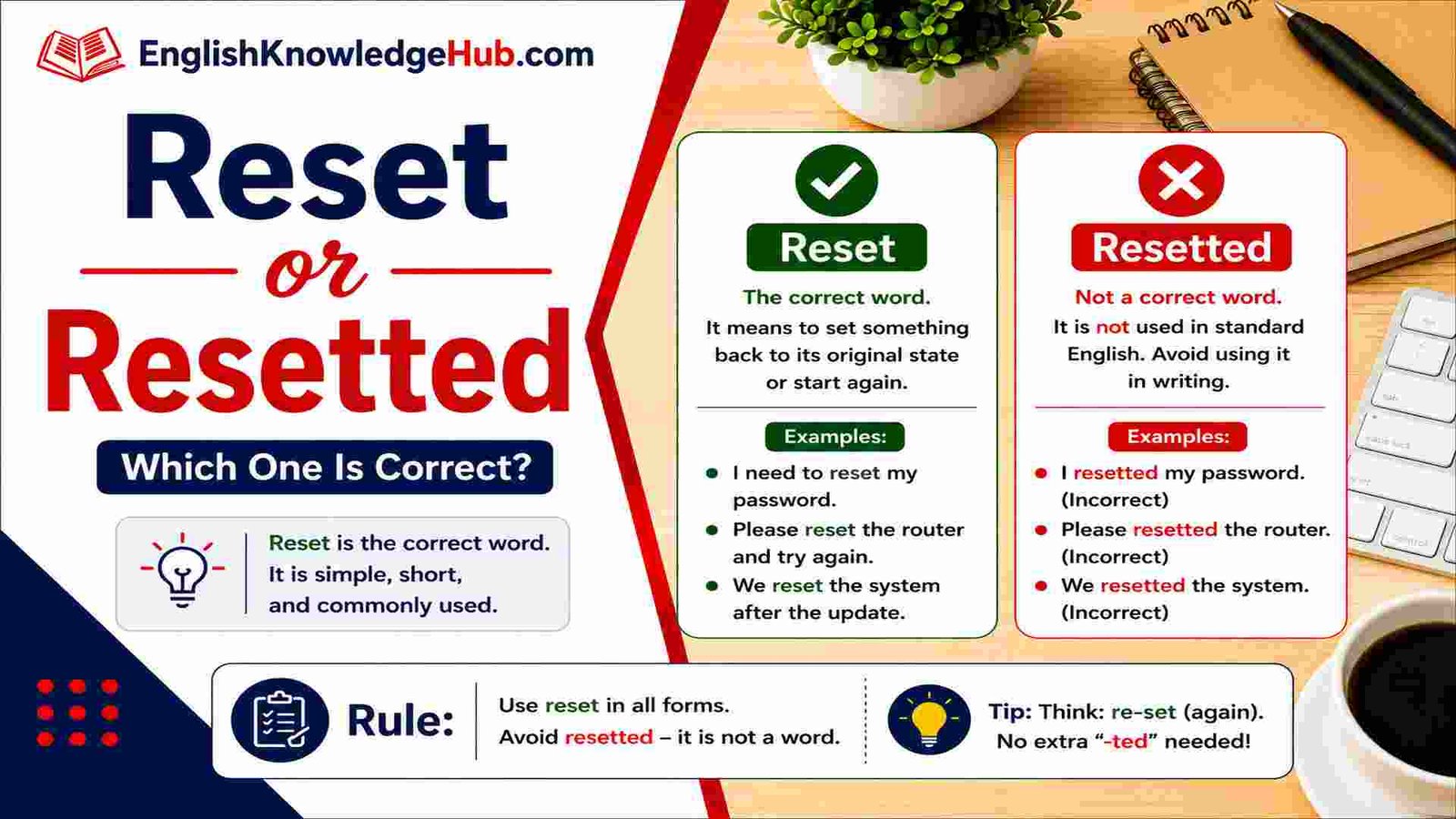
Reset is correct. Resetted is not the standard past tense of reset. The verb reset stays the same in the present, past, and past participle forms. You should say, “I reset my phone yesterday,” not “I resetted my phone.” This article explains the rule, common mistakes, and correct uses in simple English.
Many learners add -ed because most English verbs use it in the past tense. For example, we say walked, opened, and changed. However, reset does not follow that pattern.
The correct forms are:
- Present: reset
- Past: reset
- Past participle: reset
- -ing form: resetting
So, if you are choosing between Reset or Resetted, choose reset.
Why Is “Reset” the Correct Past Tense?
The verb reset contains the verb set.
Look at the pattern:
- I set the alarm every night.
- I set the alarm last night.
- I have set the alarm already.
We do not normally say setted.
The same idea applies to reset:
- I reset the alarm every evening.
- I reset the alarm yesterday.
- I have reset the alarm already.
The form does not change.
A simple way to remember this is:
set → set
reset → reset
You do not need to add -ed.
Reset or Resetted at a Glance
| Form | Correct Word | Example |
|---|---|---|
| Base form | reset | I need to reset the timer. |
| Present | reset / resets | She resets it every morning. |
| Past | reset | She reset it yesterday. |
| Past participle | reset | She has reset it already. |
| -ing form | resetting | She is resetting it now. |
This table shows why resetted should not be used in normal standard English.
How Can “Reset” Be Present and Past?
The sentence around the verb tells us the time.
Compare these examples:
Present:
I reset my alarm every night.
Past:
I reset my alarm last night.
The word reset looks the same, but the time words are different.
“Every night” shows a regular action.
“Last night” shows a past action.
This is common with some English verbs. The spelling stays the same, but the meaning becomes clear from context.
Meaning of Reset
Reset usually means to set something again, return it to an earlier condition, or give it a new starting point.
You can reset:
- a phone
- a password
- a timer
- an alarm
- a router
- a machine
- a clock
- a system
- a target
- a plan
- a device
For example:
- I reset the clock after the power came back.
- We reset our monthly goal after the meeting.
- She reset her password before lunch.
The word is very common in technology, but it is also used in everyday and workplace English.
Daily Conversation Examples
Here are some simple examples of reset in normal conversation:
- I reset my alarm before going to sleep.
- Jake reset the Wi-Fi router after dinner.
- My sister reset her phone this morning.
- We reset the kitchen timer for ten more minutes.
- I have reset my password twice this week.
- Did you reset the clock?
- The game reset after the device turned off.
Notice that the past form is always reset, not resetted.
Workplace Examples
The same rule applies in professional situations.
- The technician reset the printer before the meeting.
- I reset my login password this morning.
- Our manager reset the sales target for September.
- The support team has reset your account.
- We reset the system after finding the error.
- The administrator reset the user permissions.
Using resetted in these sentences would sound incorrect in standard English.
Academic Examples
You can also use reset in school, college, or research writing.
- The students reset the timer before the second test.
- The researcher reset the equipment before collecting new data.
- The instructor reset the device after the first trial.
- The team has reset the measurement tool several times.
- The laboratory computer was reset before the experiment.
The grammar rule does not change in academic writing.
Formal Writing Examples
In formal writing, use reset as well.
- The system was reset after the technical review.
- The department reset its yearly goals in January.
- Access rights have been reset for all new users.
- The control panel was reset before the inspection.
Formal English does not require resetted. The standard form remains reset.
Common Mistakes With Reset or Resetted
The main mistake happens when someone adds -ed automatically.
Mistake 1
Incorrect:
I resetted my phone yesterday.
Correct:
I reset my phone yesterday.
Explanation:
The past tense of reset is reset.
Mistake 2
Incorrect:
She has resetted her password.
Correct:
She has reset her password.
Explanation:
After has, we use the past participle. The past participle is also reset.
Mistake 3
Incorrect:
The machine was resetted this morning.
Correct:
The machine was reset this morning.
Explanation:
After was, we need the past participle form. Use reset.
Mistake 4
Incorrect:
Our manager resetted the weekly target.
Correct:
Our manager reset the weekly target.
Explanation:
The action happened in the past, but the verb still stays as reset.
Is “Resetting” Correct?
Yes, resetting is correct.
When we add -ing, we write the word with two ts:
reset → resetting
Examples:
- I am resetting the router.
- She is resetting the alarm.
- They are resetting the machine.
- Resetting the phone may solve the problem.
Do not write reseting with one t.
The correct spelling is resetting.
Is “Resets” Correct?
Yes.
Use resets with he, she, it, or another singular subject in the simple present tense.
Examples:
- He resets the alarm every morning.
- My phone resets automatically.
- The program resets after each test.
- Sara resets her password every few months.
So, resets is correct, but it is not the past tense.
“Has Reset” or “Has Resetted”?
Use has reset.
Correct:
- She has reset the password.
- The technician has reset the machine.
- My phone has reset itself.
- The company has reset its targets.
Incorrect:
- She has resetted the password.
- The technician has resetted the machine.
The word after has needs the past participle form, and that form is reset.
“Was Reset” or “Was Resetted”?
Use was reset.
For example:
- The password was reset yesterday.
- The device was reset by the technician.
- The clock was reset after the power failure.
- The system was reset before the test.
Was resetted is not standard English.
Reset and Restart Are Different
People sometimes use reset and restart as if they mean exactly the same thing, but they can be different.
Reset means to return something to an earlier setting, original condition, or new starting point.
Restart means to stop something and start it again.
Compare:
I restarted the computer.
This means I turned it off or stopped it, then started it again.
I reset the computer settings.
This means I returned or changed the settings.
The past tense forms are also different:
- reset → reset
- restart → restarted
This is another reason not to add -ed to reset.
A Simple Memory Trick
Here is an easy trick.
First, think about the word set.
Would you say:
“I setted the timer yesterday”?
No.
You would say:
“I set the timer yesterday.”
Now add re-:
“I reset the timer yesterday.”
This can help you remember the rule quickly.
British and American English
There is no major difference here.
Both standard British English and standard American English use reset as the past tense and past participle.
British English:
- I reset the system yesterday.
American English:
- I reset the system yesterday.
You do not need a different spelling based on the country.
Reset or Resetted in Real Sentences
Here are a few more pairs to make the difference clear.
Incorrect:
The app resetted my settings.
Correct:
The app reset my settings.
Incorrect:
I resetted the timer after five minutes.
Correct:
I reset the timer after five minutes.
Incorrect:
Have you resetted the router?
Correct:
Have you reset the router?
Incorrect:
The account was resetted by support.
Correct:
The account was reset by support.
The correct choice in standard English is always clear: use reset.
FAQs About Reset or Resetted
Is resetted a correct word?
Resetted is not the standard past tense or past participle of reset. Use reset instead.
What is the past tense of reset?
The past tense is reset.
Example:
I reset my password yesterday.
What is the past participle of reset?
The past participle is also reset.
Example:
I have reset my password.
Is it “I reset” or “I resetted”?
Use I reset.
Example:
I reset the alarm before bed.
Is “has been reset” correct?
Yes.
Example:
Your password has been reset.
Is “reseted” correct?
No. The correct past form is reset, not reseted.
Why is resetting spelled with two t’s?
The final t is doubled before adding -ing, so the correct form is resetting.
Can reset be both present and past tense?
Yes. The form can stay the same. Other words in the sentence show whether the action is present or past.
Final Thoughts
When deciding between Reset or Resetted, use reset in standard English. The verb stays reset in the base form, past tense, and past participle. Say “I reset it yesterday” and “I have reset it already.” Use resetting when you need the -ing form.
The easiest pattern to remember is:
reset → reset → reset → resetting
For more simple grammar lessons, word comparisons, and practical English examples, visit EnglishKnowledgeHub.com.
