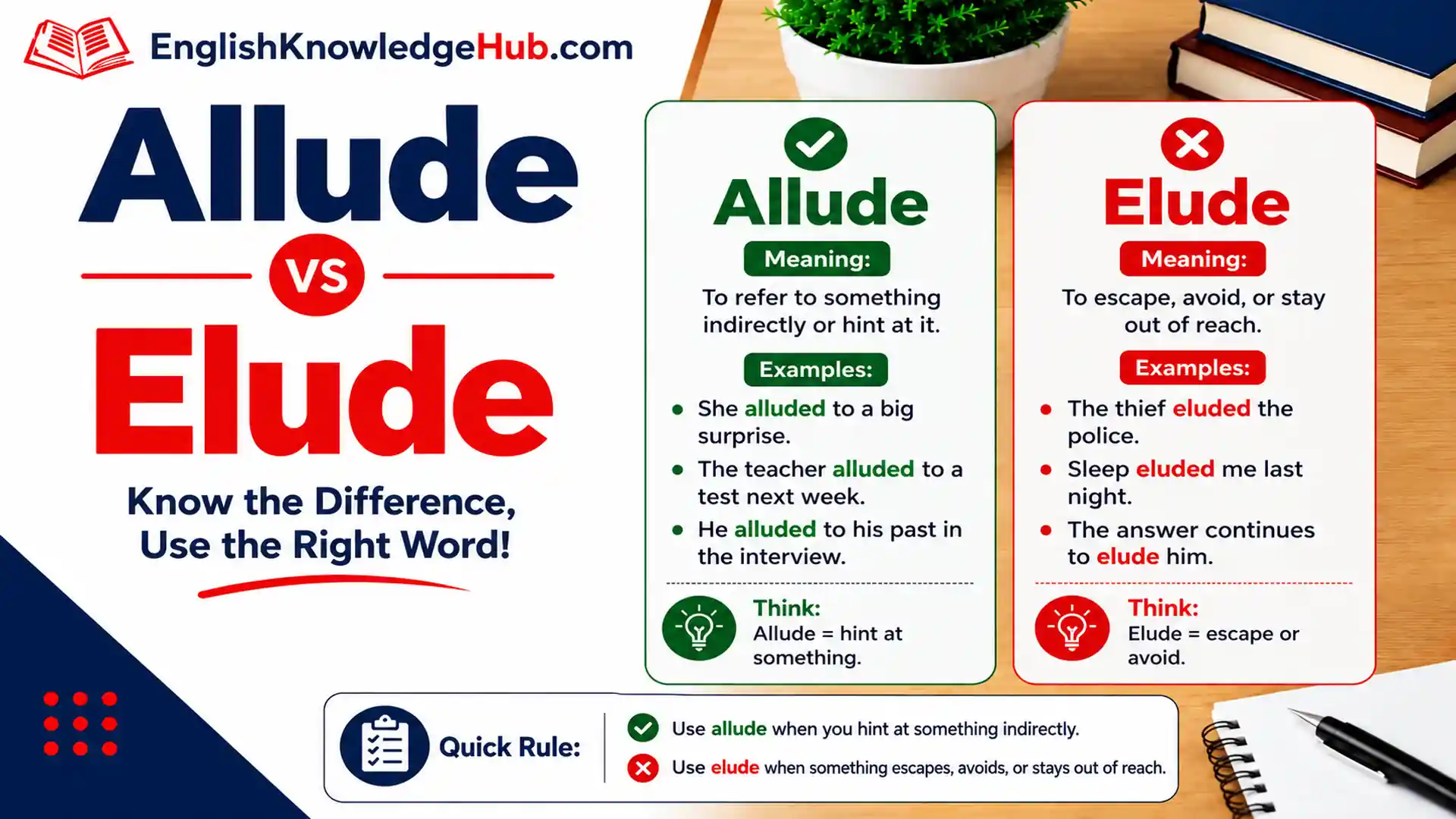
Allude Vs Elude: Allude means to refer to something without saying it directly, while elude means to escape, avoid, or stay hard to find, remember, or understand. You usually allude to a topic, but a person, answer, name, or goal can elude someone. This article explains the difference with simple rules and clear examples.
These two words sound similar, so they are easy to mix up.
The good news is that their meanings are very different.
Think of them this way:
Allude = hint at something
Elude = escape or stay out of reach
Example:
- Sara alluded to a problem at work.
- The answer eluded Sara during the test.
In the first sentence, Sara hints at a problem.
In the second sentence, Sara cannot remember or find the answer.
Allude Vs Elude: The Main Difference
The difference in Allude Vs Elude becomes easier when you look at what each word does.
| Word | Simple Meaning | Common Pattern | Example |
|---|---|---|---|
| Allude | Refer to something indirectly | allude to + thing | He alluded to the delay. |
| Elude | Escape or stay hard to reach | elude + object | The answer eluded me. |
The key idea is simple.
Use allude when someone gives a hint or indirect reference.
Use elude when someone or something escapes, cannot be found, cannot be reached, or cannot be remembered.
What Does Allude Mean?
Allude means to talk about something without saying it clearly or directly.
A person may allude to:
- a problem
- a past event
- a person
- a disagreement
- a plan
- an idea
For example:
“The manager alluded to some changes next month.”
The manager did not explain the changes. He only gave a small hint.
Another example:
“Mia alluded to an argument she had with her sister.”
Mia did not give the full story. She only referred to the argument.
How to Use Allude Correctly
The most common form is:
allude to + noun
Examples:
- He alluded to his old job.
- The teacher alluded to an earlier lesson.
- The email alluded to a possible delay.
- She alluded to problems with the new plan.
- The speaker alluded to his childhood.
Notice that to normally comes after allude.
That small grammar rule can help you choose the correct word.
Allude Does Not Mean Mention Directly
One common mistake is to think that allude simply means mention.
They are close, but they are not always the same.
Compare these two sentences:
“Emma mentioned that the store will close on Friday.”
This is direct.
“Emma alluded to a change in the store schedule.”
This is indirect.
She did not explain the exact change.
So, allude is useful when the speaker points toward an idea without fully explaining it.
What Does Elude Mean?
Elude means to escape or remain out of reach.
It can be used in several ways.
A person can elude police.
An animal can elude a person trying to catch it.
An answer can elude your mind.
A goal can elude a team.
These meanings all share one idea: something stays beyond reach.
Elude Can Mean Escape
Use elude when someone or something avoids being caught.
Examples:
- The rabbit eluded the dog and ran into the bushes.
- The thief eluded the guards.
- The bird eluded the child who tried to catch it.
- The suspect eluded police for two days.
Here, elude has a physical meaning.
Someone is trying to catch or find something, but they fail.
Elude Can Mean Difficult to Remember
We also use elude when something is hard to remember.
Examples:
- His name eludes me.
- The answer eluded me during the quiz.
- Her phone number keeps eluding me.
- One important detail eluded him.
In these sentences, nothing is physically escaping.
The information is simply hard to remember.
This is a very common use of elude.
Elude Can Mean Difficult to Understand
An idea or explanation can also elude someone.
Examples:
- The meaning of the poem eluded several students.
- The reason for the error eluded the team.
- The final step in the equation eluded me.
- The point of his joke eluded her.
In each case, the person cannot fully understand something.
Elude Can Mean Difficult to Achieve
A goal or result can also elude someone.
Examples:
- Victory eluded the team again.
- A promotion had eluded him for years.
- A simple solution continued to elude the engineers.
- First place eluded the runner by a few seconds.
This use means the person wants something but has not been able to get it.
A Simple Grammar Trick
A useful way to remember Allude Vs Elude is to look at the words that come after them.
With allude, you will often see to.
- allude to the problem
- allude to the meeting
- allude to her past
- allude to a mistake
With elude, the object comes directly after the verb.
- elude the police
- elude the team
- elude me
- elude researchers
That pattern makes the difference easier to spot.
Allude Vs Elude in Daily Conversation
Here are some natural examples.
Allude
“Jason alluded to a surprise, but he did not tell us what it was.”
He gave a hint.
“My aunt alluded to an old family story.”
She referred to the story without explaining it fully.
Elude
“I know her face, but her name eludes me.”
The speaker cannot remember her name.
“The dog eluded us for twenty minutes.”
The dog avoided being caught.
Workplace Examples
Both words also appear in professional English.
Allude
“The boss alluded to possible changes in the office.”
The boss hinted that changes may happen.
“The report alluded to problems with staff training.”
The report referred to those problems without giving full details.
Elude
“A clear solution continued to elude the support team.”
The team could not find a solution.
“The cause of the error eluded the technicians.”
The technicians could not discover the cause.
Academic Examples
Students may also see these words in essays and lectures.
Allude
“The author alludes to an earlier war without naming it directly.”
“The professor alluded to a theory discussed last week.”
Elude
“The meaning of the final paragraph eluded many students.”
“A full explanation for the result eluded the researchers.”
These examples show how Allude Vs Elude works in more formal settings.
Formal Writing Examples
These words are also useful in reports, news writing, and formal documents.
Allude
“The statement alluded to future talks but gave no date.”
“The letter alluded to earlier concerns about safety.”
Elude
“The missing file eluded investigators during the first search.”
“A final agreement continued to elude both sides.”
Both words can sound slightly more formal than simpler choices.
In casual speech, people may say hint at instead of allude to, or cannot remember instead of eludes me.
Common Mistakes With Allude and Elude
Mistake 1
Incorrect:
The manager eluded to a problem with the project.
Correct:
The manager alluded to a problem with the project.
Explanation:
The manager is referring to the problem indirectly. The correct verb is allude.
Mistake 2
Incorrect:
The cat alluded the children for ten minutes.
Correct:
The cat eluded the children for ten minutes.
Explanation:
The cat escaped or avoided being caught. Use elude.
Mistake 3
Incorrect:
She alluded her old job during the meeting.
Correct:
She alluded to her old job during the meeting.
Explanation:
The usual pattern is allude to something.
Mistake 4
Incorrect:
His name alludes me right now.
Correct:
His name eludes me right now.
Explanation:
The speaker cannot remember the name. In this case, use elude.
Mistake 5
Less suitable:
The notice alluded to the office closing at 5 p.m.
Better:
The notice stated that the office will close at 5 p.m.
Explanation:
If the information is given clearly and directly, stated, said, or mentioned is usually better than alluded to.
An Easy Memory Trick
Here is a simple way to remember Allude Vs Elude.
Think:
Allude = point toward
Elude = move away
When you allude, you point toward an idea without saying everything.
When something eludes you, it stays away from you.
You can also use these quick replacements.
If hint at works, use allude.
Example:
“She hinted at a problem.”
“She alluded to a problem.”
If escape or stay out of reach works, use elude.
Example:
“The answer stayed out of reach.”
“The answer eluded me.”
Allude, Allusion, Elude, and Elusive
These related words can help you remember the difference.
Allude and Allusion
Allude is a verb.
- She alluded to an earlier event.
Allusion is a noun.
- Her speech included an allusion to an earlier event.
Both words deal with reference.
Elude and Elusive
Elude is a verb.
- The answer eluded us.
Elusive is an adjective.
- The answer remained elusive.
Something elusive is hard to catch, find, understand, or achieve.
Are Allude and Elude Formal Words?
Both words are standard English.
They are often more common in writing, formal speech, reports, essays, and professional communication.
In casual English, simpler phrases are often used.
Instead of:
“Her meaning eluded me.”
Someone may say:
“I did not understand what she meant.”
Instead of:
“He alluded to a problem.”
Someone may say:
“He hinted at a problem.”
Both versions can be correct. The choice depends on the situation.
British and American English
There is no major difference between British and American English for these words.
Both varieties use:
- allude to for an indirect reference
- elude for escape or something that stays hard to reach
The spelling is also the same.
So learners do not need a separate British or American rule.
Quick Practice
Choose allude or elude in the correct form.
- The speaker ______ to a problem from last year.
- The missing dog managed to ______ its owner.
- Her surname ______ me right now.
- The article ______ to a change in company policy.
- A good solution continued to ______ the team.
- The teacher ______ to a topic we studied last month.
Answers
- alluded
- elude
- eludes
- alludes
- elude
- alluded
If the sentence is about a hint or indirect reference, choose allude.
If the sentence is about escape, memory, understanding, or something hard to achieve, choose elude.
Frequently Asked Questions
What Is the Difference Between Allude and Elude?
Allude means to refer to something indirectly. Elude means to escape or remain difficult to find, remember, understand, or achieve.
Is It Allude to or Elude to?
Use allude to when you mean “refer to indirectly.”
Correct:
“She alluded to a past problem.”
Do not use elude to for this meaning.
What Does Allude Mean in Simple Words?
Allude means to give a small hint about something without saying it directly.
What Does Elude Mean in Simple Words?
Elude means to escape or stay out of reach. It can also mean that something is hard to remember or understand.
Can I Say “His Name Eludes Me”?
Yes. It means you cannot remember his name at that moment.
Is Allude the Same as Imply?
Not exactly.
Allude means to refer to a topic indirectly.
Imply means to suggest an idea without saying it directly.
The two ideas are related, but they are not the same.
Is “Allude About” Correct?
The normal form is allude to.
Correct:
“She alluded to a disagreement.”
For normal modern English, use to after allude.
Can Success Elude Someone?
Yes.
“Success eluded him for many years” means he tried to succeed but did not achieve the result he wanted.
Final Rule to Remember
The easiest way to understand Allude Vs Elude is to remember one simple contrast.
Allude means hint at.
Elude means escape or stay out of reach.
Use allude to when a person refers to something without saying it directly.
Use elude when someone or something escapes, cannot be found, cannot be remembered, cannot be understood, or cannot be achieved.
That small difference will help you choose the correct word in everyday speaking and writing.
For more simple grammar lessons, word comparisons, and clear English explanations, visit EnglishKnowledgeHub.com.
